
What if the refreshing scoop you enjoy on a summer afternoon was once a state secret guarded by 17th-century monarchs under penalty of death? While many people ask who found ice cream, the answer isn’t a single inventor but a 2,500-year evolution that began with Persian yakhchal structures in 400 BC. You likely recognise ice cream as a universal staple. However, for centuries, it remained a prohibitively expensive luxury reserved for the elite.
We understand that distinguishing between the origins of gelato, sorbet, and modern dairy-based ice cream can be complex. In this guide, we’ll clarify the historical timeline and demonstrate how advancements in cooling technology transformed these frozen delicacies into a £1.4 billion industry in the UK today. You’ll gain a clear perspective on the transition from hand-cranked churns to the high-performance, bespoke display counters that define successful retail spaces. We’ll explore the technical precision required to maintain perfect serving temperatures, ensuring your vision for a prestigious dessert destination becomes a functional reality.
Key Takeaways
- Uncover the historical truth about who found ice cream by tracing its evolution from ancient Chinese dynasties to the tables of European royalty.
- Separate historical fact from popular legend as we debunk long-standing myths concerning the origins of frozen desserts in the West.
- Understand how the transition from natural ice harvesting to modern refrigeration technology revolutionised the accessibility of frozen treats for the British high street.
- Learn the retail psychology of the ‘perfect scoop’ and how bespoke lighting and colour can turn a standard display into a high-conversion destination.
- Discover the long-term operational benefits of investing in British-made, handcrafted counters that prioritise both durability and brand identity.
The Origins of Frozen Delights: Who Found Ice Cream in Antiquity?
Pinpointing exactly who found ice cream is a challenge because the dessert didn’t emerge from a single moment of discovery. It evolved through centuries of trial and error across different continents. While modern consumers associate it with high-tech refrigeration, the journey began over 2,000 years ago with a focus on cooling techniques that would eventually define the hospitality sector. The History of ice cream reveals a transition from simple chilled juices to the complex dairy structures we manufacture equipment for today. Early versions were less about creamy textures and more about the status of serving something cold in a world without electricity.
Ancient civilisations didn’t have the luxury of modern bespoke display counters; they relied on the physics of salt and ice to achieve sub-zero temperatures. By mixing salt with ice, they triggered an endothermic reaction that lowered the freezing point, allowing liquids to solidify. This technical foundation was essential for moving beyond “water ices” into the realm of frozen fats and proteins. It required a massive logistical effort to transport ice from mountain ranges to royal courts, often involving hundreds of labourers and insulated storage pits.
The Tang Dynasty: China’s Early Frozen Confections
When investigating who found ice cream in its earliest dairy form, historians point to the Chinese Tang Dynasty, which lasted from 618 to 907 AD. This era saw the development of a sophisticated treat made from buffalo milk, flour, and camphor, a substance harvested from evergreen trees to provide a unique, cooling flavour. The operation was industrial in scale for its time. King Tang of Shang reportedly employed 94 “ice-men” whose sole responsibility was to maintain the ice supply and prepare these frozen mixtures for the imperial table. Tang Dynasty ice cream stands as the first recorded dairy-based frozen dessert in history.
From Sherbet to Sorbet: The Middle Eastern Influence
The evolution continued through the Arab world, where the term “shrb” (syrup) gave birth to the modern words sherbet and sorbet. By the 11th century, Persian chefs were using snow collected from mountain peaks to chill fruit juices and rosewater. These techniques were eventually introduced to Sicily and mainland Italy through trade and conquest. This transition was vital for the catering industry, as it refined the process of sweetening and flavouring ice. It turned a simple survival technique into a culinary art form that demanded specialised storage and presentation. These early Middle Eastern methods provided the blueprint for the European “sorbetto” that would later dominate the dining rooms of the 16th-century aristocracy.
Myths vs Reality: How Ice Cream Conquered European Royalty
Many people ask who found ice cream, often pointing to Marco Polo returning from China in 1295. However, historical evidence suggests these tales were likely embellishments added centuries later to romanticise the dessert’s origins. Similarly, the popular story of Catherine de’ Medici introducing sorbet to the French court in 1533 lacks contemporary documentation; it is largely considered a Victorian invention. According to the International Dairy Foods Association, while frozen desserts have ancient roots, the refined versions we recognise today evolved through the European royal courts. During the 17th century, ice cream functioned as a definitive status symbol. Owning a dedicated “ice house” required immense capital, as these structures allowed the elite to store ice harvested from frozen ponds throughout the summer months. The first official record of ice cream in England dates to the Feast of St George in 1671 at Windsor Castle, where it was served exclusively to King Charles II’s table.
The British Connection: Royal Ices and Secret Recipes
Legends persist that King Charles I offered his personal ice cream maker a lifetime pension to keep his “cream ice” recipe a secret. While likely apocryphal, it highlights how precious these recipes were considered by the ruling class. Eventually, these secrets filtered down through the royal confectioners to the wider aristocracy. The role of the Confectioner became vital in high society, requiring a bespoke set of skills to manage delicate temperature controls without modern refrigeration. These early professionals had to master the science of endothermic reactions using salt and ice to create a smooth texture. This early demand for precision and quality mirrors the meticulous standards we apply when designing commercial catering spaces today. By the mid-1700s, recipes began appearing in popular cookbooks, such as Hannah Glasse’s The Art of Cookery, signalling the transition of ice cream from a royal secret to a public luxury.
The Rise of the Victorian Ice Cream Parlour
By the late 19th century, Agnes Marshall, known as the “Queen of Ices”, revolutionised the industry. Her 1885 book and public demonstrations brought sophisticated frozen desserts into the British home for the first time. The era also saw the transition from the “Penny Lick”, a small glass cup that was often reused without proper washing, to the edible cone. This shift wasn’t just about convenience; it was a response to growing hygiene concerns and the 1899 public health reports regarding foodborne illnesses. The invention of the cone allowed for a more robust, portable, and sanitary way to enjoy treats on the move. When investigating who found ice cream and brought it to the masses, the Italian immigrants in London’s East End deserve significant credit. They operated the first street carts, creating a vibrant culture of public consumption that laid the foundation for the modern ice cream parlour.
The Technological Leap: How Refrigeration Revolutionised Ice Cream
For centuries, the question of who found ice cream in its earliest form was secondary to the practical challenge of keeping it frozen. Natural ice was a rare, expensive commodity that restricted chilled desserts to a seasonal luxury for the elite. Without reliable cooling, production was limited to the winter months or required access to deep underground ice houses that were difficult to maintain.
During the 19th century, the “Ice Trade” attempted to solve this through sheer logistical scale. Merchants harvested massive blocks of frozen water from lakes in Norway and America, transporting them across the globe in insulated ships. While this made ice more accessible, it was an inefficient system prone to significant waste. The industry needed a more reliable, manufactured solution to move beyond the limitations of nature.
In 1843, a significant breakthrough occurred when Nancy Johnson patented the hand-cranked freezer. This invention used a central paddle to aerate the mixture while it froze, creating a consistent, smooth texture that was previously impossible to achieve manually. This moment was pivotal for those tracing who found ice cream as a viable commercial product, as it moved production away from the laborious “pot-freezing” method. Today, the industry has evolved from these hidden, manual processes to the high-visibility refrigerated grab and go display units that allow retailers to showcase their products with total temperature precision.
Mechanical Cooling: The End of the Ice House
The true revolution arrived with Carl von Linde. In the 1870s, his work on portable refrigeration using ammonia liquefaction provided the technical foundation for modern cooling. This shift meant that businesses no longer had to rely on the unpredictable arrival of ice ships. The history of refrigeration technology shows that the 1870s marked the transition from harvested ice to manufactured cold. Mechanical cooling allowed for year-round production, giving manufacturers the confidence to invest in larger facilities and permanent storage solutions.
From Batch Freezers to Continuous Production
Industrialisation in the early 20th century transformed ice cream from a rare treat into an affordable staple for the British public. The arrival of reliable electricity in the 1920s allowed local high-street cafes to install their own cooling systems, decentralising the market. As production volumes grew, the need for hygienic, durable storage became paramount. This led to the widespread adoption of stainless steel back-bar units in commercial kitchens. These units offer a robust, seamless environment that meets strict food safety standards while ensuring long-term operational efficiency. By the mid-1920s, the development of the continuous freezer meant that ice cream could be produced in a steady stream, setting the stage for the modern global industry.
The Art of the Display: Why Presentation Matters for Frozen Desserts
While historians continue to debate exactly who found ice cream in its earliest form, modern retailers know that finding the right way to show it off is what truly drives revenue. In a competitive high street environment, the visual impact of a frozen display acts as a silent salesperson. Research into consumer behaviour suggests that up to 70% of dessert purchases are made on impulse, triggered by the vibrant colours and textures visible through the glass. This is why the psychology of the “scoop” is so vital. A display featuring a diverse range of heights and decorative ripples suggests freshness and artisanal quality, encouraging customers to indulge in a premium treat.
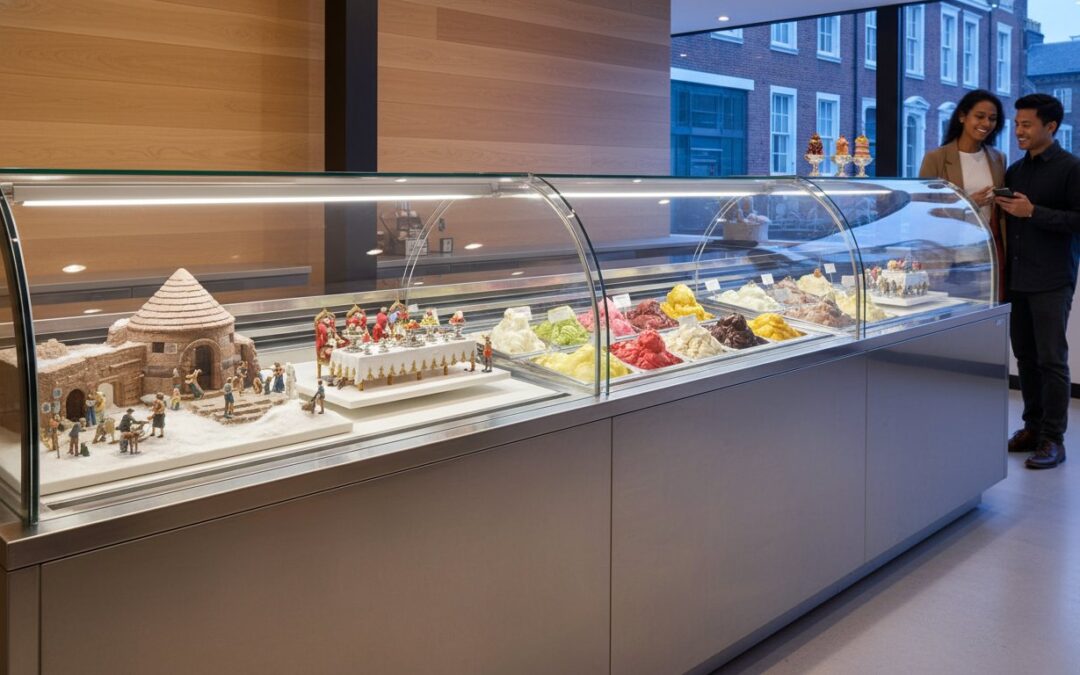
Lighting plays a critical role in this visual allure. Using high-CRI (Colour Rendering Index) LED lighting ensures that the deep reds of a raspberry sorbet or the rich browns of a Belgian chocolate gelato remain true to life, while specialists like Fibrepros offer advanced solutions that create a brilliant, heat-free sparkle using fibre optic technology for premium dessert showcases. Modern patisserie display counters have evolved significantly from basic chilled boxes into sophisticated stages for frozen art. These units now incorporate heated glass technology to prevent condensation, ensuring that the customer’s view remains unobstructed even in humid British summers. Maintaining a “scoopable” consistency is the ultimate technical challenge. A display must be cold enough to prevent melting but precise enough to avoid the rock-hard textures that make service difficult and degrade the product’s mouthfeel.
The Theatre of the Counter
Creating a seamless flow in a cafe requires a bespoke approach to counter design. We often utilise specific glass angles and deck heights to maximise the visibility of the product from a child’s eye level up to an adult’s. Clean-line designs are now the standard for modern interiors, removing bulky frames to let the product take centre stage. It is important to distinguish these units from a standard deli counter setup. While a deli unit focuses on horizontal capacity and varied temperature zones for meats and cheeses, a dedicated gelato display requires an inclined deck to present the pans at an optimal viewing angle for the passing trade.
Temperature Integrity and Airflow
The internal mechanics of a display are just as important as its exterior aesthetics. We typically specify forced-air cooling for high-traffic environments because it provides rapid temperature recovery every time the glass is opened. This constant movement of chilled air must be balanced with precise humidity control to prevent the formation of unsightly ice crystals on the surface of the gelato. Ergonomic design also plays a part here. By positioning the serving area at a comfortable height, staff can serve quickly and efficiently, which reduces the amount of time the cold air curtain is broken. This protects the integrity of the dessert and lowers operational energy costs.
Contact our expert design team today to discuss your bespoke shopfitting requirements.
Creating the Ultimate Ice Cream Destination with Bespoke Counters
While historians continue to debate who found ice cream and refined the first frozen recipes, modern retailers face a more immediate challenge: how to showcase these treats effectively. Off-the-shelf units often fail to capture a brand’s unique personality because they are designed for generic spaces rather than specific operational needs. These mass-produced cabinets frequently lack the aesthetic impact required to stand out on a competitive UK high street. British-made craftsmanship offers a superior alternative, providing the durability required for long service hours and the bespoke style that drives footfall.
Integrating your ice cream display into a larger bespoke cafe counter ensures a seamless operational flow. We manage the entire process from concept to completion, planning your shop layout to eliminate bottlenecks during peak summer periods. A well-designed counter does more than hold products; it guides the customer journey and improves transaction speed through ergonomic design. By positioning the scoop cabinet, topping stations, and payment points logically, you can increase throughput by up to 25% during busy windows.
Designing for the Modern UK High Street
Success in the hospitality sector requires a balance between stunning aesthetics and robust functionality. We utilise high-grade materials like Corian, natural stone, and 304-grade stainless steel to create surfaces that withstand heavy use while remaining easy to sanitise. Modern UK shops must also cater to changing consumer habits. We often incorporate “Grab & Go” refrigerated sections alongside traditional service areas. This allows customers to pick up pre-packed tubs or chilled drinks quickly, boosting your daily revenue without slowing down the queue for hand-scooped cones. It’s a practical way to cater to both the leisurely diner and the commuter in a hurry.
Why TFSE Products is Your Expert Partner
Our heritage in UK manufacturing spans decades, giving us the technical expertise to handle complex shopfitting projects across various sectors. We use advanced CAD modelling to visualise every millimetre of your space before production begins in our facility. This precision ensures that when our professional team arrives for installation and commissioning, the fit is perfect and disruption is minimal. We don’t just deliver a cabinet; we provide a turnkey solution that includes full mechanical and electrical integration. If you’re ready to transform your retail space into a prestigious destination, contact us for a bespoke counter consultation to discuss your vision with our design team.
Transform Your Vision Into a Prestigious Frozen Destination
Understanding the journey from ancient snow-cooled treats to modern gelato helps us appreciate the engineering behind today’s luxury displays. While historians continue to debate exactly who found ice cream in its earliest form, the transition from royal banquets to high-street retail was fueled by 19th-century refrigeration breakthroughs. Today, a stunning visual presentation is just as vital as the recipe itself for capturing customer attention in a competitive market.
Cafe Counters brings over 30 years of British manufacturing expertise to your project, ensuring every unit is built for long-term operational efficiency. Our team provides a seamless Concept to Completion service, utilising precise CAD modelling to turn your initial ideas into a functional, high-end reality. We’re proud to be trusted by leading UK retail and hospitality brands to deliver robust, bespoke solutions that reflect true craftsmanship. Explore our range of bespoke British-made display counters and discover how we can elevate your brand’s presence. We look forward to helping you create a space that truly performs.
Frequently Asked Questions
Who is credited with inventing the first ice cream?
No single individual is credited with inventing the dish, but the earliest records of a frozen milk and rice mixture date back to the Tang Dynasty in 618 AD. King Tang of Shang employed 94 ice men to create these buffalo milk treats chilled with saltpetre. While historians often debate who found ice cream, these ancient Chinese innovations provided the foundation for the dairy-based desserts we recognise today.
Did Marco Polo really bring ice cream to Europe from China?
Historical legend suggests Marco Polo returned to Italy from China in 1295 with recipes for water ices that resembled modern sherbet. Most contemporary historians believe this is a myth, as no mention of frozen desserts appears in the original manuscripts of his travels. It’s more likely that knowledge of chilled delicacies spread through established trade routes from the Middle East to Europe during the 14th century.
When did ice cream become popular in the UK?
Ice cream first appeared at a Feast of St George at Windsor Castle in 1671, where it was served exclusively to King Charles II. It remained a luxury for the elite until 1851, when Swiss entrepreneur Carlo Gatti opened the first public ice cream stand at Charing Cross. Gatti imported ice from Norway by the tonne, allowing him to sell scoops for one penny and making the treat accessible to the Victorian public.
What is the difference between sorbet and ice cream in history?
The primary historical difference lies in the base ingredients; sorbet evolved from sharbat, a chilled Middle Eastern fruit drink, while ice cream developed from dairy-based mixtures. By the 17th century, European confectioners clearly distinguished between water ices and cream ices. Modern UK regulations maintain this distinction, requiring dairy ice cream to contain at least 5% milk fat, whereas sorbet remains entirely dairy-free and fat-free.
Who invented the ice cream cone?
Italo Marchiony received the first patent for a cone-making machine in December 1903, though the concept gained global fame at the 1904 St. Louis World’s Fair. During that event, Ernest Hamwi, a Syrian pastry vendor, rolled his thin zalabia waffles to help a nearby ice cream seller who had run out of clean bowls. This practical solution transformed how customers consumed frozen treats, turning a stationary dessert into a portable convenience.
How was ice cream kept frozen before modern refrigerators?
Before mechanical refrigeration, ice cream was stored in insulated ice houses or deep underground pits lined with straw and sawdust. Confectioners used a method involving salt and ice to lower the freezing point of the mixture, a technique documented as early as the 13th century. This endothermic process allowed the cream to freeze even in summer, provided there was a steady supply of harvested lake ice stored from the previous winter.
Why is refrigeration so important for ice cream quality?
What should I look for in a commercial ice cream display counter?
A high-quality commercial display must offer precise temperature control and heated glass to prevent condensation, ensuring customers have a clear view of your products. You should look for units with ergonomic designs that allow staff to serve efficiently without physical strain. At Cafe Counters, we prioritise bespoke, robust manufacturing that combines aesthetic appeal with technical reliability, providing a seamless turnkey solution for your retail space.