
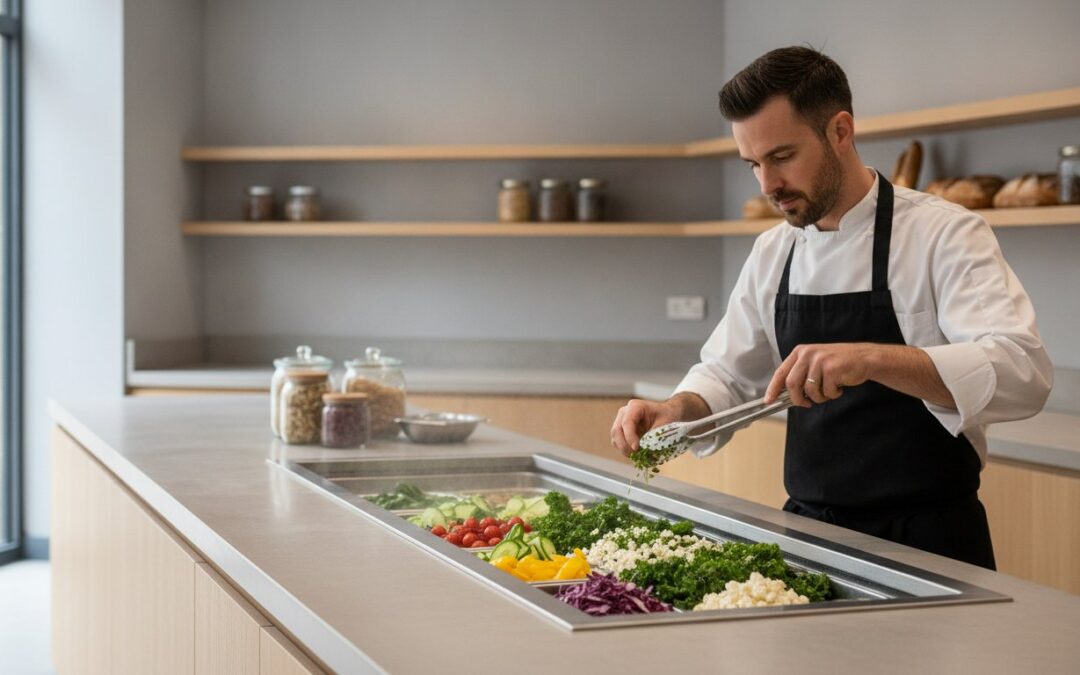
Could your current cooling setup be the silent drain on your salad bar’s profitability and premium appeal? While many off-the-shelf units promise basic functionality, they often struggle with uneven temperatures and a bulky appearance that disrupts the flow of a carefully designed space. Investing in a high-quality refrigerated well for salad bars is no longer just about meeting the Food Standards Agency’s recommended target of 0°C to 5°C. It is about creating a precision-engineered display that reflects your commitment to quality and food safety.
We understand the pressure of balancing rigorous hygiene standards with the need for a seamless, drop-in look. It is a challenge that requires more than just a cooling box. It demands a partner who values regional artisanal pride and technical durability. In this guide, you’ll discover how to select and install the perfect refrigerated well to maintain food safety and maximise visual impact. We will walk you through the essential 2026 energy regulations, the benefits of working with a UK-based manufacturer, and the methodical process of integrating a reliable solution into your bespoke serving counter.
Key Takeaways
- Understand why precision temperature control is the foundation of food safety and how it prevents costly waste in a commercial environment.
- Learn how to evaluate static versus fan-assisted cooling technology to ensure your refrigerated well for salad bars maintains the delicate texture of fresh ingredients.
- Discover the functional differences between standard drop-in units and bespoke serving counters to determine which configuration best suits your operational flow.
- Explore the professional design journey, from initial CAD modelling to final installation, ensuring a perfect fit for high-end cafe interiors.
- Gain insights into the long-term reliability of sourcing directly from a UK manufacturer committed to artisanal quality and comprehensive after-sales support.
Understanding the Refrigerated Well for Salad Bars: Freshness by Design
A refrigerated well for salad bars is far more than a simple cold storage unit. It is a precision-engineered drop-in component designed to sit flush within a bespoke counter, providing a seamless transition between the aesthetic of the room and the functionality of the kitchen. While the history of the salad bar began with basic ice-filled troughs, modern hospitality demands a sophisticated approach to thermal management. Today’s high-end establishments are moving away from bulky, standalone buffet units in favour of integrated wells that preserve the integrity of premium ingredients while enhancing the overall interior design.
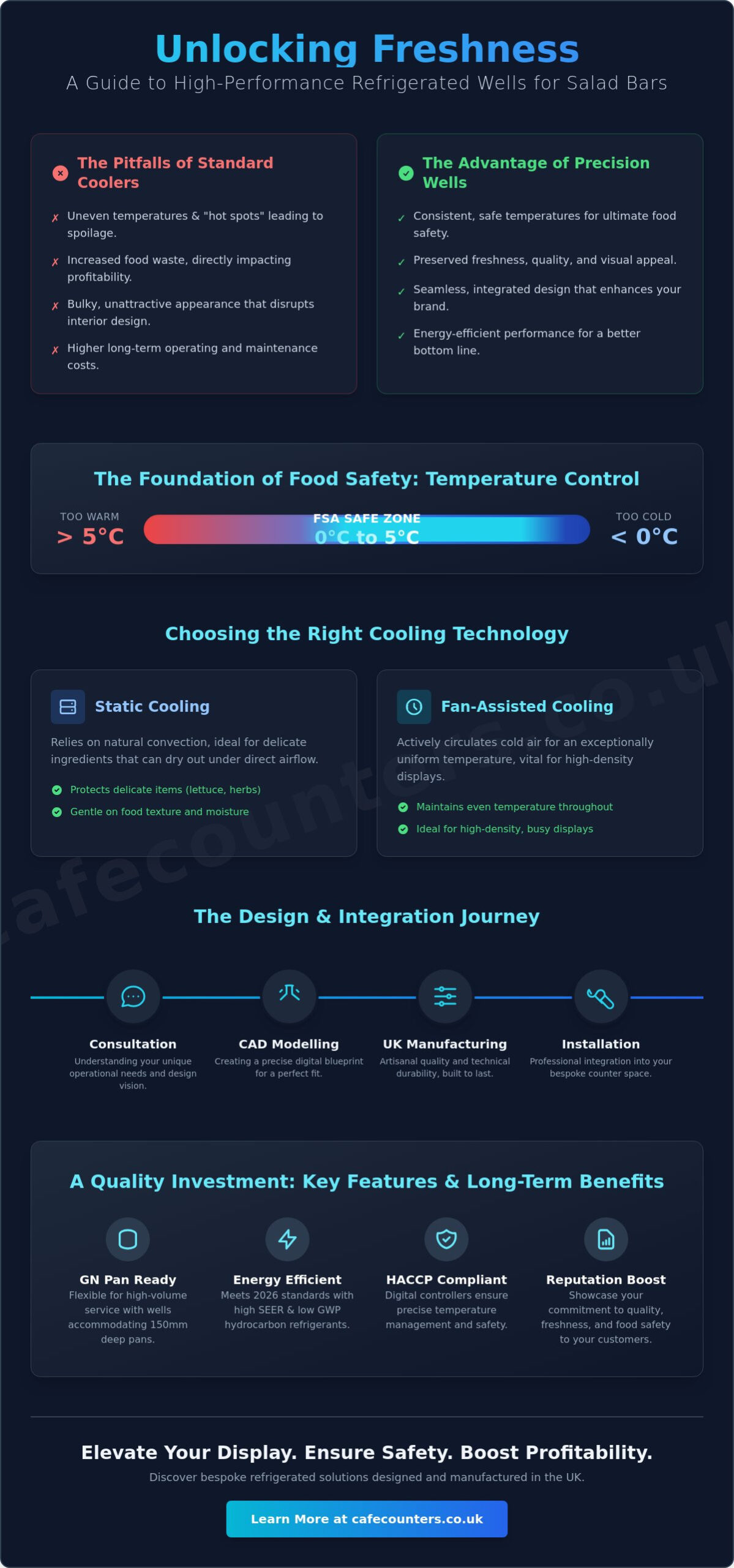
Temperature stability is the cornerstone of any successful food display. The Food Standards Agency (FSA) recommends maintaining chilled food between 0°C and 5°C to ensure safety and compliance with the Food Hygiene (England) Regulations 2006. A well-designed unit does not just meet these legal requirements; it actively reduces food waste by preventing the wilted greens and dried-out toppings that plague inferior systems. In an era where input costs and energy prices remain high, the ability to preserve stock for longer is a direct boost to your bottom line. When customers see vibrant, crisp vegetables held at the perfect temperature, their perception of your brand’s quality increases instantly.
The Functional Benefits of a Dedicated Salad Well
Modern units rely on sophisticated airflow patterns to eliminate “hot spots” that can lead to rapid spoilage. By maintaining a consistent curtain of cold air, these wells ensure that even items at the very top of the Gastronorm pans remain at safe levels. Effective condensation management is equally vital. Advanced drainage and thermal breaks prevent moisture buildup, keeping the display area clear and inviting rather than damp or unhygienic. This clarity is essential for both self-service layouts and staff-assisted deli counters where visual appeal drives sales.
Why Quality Refrigeration is a Long-Term Investment
Choosing a unit built with high-grade insulation and efficient compressor technology significantly lowers daily operational costs. These components are designed to work harder for longer, extending the lifespan of your bespoke serving counter and reducing the frequency of costly repairs. Investing in a high-quality refrigerated well for salad bars protects your reputation. It ensures that every leaf of spinach and every slice of tomato retains its intended texture and flavour, fostering trust with a health-conscious clientele that values fresh, minimally processed dishes.
Technical Specifications: Cooling Technology and Hygiene Standards
Precision engineering defines the modern refrigerated well for salad bars. Choosing between static and fan-assisted cooling depends entirely on your specific menu items. Static cooling relies on natural convection, making it an ideal choice for delicate ingredients that might dry out under constant airflow. Conversely, fan-assisted units circulate air to maintain an exceptionally uniform temperature, which is vital for high-density displays where air blockage is a constant risk. Both systems rely on digital temperature controllers to provide the granular management required for HACCP compliance. These controllers don’t just display a number; they allow for precise calibration to stay within the recommended 0°C to 5°C safety zone, ensuring your stock remains fresh and safe for consumption.
Compatibility with Gastronorm (GN) pans is a standard requirement, yet the depth of the well determines your operational flexibility. A well that accommodates 150mm deep pans allows for higher volume service during peak hours without the need for frequent restocking. From an environmental perspective, 2026 standards require units with high Seasonal Energy Efficiency Ratios (SEER). Modern wells now feature hydrocarbon refrigerants with low Global Warming Potential (GWP), aligning your kitchen with the latest UK F-Gas regulations. While the fundamental principles of refrigerated food processing dictate the need for rapid temperature reduction, maintaining that state in an open display environment requires hardware that balances raw power with energy efficiency.
Material Science: Food-Grade Stainless Steel
Hygiene begins with the surface. 304-grade stainless steel is the non-negotiable standard for professional wells because its high chromium and nickel content provides superior resistance to corrosion. Acidic dressings or harsh sanitising chemicals can degrade lower-grade metals, leading to microscopic pitting where bacteria thrive. We utilise seamless welding techniques to ensure there are no gaps at the corners of the unit. This meticulous attention to detail prevents bacterial buildup and makes the end-of-shift cleaning process both straightforward and effective, protecting your reputation for cleanliness.
Climate Class and Performance in High-Ambient Environments
A unit’s climate class rating indicates the maximum ambient temperature and humidity in which a refrigerated well for salad bars can operate effectively. In the UK, a Climate Class 4 rating is typically sufficient, but busy kitchens with high-output ovens may require Class 5 hardware to prevent system failure during summer peaks. Proper ventilation for the condensing unit is essential. If the heat extracted from the well cannot escape the counter carcass, the compressor will overwork, leading to higher energy bills and premature wear. For projects requiring a tailored approach to these technical requirements, exploring bespoke serving counters ensures every specification is met without aesthetic compromise.
Selecting the Right Configuration: Drop-in Units vs. Bespoke Solutions
Choosing the correct configuration for a refrigerated well for salad bars depends on the balance between your operational speed and the architectural vision of your space. Standard drop-in units serve as a cost-effective solution for rapid deployment, allowing for quick installation into existing worktops without the lead times associated with custom fabrication. These units are reliable workhorses, yet they often lack the seamless finish required for premium environments. To achieve a truly unique aesthetic and a functional flow that guides customers through the service line, bespoke salad bar counters are the superior choice. This approach allows the cooling technology to be integrated directly into the counter carcass, resulting in a flush, high-end appearance that off-the-shelf models simply cannot replicate.
The decision-making process also involves evaluating the secondary features that protect and present your food. While sneeze guards are a fundamental requirement for hygiene, you must decide if your service requires a simple glass shield or a more complex gantry. Although heated gantries are typically reserved for hot food service, they are often considered in multi-functional counters where the same footprint might transition from breakfast to lunch service. For a dedicated salad display, the focus shifts to LED gantries that enhance product visibility. Modern LED lighting doesn’t just illuminate; it can be calibrated to cool colour temperatures that make leafy greens and vibrant vegetables look exceptionally crisp and fresh.
Gantry Options and Food Protection
Protection levels vary from open wells, which are suitable for staff-assisted service, to those equipped with full glass sneeze guards for self-service environments. The choice of glass profile significantly impacts the cafe’s atmosphere. Curved glass profiles offer a softer, more traditional look, while square glass profiles are increasingly popular in modern, minimalist cafe designs. Illuminated gantries play a vital role here. By choosing cool-toned LEDs, you avoid the heat transfer associated with older lighting styles, ensuring the refrigerated well for salad bars doesn’t have to work harder to compensate for overhead warmth.
Capacity Planning for High-Volume Service
Determining the right size for your well requires a meticulous calculation of customer throughput and menu variety. The Gastronorm (GN) system is a global standard for tray and container sizes in the professional catering industry, governed by the EN 631-1 specification to ensure universal compatibility across kitchen equipment. Modular wells offer the greatest flexibility, allowing you to swap between several small pans for diverse toppings or fewer large pans for high-volume base ingredients. This adaptability is essential for businesses that plan to evolve their menu throughout 2026. By planning your capacity around peak-hour demand, you reduce the need for constant restocking, which keeps your service line moving and your staff focused on the customer experience.
The Design Journey: From CAD Modelling to Professional Installation
Integrating a refrigerated well for salad bars requires a methodical approach that starts long before the equipment arrives at your premises. We treat every installation as a comprehensive technical project rather than a simple equipment purchase. During the initial consultation, our focus remains on your specific operational workflow. We analyse whether the unit will serve a high-speed self-service line or a more deliberate, staff-assisted environment. This ensures the well is positioned for maximum efficiency, reducing staff strain and improving customer throughput from day one.
A detailed site survey follows the initial planning phase. This step is critical for identifying electrical loads and drainage requirements. For instance, while a standard 3xGN refrigerated well typically operates on a 13-amp supply, larger configurations or those integrated into complex counters may require dedicated circuits. Identifying these needs early prevents costly delays during the final fit-out and ensures the infrastructure is ready to support a high-performance cooling system.
CAD Design and Visualisation
Precision is the hallmark of our manufacturing process. We utilise advanced CAD modelling to create a digital twin of your space, ensuring the well fits perfectly within our bespoke cafe counters. This 3D visualisation allows you to see the ergonomics of the salad bar and how it integrates with adjacent units like deli counters. By resolving potential clashes in the digital phase, we eliminate the need for on-site modifications that can compromise the structural integrity or aesthetic finish of the counter.
Installation and Commissioning
Professional commissioning is the final, essential step in the journey. Our engineers perform rigorous testing to ensure the unit operates exactly to manufacturer specifications. This includes monitoring temperature pull-down times and verifying airflow efficiency to guarantee the refrigerated well for salad bars maintains the 0°C to 5°C range consistently even in busy environments. We also provide comprehensive staff training on daily cleaning protocols and basic maintenance. This proactive approach ensures your warranty remains valid and your equipment stays reliable for years to come. To begin planning your next project, you can consult with our design experts today.
British Manufacturing Excellence: The TFSE Products Ltd Advantage
Sourcing a refrigerated well for salad bars directly from a UK-based manufacturer offers a level of quality control that imported units simply cannot match. At TFSE Products Ltd, we combine artisanal pride with advanced engineering within our London-area facility to create assets built for the rigours of the British hospitality industry. This proximity allows us to oversee every stage of production, from the first weld of the 304-grade stainless steel to the final testing of the refrigeration system. We don’t just sell equipment. We provide a high-performance foundation for your business, backed by a deep understanding of local regulatory requirements and operational pressures.
Our ability to offer customisation beyond a standard catalogue is a significant advantage for modern brands. We understand that your brand identity is unique, and your food display should reflect that vision. Whether it’s a specific finish to match your interior design or a non-standard configuration to fit a challenging floor plan, our team can tailor the well to your exact needs. This artisanal approach ensures that your equipment is as much a design statement as it is a functional tool, much like the precision found in the bespoke hardwood furniture created by The Table Guy. It’s about providing a steady, reliable hand in a complex field, ensuring your investment remains durable for years to come.
Why “Made in Britain” Matters for Your Business
Choosing British-made equipment translates to reduced lead times and far more reliable delivery schedules. You aren’t at the mercy of international shipping delays or fluctuating import duties. Instead, you’re securing a high-performance asset while supporting the regional economy. Our internal production capabilities also mean that genuine spare parts and technical support are always within reach. If you ever need assistance, you’re dealing with the people who actually built the unit, not a third-party distributor. This ensures your refrigerated well for salad bars stays operational and efficient with minimal downtime.
A Holistic Approach to Food Display
Our Expert Partner philosophy means we look at your physical space as a cohesive environment. Your salad bar should work in harmony with other elements of your service line to maximise profitability. For instance, we can help you link your chilled offerings with refrigerated grab and go display units to capture both seated and takeaway trade. This integrated design approach ensures a seamless customer journey and a consistent aesthetic throughout your premises. We invite you to request a consultation to see how our Vision Heated Counters can complement your chilled display, providing a balanced and versatile food presentation that meets every customer need.
Elevate Your Culinary Display with Professional Precision
Ensuring your food display remains both safe and visually striking requires a balance of advanced cooling technology and meticulous design. We have explored how a precision-engineered refrigerated well for salad bars prevents food spoilage while creating a premium aesthetic that resonates with health-conscious diners. By choosing a solution that integrates seamlessly into your counter, you move beyond basic functionality to create a high-performance asset that enhances your brand’s reputation for quality and freshness.
Founded in 1991, TFSE Products Ltd brings decades of UK manufacturing experience to every commercial project. Our team utilizes advanced CAD modelling to ensure your bespoke counter fits your space perfectly, and we include a comprehensive installation and commissioning service to guarantee long-term reliability. We are ready to help you navigate the complexities of food safety regulations and technical specifications with the steady hand of an expert partner. To bring your vision to life, Contact TFSE Products Ltd for a Bespoke Salad Bar Consultation today. Let’s build a display that reflects your commitment to quality and artisanal pride.
Frequently Asked Questions
What is the difference between static and fan-assisted cooling in a salad well?
Static cooling relies on natural convection to keep items chilled, which helps prevent delicate ingredients from drying out. In contrast, fan-assisted units use forced air to maintain a highly uniform temperature across the entire display. This makes fan-assisted models ideal for high-density layouts where air blockage might otherwise occur, ensuring every item in your refrigerated well for salad bars remains within the safe temperature zone.
Do I need a floor drain for a refrigerated salad well?
Most professional installations require a drainage solution to manage condensation and cleaning runoff effectively. While some smaller units can use a manual collection container, connecting the well to a permanent floor drain is the most reliable method for high-volume environments. This prevents water buildup within the counter carcass and simplifies the daily hygiene routine for your staff, protecting the structural integrity of your bespoke furniture.
Can I install a refrigerated well into an existing wooden counter?
You can install a drop-in unit into a wooden counter provided the aperture is correctly reinforced and insulated. It’s essential to use a thermal break between the stainless steel well and the timber surface to prevent the wood from warping due to temperature fluctuations. We recommend a meticulous site survey to ensure the existing structure can support the weight of the unit and the necessary ventilation requirements for the compressor.
How often should the condenser on a salad bar well be cleaned?
You should clean the condenser at least once a month to ensure optimal airflow and energy efficiency. In busy kitchens where flour or grease is present in the air, more frequent cleaning may be necessary to prevent the compressor from overworking. A blocked condenser is a primary cause of system failure and increased energy costs; maintaining a regular schedule is vital for the long-term reliability of your equipment.
What is the ideal holding temperature for a commercial salad bar?
The ideal holding temperature for a commercial salad bar is between 0°C and 5°C. This range aligns with the Food Standards Agency’s recommendations and ensures that chilled food stays below the legal limit of 8°C. Maintaining this precise environment is critical for preventing bacterial growth and preserving the crisp texture of fresh ingredients, which directly influences your customers’ perception of quality and safety.
Are these units compatible with standard Gastronorm pans?
These units are designed for full compatibility with standard Gastronorm pans as defined by the EN 631-1 specification. This universal sizing allows you to swap between various configurations, such as using multiple 1/3 or 1/6 GN pans for toppings or larger 1/1 pans for base greens. This flexibility is essential for adapting your menu throughout the day while ensuring a perfect, flush fit within the refrigerated well for salad bars.
What electrical supply is typically required for a drop-in refrigerated well?
A standard drop-in refrigerated well typically requires a 230V, 13-amp supply, which can be connected to a standard UK socket. However, larger configurations or those with integrated heated gantries may require a 16-amp or 32-amp dedicated circuit. We verify these requirements during our initial CAD design phase to ensure your site’s electrical infrastructure is fully prepared before the installation team arrives on-site.
Can the gantry lighting be controlled independently of the refrigeration?
Gantry lighting is typically wired to operate independently of the refrigeration system, allowing you to turn off the lights during cleaning or restocking while the well remains cold. This independent control is a standard feature in our bespoke serving counters, providing operational flexibility and energy savings. It allows you to maintain the perfect display environment during service hours without keeping high-intensity LEDs running when the unit is not in use.