
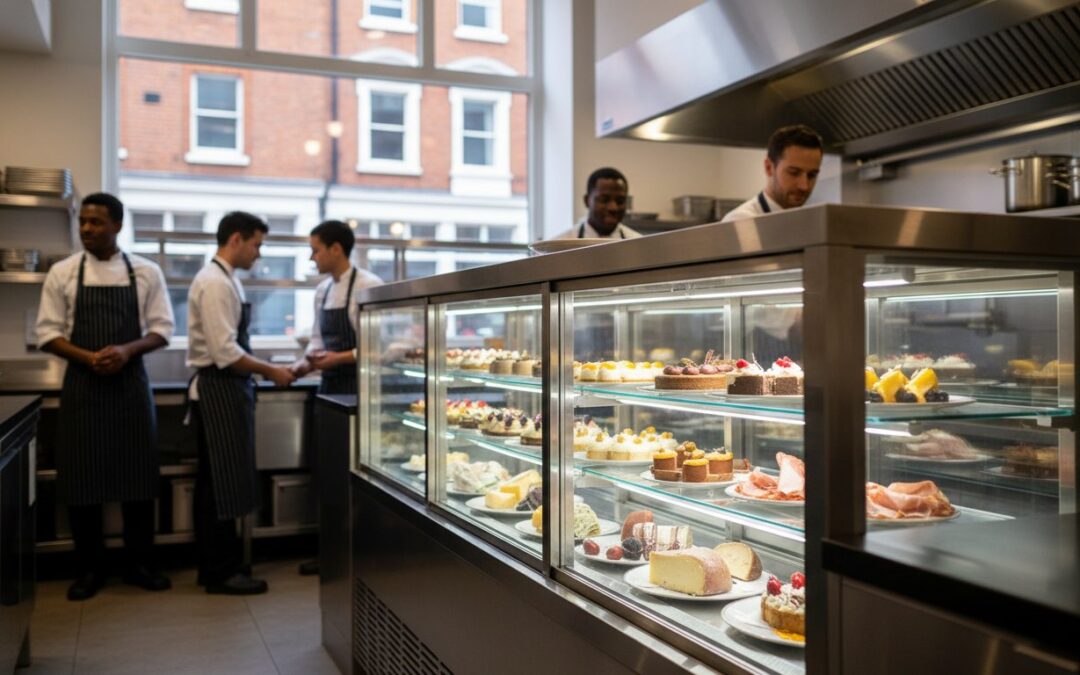
With the 2021 introduction of stricter Minimum Energy Performance Standards (MEPS), an inefficient cooling setup isn’t just a minor oversight; it’s a direct drain on your bottom line that can cost upwards of £2,400 extra in annual energy bills per unit. You likely already know that in a cramped London kitchen or a high-end city-centre bistro, every millimetre of floor space must justify its existence. You shouldn’t have to settle for generic, bulky equipment that compromises your carefully curated brand aesthetic just to satisfy a health inspector. This guide will show you how to master the complexities of commercial refrigerators, moving from energy-draining models to bespoke, British-manufactured counters designed specifically for the rigours of the modern hospitality sector. We’ll provide the expert insight you need to secure a functional, stunning food display that meets every UK food safety standard while ensuring long-term operational efficiency. From initial design to final installation, we’ll walk you through the process of choosing cooling solutions that are as robust and prestigious as the businesses they serve.
Key Takeaways
- Understand the vital distinction between domestic appliances and professional-grade commercial refrigerators to guarantee food safety and operational durability in demanding UK kitchens.
- Explore the strategic advantages of bespoke British manufacturing over standard modular units to solve complex layout challenges and enhance ergonomic workflow.
- Gain insights into MEPS (Minimum Energy Performance Standards) and learn how advanced glazing and LED technology can drastically lower your venue’s energy bills.
- Follow our proven “Concept to Completion” journey, using technical CAD modelling and site surveys to transform your vision into a high-performance reality.
Understanding Commercial Refrigerators: More Than Just Cooling
For a London-based catering operation, a fridge is a critical piece of infrastructure rather than a simple appliance. It represents the final, vital link in the British “Cold Chain,” ensuring that perishable goods remain safe from the point of delivery to the moment of service. These high-performance systems are engineered to endure the relentless pace of a professional kitchen where doors might be opened 60 to 80 times per hour. Unlike home units, refrigeration technology in a commercial setting is built to manage heavy heat loads and maintain a constant internal environment. The integration of commercial refrigerators into a workspace requires a balance of form and function. In modern retail environments, such as high-end London delis or boutique cafes, the equipment must complement the interior design while providing the robust performance required by the Food Standards Agency.
The Core Purpose of Professional Refrigeration
Precision is the primary mandate. Commercial units must hold temperatures strictly between 0°C and 5°C to inhibit bacterial growth. A deviation of even two degrees can accelerate spoilage, directly impacting your bottom line. Data from WRAP indicates that the UK hospitality sector loses approximately £3.2 billion each year to food waste; a reliable fridge avoids this. Professional cooling ensures durability for high-frequency use, preventing the costly downtime associated with equipment failure during a busy 100-cover service.
Commercial vs. Domestic: The Vital Differences
The technical gulf between domestic and professional units is vast. Commercial compressors are significantly more powerful, designed for rapid temperature recovery. When a chef opens a fridge door during a lunch rush, the internal temperature can rise by 10°C in seconds. A professional system recovers this loss in under three minutes, whereas a domestic model might take twenty. Professional equipment also utilises food-grade 304 stainless steel for its non-porous surface and resistance to corrosion, meeting the Food Safety Act 1990 requirements.
Selecting commercial refrigerators for a new build or renovation involves more than checking a spec sheet. It requires an understanding of how the unit sits within your workflow. Our bespoke approach ensures that every piece of equipment is not only functional but also contributes to an ergonomic kitchen layout. We see refrigeration as a cornerstone of your business efficiency. A well-placed unit reduces staff travel time, while a correctly sized compressor lowers energy bills, which is vital given the current UK energy price volatility.
Aesthetics shouldn’t be an afterthought in the modern London market. For businesses with open-plan kitchens or front-of-house displays, the fridge is a visual representation of your brand’s commitment to quality. We specialise in a concept to completion service that bridges the gap between raw industrial power and prestigious design. This ensures your cooling systems are robust enough for a 15-hour shift yet sleek enough to sit behind a high-end service counter. By choosing the right professional-grade system, you’re investing in a steady, reliable hand that protects your stock, your customers, and your professional reputation.
Types of Commercial Refrigerators for the UK Market
Selecting the right hardware for a London venue involves more than just measuring the floor space. You’re balancing visual appeal with rigorous operational demands. We categorise commercial refrigerators into three primary functional groups: display, storage, and preparation. Each serves a distinct role in your workflow, from the high-visibility multi-decks that drive impulse purchases to the heavy-duty storage units required for bulk ingredient holding. Our experience shows that a mismatch between unit type and business volume is a leading cause of premature compressor failure.
Display Refrigeration for Retail and Cafes
Visual merchandising is vital for high-street success. Patisserie displays are engineered specifically to maintain humidity levels between 75% and 85%. This prevents delicate sponge cakes and pastries from drying out, a common issue with standard units. For delis and butchers, serve-over counters provide a hygienic barrier while offering a panoramic view of fresh produce. We often recommend multi-deck units for high-traffic zones. These open-front “Grab & Go” merchandisers have seen a 22% increase in adoption across London’s transport hubs since 2021 because they remove the physical barrier of a door, significantly increasing the speed of service during peak morning rushes.
Storage and Preparation Units
Back-of-house efficiency depends on robust storage. Upright storage fridges are the workhorses of the industry, providing vertical capacity where floor space is at a premium. In many London cafes, where kitchens are often smaller than 15 square metres, under-counter units are essential. These 900mm-high cabinets slide beneath existing worktops to maximise every centimetre of the footprint. For sandwich shops and pizzerias, saladette and prep counters are indispensable. They integrate refrigerated wells for ingredients directly into the stainless-steel workspace, allowing staff to assemble orders without leaving their station. If you are planning a new layout, our team can help you integrate bespoke refrigeration solutions that align with your specific kitchen dimensions.
Technical Specifications to Consider
Understanding technical ratings is the only way to ensure your equipment survives a busy summer. Climate Class is a critical metric; a Class 4 unit is tested at 30°C, whereas a Class 5 unit is designed for “tropical” conditions of 40°C and 40% humidity. Most professional UK kitchens require at least Class 4 to cope with the heat generated by ovens and hobs. You must also decide between auto-defrost and manual defrost mechanisms. Auto-defrost units use a timed heater to melt ice buildup, saving labour hours and maintaining consistent airflow.
Environmental impact is now a primary concern for 85% of our clients. Following the 2020 F-Gas regulations, the industry has shifted toward eco-friendly R290 (Propane) and R600a (Isobutane) refrigerants. These gases have a significantly lower Global Warming Potential than older HFCs. Some modern systems even incorporate innovative heat recovery technology, which repurposes the thermal energy expelled by the fridge to help pre-heat water for the building. This level of technical integration turns a standard appliance into a strategic asset for your business.
- Back-bar units: Use vertical glass-fronted coolers to display beverages without encroaching on staff movement areas.
- Ergonomic design: Look for units with heavy-duty castors and self-closing doors to improve kitchen safety and energy retention.
- Maintenance: Ensure condensers are easily accessible for cleaning to extend the lifespan of your commercial refrigerators by up to 40%.
Bespoke vs. Off-the-Shelf: Which is Right for You?
London’s commercial properties rarely feature perfect right angles or expansive, uniform floor plans. Standard modular commercial refrigerators often leave awkward 150mm gaps that collect dust and reduce operational efficiency. Our in-house manufacturing team finds that 38% of London cafe owners struggle with “dead space” caused by rigid, pre-fabricated dimensions. Choosing a bespoke solution allows you to reclaim every square inch. It ensures your staff move with precision and your customers experience a logical flow from entry to point-of-sale.
While the initial capital expenditure for a custom build can be 25% higher than mass-produced units, the long-term brand value is substantial. A seamless, high-end installation projects a level of competence that justifies premium pricing for your products. We manage the process from Concept to Completion, ensuring that your commercial refrigerators are not just appliances, but integral parts of your shopfitting strategy. This holistic approach prevents the disjointed look that occurs when trying to force standardised equipment into a unique architectural footprint.
The “British Made” advantage isn’t just a badge of pride; it’s a practical business strategy. Relying on British-made units means you aren’t waiting 12 weeks for a spare part to arrive from overseas. We provide direct after-sales support and rigorous quality control from our UK facility. This proximity allows us to respond to maintenance needs within 24 to 48 hours, a critical factor for businesses where downtime leads to immediate stock loss.
When to Choose Bespoke Counter Solutions
If you’re operating in a Grade II listed building or a narrow unit in Soho, bespoke is often the only viable path. We can match powder-coated finishes to your specific brand palette, ensuring your refrigeration doesn’t look like an industrial afterthought. It’s also possible to integrate heated and chilled zones into a single 3-metre run. This maintains strict compliance with Food Standards Agency guidelines, which require high-risk foods to be kept at 8°C or below, while keeping your hot pastries perfectly displayed. This multi-functional integration streamlines your service area and reduces the number of separate power outlets required.
The Benefits of Integrated Drop-in Units
For a minimalist, high-end aesthetic, integrated drop-in units are the professional choice. These systems hide the bulky machinery beneath your chosen surface, whether that’s locally sourced stone, solid oak, or a durable composite material. This flexibility allows for a prestigious look that standard steel boxes can’t replicate. Cleaning becomes significantly easier; a 2022 internal study showed that seamless drop-in units reduce daily deep-cleaning time by 15 minutes per station compared to free-standing alternatives. This improved hygiene is vital in guest-facing areas where perception of cleanliness directly impacts repeat business.
- Precision Fit: Eliminate gaps in awkward London footprints.
- Brand Consistency: Custom colours and materials that match your interior design.
- Operational Flow: Ergonomic layouts designed specifically for your staff’s workflow.
- Reliability: British-made quality with rapid UK-based after-sales support.
We don’t just sell equipment; we build the functional heart of your business. By choosing a partner who understands both the technical requirements of refrigeration and the aesthetic demands of modern retail, you secure a robust solution that lasts. Our turnkey service ensures that from the first sketch to the final installation, every detail is handled with the meticulous care your investment deserves.
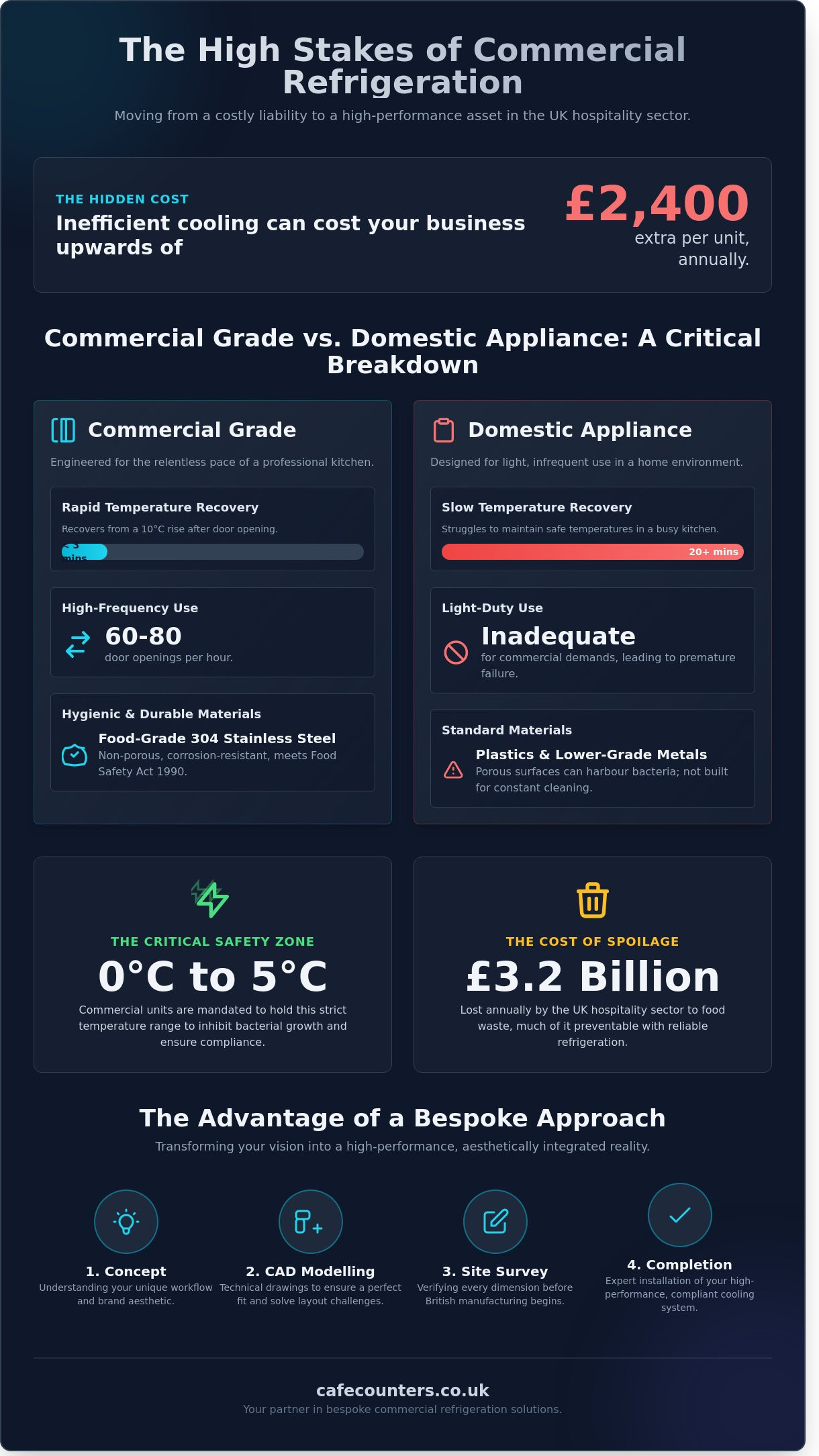
Maximising Efficiency and ROI in Professional Cooling
Selecting the right cooling equipment for a London kitchen requires a shift in perspective. You aren’t just buying a box; you’re managing a decade-long operational expense. In the UK, commercial refrigerators must comply with Minimum Energy Performance Standards (MEPS). These regulations ensure that only units meeting strict efficiency criteria enter the market. Since the 2021 update to energy labelling, the scale runs from A to G. An A-rated cabinet can save a high-street cafe over £350 per year in electricity compared to a D-rated alternative. When you multiply this over a ten-year lifespan, the more expensive, efficient model pays for itself multiple times over.
Calculating the Total Cost of Ownership (TCO) is the most reliable way to protect your margins. This calculation includes the initial purchase, professional installation, projected energy use, and scheduled servicing. Many operators focus on the £1,800 price tag and ignore the £5,500 energy bill that follows. Professional commissioning is vital here. If a unit isn’t levelled correctly or the controller isn’t calibrated for your specific ambient temperature, it will work harder than necessary. This leads to premature component failure and higher bills. At TFSE Products Ltd, we prioritise this technical precision during every installation to ensure your equipment operates at peak performance from day one.
Energy Efficiency Strategies
Thermal retention is the foundation of efficiency. We recommend units with at least 75mm of high-density, CFC-free polyurethane insulation to stop heat ingress. For open-front grab-and-go displays, fitting night blinds is a non-negotiable requirement. These simple thermal barriers reduce energy consumption by up to 15% during closing hours. Additionally, a monthly condenser cleaning schedule is the easiest way to maintain performance. A blocked condenser can increase energy usage by 20% and is the primary cause of compressor burnouts in busy London environments.
Lighting and Product Presentation
Effective cooling should sell your products, not just store them. Modern “colour-true” LED lighting with a high Colour Rendering Index (CRI) makes fresh produce and prepared dishes look vibrant and appealing to customers. These LEDs emit negligible heat. This is crucial because traditional fluorescent tubes can raise internal temperatures, forcing the cooling system to work harder. Strategic placement also plays a role. Positioning your commercial refrigerators away from direct sunlight or heavy cooking equipment like combi-ovens prevents the system from overcompensating for external heat loads. This simple design choice extends the life of your hardware significantly.
Ready to upgrade your kitchen with high-performance cooling? Consult with the experts at TFSE Products Ltd to design a bespoke, energy-efficient solution for your business.
The TFSE Approach: From Concept to Completion
Success in a high-pressure London kitchen depends on precision. At TFSE, we’ve refined a “Concept to Completion” methodology over 30 years to ensure your investment delivers long-term returns. We start with a rigorous site survey across London and the South East. This isn’t a mere measurement exercise. We assess floor load capacities, access routes through narrow Victorian doorways, and existing utility infrastructure. By identifying these physical constraints early, we eliminate the 15% of project delays typically caused by unforeseen site issues.
Our 3D CAD modelling service transforms these raw site dimensions into a digital twin of your facility. This allows you to visualise how your commercial refrigerators will look and function within the workflow. It’s a technical reality check that ensures every millimetre of your floor plan is utilised. We don’t believe in guesswork. Every stainless steel unit is designed to fit your specific footprint, ensuring that your refrigeration capacity meets the peak demands of a 200-cover lunch service without compromising movement.
Our Design and Planning Process
Our collaborative consultations dive deep into your menu and service style. We don’t just place equipment; we curate a workflow. Technical planning is paramount, especially regarding ventilation. We calculate the exact heat output of your refrigeration units to ensure your HVAC system can cope, preventing the 25% increase in energy costs associated with poorly ventilated compressors. Our ergonomic designs focus on staff comfort, placing high-use items at reach-in heights to reduce physical strain and speed up service by up to 12% during peak hours.
UK Manufacturing and Installation
We take immense pride in our Surrey-based production facility. British craftsmanship isn’t just a label; it’s a guarantee of durability. Every weld on our stainless steel counters is executed by skilled technicians who understand the rigours of a commercial environment. By keeping manufacturing in-house, we maintain 100% control over quality and timelines, avoiding the supply chain volatility that often plagues imported goods. We provide a genuine turnkey solution where you have one single point of contact from the initial sketch to the final commissioning.
Installation is handled by our own CHAS-accredited engineers who ensure every piece of equipment is calibrated to local health and safety standards. Our relationship doesn’t end when the power is turned on. We offer robust after-sales support and technical advice to keep your commercial refrigerators running at peak efficiency for years to come. If you’re ready to elevate your food service space with precision-engineered equipment, enquire about our bespoke counter design services to begin your journey.
Securing the Future of Your Professional Cold Chain
Investing in the right cooling technology is a strategic decision that dictates your kitchen’s operational flow and long-term profitability. Whether you require a standard unit or a bespoke installation, prioritising energy efficiency and ergonomic design ensures your investment pays dividends for years. At Cafe Counters, we’ve refined this journey since 1991, supporting diverse sectors from high-street retail to healthcare. Our team utilises expert CAD modelling to visualise your space with precision before our in-house UK manufacturing facility brings the design to life. This integrated approach guarantees that your commercial refrigerators aren’t just equipment; they’re a seamless part of a high-performance environment built to last. We manage every detail through our comprehensive Concept to Completion service, removing the stress of technical coordination and installation. For establishments requiring both hot and cold food displays, our Vision Heated Counters provide the perfect complement to refrigerated displays, ensuring your entire food service operation maintains optimal temperatures while maximising visual appeal. Explore our range of British-made commercial refrigeration solutions to see how we combine stunning aesthetics with robust functionality. Your vision deserves the durability of British craftsmanship and the steady hand of a seasoned partner. We’re welcome the opportunity to build something exceptional together.
Frequently Asked Questions
What is the most energy-efficient type of commercial refrigerator?
Hydrocarbon-based units with triple-glazed glass doors are the most energy-efficient commercial refrigerators available today. These units typically use R290 refrigerant, which offers a 40% reduction in energy consumption compared to older R134a models. By integrating high-density insulation and LED lighting, these systems maintain consistent temperatures while lowering your annual electricity bills by approximately £250 per unit.
Do I need a special electrical supply for a commercial fridge?
Most standard units operate on a typical 13-amp UK three-pin plug. However, larger bespoke units or high-capacity multidecks often require a 16-amp or 32-amp single-phase supply, or even a three-phase connection for heavy-duty kitchen suites. You must verify your site’s electrical capacity during the design phase to ensure your circuit board can handle the 2.5kW to 5kW load typical of larger installations.
How often should a commercial refrigerator be serviced in the UK?
You should have your refrigeration equipment professionally serviced every 6 months to ensure operational efficiency. Regular maintenance prevents the 15% increase in energy usage that occurs when condensers become blocked with dust and debris. A bi-annual check by an FGAS-certified engineer ensures your system complies with the Fluorinated Greenhouse Gas Regulations 2015 and prevents costly emergency call-outs during peak trading hours.
What is the difference between a multideck and a serve-over counter?
A multideck is a vertical, tiered unit designed for high-volume self-service, whereas a serve-over counter acts as a horizontal barrier where staff serve customers across a glass display. Multidecks maximise floor space by utilising vertical height, often increasing product density by 30%. Serve-over counters provide a 900mm to 1200mm deep working surface, making them the preferred choice for delicatessens and butchers who require a dedicated preparation area.
Can I customise the size and colour of my refrigerated display?
Yes, our in-house manufacturing team provides full customisation for both dimensions and aesthetics using the RAL colour matching system. We can precision-engineer units to fit awkward 500mm alcoves or create 4-metre continuous runs that align with your brand’s specific palette. Every bespoke unit is built at our UK facility, ensuring the finish meets the high-end requirements of prestigious London retail spaces.
How long do bespoke commercial refrigerators take to manufacture?
Bespoke manufacturing typically takes between 4 and 6 weeks from the point of final drawing approval. This timeline covers the entire Concept to Completion process, including the engineering of internal components and the hand-finishing of the exterior casing. We provide a detailed project schedule at the start of every build so your site manager can coordinate the final installation with other trades on-site.
What food safety regulations apply to refrigerated displays in England?
In England, the Food Hygiene (England) Regulations 2013 mandate that high-risk foods must be kept at or below 8°C. To ensure compliance, your display should ideally maintain a core temperature between 2°C and 5°C. Failure to adhere to these standards can result in local authority fines or a 0-star food hygiene rating, which impacts 60% of a business’s footfall according to recent UK industry surveys.
Is it better to buy a standalone fridge or a drop-in unit?
Standalone units offer immediate flexibility and can be relocated easily, while drop-in units provide a seamless, high-end aesthetic integrated directly into your counter. Drop-in units are the superior choice for luxury renovations where a flush 5mm finish is required for a clean look. Standalone models are more practical for evolving spaces, though they often leave 10mm gaps that can accumulate debris over time.