
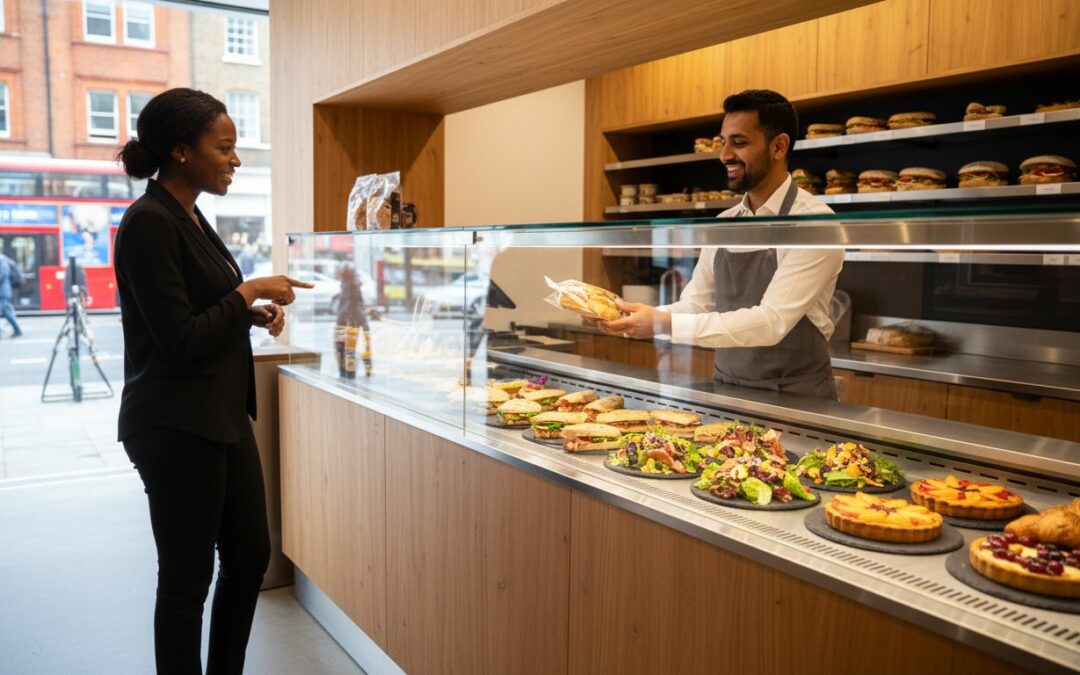
Did you know that an inefficient display fridge counter can leak over £1,500 in wasted energy costs every year while compromising your most profitable stock? You’ve likely experienced the frustration of standard, off-the-shelf units that leave awkward gaps in your layout or, worse, suffer mechanical failure just as the Saturday rush begins. It’s a common struggle for UK retailers who want to balance a prestigious visual aesthetic with the practical demands of a high-traffic food environment. You deserve equipment that works as hard as you do, without the constant worry of sourcing obscure spare parts or failing a food safety inspection.
This guide provides the technical clarity you need to select and integrate high-performance counters that maximise food safety, slash overheads, and drive impulse sales through superior British craftsmanship. We’ll walk you through our concept to completion approach, covering everything from bespoke ergonomic design to the robust manufacturing standards that ensure your investment lasts for a decade. By the end of this article, you’ll understand exactly how to transform your retail space with a functional, turnkey solution that turns passersby into loyal customers.
Key Takeaways
- Understand how to leverage eye-level merchandising and consumer psychology to transform your refrigeration into a powerful driver for impulse sales.
- Identify the critical technical differences between patisserie and grab-and-go units to ensure your equipment perfectly matches your specific menu requirements.
- Discover why a bespoke, British-made display fridge counter provides better lifetime value and operational reliability than standard off-the-shelf models.
- Prepare for future UK energy regulations, including 2026 labeling changes and MEPS, to reduce your environmental impact and long-term running costs.
- Learn how to integrate high-performance refrigeration into your shop layout by balancing customer flow with essential ventilation requirements for equipment longevity.
What is a Display Fridge Counter and Why is it Critical for Your Business?
A display fridge counter serves as the heartbeat of a high-end London deli or cafe, functioning as both a precision preservation tool and a high-performance merchandising asset. It’s far more than a simple cooling box; it’s a strategic piece of equipment designed to present your products in the best possible light while maintaining strict food safety standards. While the history of refrigeration began with basic ice-cooled cabinets, modern commercial units are now engineered to influence consumer behaviour through strategic product placement and visibility.
The psychological impact of eye-level food displays is a primary driver of revenue in the UK retail sector. Research from the Point of Purchase Advertising Institute indicates that up to 76% of purchasing decisions are made at the shelf edge. By positioning fresh salads, artisan cheeses, or cured meats at eye level, you tap into the impulse-buying reflex of your customers. A well-designed display fridge counter transforms your inventory into a visual feast, encouraging shoppers to add “just one more thing” to their basket.
Business owners must choose between standalone countertop units and integrated bespoke systems. Standalone fridges offer a quick, cost-effective solution for smaller sites with limited floor space. However, integrated bespoke systems provide a seamless finish that maximises every square inch of a premium London floor plan. These custom installations allow for a “Concept to Completion” approach, ensuring the counter aligns perfectly with your shop’s architectural flow and brand identity. Reliability is the foundation of our British manufacturing process, ensuring that your investment stands up to the rigours of a busy high-street environment.
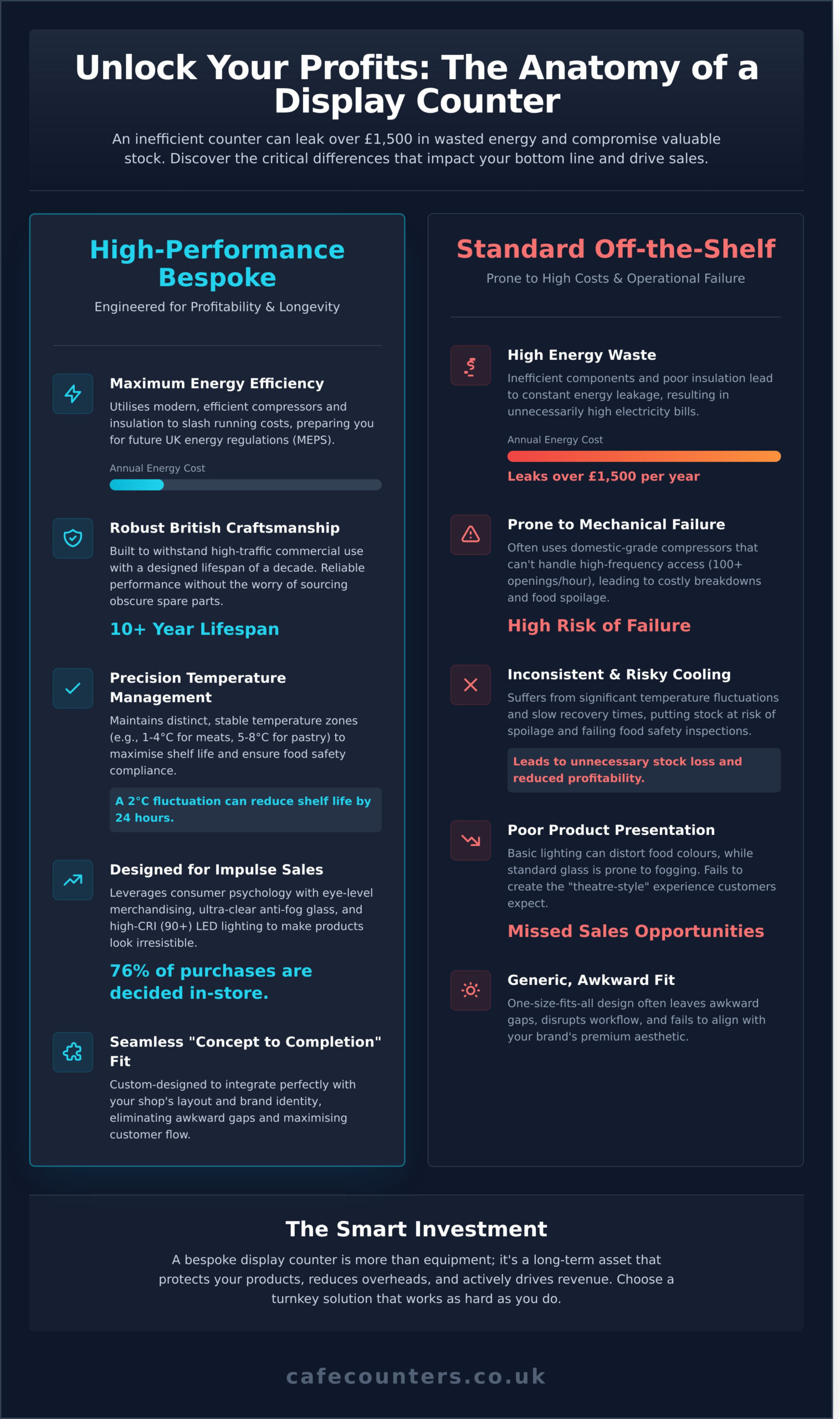
Precision temperature management is the final, critical pillar of these units. Maintaining distinct zones is non-negotiable for food safety and waste reduction. A deli counter might require 1°C to 4°C for raw meats, while an adjacent pastry section operates better at 5°C to 8°C. A minor 2°C fluctuation can reduce the shelf life of delicate greens by 24 hours, leading to unnecessary stock loss and reduced profitability.
The Role of Refrigeration in Modern Foodservice
Modern retail has shifted from hidden storage to “theatre-style” food preparation. Customers in 2024 want to see their food being handled and prepared, which builds immediate trust in your hygiene standards. High-quality displays with ultra-clear, anti-fog glass and high-CRI (90+) LED lighting ensure that product colours look vibrant and natural. This transparency reassures the London consumer that the produce is fresh, premium, and handled with care.
Commercial vs. Domestic Refrigeration: The Crucial Differences
Domestic units are designed for occasional use, whereas a commercial counter must withstand 100 or more door openings during a single lunch rush. Domestic compressors simply cannot keep up with this demand, leading to rapid mechanical failure and food spoilage. Commercial compressors are robust and built for high-frequency access. Recovery time is the speed a unit returns to its set temperature after being opened. In a professional kitchen, this rapid recovery is the only way to ensure your stock remains within the legal safety limits throughout the trading day.
Types of Refrigerated Display Counters: Matching Tech to Menu
Selecting the ideal display fridge counter requires a deep understanding of your product’s biological needs. It’s not just about keeping food cold; it’s about managing humidity, airflow, and accessibility to ensure your stock remains as fresh as the moment it was prepared. A London deli selling artisanal cheeses has vastly different technical requirements than a high-street bakery or a busy city-centre sandwich shop.
Specialist Displays: Patisserie and Deli Requirements
Patisserie items are notoriously fragile. Without precise climate control, a delicate sponge or cream-filled pastry will lose its texture within three hours. Dedicated patisserie units are engineered to maintain a high humidity level, typically between 70% and 80%, which prevents the dry air of standard refrigeration from leavening the moisture out of your cakes. These units use a soft, diffused airflow system rather than aggressive fans to protect delicate decorations. For more details on these specialized environments, see our guide on Choosing the Perfect Patisserie Display for Your Cafe.
Deli and serve-over counters focus on volume and visibility. These units feature deep stainless steel decks, often measuring 850mm to 900mm in depth, to accommodate large platters of cured meats and prepared salads. The “serve-over” glass configuration is essential for customer interaction in a traditional deli setting. It allows staff to slice and weigh products in front of the customer, building trust and allowing for upselling. Most professional deli units also include refrigerated rear storage, allowing staff to replenish the display without leaving the counter area.
Self-Service and Grab & Go Innovation
The pace of London retail has seen a 25% increase in the adoption of open-front merchandisers over the last three years. These units rely on sophisticated air curtain technology to maintain a consistent internal temperature of 2°C to 5°C. A high-velocity stream of cold air is circulated across the front of the unit, creating an invisible barrier that keeps the heat of the shop out while allowing customers instant access to products. This accessibility is a proven driver for impulse sales in high-traffic environments. You can learn more about these strategies in our article on Grab & Go Displays: How to Boost Impulse Sales.
Modern shop design increasingly favours “hybrid” counters. These bespoke installations combine a served section for premium cheeses or meats with a self-service front for bottled drinks and pre-packaged snacks. When planning these units, UK retailers must adhere to the Ecodesign for Energy-Related Products regulations. This statutory instrument, updated in 2021, mandates specific energy efficiency standards and clear labelling for all refrigerating appliances with a direct sales function. Ensuring your display fridge counter meets these UK standards is vital for both legal compliance and reducing long-term operational costs.
For shops with a specific aesthetic vision, drop-in units offer the ultimate flexibility. These are self-contained refrigeration systems designed to be lowered into custom-built timber, marble, or stone counters. This approach allows the technical reliability of a professional cooling system to be integrated into a prestigious, one-of-a-kind shopfit. If you’re currently planning a renovation, our team can help you design a bespoke counter layout that balances these technical requirements with your brand’s unique style.
Bespoke vs. Off-the-Shelf: The Case for Custom UK Manufacturing
Investing in a high-quality display fridge counter often triggers a debate between the lower upfront price of mass-produced imports and the long-term reliability of British-built assets. While an off-the-shelf unit might save you £1,500 on the initial invoice, the operational efficiency of a bespoke unit often pays for itself within the first 14 months. This return on investment comes through a 22% reduction in energy consumption and the total elimination of costly downtime. When a cheap component fails on an unbranded unit, your deli loses stock and revenue. Our British-led manufacturing ensures that 95% of replacement parts are available for next-day delivery, keeping your shop floor operational when it matters most.
Technical precision is the hallmark of our workshop. We utilise high-grade 304 stainless steel for all internal and external surfaces. Unlike the 430-grade steel found in budget alternatives, 304-grade contains higher levels of chromium and nickel. This makes it exceptionally resistant to the lactic acid found in dairy and the citric acids in deli meats. Hygiene remains a non-negotiable priority for any London food business. Using these premium materials helps you maintain the strict standards outlined in the Safer Food, Better Business (SFBB) pack, particularly regarding the prevention of bacterial growth on food contact surfaces.
Our CAD modelling process removes the guesswork from your renovation. London shops are famous for their awkward footprints, often featuring 150-year-old alcoves or uneven flooring. We create a digital twin of your space to ensure a “first-time fit” that accounts for every millimetre. This precision prevents the 10% to 15% of wasted floor space typically seen with standard rectangular units. A bespoke display fridge counter is designed to follow the natural contours of your shop, improving the ergonomic flow for your staff and creating a seamless journey for your customers.
The Pitfalls of Cheap Imported Refrigeration
Unbranded units frequently suffer from poor insulation density, forcing compressors to work 30% harder to maintain temperature. This leads to high noise levels, often exceeding 65 decibels, which can ruin the atmosphere of a boutique cafe. Furthermore, these “disposable” units are rarely designed for repair. When a sealed system fails, the entire unit often ends up in a landfill. British-made assets are engineered for a 10-year lifecycle, providing a sustainable alternative that avoids the environmental and financial costs of frequent replacements.
The Bespoke Design Process: From Concept to Completion
Every project begins with a comprehensive site survey. We don’t just measure the walls; we identify access restrictions, such as narrow 750mm doorways, and assess your existing electrical load to prevent circuit overloads. Custom fabrication allows you to move beyond basic steel finishes. You can integrate reclaimed timber, branded Corian worktops, or specific LED colour temperatures that make your produce pop. We manage the entire journey, providing a Bespoke Counter Design Process from Start to Finish that eliminates the friction of dealing with multiple contractors. This holistic approach ensures your counter isn’t just a piece of equipment, but a core part of your brand identity.
Technical Specifications: Energy Efficiency and Compliance
Selecting a display fridge counter requires more than an eye for design; it demands a deep understanding of the regulatory landscape. By 2026, UK energy labelling will undergo further refinement under Minimum Energy Performance Standards (MEPS). These updates make it easier for London business owners to identify high-efficiency units that meet strict carbon reduction targets. These labels provide a transparent look at annual kilowatt-hour (kWh) consumption, which is vital when commercial electricity prices average around £0.28 per unit. Investing in a unit with a high energy rating isn’t just a “green” choice; it’s a direct protection of your daily profit margins.
The choice of refrigerant gas is a major factor in both environmental impact and operational costs. We utilise R290 refrigerant across our manufacturing range. This hydrocarbon gas has a Global Warming Potential (GWP) of just 3, which is a stark contrast to older gases like R404A that had a GWP of 3,922. R290 isn’t just better for the planet; it offers superior thermodynamic properties. In practical terms, this often leads to a 15% reduction in energy consumption compared to systems using legacy HFC refrigerants. It’s a robust solution for the modern, eco-conscious deli.
Our manufacturing process integrates high-density, CFC-free polyurethane insulation to create a seamless thermal barrier. This is paired with intelligent digital controllers from industry leaders like Dixell or Carel to manage defrost cycles with precision. These components ensure the compressor only engages when absolutely necessary, protecting the hardware from unnecessary wear. To maintain this efficiency long-term, we design our units with accessible condensers. A condenser blocked by dust can force a system to work 25% harder, shortening its lifespan and inflating your monthly bills. Regular cleaning of these components is the simplest way to ensure your investment lasts for a decade or more.
Maximising Energy Efficiency in Your Cafe
Strategic placement is the simplest way to protect your margins. Positioning a fridge near a pizza oven or in direct afternoon sunlight increases the heat load significantly. We recommend using LED lighting inside the display, as these bulbs emit minimal heat compared to old-fashioned fluorescent tubes. For businesses using open-fronted units, high-quality night blinds are essential. These simple barriers can slash energy bills by 20% by containing the cold air during hours when the shop is closed. It’s a small operational change that yields a massive return over a 12-month period.
Food Safety Regulations and HACCP Compliance
Regulatory compliance is non-negotiable for any London food business. UK food safety law requires chilled high-risk foods to be held at or below 8°C, though 5°C is the recommended industry standard for displays. To facilitate easy Hazard Analysis and Critical Control Point (HACCP) logging, every display fridge counter we install features a prominent external digital temperature display. We engineer our units with forced-air cooling systems to ensure consistent airflow across every shelf. This prevents the “warm spots” that can lead to bacterial growth in static-cooled alternatives, ensuring your produce stays fresh and safe for your customers.
Planning Your Installation: Integrating the Fridge into Your Layout
Successful installation is the bridge between a high-quality design and a high-performance retail environment. A poorly positioned display fridge counter does more than just look out of place; it can actively disrupt your operations and shorten the lifespan of your equipment. In the fast-paced London hospitality market, where floor space often commands a premium, every centimetre must be calculated to support both staff efficiency and the customer experience.
Ergonomics and Customer Flow
The placement of your counter dictates the natural path customers take through your shop. You should align the unit to create an intuitive journey from entry to point of sale. Placing the most visual elements of your display fridge counter at the “Goldilocks zone” height, typically between 900mm and 1200mm, ensures products sit directly in the natural line of sight for an average adult. This visibility is a primary driver for impulse purchases. To see how these physical layouts impact your bottom line, you can read our guide on How to Maximise Your Cafe’s Customer Flow. Staff must also have at least 900mm of clearance behind the counter to move freely without colliding. This prevents service bottlenecks during the 12:00 PM to 2:00 PM peak periods when speed of service is critical for London professionals.
Technical considerations are equally vital for the longevity of your investment. Every refrigeration unit requires “breathing space” to function. If you tuck a compressor against a wall without the manufacturer-recommended 100mm to 150mm clearance, the system will overwork to dissipate heat. This lack of ventilation can increase your energy bills by 20% and lead to premature component failure. We’ve seen compressors fail in under two years because they were “boxed in” by decorative panelling that lacked adequate airflow grilles. Professional commissioning is the final, non-negotiable step. Our engineers calibrate the unit on-site to ensure it maintains a consistent 2°C to 5°C, even when the shop door is frequently opening and closing.
Turnkey Service: The TFSE Advantage
Since our founding in 1991, TFSE has operated on a “Concept to Completion” philosophy. We don’t just ship a crate to your door; we act as your technical partner throughout the entire build. Our British manufacturing roots mean we understand the specific electrical and spatial constraints of UK commercial properties. By managing the design, fabrication, and final installation in-house, we eliminate the communication gaps that often occur when using multiple third-party contractors. This seamless approach ensures that the bespoke counter you approved in the 3D render is exactly what’s bolted to your floor.
Choosing TFSE means you’re investing in a robust, long-term solution backed by decades of experience across the retail and healthcare sectors. We provide the technical expertise to ensure your shop is functional from day one, offering the after-sales support that keeps your business running smoothly. Our team handles the heavy lifting, from initial site surveys to the final temperature checks, allowing you to focus on your grand opening. Contact us today for a bespoke counter consultation and let’s start building your vision together.
Transforming Your Vision into a High-Performance Reality
Selecting the ideal display fridge counter is a strategic investment that balances technical compliance with aesthetic appeal. You’ve explored how energy efficiency ratings impact your long-term overheads and why a bespoke layout maximizes every square inch of your floor plan. These decisions define your brand’s physical presence and operational flow for years to come. Choosing the right equipment isn’t just about cooling; it’s about creating an environment where your products and your business can thrive.
Since 1991, TFSE Products Ltd has manufactured high-quality food display equipment right here in the UK. We don’t just sell units; we provide a comprehensive service that includes professional CAD modelling and a detailed site survey to ensure your installation is seamless. Our team specializes in bespoke stainless steel and high-end retail finishes that turn a functional necessity into a prestigious centerpiece. By choosing a partner that manages everything from the initial design to the final installation, you eliminate the risks associated with off-the-shelf solutions. View our range of British-manufactured display counters and start your journey from concept to completion today. Your vision deserves the durability of British craftsmanship and the precision of an expert partner.
Frequently Asked Questions
What is the best temperature for a display fridge counter?
The ideal temperature for a standard deli display fridge counter is between +1°C and +5°C. Maintaining this precise range ensures food safety compliance and preserves the freshness of perishable goods like cheeses and cured meats. If you’re displaying fresh raw meat, you must maintain a stricter range of 0°C to +2°C. Our bespoke units feature digital controllers to manage these settings, protecting your stock and your reputation.
How much does a bespoke refrigerated display counter cost?
A bespoke refrigerated display counter typically costs between £3,500 for a compact 1.2 metre unit and £15,000 or more for a complex, multi-section installation. These prices reflect the high quality British materials and custom engineering required for a unique fit. Investing in a tailored solution eliminates the need for expensive modifications later. We provide transparent, itemised quotes during the design phase to ensure your project remains within its allocated budget.
What is the difference between ventilated and static cooling?
Ventilated cooling uses internal fans to circulate chilled air evenly, while static cooling relies on natural convection to maintain temperature. Ventilated systems are excellent for high traffic London shops because they recover temperature quickly after the doors are opened. Static cooling is often preferred for delicate items like fresh pasta or unwrapped meats as it doesn’t dry out the product. Most of our high end counters utilise ventilated systems for superior thermal stability.
How often should I service my commercial display fridge?
You should schedule a professional service for your commercial display fridge counter at least every 6 months. Regular maintenance includes cleaning the condenser coils and checking refrigerant levels to prevent the 30% increase in energy consumption caused by dirty components. Our technicians focus on preventative care to extend the lifespan of your equipment beyond the standard 10 year cycle. Keeping a consistent service log is also a requirement for many insurance policies.
For general electronic maintenance needs or sourcing specific components for other equipment, a comprehensive supplier can be useful; for example, online retailers like Tunewtec stock a wide range of electronic parts.
Can I customise the exterior finish of my refrigerated counter?
You can fully customise the exterior finish of your counter to match your brand identity using materials like Corian, reclaimed timber, or powder coated steel. We offer over 100 different laminate options and 50 stone finishes to ensure your unit feels like a natural extension of your shop’s interior. Our in house manufacturing team applies these finishes with surgical precision. This level of customisation transforms a functional appliance into a stunning focal point for your retail space.
What are the ventilation requirements for an integrated drop-in fridge?
An integrated drop-in fridge requires a minimum of 200 square centimetres of clear airflow to the condenser to prevent overheating. Without proper ventilation, the compressor works 25% harder, leading to premature mechanical failure and increased electricity bills. We design bespoke cabinetry with discreet, CNC machined vents that provide the necessary air intake without compromising the sleek aesthetic of your counter. Proper airflow management is a critical step in our concept to completion process.
Do I need a special power supply for a large deli counter?
Most standard deli counters operate on a 13 amp plug, but larger units exceeding 2.5 metres often require a dedicated 16 amp or 32 amp single phase supply. It’s vital to confirm your shop’s electrical capacity during the initial site survey to avoid installation delays. We provide detailed technical drawings that specify the exact kilowatt loading for your bespoke unit. This ensures your electrical contractor can install the correct rotary isolators before our team arrives for the final fitting.
How long does it take to manufacture a bespoke display unit in the UK?
Manufacturing a bespoke display unit in our UK facility typically takes between 4 and 8 weeks from the final design approval. This timeframe allows us to source premium components and complete rigorous quality control testing before the unit leaves the factory. While imported units often face shipping delays, our British based production ensures a reliable delivery schedule. We manage every stage of the timeline to ensure your shop opening or renovation stays on track.