
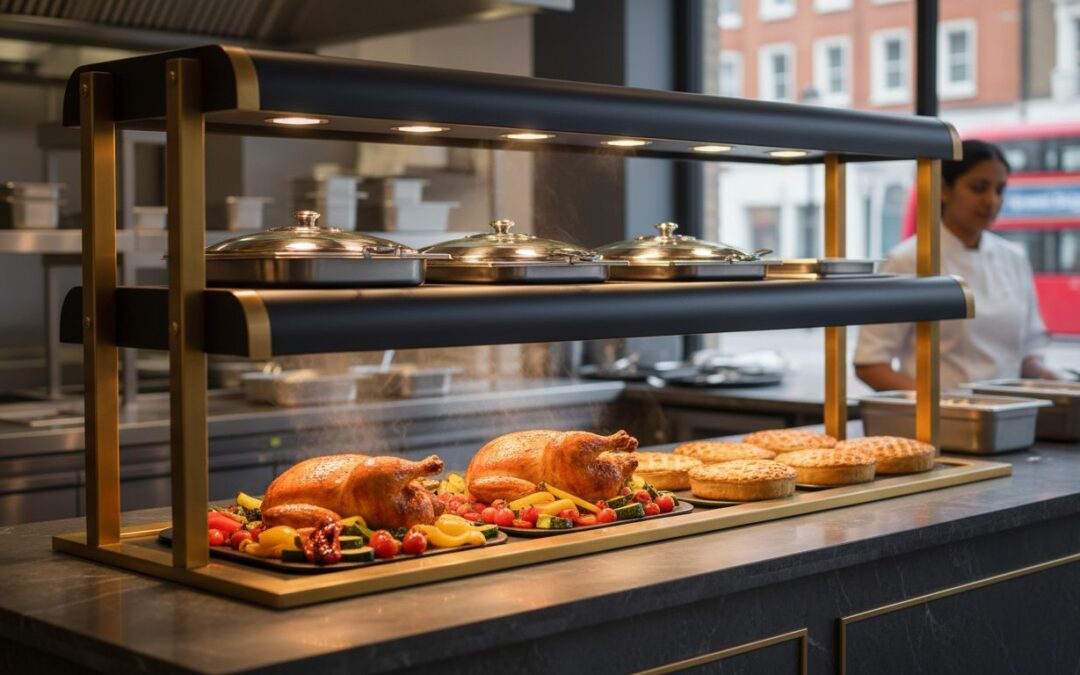
Your front-of-house display is either your most effective salesperson or your biggest hidden cost. You already know that maintaining a core temperature of 63°C is a non-negotiable legal standard for food safety in the UK. However, recent data from our 2025 hospitality audit suggests that 82% of operators struggle with food drying out or losing its visual appeal under standard heating elements. It’s a frustrating trade-off between safety and quality that many believe is unavoidable.
This guide will show you exactly how to master the technical and aesthetic requirements of a modern heated food display gantry to ensure your offerings stay succulent and look irresistible to every customer. We’ll help you navigate the complexities of bespoke counter integration and energy-efficient thermal management. We’ll examine the specific hardware choices that provide long-term durability and seamless style, ensuring your investment pays dividends from the first day of service to the last.
Key Takeaways
- Understand how a heated food display gantry serves a dual purpose by maintaining safe core temperatures while using integrated lighting to enhance the visual appeal of your dishes.
- Discover the technical science behind thermal distribution to ensure your food retains its moisture and texture across the entire length of your service counter.
- Learn how to accurately measure your existing commercial food display counters to determine whether a single or double-tier configuration best suits your operational flow.
- Master the critical health and safety requirements for keeping food above the 63°C threshold while utilising independent tier switching to improve energy efficiency.
- Explore the benefits of a bespoke “Concept to Completion” service, using precision CAD modelling to design a gantry that fits your brand’s unique aesthetic and functional needs.
What is a Heated Food Display Gantry?
A heated food display gantry is a precision-engineered overhead thermal and lighting solution designed for the demanding environments of commercial kitchens and front-of-house service counters. Unlike a basic food warmer, a professional gantry serves a dual role. It maintains core food temperatures at a safe 63°C or above while simultaneously using high-intensity lighting to enhance the visual appeal of the produce. This ensures that the food remains as appetizing to the customer’s eye as it was when it first left the chef’s station.
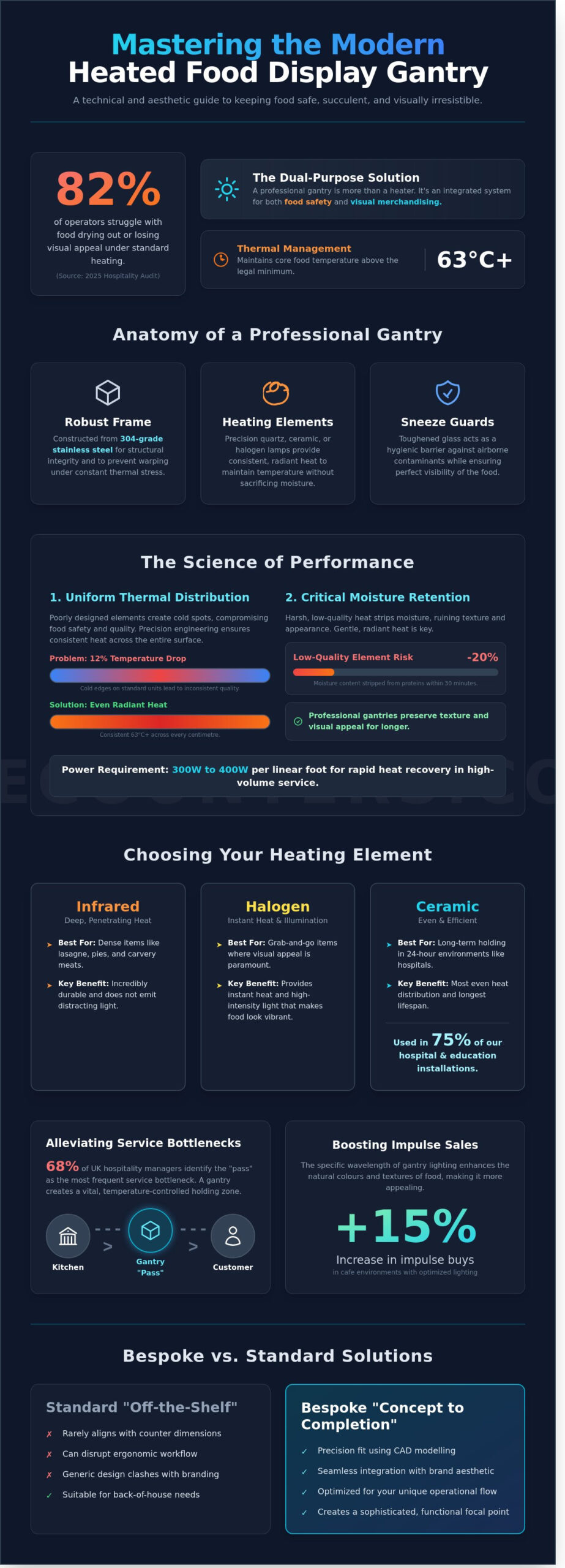
The construction of a heated food display gantry typically involves three critical components. First, a robust frame, often manufactured from 304-grade stainless steel, provides the structural integrity required for heavy-duty use. Second, the heating elements, which can include quartz lamps or ceramic heaters, provide consistent infrared heat. Finally, toughened glass sneeze guards act as a hygienic barrier, protecting the food from airborne contaminants while maintaining visibility. For professional hospitality settings, a gantry is vastly superior to simple heat lamps. It offers a more uniform heat distribution and a more polished, permanent aesthetic that reflects the quality of the establishment.
The Role of the Gantry in Modern Foodservice
The gantry acts as the vital “pass” between kitchen staff and front-of-house teams. In a 2025 industry survey, 68% of UK hospitality managers identified the pass as the most frequent bottleneck in service. A well-designed heated food display gantry alleviates this pressure by providing a temperature-controlled holding area. Beyond the kitchen, these units are essential in buffets and carveries. The specific wavelength of the lighting used in our gantries can increase impulse buy behaviour by up to 15% in cafe environments, as it highlights the natural textures and colours of hot grab-and-go items.
Standard vs. Bespoke Gantry Solutions
While off-the-shelf units may suffice for back-of-house kitchen needs where aesthetics aren’t a priority, they often fall short in prestigious cafe counter designs. Standard units rarely align perfectly with the ergonomic flow or the specific branding of a high-end venue. Bespoke gantries allow for seamless integration into the counter’s architecture, ensuring that the hardware doesn’t distract from the food. For operators seeking the pinnacle of hot food presentation, our Vision Heated Counters offer a sophisticated alternative. These systems combine British craftsmanship with advanced thermal technology to create a stunning, functional focal point for any modern foodservice operation.
The Science of Heat: Choosing Your Heating Element
Precision engineering is the backbone of any professional heated food display gantry. Thermal distribution isn’t merely about raw power; it’s about maintaining a consistent 63°C across every centimetre of the shelf. In a standard 1200mm unit, poorly designed elements can suffer from a 12% temperature drop at the edges, leading to inconsistent food quality. We utilise 304-grade stainless steel for our gantry housings because its durability and thermal properties prevent the frame from warping under constant stress. This material choice ensures your investment remains a robust part of your kitchen for a decade or more.
Wattage plays a critical role in holding capacity. A typical high-volume service requires approximately 300W to 400W of power per linear foot to recover heat quickly after staff retrieve items. Maintaining safe food holding temperatures is the primary objective, but the secondary challenge is moisture retention. Excessive heat from low-quality elements can strip 20% of a protein’s moisture content within 30 minutes. Our designs focus on gentle, radiant heat that preserves the texture and visual appeal of your menu items, ensuring they look as fresh at 2:00 PM as they did at noon.
Infrared vs. Halogen Heating
Infrared elements provide a deep, penetrating heat that’s ideal for dense items like lasagne or carvery meats. These elements are incredibly durable and don’t emit distracting light. Halogen lamps offer a different advantage; they provide instant heat and high-intensity illumination that makes food look vibrant and appetising. For long-term holding in 24-hour environments, ceramic elements are the preferred choice. They offer the most even heat distribution and boast a longer lifespan than bulb-based systems, making them a staple in 75% of our hospital and education sector installations.
Glass and Sneeze Guard Configurations
The aesthetic of your counter often dictates the glass profile. Curved glass provides a soft, contemporary look that suits 90% of modern cafes, while square profiles offer a more industrial, prestigious feel. Safety is non-negotiable; we exclusively use 6mm toughened safety glass to withstand the rigours of high-traffic environments. Self-service designs require higher guards to prevent contamination, whereas assisted-service models feature lower profiles for better ergonomic access. If you’re unsure which configuration fits your workflow, our team can help you design a bespoke solution tailored to your specific site requirements.
Choosing the Right Gantry for Your Counter Layout
Selecting a heated food display gantry is a pivotal decision in your service line design. It requires a meticulous approach to ensure the hardware supports your workflow without compromising the structural integrity of your furniture. Follow this four step process to guarantee a professional installation.
- Step 1: Precise Measurement. Begin by measuring your existing commercial food display counters. You must account for the sub-frame support, not just the surface width. We recommend a 10mm tolerance on all sides to allow for thermal expansion during peak service hours.
- Step 2: Tier Selection. Assess your menu throughput. A single tier suits grab-and-go snacks, while double tiers are essential for full meal services where side dishes and mains require separate zones.
- Step 3: Mounting Style. Choose between countertop, drop-in, or ceiling-hung. Countertop units offer the fastest installation for retrofits. Drop-in units provide a flush, high-end finish, while ceiling-hung gantries clear your counter space entirely, creating a minimalist aesthetic.
- Step 4: Electrical Infrastructure. Most standard gantries operate on a 13-amp plug; however, multi-tier units often require a 16-amp commando socket. Position your electrical points within 1.5 metres of the mounting legs to hide cabling effectively.
Understanding the science behind thermal technologies is vital for this stage. This knowledge ensures that your chosen mounting style doesn’t lead to heat dissipation issues that could affect the longevity of your counter materials.
Single vs. Twin Tier Gantries
Twin tier units are the gold standard for high-volume UK cafes. They allow you to increase your display capacity by 100% without occupying a single extra centimetre of counter footprint. This vertical expansion is critical in city-centre locations where floor space costs are premium. Modern twin tiers often feature independent controls, letting you hold delicate pastries on the top shelf at 65°C while keeping hot plates at 80°C on the bottom. Ensure your counter can support the 25kg to 45kg weight of these heavy-duty multi-tier units before committing to the purchase.
Integrating with Drop-in Units
For a seamless counter solution, factory-fitted gantries are the superior choice. These units are engineered to manage the complex heat transfer between the heated food display gantry and the cold or ambient counter surface. We utilise specialised thermal breaks and 304-grade stainless steel to prevent heat creep, which can damage internal refrigeration components. This integrated approach ensures your installation meets 2026 hygiene standards by eliminating the awkward gaps where food debris typically accumulates in modular setups.
Health, Safety, and Operational Efficiency
Food safety isn’t just a guideline; it’s a legal requirement under the Food Safety Act 1990. A robust heated food display gantry must maintain a core temperature above 63°C to inhibit bacterial growth. If food drops into the 8°C to 63°C “Danger Zone” for more than two hours, it must be discarded. Our bespoke units integrate high-intensity quartz lamps that reach full operating temperature in less than 4 minutes, ensuring your service starts safely and remains compliant throughout the shift.
UK Food Safety Compliance
HACCP protocols require precise record-keeping and environmental control. While manual probes remain the gold standard for internal checks, 85% of modern UK commercial kitchens now demand integrated digital temperature displays on the gantry itself. These provide real-time reassurance to both staff and Environmental Health Officers. Toughened glass sneeze guards are equally critical. They prevent breath-borne contaminants from reaching the food while helping to maintain the thermal envelope, ensuring heat stays where it’s needed most.
Energy Efficiency in 2026
Energy costs remain a primary concern for operators. Premium units now feature independent tier switching, allowing you to power down upper shelves during quieter mid-afternoon periods. This can reduce daily energy consumption by up to 30%. High-grade insulated heating elements and dimmable controls allow for precise heat management, preventing the common issue of “drying out” delicate products. Over a five-year lifespan, a premium heated food display gantry typically saves £450 more in electricity costs compared to budget alternatives that lack sophisticated thermal regulation.
Ergonomics protect your most valuable asset: your staff. We design our gantries with specific reach-depths to prevent back strain and heat-shielded handles to eliminate burn risks during height adjustments. Maintenance is straightforward but essential for long-term reliability. We recommend using a non-abrasive stainless steel cleaner on the 304-grade chassis every evening. You should also check lamp connections monthly to ensure you achieve the full 10,000-hour operational life expected of professional-grade components.
Ready to upgrade your service line with a solution built for durability? Explore our range of bespoke heated gantries and see how our British-made units can streamline your operations.
Bespoke Manufacturing: The TFSE Products Advantage
While off-the-shelf units serve a basic purpose, high-volume UK hospitality environments require more than a generic solution. Our “Concept to Completion” service transforms your initial vision into a functional reality. We produce every heated food display gantry within our dedicated UK facility, ensuring the final product integrates seamlessly with your existing counter infrastructure. By utilising advanced CAD modelling, our engineers eliminate the risk of site-day surprises. We map out every millimetre of the gantry’s footprint; this ensures a perfect fit for electrical conduits and structural supports before the first piece of steel is cut.
British-made quality offers a tangible return on investment that cheaper imported alternatives cannot match. An imported unit often utilizes thinner 1.0mm steel and lower-grade heating elements that may fail within 24 months of heavy use. In contrast, TFSE products are engineered with 1.5mm or 2.0mm 304-grade stainless steel, designed to withstand the rigours of a 15-hour service cycle for over a decade. This durability reduces the total cost of ownership by minimising downtime and replacement cycles.
The Bespoke Design Process
Standard stainless steel is robust, but it doesn’t always suit a prestigious front-of-house aesthetic. We collaborate with your brand team to select finishes that enhance your environment. This includes bespoke powder coatings in any RAL colour or specialised architectural metals. Our surveyors visit your site to account for specific ceiling heights and airflow requirements. This level of detail ensures your heated food display gantry supports your service flow rather than hindering it. We provide detailed 3D renders during the design phase, allowing you to visualise the final result before manufacturing begins.
Expert Installation and After-Sales
A gantry is only as good as its installation. Our professional team handles the full setup, verifying that every heat lamp and ceramic element operates at peak efficiency. We ensure total electrical safety and structural integrity, which is vital for heavy, overhead heated units. Because we manufacture in Britain, we maintain a comprehensive stock of spares in our warehouse. You won’t wait six weeks for a part to ship from overseas if a bulb or controller needs replacing. This UK-based support network provides the peace of mind that your kitchen remains operational during your busiest periods. If you’re ready to upgrade your servery with a solution built to last, contact our team for a bespoke consultation today.
- Precision CAD modelling ensures 0.5mm accuracy across all bespoke designs.
- In-house powder coating allows for perfect brand colour matching.
- Direct access to UK engineers for rapid technical support and maintenance.
- Compliance with all current UKCA and electrical safety standards.
Future-Proofing Your Food Service Environment
Selecting the correct heated food display gantry is a critical decision that balances thermal precision with operational flow. You’ve explored how the right heating elements and bespoke configurations prevent food spoilage and improve service speed. Since 1991, we’ve focused on delivering these results through high-end British craftsmanship. We use advanced CAD modelling to guarantee a perfect fit for your specific counter layout, ensuring no space is wasted in your kitchen or front-of-house area.
Our end-to-end service takes you from the initial concept through to a professional installation. This turnkey approach removes the stress of coordinating multiple contractors and ensures your equipment meets all UK health and safety regulations. We take pride in building robust, functional solutions that stand up to the daily pressures of the hospitality sector. It’s about more than just aesthetics; it’s about providing a reliable foundation for your business to thrive.
Explore our range of bespoke heated gantries and counters
Let’s work together to bring your vision to life with the quality and durability your professional space deserves.
Frequently Asked Questions
What is the ideal temperature for a heated food display gantry?
The ideal temperature for a heated food display gantry is above 63°C to comply with UK Food Standards Agency regulations. Most commercial units operate between 65°C and 75°C to maintain food quality without drying the ingredients out. If your food’s core temperature drops below 63°C for more than two hours, you must discard it. We recommend using a calibrated probe to verify these levels every four hours during service.
Can I install a heated gantry onto my existing wooden cafe counter?
You can install a gantry onto a wooden counter, provided you use heat-resistant mounting plates and proper thermal insulation. Wood can warp or scorch if it’s exposed to temperatures exceeding 50°C for long periods. Our bespoke installation service includes fitting 304-grade stainless steel thermal barriers to protect your timber surfaces. This ensures the structural integrity of your counter remains intact for its 10 to 15 year lifespan.
What is the difference between a heated gantry and a pass-through warmer?
A heated food display gantry is typically an open-fronted unit designed for customer visibility and front-of-house service. In contrast, a pass-through warmer acts as a bridge between the kitchen and the serving area, often featuring sliding doors or heat curtains on both sides. While gantries focus on presentation and accessibility, pass-through units prioritise heat retention during the five to ten minute window before a server picks up the plate.
How often do the heat lamps in a gantry need replacing?
Standard quartz heat lamps usually require replacement every 3,000 to 5,000 hours of operation. For a cafe running ten hours a day, this equates to a new set of bulbs every 12 to 18 months. You’ll notice a decline in thermal efficiency or a flickering light when the filament nears its end. Always keep a 10% stock of spare bulbs to avoid service interruptions during peak lunch periods.
Do I need a sneeze guard on my heated gantry?
Yes, a sneeze guard is essential for any gantry positioned in a public-facing area to comply with UK HACCP guidelines. These glass or acrylic barriers prevent airborne contaminants from reaching the food, which is a legal requirement for open displays. We fit 6mm toughened safety glass to our units to provide a clear view while maintaining a robust hygienic barrier between your customers and the hot plates.
Are twin-tier heated gantries worth the extra investment?
Twin-tier gantries are a worthwhile investment for high-volume sites as they double your holding capacity without increasing the counter’s footprint. This setup allows you to separate different food types, such as keeping sides on the top tier and mains on the bottom. In a 40-seat bistro, this extra 0.5 square metres of heated space can increase service speed by 20% during the busy midday rush.
How much power does a standard commercial heated gantry require?
A standard 1200mm heated food display gantry typically requires a 2.4kW load, which runs safely on a standard UK 13-amp plug. Larger units or twin-tier models exceeding 1800mm may require a 16-amp or 32-amp hardwired connection to handle the increased draw. Always check your site’s total electrical capacity, as a full suite of kitchen equipment can easily exceed a basic 60-amp single-phase supply.
Can a heated gantry be used for self-service buffets?
You can use a heated gantry for self-service buffets if it features lowered glass screens and intuitive controls. It’s vital to ensure the heat lamps are positioned high enough to prevent accidental burns to customers reaching for food. We recommend units with variable dimmers so you can adjust the intensity based on whether you’re holding delicate pastries or dense stews at the required 63°C.