
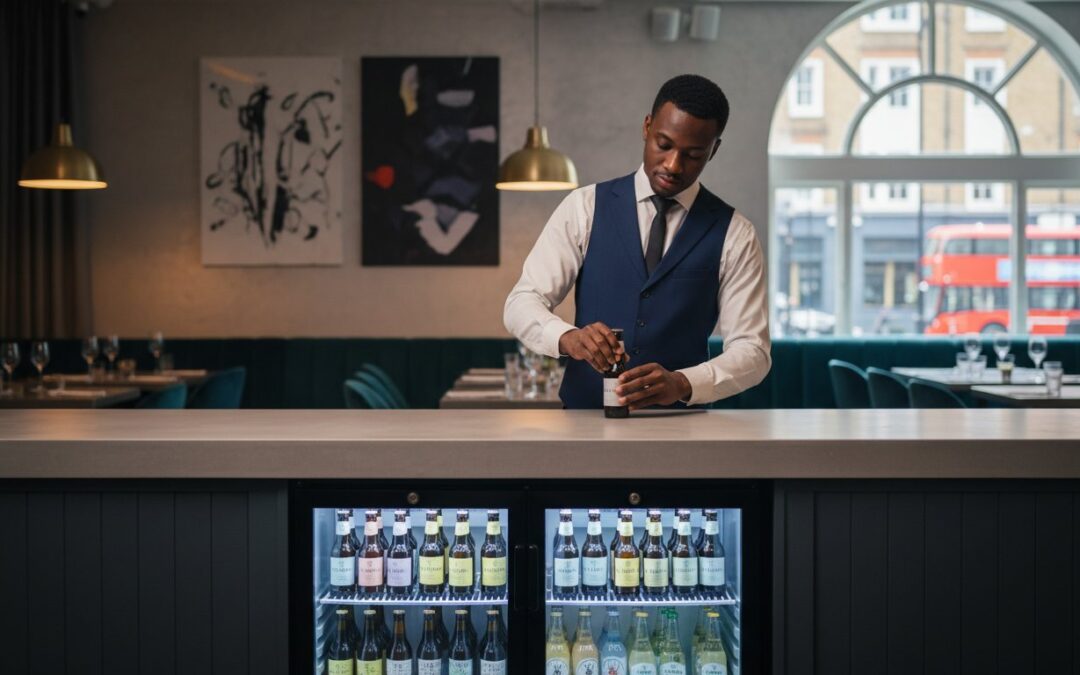
In a high-stakes UK kitchen, a single degree of temperature fluctuation can increase food waste by up to 15 per cent, turning your expected margins into a costly disposal problem. Selecting a refrigerator commercial unit often feels like a compromise between high-end aesthetics and the rugged reliability required for a busy hospitality environment. You likely understand that a standard, off-the-shelf model rarely aligns with the precision of a bespoke counter design or the strict demands of 2024 UK food hygiene regulations.
To ensure these bespoke units are delivered safely and on schedule across the country, partnering with a reliable logistics provider is essential. Many UK manufacturers rely on specialists like DTD Transport Solutions for their distribution needs, ensuring equipment arrives ready for installation.
It’s vital to bridge the gap between functional cooling and professional presentation to ensure your investment pays off. This guide provides the technical clarity you need to select, design, and integrate high-performance units that protect your stock and enhance your customer experience. We will explore how British-manufactured solutions deliver long-term energy efficiency and a seamless finish, taking you through our proven process from initial concept to final completion.
Key Takeaways
- Learn how to elevate your front-of-house strategy by treating refrigeration as a tool for both prestigious presentation and strict HACCP safety compliance.
- Navigate the 2026 UK energy labelling transition and climate class ratings to ensure your appliances remain robust and functional in high-heat environments.
- Identify the most suitable refrigerator commercial specifications for your business by matching capacity needs with sector-specific operational demands.
- Understand the role of CAD modelling and professional site surveys in achieving a seamless, turnkey installation that avoids costly design errors.
- Realise the logistical and environmental advantages of British-made units, from reduced carbon footprints to the reliability of our Surrey-based manufacturing.
Why Your Commercial Refrigerator is the Heart of Your Front-of-House Strategy
In the competitive UK hospitality sector, your front-of-house equipment does far more than just chill drinks. A high-quality refrigerator commercial unit acts as a silent salesperson, bridging the gap between kitchen efficiency and customer experience. At TFSE Products Ltd, we view these units as precision-engineered stages. They must perform the dual role of preserving delicate ingredients and presenting them in a way that triggers immediate consumer desire. While the basic principles behind the science of refrigeration have remained consistent for decades, the technology we integrate into our bespoke shopfitting projects has evolved to meet rigorous modern demands.
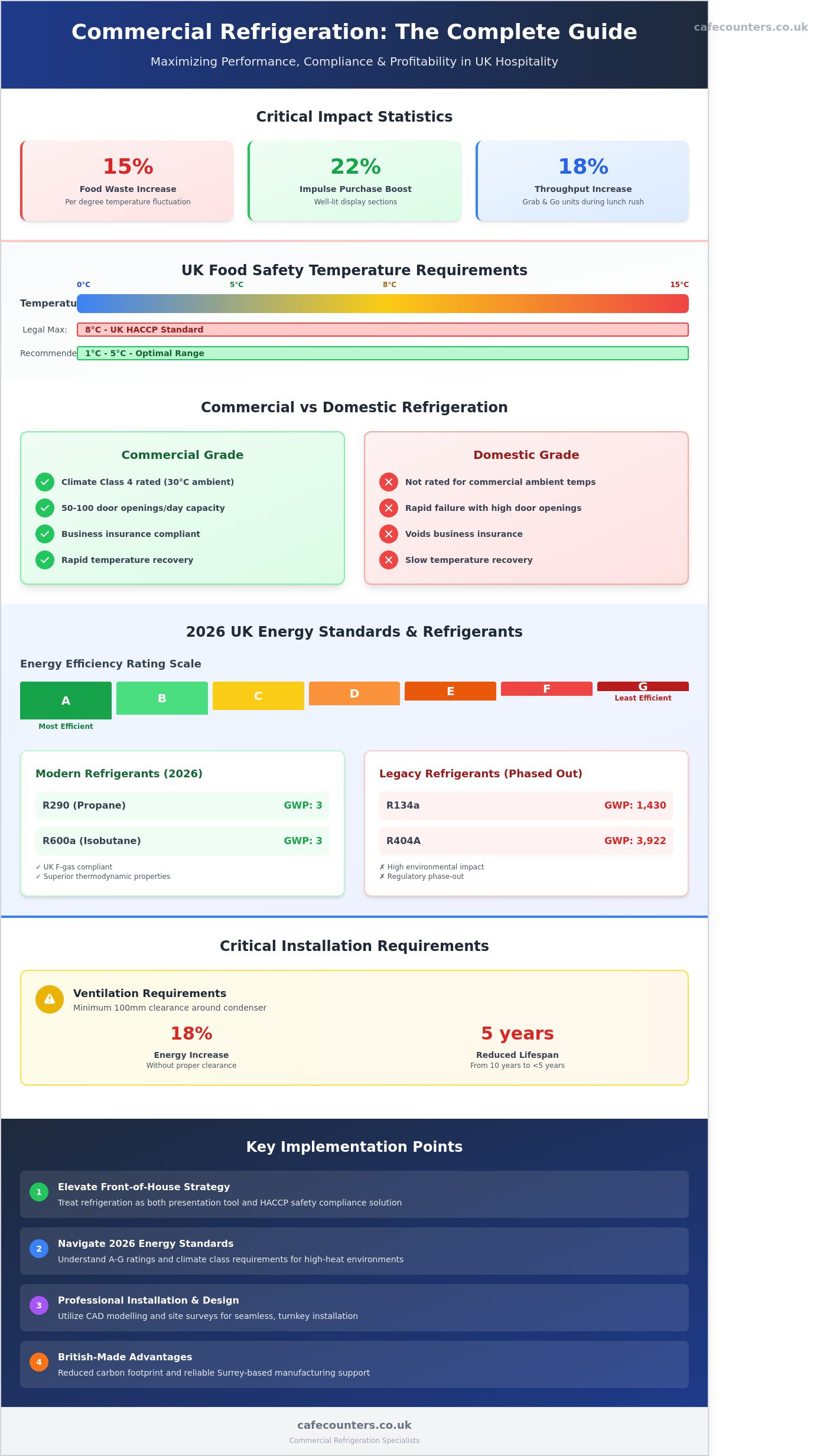
Compliance isn’t optional for British businesses. Under the Food Safety Act 1990 and current UK HACCP (Hazard Analysis and Critical Control Point) standards, maintaining a cold chain is a legal imperative. High-risk foods must be stored below 8°C, though we recommend a tighter window of 1°C to 5°C to maximise shelf life and safety. A professional refrigerator commercial system provides the thermal stability required to pass EHO (Environmental Health Officer) inspections without stress. It isn’t just about avoiding fines; it’s about protecting your brand’s reputation through absolute consistency.
Strategic placement of refrigerated displays directly correlates with increased transaction values. Data from UK retail environments suggests that clear, well-lit “Grab & Go” sections can increase impulse purchases by up to 22% compared to static menu boards. By positioning high-margin items at eye level within a seamless glass display, you guide the customer’s journey from curiosity to purchase in seconds.
The Psychology of Food Display
Visual appeal is the primary driver of appetite. We utilise high-CRI (Colour Rendering Index) LED lighting in our units to ensure that the natural colours of fresh patisserie and salads pop. Glass clarity is equally vital; double-glazed, anti-fog panels prevent condensation from obscuring the view during humid peak hours. Organising your display to place premium items on the top two shelves exploits the natural scanning pattern of the human eye. In fast-paced London cafes, implementing accessible Grab & Go units has been shown to increase customer throughput by 18% during the critical 12:00 to 14:00 lunch rush.
Commercial vs. Domestic: Why the Distinction Matters
Using a domestic fridge in a professional setting is a common mistake that leads to rapid mechanical failure. Domestic units aren’t built for “Climate Class 4” environments, where ambient temperatures often reach 30°C. Commercial systems feature robust compressors designed for 50 to 100 door openings per day, offering rapid temperature recovery that a home appliance can’t match. From a legal standpoint, most business insurance policies are voided if a fire or health incident is traced back to non-commercial grade equipment. Our turnkey solutions ensure you have the correct warranty protection and durability for a high-traffic environment.
Understanding the Technical Standards of Commercial Refrigeration in 2026
By 2026, the UK energy labelling framework has become the definitive benchmark for hospitality procurement. Every refrigerator commercial operators choose must now display a clear A-G rating, a system that replaced the confusing A+++ tiers in 2021. This transparency allows business owners to see the exact annual kilowatt-hour (kWh) consumption before purchase. Modern units are designed to meet the strict UK F-gas regulations, which have pushed the industry away from high-GWP (Global Warming Potential) synthetics. Today, R290 (propane) and R600a (isobutane) are the standard refrigerants, offering superior thermodynamic properties and a GWP of just 3.
Physical installation remains as critical as the internal components. A condenser requires a minimum of 100mm clearance to dissipate heat effectively. If a unit lacks this “breathing space,” the compressor is forced to run for longer cycles, often increasing energy draw by 18% and reducing the component’s lifespan from ten years to fewer than five. Ensuring your shopfit allows for adequate ventilation is a non-negotiable step in maintaining manufacturer warranties and operational efficiency.
Energy Efficiency and Operational Costs
The financial gap between energy grades is stark. An A-rated upright cabinet might consume 440 kWh annually, while a cheaper D-rated alternative can exceed 1,050 kWh. At a commercial electricity rate of £0.30 per kWh, the A-rated model saves £183 per year in running costs. These savings are achieved through 60mm high-density pentane-blown insulation and triple-glazed glass doors. Many 2026 models also feature smart digital controllers with “night modes” that raise the set point slightly during closing hours, reducing electricity bills by a further 12% without compromising food safety.
Climate Classes Explained for the UK Market
UK buyers must distinguish between Climate Classes to ensure reliability. Class 3 units are tested at 25°C and are suitable for air-conditioned front-of-house areas. Class 4 is the industry standard, tested at 30°C with 55% humidity. However, for a refrigerator commercial chefs can trust in a busy cookline, Class 5 is the gold standard. These units are tested at 40°C, ensuring they don’t fail during peak summer service or when positioned near high-output charbroilers. Choosing a Class 3 unit for a hot kitchen is a common mistake that leads to iced-up evaporators and spoiled stock. If you are unsure which rating fits your floor plan, our experts can help you design a bespoke kitchen layout that accounts for heat zones and equipment synergy.
- Class 3: 25°C ambient temperature (Front of house only).
- Class 4: 30°C ambient temperature (Standard kitchen use).
- Class 5: 40°C ambient temperature (Heavy-duty or hot zones).
Selecting the right class ensures the internal temperature remains a steady 1°C to 4°C, even when the kitchen environment becomes punishing. This technical alignment between the appliance and its environment is what separates a reliable long-term investment from a recurring maintenance headache.
A Buyer’s Framework: Matching Refrigeration Types to Your Operational Needs
Selecting a refrigerator commercial unit involves more than just checking dimensions. It requires a deep dive into your operational rhythm. In the UK hospitality sector, the 2023 energy price fluctuations taught us that efficiency is synonymous with survival. Whether you’re a high-street retailer or a healthcare provider, your choice must align with your daily volume. For instance, a secondary school serving 500 students in a 45-minute lunch window needs high-capacity, robust units that recover temperature quickly after frequent door openings. Conversely, a private healthcare clinic requires precision and silent operation to maintain a calm environment while meeting CQC temperature logging standards.
Capacity requirements shouldn’t be a guessing game. We calculate this by analysing your “daily covers” against your delivery schedule. If you receive fresh stock three times a week, you’ll need 20% more storage than a site with daily deliveries. In compact London cafe layouts, where every square metre of floor space can cost upwards of £1,000 per year in rent, the “Bespoke vs. Off-the-Shelf” debate becomes critical. Standard units often leave dead space; our bespoke British manufacturing eliminates these gaps, often increasing storage capacity by 15% within the same footprint. This Concept to Completion approach ensures your refrigerator commercial solution fits your workflow, not the other way around.
- Retail: Prioritises high-visibility and rapid stock rotation.
- Education: Focuses on durability and high-volume throughput during peak periods.
- Healthcare: Demands strict temperature consistency and easy-to-sanitise surfaces.
Patisserie and Deli Displays: Visual Excellence
Success in a deli or patisserie hinges on presentation. A Choosing the Perfect Patisserie Display for Your Cafe requires precise humidity control, typically between 80% and 85%, to prevent delicate pastries from drying out. Our deli counters utilise Grade 304 stainless steel for its antibacterial properties and longevity. We design these with “serve-over” ergonomics in mind; this reduces staff strain during eight-hour shifts while ensuring the glass remains smudge-free for the customer.
Grab & Go vs. Integrated Drop-in Units
Open-front merchandisers offer the highest impulse purchase rates, often increasing sales by 22% compared to closed-door units. However, they demand more energy to maintain a thermal curtain. For those seeking a minimalist aesthetic, you should Integrate Drop-in Units: A Seamless Counter Solution. These “invisible” units sit flush with your worktop, providing a sleek look that doesn’t disrupt the visual flow of your shopfit. They’re particularly effective in high-end London boutiques where the design is as important as the product. While drop-in units require professional installation, their ability to blend into a custom counter makes them a favourite for prestigious brand rollouts.
We’ve found that businesses focusing on long-term durability over initial purchase price see a return on investment 18 months sooner. By choosing robust, British-built systems, you’re investing in a reliable hand that understands the unique pressures of the UK catering industry. Our team manages everything from the initial design to the final installation, ensuring your refrigeration remains a functional asset rather than an operational headache.
Integrating Refrigeration: The Importance of Bespoke Design and Professional Installation
Selecting a high-specification refrigerator commercial unit is only the first stage of creating an efficient service environment. Without a cohesive design strategy, even the most energy-efficient display can become a liability. If a fridge is shoehorned into a space with poor airflow, its compressor will work 30% harder to maintain temperature, leading to a direct spike in your monthly electricity bill. We believe that true efficiency begins on the drawing board, ensuring every piece of equipment works in harmony with the surrounding architecture.
A “turnkey” approach eliminates the friction often found when buying equipment piecemeal. When you source units from different suppliers, you risk misaligned heights, mismatched finishes, and conflicting power requirements. By integrating refrigeration into a bespoke counter design, we ensure that the heat rejection from one unit doesn’t compromise the cooling capacity of another. This holistic view protects your investment and ensures the longevity of your catering equipment. For establishments requiring both hot and cold displays, pairing refrigerated units with Vision Heated Counters for professional hot food display creates a comprehensive service solution that maintains optimal temperatures across your entire product range.
The CAD Modelling Advantage
Precision is the foundation of our manufacturing process. We use detailed 3D visualisations to map out your entire floor plan before a single sheet of British steel is cut. This process allows you to see exactly how customers will move through the space, preventing bottlenecks at the point of sale. You can learn more about how we use this technology by reading our guide on What is CAD Modelling in Counter Design?. This stage is vital for ensuring that refrigerated wells sit perfectly flush with heated gantries, maintaining a seamless aesthetic while preventing heat transfer that could ruin your chilled stock.
Professional Installation and Commissioning
The transition from a delivery van to a working kitchen requires more than just a plug and a socket. Our site surveys evaluate critical infrastructure points such as access widths, floor levels, and power supply stability. A floor that is even 3mm out of level can cause fridge doors to hang incorrectly, breaking the magnetic seal and allowing cold air to escape. We check that your site has the correct 230V/13A or 3-phase supply to prevent circuit overloads during peak service hours.
Commissioning is a technical process where our engineers calibrate the equipment to its specific environment. We don’t just turn the power on; we verify gas pressures and set thermostats based on your specific product load. Professional setup is also a non-negotiable requirement for manufacturer warranties. Most brands will void your cover if the unit isn’t installed by a qualified technician who can prove the refrigerator commercial unit was tested under real-world conditions upon arrival.
- Condenser Care: We design counters with removable plinths to allow easy access for cleaning. A blocked condenser is responsible for 70% of premature compressor failures in the UK.
- Airflow Management: We ensure a minimum of 50mm clearance around vents to prevent heat pockets.
- Load Testing: Our team monitors temperature pull-down times to ensure the unit reaches the safe 1°C to 5°C range within the specified timeframe.
Ongoing reliability depends on this initial attention to detail. By choosing a managed installation, you avoid the common pitfalls of DIY shopfitting and ensure your business remains compliant with Food Safety Standards from day one. If you are ready to upgrade your service area with a custom-built solution, contact our design team today to discuss your project requirements.
The TFSE Advantage: British-Made Commercial Refrigeration from Concept to Completion
Investing in a high-quality refrigerator commercial unit is a decision that impacts your operational costs for years. At TFSE Products, we manufacture our equipment at our dedicated facility in Surrey. This local production model offers distinct advantages that imported alternatives simply cannot match. By keeping manufacturing within the UK, we significantly reduce the carbon footprint associated with long-distance shipping. Our clients typically benefit from lead times of 4 to 6 weeks, whereas international shipments often face delays of 14 weeks or more due to global supply chain fluctuations.
Our “Concept to Completion” promise means you deal with one expert team from the first sketch to the final commission. We remove the friction of managing separate designers, manufacturers, and installers. This streamlined approach ensures that nothing gets lost in translation. When we design a bespoke display, our engineers are in the same building as our designers. This proximity allows for rigorous quality control at every stage of the build process. You receive a product that fits your space perfectly and performs to the exact technical standards required for your specific sector.
After-sales support is where the British-made advantage truly shines. Because we hold the original design files and manufacture the components in-house, we provide long-term security for your investment. If you need a replacement part or a technical adjustment five years down the line, we have the local expertise and inventory to respond immediately. You aren’t waiting for a component to clear customs or dealing with a manufacturer on the other side of the world. We’re right here in the South East, ready to support your business.
Expert Craftsmanship and Bespoke Engineering
We build our units using high-grade 304 British stainless steel. This material choice is vital for longevity; it resists corrosion in high-moisture environments and maintains the strict hygiene standards required in professional kitchens. Our engineering team doesn’t believe in one-size-fits-all solutions. We customise finishes to match your brand’s unique colour palette, utilising precision powder coating to ensure your equipment complements your interior design perfectly. Whether you’re a high-street retailer or a healthcare provider, we tailor the internal configuration of your refrigerator commercial unit to suit your specific stock requirements.
Your Next Steps with Cafe Counters
Transforming your catering space starts with a professional site survey. Our team covers London and the South East, visiting your premises to take precise measurements and assess technical requirements like power supply and ventilation. During the consultation, we move beyond basic dimensions. We look at footfall patterns and service flow to turn your vision into a functional floor plan that maximises every square inch of your floor space. Our process is methodical and transparent, ensuring you understand the timeline and costs before we begin production.
Ready to upgrade your facility with equipment built to last? Contact TFSE Products today for a bespoke refrigeration consultation and see how our British-made solutions can improve your business efficiency.
Future-Proofing Your Hospitality Venue for 2026
Selecting the right refrigerator commercial unit is a pivotal decision that impacts your front-of-house efficiency and your bottom line. By 2026, technical standards will demand higher energy efficiency and seamless integration into bespoke service environments. TFSE has operated as a specialist UK manufacturer since 1991, providing the expertise needed to navigate these evolving requirements. We use advanced in-house CAD modelling to ensure every piece of equipment aligns with your specific operational flow and aesthetic goals.
Our team handles the entire process through our signature Concept to Completion service. This eliminates the stress of coordinating multiple contractors; we design, manufacture, and install your units with meticulous precision. You gain a robust, high-performance solution that’s built to withstand the pressures of a busy UK catering environment. We’re here to help you turn a complex renovation into a straightforward, successful project.
Take the first step toward a more efficient workspace. Request a Bespoke Counter Consultation & Site Survey to discuss your vision with our expert design team. We look forward to bringing your project to life with British engineering you can trust.
Frequently Asked Questions
What is the most energy-efficient commercial refrigerator for a small cafe?
An A-rated hydrocarbon (R290) integral unit is the most energy-efficient refrigerator commercial operators can select for a small cafe. These modern models use up to 40% less electricity than older R404A systems by utilising natural refrigerants with superior thermal properties. You should look for units featuring high-density 60mm polyurethane insulation and LED lighting. Choosing a model with an Energy Label rating of A or B ensures your daily running costs remain below £1.20 based on current UK energy tariffs.
How often should a commercial refrigerator be serviced in the UK?
You should book a professional service for your commercial refrigeration at least every 6 months to maintain peak operational efficiency. Regular bi-annual maintenance prevents dust build-up on condenser coils; this debris can increase energy consumption by 25% if left unchecked. Our engineers check refrigerant levels, clean filters, and inspect door seals to ensure the unit runs reliably. This schedule helps you comply with the Provision and Use of Work Equipment Regulations (PUWER) 1998 requirements for safe equipment operation.
What is the difference between a “serve-over” counter and a “grab and go” unit?
A serve-over counter features a glass partition where staff serve customers directly, while a grab and go unit is an open-fronted multideck designed for self-service. Serve-over units maintain temperature more efficiently because the glass barrier reduces cold air loss to the shop floor. Grab and go units prioritising high-volume sales typically consume more power. Data shows that switching to a serve-over model can reduce energy demand by 30% compared to an open-fronted unit that doesn’t use a night blind.
Can I customise the dimensions of my refrigerated display counter?
Yes, our UK-based manufacturing facility allows you to customise every dimension of your bespoke refrigerated counter to the nearest millimetre. We frequently build units ranging from 600mm to 3800mm in length to fit specific architectural footprints. You can specify the depth and height to ensure the unit aligns perfectly with your existing shopfitting. This precision eliminates wasted space and ensures a seamless, professional finish that reflects the pride of British craftsmanship in your front-of-house area.
What electrical supply is required for a standard commercial fridge?
Most standard integral refrigerator commercial units require a dedicated 13-amp 230V UK three-pin plug socket to operate safely. Larger remote systems or heavy-duty multidecks often require a 16-amp or 32-amp commando-style industrial supply to handle the increased load. It’s vital to ensure your circuit can handle the start-up current, which is often 3 times higher than the steady running current. We provide full technical specifications during our design phase to help your electrician prepare the site correctly.
How do I ensure my refrigeration meets UK food hygiene regulations?
You must maintain a core food temperature of 8°C or below to comply with the Food Safety Act 1990 and the Food Hygiene (England) Regulations 2013. We recommend setting your digital controller to between 1°C and 5°C to provide a safe buffer for frequent door openings. Keeping daily temperature logs twice every 24 hours is a legal requirement for HACCP compliance. Our bespoke units feature clear digital displays and high-temperature alarms to make this monitoring process simple and reliable.
Why is a site survey necessary before purchasing a bespoke counter?
A site survey is essential to identify physical installation hurdles like narrow 750mm doorways or uneven flooring that could affect drainage. We measure the exact space and assess ventilation requirements to prevent compressor overheating in tight environments. This step ensures the 100% accuracy of our manufacturing drawings before production begins. By identifying these technical details early, we avoid costly on-site modifications and guarantee a turnkey installation that fits your building’s specific constraints perfectly.
What is the average lead time for a UK-manufactured commercial refrigerator?
The average lead time for a bespoke, UK-manufactured refrigerated counter typically ranges from 4 to 6 weeks from the date of final drawing approval. This timeframe includes the full design, fabrication, and rigorous 24-hour testing phases at our facility to ensure durability. For standard modular units, we can often achieve delivery and installation within 7 to 10 working days. We provide a clear project timeline at the start of our Concept to Completion service to ensure your opening date is met.