
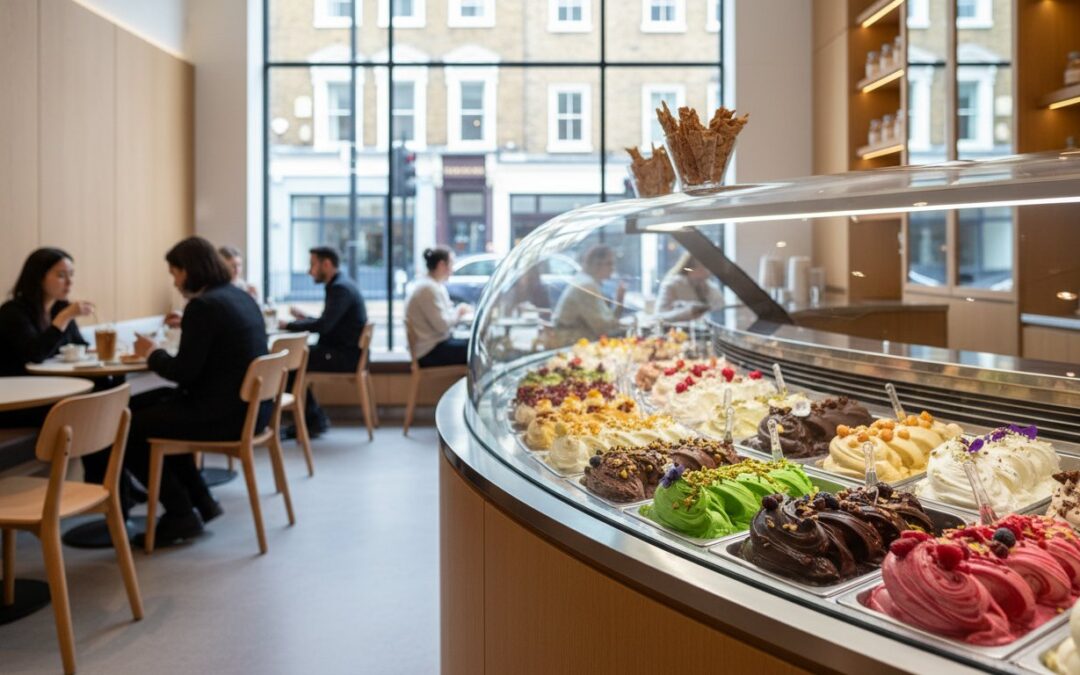
Marco Polo never brought ice cream back from China, and Catherine de Medici didn’t introduce it to France; the true origins of your favourite dessert are far more sophisticated than these popular myths suggest. Many hospitality professionals still struggle to pinpoint exactly when and who invented ice cream, often relying on oversimplified timelines that ignore the vital role of early refrigeration technology. You likely recognize that ice cream is more than just a seasonal treat. It’s a cornerstone of the British high street and a testament to centuries of culinary innovation and British craftsmanship.
We’ll explore the fascinating 2,000-year evolution of this frozen delicacy, moving from ancient Persian snow-chilled treats to the sophisticated, bespoke commercial displays found in modern UK patisseries. This guide provides a clear, myth-busting timeline that tracks the transition from royal luxury to a commercial staple. By understanding this journey from concept to completion, you’ll gain the historical context needed to inspire your next dessert presentation or retail space. We’ll examine how the arrival of the first commercial ice cream plant in 1851 transformed the industry forever.
Key Takeaways
- Trace the 2,000-year evolution of chilled desserts to understand exactly when and who invented ice cream, beginning with ancient Persian engineering and ice-storage yakhchals.
- Debunk the Marco Polo myth and uncover how Italian influence during the Renaissance transformed simple sorbets into the sophisticated royal treats of the French court.
- Discover the rich British heritage of the dessert, from its exclusive debut at King Charles II’s 1671 banquet to the accessible Victorian “Penny Lick” street culture of London.
- Identify the industrial pioneers who standardised textures through the hand-cranked churn and established the first wholesale factories to bring ice cream to the masses.
- Learn how the history of the “visual feast” informs modern standards for deli counters, balancing bespoke British aesthetics with essential thermal efficiency.
The Ancient Origins: Who Really Invented the First Frozen Treat?
Determining exactly when and who invented ice cream requires looking back through two millennia of technological progress rather than searching for a single patent. Ice cream is a culinary evolution rather than a singular event. It’s the result of centuries of refinement in temperature control and ingredient blending. While we often associate the treat with modern refrigeration, the foundational techniques were established by ancient civilisations that mastered the art of harvesting and preserving cold. These early pioneers didn’t just stumble upon frozen desserts; they engineered them through a deep understanding of thermodynamics and seasonal storage.
The Persian Yakhchal and Early Cooling
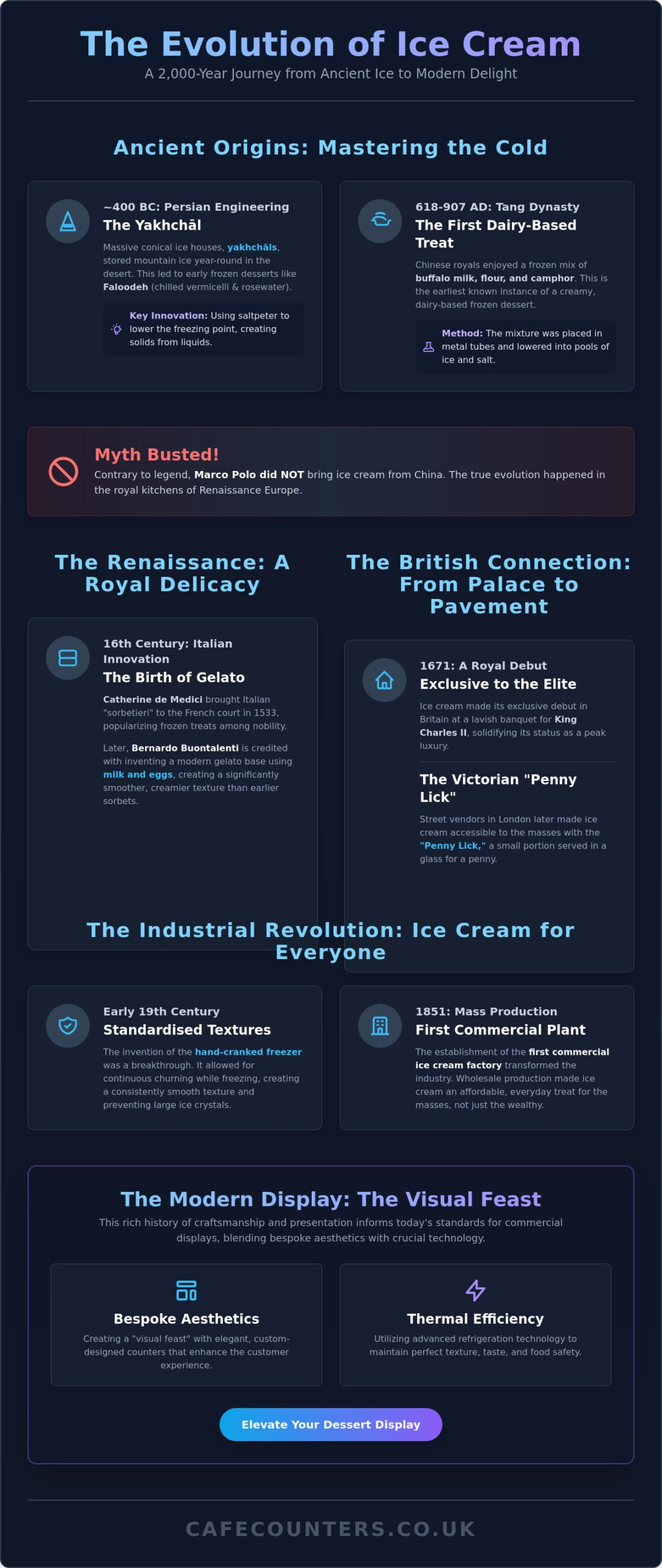
Around 400 BC, Persian engineers developed a robust solution for ice storage in arid climates. They constructed yakhchals, which were massive conical structures designed to keep ice frozen throughout the summer months. These ancient cooling systems allowed them to store ice harvested from nearby mountains or created during cold nights. This technical capability led to the creation of Faloodeh, a dessert made of vermicelli noodles and rosewater chilled with ice. The History of Ice Cream highlights that these early pioneers also understood the chemical properties of cooling. By using saltpeter to lower the freezing point of ice, they moved beyond simple chilled drinks to create structured, frozen solids. This transition from liquid to solid was a critical step in the journey of frozen confectionery, proving that bespoke engineering has always been at the heart of food service.
The Chinese Innovation: Buffalo Milk and Camphor
The Tang Dynasty, spanning from 618 to 907 AD, is frequently cited as the true birthplace of dairy-based frozen treats. Chinese royals enjoyed a sophisticated mixture of buffalo milk, flour, and camphor. The camphor was used for its aromatic qualities and its functional role as a preservative. This recipe represents the first documented instance of a dairy product being frozen for consumption. The process was meticulous, involving the mixture being placed into metal tubes and lowered into pools of ice and salt. These innovative techniques likely travelled along the Silk Road, eventually reaching European markets. When we consider when and who invented ice cream, the Tang Dynasty provides the earliest evidence of the creamy texture we recognise today. Their ability to manage temperature and texture reflects a high level of craftsmanship that mirrors the precision required in modern commercial kitchen design. It shows that even a thousand years ago, the success of a product depended on the quality of the equipment and the skill of the maker.
The European Renaissance: From Sorbets to Royal Gelato
The quest to discover when and who invented ice cream often leads to the popular myth of Marco Polo. Legend suggests the Venetian explorer returned from China in the 13th century with recipes for water ices, yet historical evidence for this is sparse. While Polo’s travels certainly opened trade routes, the true refinement of frozen desserts happened within the high-status kitchens of the Italian Renaissance. This period saw the transition from simple crushed ice with fruit to the sophisticated, dairy-based textures that define modern confectionery.
By the 16th century, the Italian influence on culinary culture became a primary driver of innovation. Catherine de Medici is frequently cited as the catalyst for this change when she moved to France in 1533 to marry Henry II. She brought her personal chefs and “sorbetieri,” who introduced the French court to flavoured ices. This cross-cultural exchange turned frozen treats into a symbol of prestige, though they remained a luxury reserved for the aristocracy due to the immense cost of ice harvesting and storage.
The Italian Influence and the Medici Legacy
Bernardo Buontalenti, a Florentine architect and artist, is the figure most often credited with inventing the modern gelato base. In the late 16th century, he organised a lavish banquet for the Medici family where he served a chilled cream made with bergamot, lemons, and oranges. Unlike the grainy “sorbetto” of the past, Buontalenti’s creation utilised milk and eggs to create a smoother consistency. These recipes were treated as state secrets, guarded by the Renaissance courts to maintain their exclusive status. As noted in The History of Ice Cream, these early European developments were essential for the eventual commercialisation of the product.
France and the Commercialisation of Confections
The transition from private royal indulgence to a public commodity began in 1686 with the opening of Café Procope in Paris. Francesco Procopio dei Coltelli, often called the “Father of Italian Gelato,” established this venue as the first true ice cream parlour. He utilised a refined technique of mixing salt with ice to lower the freezing point, which allowed for a more consistent and reliable production process. This setting changed how desserts were displayed; they were no longer just food but a performance of luxury and engineering.
During this era, the introduction of higher butterfat content and egg yolks transformed the mouthfeel of the dessert. Achieving this level of quality required precision and specialized equipment, a standard we still uphold today when we provide a bespoke service counter for high-end catering environments. By the end of the 17th century, the foundations for the global ice cream industry were firmly in place, moving from the secret laboratories of architects to the bustling cafes of the Parisian elite.
The British Connection: Ice Cream in UK History
The British story of ice cream begins with royal indulgence and extreme scarcity. In 1671, historical archives record that “one plate of ice cream” was served at a Feast of St George banquet for King Charles II. At this time, the treat was exclusive to the Windsor Castle table; it was a luxury that few others in the country could imagine. While historians still debate when and who invented ice cream in its earliest form, its arrival in Britain was a clear mark of prestige and power.
Royal Banquets and the “Ice House” Culture
During the 17th and 18th centuries, serving frozen desserts required immense logistical effort. Wealthy estates constructed subterranean ice houses, which were deep brick-lined pits designed to store blocks of ice harvested from lakes during the winter. This allowed the gentry to enjoy chilled delicacies even in the height of summer. The first printed English recipe for the treat appeared in Mrs. Mary Eales’s Receipts in 1718, providing a glimpse into the kitchens of the elite. The International Dairy Foods Association’s history of ice cream notes that these early versions were often dense and fruit-based, lacking the airy texture we recognize in modern parlours. Understanding when and who invented ice cream helps us appreciate the technological leaps made since those early royal banquets.
The Victorian Street Trade and Hygiene Reforms
By the mid-1800s, ice cream moved from palaces to the pavement. Italian immigrants, often called “Hokey Pokey” men after the phrase O che poco (oh how cheap), sold small portions for a penny. These were served in “Penny Licks”, which were small glass cups that customers licked clean before returning them to the vendor. However, these glasses were rarely washed properly, posing a significant risk to public health. This led to the eventual rise of the edible wafer cone as a more sanitary alternative.
As hygiene standards improved throughout the early 20th century, the British dairy industry scaled up production to meet the demand of seaside holidaymakers. This transition required more sophisticated storage and presentation methods to maintain food safety. Modern businesses now rely on high-specification patisserie display counters to ensure products remain at precise temperatures while attracting customers. This evolution from the unhygienic street trade to the bespoke, ergonomic installations used today reflects a broader commitment to quality and durability in the UK hospitality sector. The shift from simple ice houses to precision-engineered cooling systems ensures that the British love affair with frozen treats continues to thrive in a professional, commercial environment.
The Industrial Revolution: Engineering the Modern Dessert
The 19th century transformed ice cream from an elite delicacy into a democratic treat. While earlier eras focused on laborious manual methods, the 1840s introduced engineering precision. In 1843, Nancy Johnson patented the hand-cranked churn, a device that utilised a central dasher to aerate the mixture. This innovation solved the problem of inconsistent, icy textures; it set the stage for anyone asking when and who invented ice cream in its modern, creamy form. Her design was so effective that it remains the blueprint for manual churns used today.
Jacob Fussell took this mechanical foundation and scaled it for the masses in 1851. Often called the “Father of the Ice Cream Industry,” Fussell was a Baltimore milk dealer who found himself with a surplus of cream. Rather than wasting the product, he opened the first wholesale ice cream factory. This move shifted production from the back of small shops to a centralised, industrial process. By 1900, the rapid development of mechanical cooling systems meant the industry no longer relied on the unpredictable natural ice trade, allowing for year-round production and stable pricing.
Hand-Cranked Churns vs. Industrial Factories
The shift from manual pot-freezing to steam-powered manufacturing changed everything for the UK hospitality sector. Manual production was slow and yielded small batches that were difficult to keep consistent. In contrast, Fussell’s factory model introduced scale, hygiene, and rigorous quality control. Mass production lowered costs significantly, making ice cream a staple across all social classes rather than just the Victorian upper crust. This era also saw the rise of the soda fountain, which became a central feature in commercial spaces, driving the early commercialisation of frozen desserts. While ancient origins are debated, the question of when and who invented ice cream as a commercial powerhouse is firmly answered by these 19th-century industrial leaps.
The Birth of Mechanical Refrigeration
Reliable cooling was the final piece of the engineering puzzle. Carl von Linde’s development of the ammonia compressor in the 1870s laid the groundwork for modern food safety and storage. This technology allowed businesses to maintain constant, sub-zero temperatures, which revolutionised how we use commercial refrigerators in professional kitchens. We’ve moved from simple cold storage to sophisticated units like Vision Heated Counters and precision cooling displays. These advancements ensure that products remain at the perfect serving temperature, protecting both the texture of the dessert and the operator’s profit margins. Modern units now offer the same reliability that early pioneers like von Linde could only imagine.
If you’re planning a high-end fit-out for your catering business, you need equipment built with the same precision that defined the Industrial Revolution. Explore our range of bespoke shopfitting and refrigeration solutions to elevate your space.
The Modern Display: How History Informs Today’s Cafe Standards
The journey from ancient snow-chilled delicacies to the modern gelato parlour represents a massive shift in how we consume food. While the debate over when and who invented ice cream often leads back to 16th-century Italy or 17th-century France, the focus for today’s business owner is the “visual feast.” In a competitive UK market, the presentation of a frozen treat is now just as vital as the secret recipe itself. Modern consumers expect an experience that begins the moment they step through the door, where the history of the product is reflected in a premium setting.
Achieving this requires a delicate balance between historical charm and 2026 technical standards. While historians pinpoint when and who invented ice cream to explain its cultural rise, TFSE Products focuses on the engineering required to preserve that legacy. High-performance deli counters and patisserie units must provide a stable thermal environment, usually maintaining temperatures between -14°C and -18°C, while ensuring absolute glass clarity. British craftsmanship plays a pivotal role here, as bespoke units are designed to withstand the rigours of high-footfall environments without compromising on the sleek, high-end aesthetic that defines luxury brands.
Aesthetics and Ergonomics in Counter Design
The evolution from 19th-century street carts to modern bespoke cafe counters shows a clear trend toward transparency and lighting. Research indicates that approximately 70% of retail purchase decisions are made at the point of sale, making visibility essential. We use low-iron glass to eliminate the green tint found in standard glazing, ensuring the product’s natural colours pop under LED arrays with a high Color Rendering Index (CRI). These counters respect the heritage of the product while utilizing advanced airflow technology to prevent ice crystal formation on the display surface.
Concept to Completion: Building Your Own Legacy
Choosing a UK-based manufacturer like TFSE Products provides a level of quality control that imported units simply cannot match. Our process utilizes precise CAD modelling to integrate cooling systems into unique architectural spaces, ensuring every millimetre is functional. This Concept to Completion service removes the stress from commercial renovations by managing everything from the initial design to the final installation. We handle the technical complexities of refrigeration and ergonomics, allowing you to focus on the legacy of your brand. If you’re ready to elevate your food service environment, contact TFSE Products to design your bespoke food display today.
Elevating Your Service with Historic Precision
From the ancient snow-chilled delicacies of the East to the 17th-century banquets of King Charles II, the evolution of frozen desserts is a story of constant technical refinement. Understanding when and who invented ice cream highlights how far refrigeration has come, moving from simple ice pits to the precision-engineered systems used in modern retail. At Cafe Counters, we’ve been upholding these standards of excellence since 1991, focusing on British manufacturing that prioritises durability and operational efficiency.
Our team employs in-house CAD modelling and the latest energy-efficient refrigeration technology to create bespoke environments for UK hospitality businesses. We offer a Concept to Completion service that handles every detail of your project, ensuring your retail space is both robust and visually stunning. Whether you’re a high-street retailer or a prestigious healthcare provider, we provide the technical expertise needed to bring your vision to life. Explore our range of British-made bespoke cafe counters to find a solution that blends traditional craftsmanship with modern performance. We’re ready to help you create a space where history and innovation meet.
Frequently Asked Questions
Who is officially credited with inventing ice cream?
No single individual holds the official title for inventing ice cream, as its evolution spans several centuries and cultures. Records from China’s Tang Dynasty between 618 and 907 AD describe a frozen mixture of buffalo milk, flour, and camphor. While people often ask when and who invented ice cream, the modern dairy version we recognize today was refined by European confectioners during the 17th century.
When was the first ice cream parlour opened?
The first dedicated ice cream parlour opened in New York City in 1790, established by an Italian confectioner named Giovanni Bosio. Before this commercial milestone, Francesco Procopio dei Coltelli began serving frozen treats at Café Procope in Paris in 1686. These early establishments transformed ice cream from an elite luxury into a commercial product, setting the stage for the vibrant high-street dessert culture we design for today.
Did Marco Polo really bring ice cream to Europe?
Historians generally consider the story of Marco Polo bringing ice cream recipes from China to Italy in 1295 a myth. While he likely encountered chilled desserts during his travels, no contemporary 13th century records confirm he introduced them to Europe. The popularisation of frozen treats in the West more likely occurred through trade routes with the Arab world, where chilled sherbets were already a staple.
When was the ice cream cone invented?
The ice cream cone was officially patented by Italo Marchiony in December 1903, though it gained global fame at the 1904 St. Louis World’s Fair. During that event, Ernest Hamwi, a Syrian concessionaire, rolled waffles into cones to help an ice cream vendor who had run out of glass dishes. This innovation revolutionized the portable food industry and remains a fundamental element of modern kiosk and cafe design.
What was the first flavour of ice cream ever made?
The earliest recorded flavours were honey and fruit syrups used to sweeten snow in the Roman Empire during the 1st century. In China’s Tang Dynasty, a mixture of buffalo milk and camphor provided a distinct, aromatic profile for frozen desserts. Vanilla didn’t become the dominant flavour until the late 1700s, after Thomas Jefferson discovered the recipe in France and brought it back to the United States in 1789.
How did they keep ice cream frozen before electricity?
Before the advent of mechanical refrigeration in the late 19th century, ice cream was kept frozen using ice houses and the endothermic property of salt. Harvesters cut blocks of ice from frozen lakes in winter and stored them in insulated underground pits lined with straw. By mixing this ice with salt, confectioners could lower the freezing point enough to harden the cream in hand-cranked metal canisters.
Why is ice cream so important to the history of the British high street?
Ice cream is central to British retail history because it democratised luxury on the high street during the 1850s. Italian immigrants, particularly in London and Glasgow, sold “penny licks” from barrows, making frozen treats accessible to the working classes. This movement laid the foundation for the bespoke ice cream parlours and milk bars that remain iconic, prestigious fixtures of British seaside towns and urban centres today.
When did ice cream become affordable for the general public?
Ice cream became affordable for the general public in 1851 when Jacob Fussell established the first wholesale factory in Baltimore. This industrialisation dropped prices significantly by moving production away from small, labor-intensive batches. By the early 20th century, technological advancements in British manufacturing allowed vendors to serve consistent, high-quality products at a price point accessible to every family on a weekend outing.