
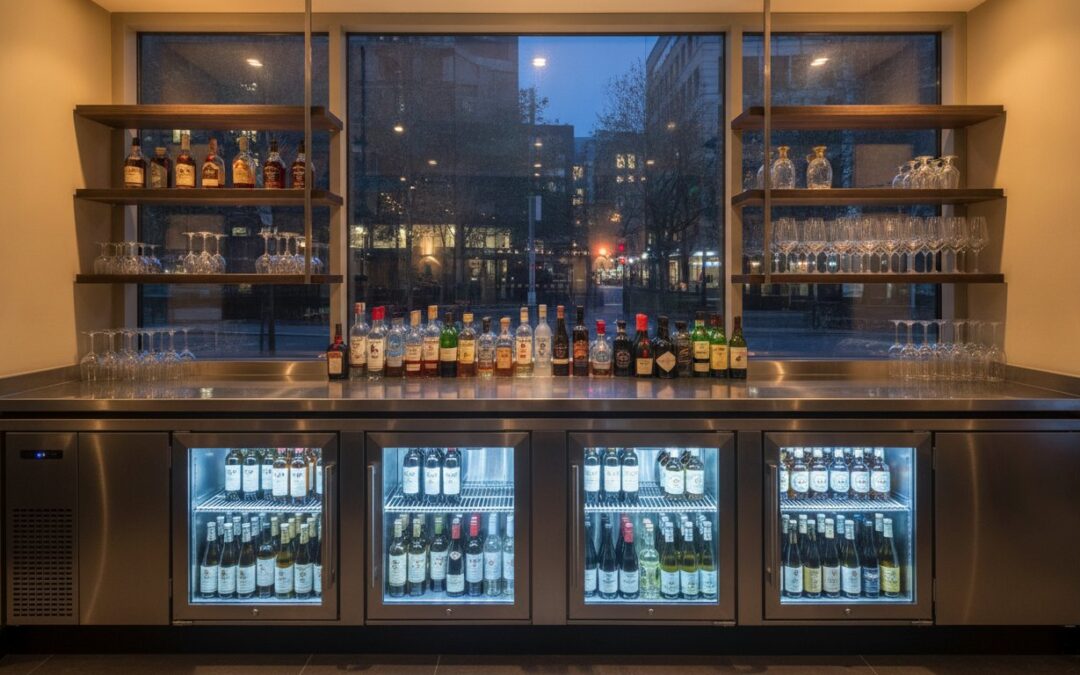
A cluttered back bar isn’t just a visual mess; it’s a direct leak in your Friday night profits. Most operators understand the stress of running out of cold storage during peak hours or dealing with failing equipment due to poor ventilation. Effective back bar design with bottle coolers isn’t simply about filling gaps with fridges. It’s about engineering a professional stainless steel ecosystem that prioritises both thermal efficiency and bartender ergonomics.
We understand that a seamless workflow is the backbone of any successful venue, from regional pubs to high-end commercial spaces. You want a layout that feels intuitive, where every bottle is within reach and every cooler operates at peak performance without cluttering the workspace. In this guide, we’ll show you how to integrate high-performance cooling into a bespoke design that enhances your aesthetics and profitability. We will walk through the technical requirements for UK hygiene standards, the benefits of precision stainless steel fabrication, and the specific layout strategies that keep your service moving fast.
Key Takeaways
- Learn how to manage ventilation and airflow within your counters to prevent compressor burnout and ensure long-term equipment reliability.
- Master the principles of back bar design with bottle coolers to create an ergonomic “Golden Triangle” that accelerates speed of service during peak hours.
- Understand the critical dimension differences between standard and slimline units to optimise your storage capacity without compromising floor space.
- Discover why food-grade stainless steel is the essential material for resisting moisture and acidity while meeting rigorous UK hygiene standards.
- Explore the benefits of a bespoke manufacturing process, from initial CAD modelling to professional installation, for a precision-engineered bar environment.
The Fundamentals of Back Bar Design with Bottle Coolers
The back bar serves as the nerve centre of any high-volume hospitality venue. It isn’t merely a storage area for drinks; it represents the primary merchandising tool at your disposal. A well-executed back bar design with bottle coolers ensures that your highest-margin products remain visible while maintaining the rapid speed of service required during peak trading. When we consider bar design fundamentals, the back bar must balance the “show” of premium spirits with the “go” of chilled bottled beverages.
In the UK pub and bar market, which is projected to reach £24.9 billion by 2026, competition is fierce and margins are tight. Customers expect more than just a drink; they want an experience that feels professional and curated. Professional back bar design directly influences customer spend by presenting options clearly and attractively. If a bartender has to hunt for a bottle in a cluttered, poorly lit cooler, the rhythm of service breaks. This leads to frustrated staff and lost revenue during those critical “power hours” of a shift.
Defining the Modern Back Bar Environment
Maximising visual impact requires a thoughtful mix of vertical and horizontal displays. While spirit bottles often dominate eye-level shelving, bottle coolers provide the foundational layer of the back bar. We use integrated lighting to highlight premium stock, turning a functional fridge into a high-end display case. The back bar is the critical intersection of refrigeration and retail display. Utilising 304-grade stainless steel ensures these areas remain hygienic and durable against the daily rigours of a busy commercial environment. This material choice isn’t just about looks; it’s about a surface that withstands moisture and heavy use for years.
Why Integrated Bottle Coolers Outperform Standalone Units
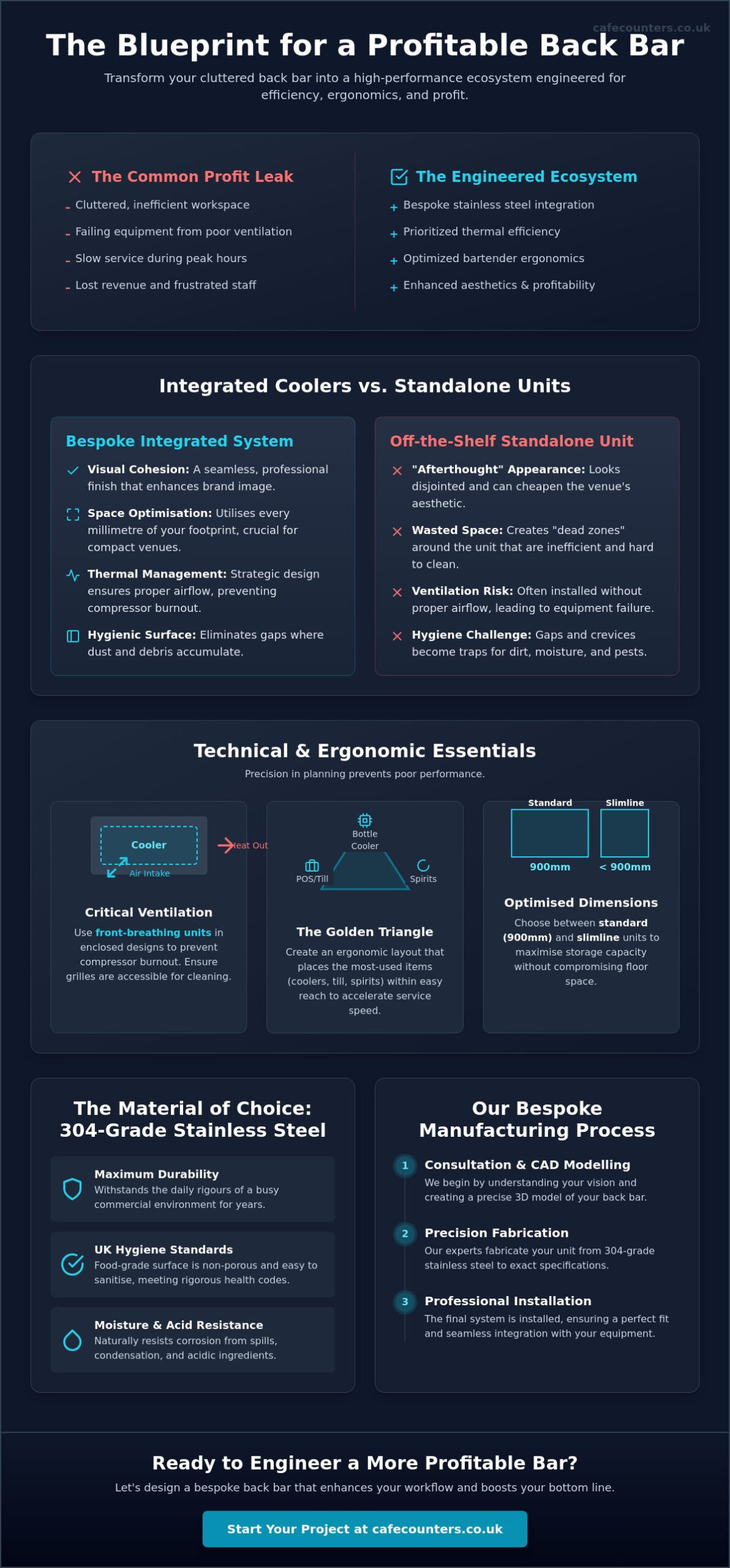
Standalone units often create “dead zones” where dust and debris accumulate, making hygiene maintenance difficult and time-consuming. Our bespoke stainless steel back-bar units eliminate these gaps, creating a seamless, professional finish that enhances the overall aesthetic of your venue. This integrated approach offers several practical advantages:
- Visual Cohesion: Bespoke surrounds ensure that equipment looks built-in rather than like an afterthought, reinforcing a premium brand image.
- Space Optimisation: Custom fabrication allows us to utilise every millimetre of your footprint. This is vital in compact urban venues where floor space is at a premium.
- Thermal Management: Strategic housing design facilitates proper airflow. This is essential to prevent compressor burnout and extend the life of your equipment by allowing heat to escape efficiently.
By integrating coolers directly into the counter structure, we also reduce the ambient noise and heat felt by both staff and customers. It’s a methodical approach to back bar design with bottle coolers that prioritises long-term operational efficiency over temporary fixes.
Technical Requirements for Commercial Bottle Cooler Integration
Precision is the hallmark of any successful commercial installation. When planning your back bar design with bottle coolers, the first technical hurdle is often the physical footprint. Standard double-door units typically measure 900mm in width, while slimline alternatives cater to the narrower footprints common in heritage UK pubs. Selecting the right dimensions isn’t just about fitting the unit into a gap. It’s about ensuring an ergonomic bar layout that doesn’t impede the bartender’s movement during a busy shift.
Ventilation and Heat Dissipation Standards
Ventilation remains the most overlooked aspect of integrated refrigeration. If you house a cooler within a bespoke counter without adequate airflow, the compressor will work overtime, leading to premature failure. Front-breathing units are the gold standard for enclosed designs because they draw in and expel air from the front grille. We always recommend incorporating removable grilles into the counter design to allow for easy condenser cleaning. Neglecting this simple maintenance task can cause a significant spike in electricity consumption as the system struggles to shed heat. Poorly ventilated coolers are a primary cause of compressor burnout, a costly repair that is entirely avoidable with meticulous planning.
Capacity Planning for Peak Trade
Capacity planning must account for your busiest Friday night, not your quietest Tuesday. While single-door units work well for niche products or low-alcohol options, high-traffic venues usually require triple-door configurations to maintain service speed. For environments with high self-service demand or retail elements, integrating refrigerated grab and go display units can divert traffic away from the main service point. This reduces congestion and allows your staff to focus on complex drink orders.
Compliance with UK sustainability goals and food safety regulations is essential. Since January 1, 2025, the use of virgin HFC refrigerants with a GWP of 2,500 or more, such as R404A, has been prohibited for servicing. When we specify equipment, we ensure your coolers use modern, low-GWP refrigerants that meet current F-Gas regulations. This protects your investment and ensures your stock is kept at the 0°C to 5°C target recommended by the Food Standards Agency for optimal safety and quality.
Infrastructure requirements like power sockets and drainage for condensate must be plotted before the counter arrives on site. This methodical approach prevents costly modifications during the installation phase. If you’re looking to upgrade your venue, our team can help you select the right equipment specifications to ensure your new layout operates with total reliability.
Ergonomics and Workflow: Designing for the Bartender
Bartending is a physical discipline that requires precision under pressure. If your staff spend their shift dodging each other or overstretching to reach stock, your service speed inevitably drops. A professional back bar design with bottle coolers prioritises the bartender’s physical journey through what we call the ‘Golden Triangle’. This concept links the three most frequented points: the till, the glass storage, and the bottle coolers. By positioning these elements in a tight, logical sequence, you eliminate wasted movement and reduce staff fatigue.
To minimise physical strain and maximise efficiency, we recommend a workspace of 31 to 37 inches between the front and back bar. This specific clearance, based on established industry ergonomic standards, allows for safe, fluid movement without forcing staff to take unnecessary steps. Repetitive strain is a significant risk in hospitality; therefore, the height of under-counter coolers must align with a natural reach to prevent constant stooping or over-extension during a ten-hour shift.
When choosing equipment, the door configuration is a critical decision that impacts the entire workflow. In narrow walkways, sliding doors are often superior because they don’t obstruct the path of other staff members when open. In wider environments, hinged doors might be preferred for their robust thermal seal and ease of access for restocking. Every choice should aim to reduce ‘travel time’, ensuring your team spends more time engaging with customers and less time navigating a poorly planned floor.
Optimising the Reach and Pour Cycle
The ‘reach and pour’ cycle is the heartbeat of your service. High-volume sellers should always occupy eye-level shelves within the coolers to ensure they’re the first thing a bartender sees. Integrating glass frosters and ice wells directly adjacent to your bottle storage creates a self-contained station that limits lateral movement. Shaving just two seconds off the service time for every drink poured can translate into significant additional revenue across a high-volume weekend shift. This level of detail in your back bar design with bottle coolers separates a functional bar from a high-performance one.
Safety and Hygiene in the Back Bar Zone
Safety is non-negotiable in a fast-paced commercial environment. We utilise non-slip surfaces and precision stainless steel fabrication to ensure the back bar is both safe to navigate and easy to sanitise. For venues that serve fresh garnishes or small plates alongside drinks, we often integrate deli counter principles into the layout. This ensures that perishable ingredients are kept at the correct temperatures, between 0°C and 5°C, while remaining immediately accessible. Our methodical approach ensures that these practical requirements never clash with your aesthetic vision.
Materials and Durability: The Case for Stainless Steel
While some designers favour the warmth of wood or the shine of copper, these materials often fail the test of time in a high-moisture environment. A robust back bar design with bottle coolers relies on materials that can withstand the daily assault of heavy glassware, constant moisture, and the high acidity of citrus spillages. Type 304 food-grade stainless steel remains the industry standard because it’s non-porous, incredibly durable, and naturally resistant to corrosion. It doesn’t just look professional; it provides a level of structural integrity that modular, “off-the-shelf” solutions simply can’t match.
The longevity of bespoke fabrication is a primary factor in long-term profitability. While the raw material cost for Type 304 stainless steel is approximately three times that of standard carbon steel, the return on investment is found in its lifespan. A well-manufactured counter won’t warp, stain, or harbour odours over years of intensive use. Maintenance is equally straightforward. A simple cleaning routine with appropriate solutions keeps the surface looking new, ensuring your venue always meets the high visual standards your customers expect.
Hygiene Standards and Food Safety Compliance
Meeting UK Environmental Health requirements is a non-negotiable part of bar management. We focus on eradicating bacteria traps through precision engineering techniques like seamless welding and coved corners. These rounded internal edges prevent the accumulation of grime and spillages in hard-to-reach areas. By utilising high-grade UK-sourced steel for all projects, TFSE Products Ltd ensures that every unit adheres to the strictest hygiene standards. This methodical approach to construction provides bar owners with total peace of mind during inspections.
Aesthetic Versatility of Metal Fabrication
Stainless steel doesn’t have to mean a clinical or industrial aesthetic. Modern fabrication allows for incredible visual variety. We can apply powder coating or specialised cladding to ensure your equipment matches your brand’s specific colour palette. For venues looking to create a sense of depth and luxury, we integrate glass shelving and mirrored back-panels. These elements reflect light and highlight your premium bottle stock, making the back bar a true focal point of the room.
This focus on a refined brand image is what draws in discerning clientele who appreciate quality in every detail, whether it is the design of your bar or the luxury ground transportation they use, such as jafexecutivetravels.com, to arrive at your venue.
Bespoke manufacturing also grants the freedom to move beyond rectangular layouts. Whether your venue requires curved counters to follow a building’s architecture or angled sections to fit a tight corner, our internal production facilities can bring those unique shapes to life. If you’re ready to invest in a workspace that combines artisanal pride with practical durability, explore our range of Stainless Steel Back-bar Units to see how we can transform your service area.
Designing Your Bespoke Back Bar with TFSE Products Ltd
Many operators treat the purchase of refrigeration and the construction of the bar counter as two separate tasks. This disjointed approach often leads to the ventilation issues and ergonomic bottlenecks we’ve discussed in previous sections. Our approach to back bar design with bottle coolers is different. TFSE Products Ltd provides a comprehensive, end-to-end service that views the back bar as a single, high-performance machine. By integrating specific refrigeration brands directly into our custom-built stainless steel housings, we ensure every unit has the precise clearance it needs to breathe and perform at peak efficiency.
Our internal production facilities are the heart of our operation. Based in the UK, we maintain total quality control over every weld, fold, and finish. This geographic proximity doesn’t just guarantee artisanal excellence; it significantly reduces lead times compared to imported modular units. We begin every project with a detailed site survey. This technical planning stage is vital for a “first-time” fit, accounting for existing plumbing, electrical points, and floor levels before manufacturing commences. It is the steady, methodical pace of our process that ensures a reliable hand in even the most complex commercial environments.
The Power of CAD Modelling in Bar Planning
Visualising a workflow is difficult on a flat floor. Our design team uses CAD modelling to create a virtual twin of your bar environment. This allows you to walk through the layout before a single piece of steel is cut. It’s a collaborative process where we refine your vision; we ensure that glass storage, till points, and bottle coolers are exactly where they need to be for maximum efficiency. Precision engineering at this stage eliminates costly on-site errors and ensures the final physical space matches the initial concept. You gain the confidence that your Stainless Steel Back-bar Units will perform exactly as intended from the moment they are installed.
Installation and Commissioning Across the UK
The journey from a broad concept to a finished space ends with professional installation and commissioning. Our team doesn’t just drop off equipment. We integrate every component into the fabric of your building, ensuring that all refrigerated units meet manufacturer specifications once they’re in place. This includes verifying airflow and testing temperature pull-down times to meet UK hygiene standards. TFSE Products Ltd positions itself as your Expert Partner, handling the technical complexities so you can focus on running your business. If you’re ready to elevate your venue with a workspace built for speed and durability, Contact TFSE Products Ltd for a bespoke back bar consultation today.
Elevate Your Service Standards with Precision Engineering
A high-performance bar environment is the result of meticulous planning and a deep understanding of the unique pressures within the hospitality sector. Throughout this guide, we’ve examined how technical precision in ventilation and the ergonomic “Golden Triangle” are essential for maintaining speed during peak trade. By choosing durable materials and bespoke integration, you ensure your investment meets rigorous UK hygiene standards while resisting the daily wear of a high-volume venue. A professional back bar design with bottle coolers isn’t just about refrigeration; it’s about creating a seamless ecosystem where your staff can excel and your inventory is presented with artisanal pride.
Since 1991, TFSE Products Ltd has operated as a dedicated UK manufacturer, providing the technical expertise required to bring complex commercial visions to life. Our process combines in-house CAD design and engineering with a national installation and commissioning service, ensuring total quality control from the initial survey to the final fit. We invite you to design your perfect back bar with TFSE Products Ltd and secure a layout that prioritises both long-term durability and operational excellence. Let’s work together to build a workspace that truly reflects the quality of your brand.
Frequently Asked Questions
What is the best depth for a back bar with bottle coolers?
The optimal depth for a back bar counter is typically between 600mm and 650mm. This dimension comfortably accommodates standard commercial refrigeration while providing ample surface area for spirit displays and drink preparation. If you are working within a restricted footprint, slimline units allow for a shallower counter depth of around 500mm. We always verify these measurements during the CAD modelling phase to ensure a precision fit for your specific inventory.
Do I need a special floor for heavy commercial bottle coolers?
You must ensure your flooring is level and capable of supporting the significant weight of fully stocked refrigeration. A double-door cooler can weigh over 200kg when loaded with glass bottles, which can cause floor compression over time if the surface is unsuitable. We recommend a reinforced, non-slip floor finish that meets UK health and safety standards. This prevents units from shifting and ensures that doors remain properly aligned for an airtight thermal seal.
Can I use sliding doors on my bottle coolers in a narrow bar?
Sliding doors are the preferred choice for narrow bars where hinged doors would obstruct the bartender’s movement. They allow for full access to the inventory without encroaching on the clearance recommended for an ergonomic workflow. While hinged doors are traditional, modern sliding door technology is highly efficient and significantly improves the speed of service in tight spaces. This choice is a key consideration in any professional back bar design with bottle coolers.
How much ventilation space do under-counter bottle coolers need?
Under-counter bottle coolers generally require a minimum of 50mm clearance at the rear and sides if they are not front-breathing models. Proper airflow is critical to prevent the compressor from overheating and failing prematurely. When we execute a back bar design with bottle coolers, we often incorporate custom-fabricated grilles into the stainless steel counter. This allows heat to dissipate effectively while keeping the machinery hidden from the customer’s view.
Is stainless steel or wood better for a back bar counter?
Stainless steel is the superior choice for any professional back bar due to its non-porous nature and resistance to corrosion. While wood offers a traditional aesthetic, it is prone to warping and harbouring bacteria when exposed to the constant moisture and citrus acidity of a bar environment. Our bespoke stainless steel back-bar units provide the structural integrity required for heavy commercial use while remaining easy to sanitise according to UK hygiene regulations.
Can you integrate existing coolers into a new bespoke back bar?
We can certainly integrate your existing refrigeration into a new bespoke layout. Our technical team takes precise measurements of your current units during the initial site survey to ensure the new stainless steel housings fit perfectly. This approach allows you to upgrade your bar’s aesthetic and workflow without the immediate expense of replacing functional equipment. We simply ensure the new design provides the necessary ventilation and power access for your specific models.
What are the UK regulations for bar refrigeration hygiene?
UK regulations require chilled beverages to be stored at 8°C or below, though the Food Standards Agency recommends a target of 0°C to 5°C for optimal safety. Additionally, businesses must comply with F-Gas regulations regarding the maintenance and sourcing of refrigerants. All professional installations must facilitate easy cleaning to prevent bacteria accumulation. Our designs utilise coved corners and seamless welding to help you meet these Environmental Health requirements with total confidence.
How long does a bespoke back bar installation typically take?
A typical back bar installation takes between one and three days on-site, depending on the complexity of the project. This follows several weeks of precision manufacturing in our UK facility. Because we use CAD modelling to identify potential issues early, the physical installation is a methodical and efficient process. We aim to minimise downtime for your venue by ensuring every component is ready for immediate commissioning upon arrival.