
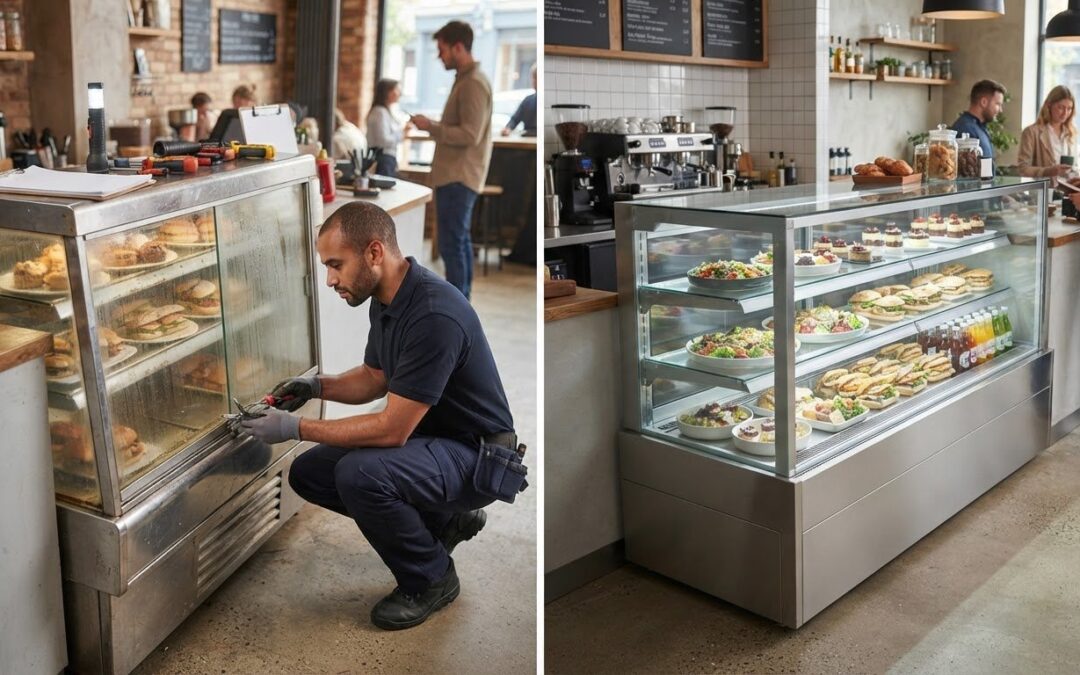
The lowest purchase price can become the costliest refrigeration choice. In the used vs new commercial refrigeration UK decision, a second-hand unit may reduce the initial outlay, but its condition, remaining service life and likely repair needs can be difficult to judge. If it fails, service and stock may be at risk.
It’s understandable to focus on the price tag, especially when budgets are tight. A fair comparison also considers energy use, maintenance, replacement risk and whether the equipment suits your space and service style. New equipment isn’t automatically the right answer, but it may offer a better fit and a clearer route through planning, installation and commissioning.
This guide compares used and new refrigeration against the same operational needs. You’ll find practical checks to make before buying a used unit, from its condition and service history to its refrigerant and energy information. Where a standard second-hand display won’t meet your requirements, a bespoke counter designed and manufactured in the UK may be planned around your site and display needs.
Key Takeaways
- Compare used and new options against the same operational needs, including delivery, installation, servicing, energy use and possible downtime.
- In the used vs new commercial refrigeration UK decision, treat a refurbished claim as something to verify, not proof of condition or remaining service life.
- Before considering a used unit, confirm its identity, documented age, service history and reason for sale, then arrange an appropriate inspection.
- Choose used equipment only when its condition and fit are supported by evidence. Consider new when your project needs greater control over specification.
- For a food display project, account for the footprint, service style and site requirements, especially if a standard unit won’t suit the space.
Used vs New Commercial Refrigeration in the UK: What Should You Compare First?
Used equipment may cost less upfront; new equipment can offer more control over its fit, specification and buying support. The right choice depends on your operation, what the site can accommodate and how disruptive a failure would be.
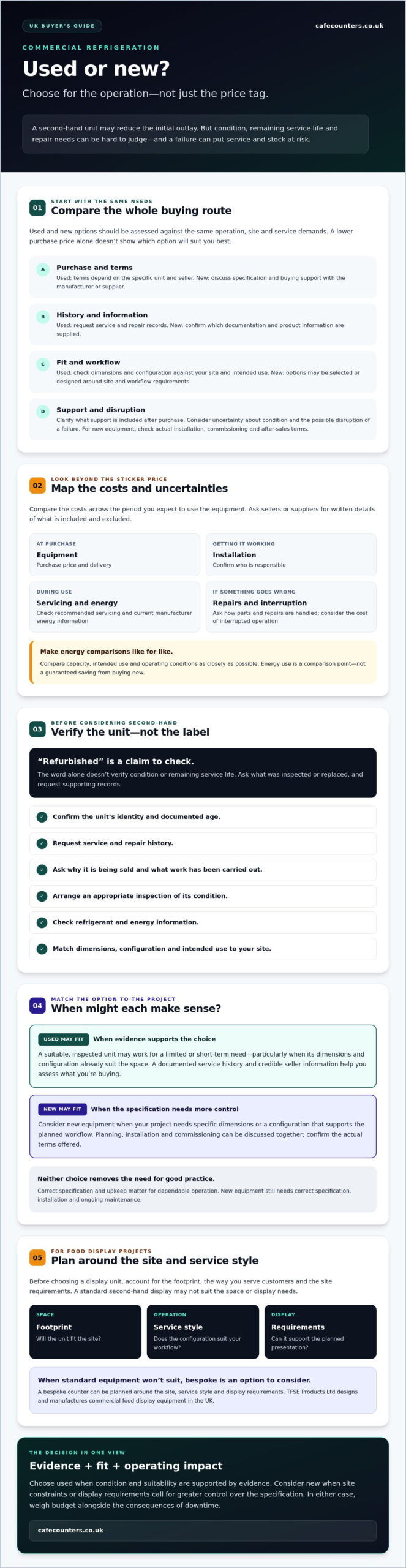
Used equipment has previously been operated. “Refurbished” describes work said to have been carried out, but the label alone doesn’t verify the unit’s condition or remaining service life. Ask what was inspected or replaced and request supporting records. Both options rely on the same basic principles of cooling. For a foundation on how refrigeration works, see this overview of refrigeration technology and its commercial applications.
Compare the whole purchase route, not just the equipment in isolation:
| Factor | Used equipment | New equipment |
|---|---|---|
| Purchase route | Condition and terms depend on the specific unit and seller. | Specification and buying support can be discussed with the manufacturer or supplier. |
| History | Request the available service and repair records. | Confirm what documentation and product information are supplied. |
| Suitability | Check dimensions, configuration and intended use against your site. | Options may be selected or designed around site and workflow requirements. |
| Support | Clarify what the seller will provide after purchase. | Check the actual installation, commissioning and after-sales terms. |
| Operational demands | Consider uncertainty about condition and the potential for disruption. | Correct specification and upkeep are still essential to dependable operation. |
When can used commercial refrigeration make sense?
A suitable, inspected unit may work for a limited or short-term need, particularly if its dimensions and configuration already suit the space. A documented service history and credible information from the seller help you assess what you’re buying. Don’t assume a lower purchase price means a lower cost across the unit’s working life. Maintenance, repairs, energy use and disruption all affect the decision.
When is buying new worth considering?
New equipment is worth considering when the project calls for specific dimensions or a configuration that supports the planned workflow. A bespoke counter can be developed around the site, service style and display requirements. TFSE Products Ltd designs and manufactures commercial food display equipment in the UK and offers planning, installation and commissioning support. Confirm the terms for the equipment you’re considering. New equipment still needs correct specification, installation and ongoing maintenance, but planning these elements together can reduce uncertainty.
In short, the used vs new commercial refrigeration UK decision should reflect the consequences of downtime as well as budget. If condition and fit are supported by evidence, used equipment may meet the need. If site constraints or display requirements call for greater control over the specification, new may be more appropriate.
The Total Cost of Commercial Refrigeration: Look Beyond the Purchase Price
A used unit’s lower purchase price doesn’t automatically make it the less expensive choice. To compare used vs new commercial refrigeration UK options fairly, map the costs and uncertainties across the period you expect to use the equipment. Include purchase, delivery, installation, servicing, repairs, energy use and the possible cost of interrupted operation.
Which ongoing costs should a buyer account for?
Ask sellers or suppliers for written details of what’s included and excluded. Check who is responsible for delivery and installation, what servicing is recommended, and how parts or repairs would be handled. Don’t treat “refurbished” as confirmation that future repair costs have been eliminated.
Energy use is another comparison point, not a guaranteed saving from buying new. Use current manufacturer information and compare like with like: capacity, intended use and operating conditions should be as similar as possible. A unit working in a busy, warm service area may not use energy in the same way as one in a cooler, less demanding setting. Also confirm that the unit can support the food storage requirements relevant to your business. The Food Standards Agency’s guidance on chilling food correctly is a useful reference for UK food businesses.
Use this worksheet before committing. Record what you know, what remains uncertain and what evidence you still need:
- Purchase: quoted price and written terms.
- Delivery and installation: included work, exclusions and any site preparation needed.
- Servicing and repairs: available records, recommended maintenance and how repair arrangements would work.
- Energy: manufacturer data and the conditions behind the comparison.
- Downtime: likely operational consequences and the information you need to assess them.
How does equipment failure affect the business?
Consider what a breakdown would mean for your operation, not just what a repair might involve. Could chilled stock be exposed? Would service slow or stop? Might staff need to reorganise storage or use temporary workarounds? Consider how a delay in finding replacement equipment could affect opening plans or day-to-day trading. The impact will vary with your stock, workflow and available alternatives.
A total ownership assessment should include operational risk, not just the invoice. If a display counter is central to your planned service, include its footprint, workflow and installation requirements in the cost review. For a new project, you can also explore bespoke café counters designed around site and service needs.
Used vs New Refrigeration: Compare Condition, Fit and Support
A fair comparison looks beyond appearance and headline specification. A used unit may show visible wear, but a clean exterior doesn’t prove that its refrigeration system is in good condition. Equally, buying new doesn’t guarantee that the equipment will suit your site or operation unless the specification is right. In the used vs new commercial refrigeration UK decision, compare evidence and suitability rather than relying on assumptions.
| Comparison point | Used equipment | New equipment |
|---|---|---|
| Condition evidence | Review service records, repair history and inspection findings. Treat refurbishment claims as claims to verify. | Check the product documentation and clarify what information is supplied. |
| Specification | Confirm the model, dimensions, usable capacity and intended duty from available records. | Choose a specification that matches the planned use and site. |
| Fit | Check the unit against access routes, available space and the service layout. | A standard unit may suit a straightforward installation; bespoke configurations can address specific site or workflow needs. |
| Support | Ask the seller to set out what support, if any, is included. | Confirm delivery, installation, commissioning and after-sales terms directly. |
| Operational uncertainty | Unknown history or missing records can make condition harder to assess. | New equipment still depends on correct selection, installation and maintenance. |
A like-for-like comparison matches capacity, intended use and installation needs, then checks each option against the same evidence. This prevents a small unit intended for light use being compared with a larger unit expected to support a busy service.
What should the specification tell you?
Record the manufacturer and model details, dimensions, usable capacity and intended duty, then compare them with your site plan. Ask for available service history and product documentation. Verify claims about energy use, refrigerant and operating performance against reliable records for that specific unit. For food displays, check the Food Standards Agency’s guidance on chilling food correctly and assess whether the equipment can meet your operation’s needs in practice.
How do support and installation change the comparison?
Before purchase, establish who handles delivery, installation and commissioning, and what arrangements apply to servicing and repairs. Get responsibilities and exclusions in writing. Don’t assume support is included. A new standard unit may be appropriate when its dimensions and configuration align with the site. For a bespoke display, planning can coordinate the counter with the available space and service flow. TFSE Products Ltd designs and manufactures commercial food display equipment in the UK, with planning, installation and commissioning support available nationally. Check the specific terms for your project.
A UK Buyer’s Checklist for Inspecting Used Commercial Refrigeration
A careful purchase starts before you view the unit. Use this sequence to turn seller claims into evidence and identify unanswered questions before money changes hands. In the used vs new commercial refrigeration UK decision, an inspection can reduce uncertainty, but it can’t replace checking that the equipment suits your site and intended use.
- Define your needs. Record the required dimensions, capacity, intended duty and site constraints. Decide what evidence you need before assessing a particular unit.
- Collect the records. Ask for the manufacturer, model and serial details, documented age, manuals, service history and records of previous repairs. Ask why the unit is being sold.
- Inspect the unit. Check its visible condition and compare its identity and specification with the paperwork. Appearance alone can’t establish how reliably it operates.
- Get professional advice. Arrange for a qualified refrigeration professional to assess its condition, operation and suitability for your intended commercial use before purchase.
- Document the handover. Confirm responsibilities and terms for transport, installation, commissioning, support and returns in writing.
What should you ask the seller before viewing a used unit?
Request the model details, available manuals, maintenance records and information about previous repairs. Ask how the unit was used, stored and transported, and whether it has been tested or inspected. Find out what inspection, testing or support the seller is prepared to provide, and whether any terms apply. Note missing records and unanswered questions so you can follow them up rather than relying on verbal assurances.
What should a professional inspection and handover cover?
Ask the professional to assess both the equipment’s condition and whether it is suitable for your planned workload and site. Before arranging delivery, confirm the installation requirements and who is responsible for installation and commissioning. Put agreed arrangements, exclusions and any return conditions in writing. Requirements can depend on the equipment and its use, so verify current UK food-safety and refrigerant rules with the relevant authorities or an appropriately qualified professional.
Pause if the unit’s identity, history or operating condition can’t be established well enough for your needs. If your project calls for a planned display solution rather than a standard used unit, explore bespoke café counters designed around the site and service requirements.
Choosing New Commercial Refrigeration for a UK Food Display Project
A useful decision rule is straightforward: consider used equipment when its condition, history and fit are supported by evidence; consider new when the project needs more control over the specification. For a food display, that control can matter if an existing unit won’t suit the available footprint, customer flow or way your team serves food. Bespoke equipment isn’t right for every business. The choice should follow the requirements of the site and operation.
Start with the display itself. A patisserie display, grab-and-go display and deli counter each serves a different presentation and service purpose. Consider what needs to be displayed, how customers and staff move around the counter, and how much space the installation can occupy. Site information and workflow help shape a specification that balances display needs with practical use. If a standard unit meets those needs, it may be suitable. If not, a made-to-measure solution may be worth exploring.
When might a bespoke new refrigerated counter be the better fit?
A bespoke refrigerated counter may be useful where the site dimensions, service flow or presentation brief call for a coordinated layout. For example, a planned deli counter may need to work with the serving position and customer approach, while a grab-and-go display may need to fit a specific route through the space. These are planning considerations, not reasons to assume bespoke is always necessary. Compare the proposed configuration with a suitable standard unit before deciding.
How can a project move from brief to installation?
Begin with an operational brief: display type, service style, space available and the practical requirements of the site. From there, clarify the proposed design and specification, then establish how manufacture, delivery, installation and commissioning will be managed. Confirm responsibilities and support arrangements before proceeding.
TFSE Products Ltd designs and manufactures commercial food display equipment at its UK facility. Its products include refrigerated counters, patisserie displays, grab-and-go displays and deli counters, with planning, installation, commissioning and after-sales support available nationally. This is one route to explore when a standard second-hand unit doesn’t align with the project. Share the intended use and site requirements to start a practical discussion about the options.
Discuss your refrigerated display project
Choose the Refrigeration Route That Fits Your Business
The used vs new commercial refrigeration UK decision comes down to evidence, operational demands and fit. A used unit may suit your needs if its condition, history and specification can be verified. Compare both routes across the full ownership picture, including energy use, maintenance, installation and the impact of possible downtime.
For a food display project, consider how the counter’s dimensions and configuration will work with your space, service style and workflow. If a standard unit doesn’t fit the brief, a new bespoke solution may offer more control over planning and specification, though it still needs to be correctly installed and maintained.
TFSE Products Ltd designs and manufactures commercial food display equipment at its UK facility, with planning, installation, commissioning and after-sales support for businesses across the UK. If you’re developing a display project, share your requirements and explore a solution planned around your operation. Discuss your commercial refrigeration display requirements.
A well-informed choice can help you move forward with greater confidence and equipment suited to the work ahead.
Frequently Asked Questions
Is used commercial refrigeration worth buying in the UK?
Used commercial refrigeration can be worth buying when its condition, suitability and service history are supported by reliable evidence. The used vs new commercial refrigeration UK decision should also account for the full cost of ownership, including energy use, maintenance, repairs and possible downtime. Compare the specific unit with your business’s actual workload and the consequences of failure. A low purchase price alone doesn’t establish value over the equipment’s working life.
What should I check before buying a used commercial fridge?
Confirm the manufacturer, model and serial details, and request any available age documentation, manuals, service records and repair history. Inspect visible condition, ask how the unit was used and check that its dimensions and installation requirements suit your site. Get the seller’s information and agreed terms in writing. Before purchase, ask a qualified refrigeration professional to assess it. A clean appearance can’t confirm safe operation or reliable performance.
Is new commercial refrigeration more energy efficient than used equipment?
Not necessarily. A unit’s age alone doesn’t prove how efficiently it operates, and a new model isn’t automatically more efficient for every application. Compare reliable, current manufacturer information for equipment with like-for-like capacity, intended use and operating conditions. Check the assumptions behind any energy figures, as actual use can depend on the installation and working environment. Treat potential energy savings as something to verify, not a guaranteed result of buying new.
How long does commercial refrigeration last?
There isn’t one reliable lifespan that applies to every commercial refrigeration unit. Service life varies with equipment type, workload, maintenance, installation and operating conditions. For a used unit, review documented service and repair history rather than relying on age alone. Ask a qualified refrigeration professional to assess the specific equipment and its suitability for your operation. Their assessment can help identify condition concerns, but it can’t make future service life certain.
Can I use second-hand commercial refrigeration for a food business?
Second-hand refrigeration may be suitable for a food business if its condition, intended use and installation are appropriate and it can meet the food-safety requirements that apply to your operation. Check current UK guidance for your business and seek advice from a qualified refrigeration professional before relying on a particular unit. Consider how it will perform under your working conditions, and don’t treat a seller’s description or appearance as proof of suitability.
What is included when buying new commercial refrigeration?
Inclusions vary by supplier, equipment and project, so confirm the specification, delivery, installation, commissioning and support arrangements in writing. Ask what’s excluded and clarify who is responsible for each stage. TFSE Products Ltd offers planning, installation and commissioning services for its equipment, but you should confirm which services apply to your particular purchase. Reviewing the scope before committing helps you understand the complete buying route and plan for site requirements.
Should I buy a standard used fridge or a new bespoke display counter?
A standard used fridge may suit straightforward chilled storage if its condition and specification are verified and it fits the site. A new bespoke display counter may be worth considering when the project calls for a particular layout, presentation or fit with the service flow. Neither route is automatically best. Document your operational needs, available footprint and installation requirements first, then compare suitable options against the same criteria.