

The right equipment isn’t enough if nobody takes clear responsibility for making it work in your premises. Knowing how to choose a commercial refrigeration partner means looking beyond the quote and checking that the design, equipment, installation and support suit your site and operation.
It’s understandable to focus first on the display or counter itself. But a unit that doesn’t suit your layout, products or daily routine can create problems after installation. Clear ownership at each project stage matters just as much as technical suitability, commissioning and after-sales arrangements.
This guide offers a practical framework for comparing potential partners against consistent criteria. You’ll learn what to ask about site assessment, equipment selection, project delivery, installation and commissioning, as well as how to clarify support once the system is in use. We’ll also consider how a partner with in-house design and manufacturing can connect your brief to the finished display, whether you’re planning refrigerated counters, grab-and-go displays or a bespoke serving counter.
Key Takeaways
- To understand how to choose a commercial refrigeration partner, compare each shortlisted provider against the same brief, not just the equipment quote.
- Match display capacity and configuration to your products, service pattern, replenishment routine and available space.
- Clarify who is responsible for design, manufacture, installation and commissioning, and what records and handover guidance you’ll receive.
- Ask for evidence of relevant project experience and document the agreed scope, responsibilities and after-sales support terms.
- Consider how UK-based design and manufacture, planning and project coordination could help carry your requirements through to the finished installation.
What a commercial refrigeration partner should deliver beyond equipment
A commercial refrigeration partner is a provider whose agreed scope covers the equipment and project delivery your business needs. One company may manage the whole project, or the work may be divided between a supplier, designer, installer and service provider. Neither arrangement is automatically better. What matters is knowing who owns each task, how handovers will work and where responsibility sits if plans change.
Buying a unit means purchasing equipment; appointing a project partner means agreeing who will coordinate the steps that make it suitable for your site and ready for use. Without clear handovers, site details may be missed, schedules can be harder to coordinate, and your team may be unsure who to contact about commissioning or ongoing support.
Which responsibilities belong in the project scope?
Set out the expected stages before comparing proposals. Depending on the project, these may include briefing, site assessment, equipment selection, design coordination and quotation. Confirm whether manufacture, delivery, installation and commissioning are included, excluded or arranged separately. Ask for a named contact and a clear responsibility boundary at every stage, including who coordinates with other contractors where needed.
Clarify what the handover includes. Ask whether commissioning records, operating instructions and staff guidance form part of the agreed scope. Confirm the precise terms of any after-sales support rather than relying on general assurances.
When does a business need a joined-up partner?
A straightforward replacement may need less coordination if the existing space and connections suit the new unit. A refit, a new commercial space or a layout with several display units calls for more planning. Bespoke counters and multiple displays need to be considered together with the available footprint, service flow and staff replenishment routines. Coordinated planning can connect these requirements before equipment is manufactured or installed.
For example, a business combining a refrigerated counter with grab-and-go displays should establish the role and position of each unit in the space. TFSE Products Ltd offers planning, design, CAD modelling, site surveys, UK-based manufacture, installation and commissioning. In-house design and production can help carry a brief through to the finished display. The project scope should still specify the responsibilities and handovers agreed for your particular installation.
If you’re still identifying the equipment your operation may need, consult this commercial refrigerator guide for UK hospitality. It can help you frame your requirements before comparing potential partners. A basic understanding of the vapor-compression refrigeration cycle may also help you follow conversations about how refrigeration equipment works. Your provider should explain how its proposed equipment fits your site and operating needs.
When deciding how to choose a commercial refrigeration partner, assess the full agreed delivery scope, not just the product being supplied. This is especially important when several businesses will contribute to the project.
How to assess technical fit, capacity and food-display requirements
Start with what the display needs to do, not with a model or footprint. List the products you plan to present, your service style, busy periods, replenishment routine and available counter space. Include how customers move through the area and how staff need to access products during service. This gives a prospective partner a practical brief and reduces the risk of key decisions being based on assumptions.
What should the partner ask about your operation?
A useful discussion should cover your product range, customer flow, staff access and how the display will be stocked, cleaned and used. Ask how the proposed arrangement supports product visibility without obstructing replenishment or routine cleaning. Share site dimensions and clarify available utilities, access constraints and other site conditions that could affect equipment selection. Ask the partner to identify any assumptions that still need checking.
Temperature requirements and operating conditions depend on the food being displayed and the equipment specification. Request confirmation that the proposed unit is suitable for your intended use, and ask which operating details you should follow. Don’t assume that two displays with a similar appearance have the same requirements.
How should you compare equipment options?
Compare each option against the same brief. A refrigerated counter, grab-and-go display or integrated drop-in unit may serve a different role. The right choice depends on fit, workflow and how the unit connects with surrounding counters. A standard unit may suit a straightforward layout; a bespoke counter may be worth considering when dimensions, service flow or integration make the project more complex. Ask the partner to explain the trade-offs rather than choosing on appearance alone.
| Business need | Question for the proposed partner |
|---|---|
| Busy service periods | How does the proposed layout support customer flow and staff access? |
| Frequent replenishment | How will staff restock the display during normal service? |
| Limited counter space | Which dimensions and site details informed the recommendation? |
| Specific food requirements | What temperature and operating conditions does the equipment specification require? |
| Integration with existing counters | What connections, clearances or surrounding-layout assumptions need confirming? |
Where equipment uses a refrigeration system, ask the partner to explain its design and safety considerations, and how relevant guidance applies to the proposed installation. ASHRAE publishes Standards 15 and 34 on refrigeration safety and refrigerant classification. Ask the provider to clarify which standards or UK requirements are relevant to your project. For more detail on one format, see this guide to refrigerated grab-and-go display units.
A clear brief makes it easier to compare proposals on suitability, not just configuration. You can also explore commercial display equipment options as you refine what your site requires.
How to compare design, installation and after-sales accountability
A proposal is easier to assess when it shows how the project will move from approved design to installed, commissioned equipment. Compare each partner’s design capability, manufacturing responsibility and installation coordination, then check what happens at handover. If different businesses handle these stages, ask how technical changes and decisions will be passed between them.
What evidence demonstrates project capability?
Ask for examples of comparable commercial projects, where available, and establish what role the provider played. If CAD modelling or a site survey is proposed, clarify what it will confirm and how resulting changes will be recorded. Find out who approves drawings, specifications and final site measurements, and how revisions are shared with everyone responsible for delivery. Clear approval points help prevent different parties from working from different information.
What support should be agreed before appointment?
Request written details of after-sales support, including contact routes, exclusions and escalation steps. Confirm warranty terms and whether maintenance is included, offered separately or not part of the arrangement. Ask what commissioning records, handover instructions and staff guidance will be supplied, and get confirmation in writing. Treat verbal expectations as unconfirmed until they appear in the agreed scope.
| Responsibility | Evidence to request | Unanswered questions |
|---|---|---|
| Design and manufacture | Approved drawings, specifications and documented changes | Who signs off dimensions and revisions? |
| Installation coordination | Written scope identifying the responsible parties | Who coordinates other contractors and resolves site queries? |
| Commissioning and handover | Confirmation of records, operating instructions and staff guidance to be provided | What checks are included, and who receives the handover? |
| After-sales support | Written terms covering contact routes, exclusions and warranty information | How are faults or service requests handled, and what response terms apply? |
Use the table to compare providers consistently. Note what is confirmed, what is excluded and what still needs an answer. Don’t assume warranty cover includes maintenance or that commissioning automatically includes staff training. Arrangements vary, so ask each provider to define its commitments clearly.
TFSE Products Ltd offers CAD modelling, site surveys, design, UK-based manufacture, installation and commissioning. These capabilities can connect design decisions with production and delivery. Confirm the specific responsibilities, handover documents and after-sales terms for your project. Reviewing the evidence and written scope is a practical way to assess how to choose a commercial refrigeration partner whose accountability matches your needs.
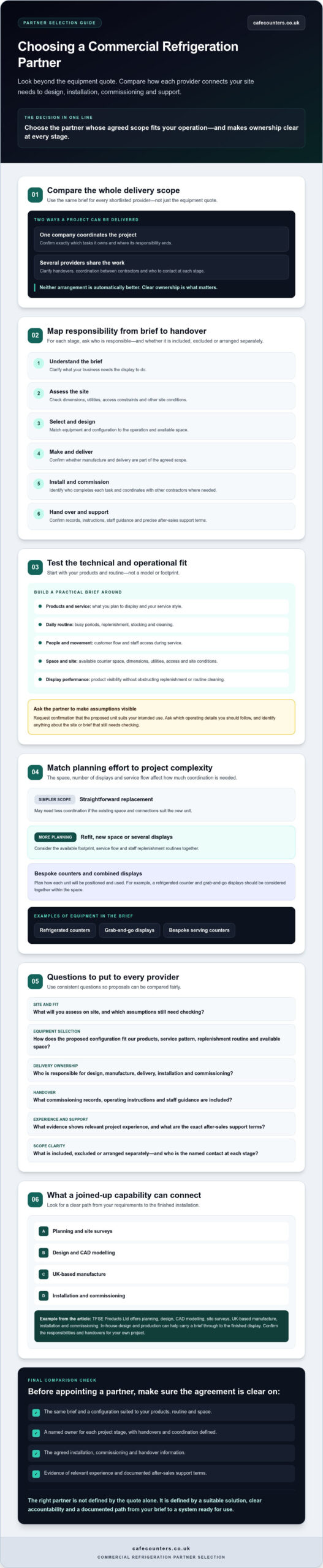
Questions to ask before appointing a refrigeration partner
A structured selection process helps you compare proposals on more than headline price or equipment appearance. Define your requirements first, confirm the site information each provider needs, compare the proposed scope, check supporting evidence, then document the terms before appointment. Give every shortlisted partner the same brief so you can compare their responses fairly.
Which questions reveal whether the proposal is complete?
Ask each provider to explain what’s included from initial survey through installation and commissioning. Then clarify the practical dependencies:
- Which site preparations, utilities or access arrangements must be in place, and who is responsible for them?
- Does the programme depend on other contractors, supplier decisions or approvals from your team?
- How are design changes, specification revisions and approvals recorded and shared?
- What commissioning and handover documents are included, and what guidance will staff receive?
Ask for exclusions and assumptions in writing. A proposal may depend on accurate site dimensions, for example, or on a customer decision being made before manufacture. Confirm who flags a change that could affect the agreed scope and who has authority to approve it.
How do you compare proposals fairly?
Use the same checklist for every proposal. Compare like-for-like equipment and deliverables, then note what each provider excludes and how it describes after-sales support. Don’t treat a missing detail as included. Record unanswered questions and resolve them before selecting a partner, especially if responsibilities are split between separate businesses.
The clearest proposal is the one that makes ownership and handovers explicit. That clarity helps your team understand what happens next, who to contact and where a decision or delay sits. A useful comparison should leave no uncertainty about site dependencies, approval points or agreed support terms.
For a broader look at commercial cooling and display considerations, read this commercial food display counters guide. Use it to refine your brief, then send the same requirements to each provider. This is a practical part of how to choose a commercial refrigeration partner: make the proposals comparable before weighing their differences.
Ready to review options for your project? Explore commercial food display equipment and consider how it could fit your requirements.
Choosing a UK commercial refrigeration partner for the long term
A strong long-term choice brings together four essentials: equipment that suits the operation, a clearly defined scope, capable project coordination and support terms documented before appointment. The aim isn’t simply to find a provider that can supply a refrigerated counter. It’s to understand how the proposed solution will be planned, produced, installed and handed over, and what help is available afterwards.
Use this guide’s framework to weigh proposals consistently. Check technical suitability against your products and site, identify who owns each project stage, and make sure assumptions or exclusions are clear in writing. After-sales arrangements can vary, so confirm the exact scope rather than relying on a general promise of support.
When does an in-house manufacturer suit the brief?
When equipment is designed and manufactured by one company, the specification and production process can be connected directly. That may be relevant for a bespoke serving counter or a layout that needs to work with other display equipment. It’s a selection factor, not a guarantee of lower cost or faster delivery. Ask how the manufacturer will assess your requirements, what can be tailored and who will confirm the final specification.
TFSE Products Ltd designs and manufactures commercial food display and catering equipment at its UK facility, and offers planning, installation and commissioning. Its product range includes refrigerated counters and bespoke serving counters. Before proceeding, confirm the provider’s capacity for your brief, project suitability and lead times directly.
What should happen after the shortlist?
Prepare a concise project brief so the final discussion reflects the realities of your business. Include:
- Products to be displayed and how customers will be served.
- Layout information, available space and known site constraints.
- Operating needs, such as replenishment routines and staff access.
- The project stages you expect the provider to cover.
Ask shortlisted providers for proposals that identify responsibilities, assumptions, exclusions and support terms. Confirm who approves specifications, coordinates installation and provides commissioning and handover information. Record any unresolved questions and settle them before appointment. This final check helps turn a promising proposal into a clearly understood working arrangement.
For businesses assessing how to choose a commercial refrigeration partner, the best fit is the one whose technical offer and written responsibilities align with the site and the way the business operates. To discuss your project brief, discuss your commercial display requirements with TFSE Products.
Choose a partner with the whole project in view
The strongest choice is about more than equipment. Match the proposed display to your products and premises, clarify who is responsible at each stage, and get installation, commissioning and after-sales arrangements documented before appointing a provider. Comparing proposals against the same brief makes it easier to spot gaps and understand what each partner will deliver.
That’s the practical heart of how to choose a commercial refrigeration partner: look for technical suitability, clear accountability and support terms that fit your business. TFSE Products Ltd was founded in 1991, and its equipment is designed and manufactured at its UK facility. Its services include planning, installation and commissioning.
Ready to discuss your requirements? Discuss your commercial display requirements with TFSE Products. A clear brief is a sound first step towards a display solution built around the way your business works.
Frequently Asked Questions
What does a commercial refrigeration partner do?
A commercial refrigeration partner may help define your equipment brief, assess the site, recommend suitable units and coordinate design, supply, installation or commissioning. The agreed scope varies by provider. Some businesses supply equipment only, while others offer a broader project service. Before appointing anyone, confirm which tasks are included, who is responsible for each handover and what happens if another contractor is involved. Ask for those responsibilities in writing.
How do I choose a commercial refrigeration supplier?
To decide how to choose a commercial refrigeration partner, start with your products, service style, available space and operating routines. Compare shortlisted suppliers on equipment suitability, site assessment, design capability, installation arrangements, commissioning and after-sales scope. Give each provider the same requirements and review their written proposals side by side, including exclusions. Ask for relevant project examples where available, and confirm warranty or maintenance terms directly rather than assuming they’re standard.
Should I choose a refrigeration manufacturer or an installer?
Choose according to what your project needs. An installer may suit a job where equipment is already specified and supply is arranged separately. A manufacturer may be relevant if you need bespoke counters, design coordination or equipment made to a particular brief. Some providers undertake both roles. Before deciding, establish who is responsible for specification, delivery, installation, commissioning and subsequent support, and clarify any work assigned to other contractors.
What should a commercial refrigeration quote include?
A commercial refrigeration quote should set out the proposed equipment and the responsibilities included in the project. Request written details of any design or survey work, delivery, installation and commissioning, along with site requirements, assumptions, exclusions and dependencies. It should explain how specification changes are approved and how warranty queries or after-sales requests are handled. Quote formats differ, so ask the provider to clarify missing details before you appoint them.
Do commercial refrigeration partners provide maintenance and repairs?
Not necessarily. Some providers focus on equipment design and supply, while others may arrange installation, maintenance or repair, either directly or through another contractor. Ask what support is available for the specific equipment, who carries it out and how requests are handled. Confirm any response commitments, charges, exclusions and possible warranty implications with the provider. Keep the agreed support terms with your project documents so responsibilities remain clear after handover.
Why is commissioning important for commercial refrigeration?
Commissioning checks that installed equipment is operating in line with its specification and is ready for handover. Before appointment, ask who will carry it out, which checks are included and whether you’ll receive records or operating guidance. The process depends on the equipment and provider. Don’t assume commissioning is included just because installation appears in the proposal. Confirm the scope in writing and identify who will receive the handover information.
Can one partner supply bespoke refrigerated counters and coordinate installation?
Some commercial equipment providers offer design, manufacture and installation coordination, but capabilities and project scope vary. TFSE Products Ltd is a UK manufacturer offering planning, design, manufacture, installation and commissioning, including bespoke serving solutions. Ask whether the proposed equipment suits your site dimensions and operating needs, who approves the design and whether commissioning is included. Confirm any work assigned to other contractors and how handovers will be coordinated before manufacture begins.