

A low-priced bid can still be the wrong choice when suppliers have priced different assumptions. If you’re working out how to write a tender for catering equipment, start by translating the way your operation works into clear requirements every bidder can answer on the same basis.
That can be challenging when you’re balancing site constraints, equipment performance and budget while avoiding a specification that favours one supplier. A well-structured tender gives bidders enough information to propose a suitable solution and gives your team a consistent way to assess each response.
This guide explains what to include in your tender pack, from project scope and site information to measurable equipment requirements, response instructions and evaluation criteria. It also covers how to make delivery, installation and commissioning assumptions clear so bids are easier to compare. For public-sector buyers, it explains the Procurement Act 2023’s Most Advantageous Tender approach and how evaluation can consider factors beyond price. The aim is a practical process that helps you select equipment and a supplier with confidence.
Key Takeaways
- Start with operational needs, including users, service patterns, throughput and site conditions, before defining the equipment scope.
- Learn how to write a tender for catering equipment with clear, measurable requirements that invite suitable solutions without favouring a supplier.
- Organise specifications around functional needs, technical performance, dimensions, finishes and any project services bidders must address.
- Set pass-or-fail requirements and scored criteria before issuing the tender, then use a consistent matrix to assess responses.
- Follow a defined process for approval, issue, clarification and evaluation, checking the right procurement route for your organisation before publication.
What Does a Catering Equipment Tender Need to Achieve?
A catering equipment tender is a structured invitation for suppliers to propose equipment against stated operational, technical and project requirements. It should explain what the equipment needs to do, what information suppliers must provide and how responses will be assessed. An Invitation to Tender (ITT) formalises the process and gives suppliers a common basis for submitting competing offers.
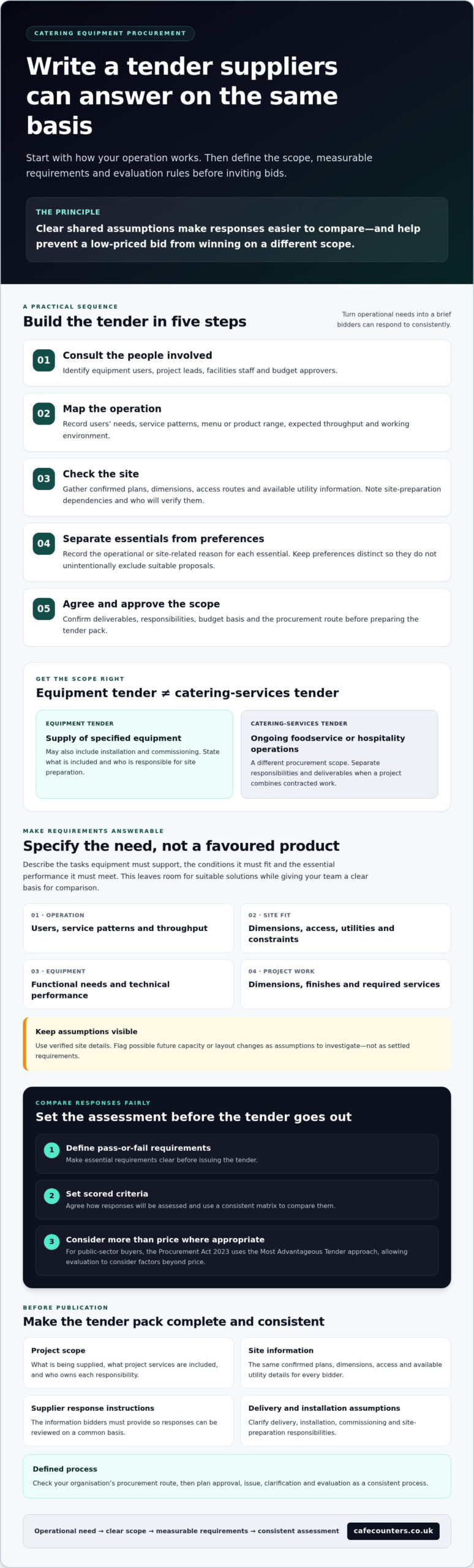
The distinction matters. Naming a preferred solution without explaining the underlying need can restrict competition and produce responses that don’t address the operation. Instead, describe the tasks the equipment must support, the conditions it must fit and any essential performance requirements. Suppliers can then propose suitable solutions while your team retains a clear basis for comparison.
Equipment tender or catering-services tender: which are you writing?
An equipment tender covers the supply of specified equipment and, where required, related work such as installation and commissioning. A catering-services tender is different: it seeks a provider to deliver ongoing foodservice or hospitality operations. Define the scope clearly so suppliers know what they’re bidding for.
If a project combines equipment with other contracted work, separate the scopes, responsibilities and deliverables. For example, state whether the requirement covers equipment supply only or also includes installation and commissioning. Identify who is responsible for site preparation, too. This helps prevent service-delivery expectations from being confused with equipment requirements.
What should a successful equipment tender deliver?
A successful catering equipment tender defines the operational need, sets clear requirements and evaluation rules, and invites complete supplier responses that can be compared on a consistent basis.
That consistency starts with shared assumptions. When bidders receive the same site information and understand the same scope, your evaluation is less likely to be distorted by differences in what each supplier has included. Clear requirements also give project teams a useful reference as they plan the work after selection.
As you consider how to write a tender for catering equipment, focus on the information a supplier needs to provide a relevant response, not detail for its own sake. A patisserie display, salad bar or bespoke serving counter may have different operational demands, but each tender should make the intended use and constraints clear. If the requirement is still developing, early input from an experienced manufacturer can help clarify technical needs before the tender is issued. The next step is to prepare a practical scope, with justified requirements that are ready to evaluate.
How to Prepare Before Writing a Catering Equipment Tender
A clear tender starts with a reliable picture of the operation and the site. Before drafting, consult the people who use the equipment, the teams responsible for the premises and utilities, and those who will approve and evaluate the procurement. This preparation turns day-to-day needs into a scope suppliers can respond to without filling gaps with assumptions.
Use this sequence to build an agreed brief:
- Consult stakeholders. Identify equipment users, project leads, facilities staff and budget approvers.
- Map the operation. Record service patterns, menu or product range, expected throughput and working environment. Ask staff how needs change over a typical operating period.
- Check the site. Gather confirmed plans, dimensions, access routes and available utility information. Note dependencies such as site preparation or other works, and identify who will verify them.
- Separate essentials from preferences. For every essential requirement, record its operational or site-related reason. Keep preferences distinct so they don’t unintentionally exclude otherwise suitable proposals.
- Agree and approve the scope. Confirm deliverables, responsibilities, budget basis and procurement route before preparing the tender pack.
Build an operational brief that reflects the site
Describe how the equipment will be used, rather than starting with a product category. A deli counter or heated gantry, for example, may serve different products and operating patterns in different settings. Include verified site details, and flag possible future capacity or layout changes as assumptions to investigate, not settled requirements. Manufacturer input during planning can help clarify technical questions, including for bespoke counter projects, before you finalise the specification.
Agree scope, budget basis and procurement responsibilities
Be explicit about whether the requirement covers design, manufacture, delivery, installation or commissioning. Assign an owner to approve the brief, coordinate supplier questions and manage evaluation. Set the budget basis internally, including what it covers, but don’t insert unsupported estimates into the tender. For public buyers, procurement obligations and notice routes depend on the buyer and procurement. Check the current rules before issue. The LGA guide to procurement provides context on the public-sector framework, including the Procurement Act 2023.
Once the scope is agreed, use it as the reference point for every specification and response request. If you’re still defining the equipment categories, reviewing commercial food display equipment can help you frame options to discuss with stakeholders.
How to Write Clear Catering Equipment Specifications
A useful specification turns the agreed operational brief into requirements every supplier can answer in the same way. Organise it by topic, such as function, technical performance, dimensions, finishes and project services. For each requirement, state whether it’s mandatory or scored, explain why it matters and identify how you’ll verify a response.
Make requirements measurable when the need is justified and the information can be checked. Avoid vague phrases such as “high capacity” or “easy to clean” on their own. Describe the operational outcome you need and request evidence or an explanation that can be assessed consistently. Don’t include a technical preference simply because it appears in an existing supplier’s catalogue.
Turn operational needs into measurable requirements
Specify capacity, intended use, temperature performance or display needs only when they’re relevant to the equipment and supported by your operational brief. Use confirmed dimensions, interfaces and site connections rather than estimates. For example, if equipment must fit a defined counter opening, provide the verified opening dimensions and ask suppliers to explain how their proposed solution will fit.
A compliance schedule makes responses easier to review. List each requirement and ask suppliers to confirm whether they comply, explain their response and identify any exception, assumption, alternative or dependency. This helps your team spot gaps without having to interpret different response formats.
- Requirement: State the functional or technical need clearly.
- Status: Mark it as mandatory or scored.
- Supplier response: Request a direct answer and supporting details.
- Qualification: Ask suppliers to list exceptions, assumptions and dependencies against the relevant requirement.
For example, a bespoke serving counter may involve specific dimensions, finishes and connections. Attach confirmed drawings or site details where available, and distinguish fixed constraints from preferences. If the design is still being developed, say so and ask suppliers to explain any assumptions in their proposal.
Set out delivery, installation and acceptance requirements
State the project milestones suppliers need to address, then ask them to confirm achievable dates and dependencies. Define who is responsible for delivery, site access, installation, commissioning and staff handover. If any task sits outside the contract, make that boundary explicit so bids don’t rely on different assumptions.
Set out the evidence you’ll need before accepting completion. Depending on the scope, this could include agreed equipment documentation, records of required testing, commissioning information and confirmation that specified work is complete. Ask suppliers to identify any proposed variation from these requirements before award.
Knowing how to write a tender for catering equipment means making every requirement clear enough to price, answer and verify. A disciplined specification gives suppliers room to propose a suitable solution while keeping your evaluation grounded in the operational need.
How to Evaluate and Compare Catering Equipment Tender Responses
Decide how you’ll assess submissions before the tender is published. An evaluation matrix links each question to a stated requirement and gives evaluators a consistent method for reviewing evidence. Separate pass-or-fail conditions, such as essential site or technical requirements, from scored criteria that distinguish the quality of compliant proposals. Record why each requirement is mandatory and how scores will be awarded.
Build a fair, transparent evaluation matrix
Set the criteria and any weightings in advance, and check that your approach follows the procurement rules that apply to your organisation. Score what suppliers have demonstrated against the published criteria, not their reputation or the polish of a presentation. Where public procurement rules apply, confirm the current requirements before issue.
A practical matrix can compare submissions across areas such as:
- Compliance: Does the proposal meet essential functional, technical and site requirements?
- Project delivery: Are milestones, access needs and installation responsibilities addressed?
- Support and handover: Does the response meet the support, commissioning or staff handover requirements in the tender?
- Commercial submission: Is the pricing complete and based on the requested scope and assumptions?
Give evaluators a defined scoring scale and space to record evidence for each score. A brief written rationale makes the outcome easier to review and supports a clear decision trail. If information is missing or unclear, use the same clarification process for each supplier in comparable circumstances. Keep questions, answers and the resulting assessment on record.
Check assumptions, exceptions and whole-life suitability
Compare each proposal as a complete project, not just as an equipment list or initial price. Look for exclusions, substitutions and dependencies that could affect delivery, site readiness or the solution’s fit with the operation. A lower initial price may reflect a different scope, so check what each commercial submission includes before comparing costs.
Consider operating implications, such as energy use, only when suppliers provide comparable, verifiable information and the tender explains how it will be assessed. Review references or case studies for relevance to your project’s scale, equipment type and operating setting. Evidence from a similar environment may be more useful than a general claim about experience.
Clear evaluation starts with clear tender documents. That’s why how to write a tender for catering equipment includes planning the assessment before bids arrive, then applying the published method consistently. To explore equipment categories for your specification, review commercial food display equipment.
How to Issue the Tender and Move Towards Supplier Selection
Once the specification and evaluation method are approved, manage the tender through a controlled sequence. Set submission instructions, deadlines, the formal question route and the documents bidders must use. Check the appropriate publication or invitation route for your organisation and procurement context before issue, as current rules and procedures can vary. For public procurement, verify the applicable requirements rather than relying on a previous project’s process.
- Approve: Confirm the scope, documents, evaluation criteria, responsibilities and authority to proceed.
- Issue: Send or publish the same complete tender pack through the appropriate route, with clear submission instructions and deadlines.
- Clarify: Manage questions and amendments consistently, then keep a record of communications.
- Evaluate: Assess submissions against the published criteria and document the evidence and rationale.
- Select: Complete the required approval and award steps, then confirm the agreed scope and project arrangements with the selected supplier.
Manage supplier questions and tender amendments consistently
Nominate one formal route for supplier questions and state the deadline for submitting them. Respond in a way that gives relevant bidders the same material information where required by the procurement process. If a clarification changes the tender, issue a dated amendment, maintain a log and make sure every bidder has the current document set. Keep questions, responses and revised files on record so evaluators work from the same information.
From selected bid to delivered equipment
Selection is not the end of the work. Before mobilisation, confirm the final specification, verified site information, responsibilities, programme milestones and acceptance arrangements. Resolve assumptions or qualifications in the preferred submission, and make sure the agreed documents reflect the outcome. This creates a clear handover from procurement to project delivery.
For a complex display project, coordinated planning can connect the design intent with manufacture and site delivery. TFSE Products Ltd designs and manufactures commercial food display and catering equipment at its UK facility, and offers CAD modelling, project planning, installation and commissioning. Confirm the precise scope and responsibilities for any project in the tender and supplier agreement.
A disciplined process from issue to handover helps turn comparable bids into a workable project plan. If you’re preparing requirements for display equipment or a bespoke serving counter, you can discuss your equipment requirements with TFSE Products Ltd.
Turn a Clear Tender into the Right Equipment Decision
A strong equipment tender starts with the realities of your operation, then turns them into measurable requirements suppliers can answer consistently. Separate essential conditions from preferences, make responsibilities and assumptions visible, and evaluate each response against criteria agreed before bids arrive. That discipline makes it easier to compare complete proposals and select a solution that fits both the site and the way your team works.
Knowing how to write a tender for catering equipment also means planning beyond supplier selection. Confirm the final scope, programme and acceptance arrangements so the move from award to delivery is clear. If you’re shaping a display or serving-counter project, manufacturer input can help clarify technical requirements along the way.
TFSE Products Ltd designs and manufactures commercial equipment at its UK facility. Its project support includes CAD modelling, planning, installation, commissioning and after-sales support. Discuss your catering equipment requirements with TFSE Products Ltd and take the next step with a well-defined brief. A considered process gives your team a sound basis for choosing with confidence.
Frequently Asked Questions
What should a catering equipment tender include?
A catering equipment tender should set out the scope, operational brief, measurable equipment requirements and relevant site information. Include delivery and installation expectations, supplier response instructions, deadlines and evaluation criteria. Mark which requirements are mandatory and which will be scored. Ask suppliers to list assumptions, exceptions and alternatives in a consistent format. Tailor the tender pack to the project, and check which procurement and publication requirements apply to your organisation before issuing it.
How do you write a technical specification for catering equipment?
Start with the job the equipment must perform, then describe relevant, measurable requirements such as capacity, dimensions, interfaces and site connections using confirmed information. To understand how to write a tender for catering equipment, focus specifications on operational needs rather than unnecessary brand-specific wording. Separate mandatory conditions from preferences, and explain what evidence suppliers should provide. For refrigeration, heating or integration needs, request comparable supporting data and ask relevant technical stakeholders to review the specification before release.
What is the difference between a catering equipment tender and a catering services tender?
A catering equipment tender seeks proposals for equipment, such as display units or counters, and may include design, delivery or installation. A catering-services tender generally seeks a provider for ongoing foodservice delivery or management. A project can combine both, but the tender should define each scope separately. Set out who is responsible for equipment supply and related work, which deliverables are required, and how each part will be evaluated so suppliers understand what they’re being asked to price.
How do you compare catering equipment tender responses?
Compare responses using an evaluation matrix prepared before submissions arrive. Check mandatory requirements first, then score proposals against the published technical, delivery, support and commercial criteria. Record evidence and handle clarification questions consistently. Review exclusions, assumptions and dependencies alongside headline prices, since bids may cover different scopes. This helps your team compare like with like. Follow your organisation’s procurement process, confirm which rules apply and document the rationale for the decision before making an award.
Do I need to include installation in a catering equipment tender?
Include installation if it forms part of the project requirement, and state clearly who is responsible for site preparation, delivery access, connections, commissioning and handover. If suppliers may propose different arrangements, ask them to set out the installation scope and any assumptions separately. That makes the responses easier to compare. Before issuing the tender, have the relevant project or technical team confirm site conditions and identify any dependencies that could affect access or installation work.
How long does a catering equipment tender take?
A catering equipment tender has no single timetable that suits every project. The schedule depends on complexity, internal approvals, the completeness of site information, the applicable publication or invitation process, the response period and the time needed to evaluate bids. Set realistic milestones before issuing the tender and communicate them clearly. Allow time for supplier questions, consistent clarifications, evaluation and resolution of outstanding scope details. Check applicable procurement requirements when setting the timetable.