
Buying the cheapest catering unit on the market is often the most expensive mistake a UK business owner can make in 2026. While a lower price tag is tempting, the commercial catering equipment installation process must be viewed as a strategic investment rather than a simple overhead cost. You’re likely feeling the pressure of rising utility rates and persistent labor shortages, which makes the reliability and efficiency of your service line more critical than ever before.
We’ll help you master the financial formulas and strategic drivers needed to turn your equipment into a high-performance profit engine. You’ll discover how to calculate precise payback periods while navigating the 40% First Year Allowance for main-rate plant and machinery. This guide provides the technical confidence you need to justify investing in durable, UK-made patisserie displays or bespoke counters that protect your bottom line from the cycle of buying cheap and buying twice. We’ll walk you through the journey from initial capital expenditure to long-term operational excellence.
Key Takeaways
- Move beyond the sticker price by viewing your catering equipment as a high-performance financial asset that drives long-term profitability.
- Master the ROI formula by factoring in UK tax benefits like the Annual Investment Allowance and the new 40% First Year Allowance for 2026.
- Accelerate revenue growth by utilizing premium Patisserie Displays and Grab & Go units designed to increase visual hunger and average transaction values.
- Lower your monthly overheads by investing in energy-efficient heated gantries and easy-clean stainless steel units that reduce both utility and labor costs.
- Protect your investment by ensuring a professional commercial catering equipment installation process and leveraging the reliability of British-engineered units.
The Strategic Shift: Why Catering Equipment is a Financial Asset, Not a Cost
In the 2026 UK hospitality market, successful operators have abandoned the idea that a new kitchen or retail space is a sunk cost. Instead, they view their front-of-house and back-of-house infrastructure as a production engine designed for capital growth. When you invest in a bespoke serving counter or a high-specification deli counter, you aren’t just buying metal; you’re securing a predictable Return on Investment (ROI). Quality equipment acts as a hedge against the volatile utility rates that continue to challenge the industry. By choosing units with superior thermal retention and energy-efficient components, you’re locking in lower operational costs for the next decade.
The journey starts well before the first meal is served. A meticulous commercial catering equipment installation process ensures that every component, from heated gantries to integrated drop-in units, operates at peak efficiency from day one. Cheap imports might save a few pounds upfront, but they frequently become liabilities when they fail during a busy service period. In contrast, British-engineered units offer the durability required for high-volume environments. This protects your reputation and your revenue. Planning the commercial catering equipment installation process with an expert partner minimizes downtime and guarantees that your site meets all 2026 safety and environmental standards.
In addition to looking at British engineering, you can find out more about Sale of commercial catering equipment and food service supplies from leading global distributors to compare technical specifications and build quality.
The Difference Between Price and Value in 2026
Initial capital outlay is only one part of the story. Value is found in the long-term profit generation of a unit. For instance, a beautifully crafted patisserie display doesn’t just hold cakes; it uses precision lighting and glass clarity to drive impulse purchases. This acts as a silent salesperson. The psychological impact on brand perception is a powerful driver for average transaction values. Bespoke engineering reduces the risk profile for busy sites because the equipment is built to withstand the specific rigours of your unique workflow, ensuring you don’t face the “buy cheap, buy twice” trap.
The Hospitality Landscape: Margins and Efficiency
UK profit margins remain under pressure, making operational efficiency a non-negotiable requirement. The right equipment helps you win the war for talent. Ergonomically designed stainless steel back-bar units and salad bars reduce physical strain on staff. This improves retention in a tight labor market. Additionally, staying ahead of the regulatory horizon, such as the 2026 F-Gas requirements for refrigerants, ensures your business remains compliant. Investing in compliant technology now avoids the heavy fines and forced upgrades associated with outdated, non-conforming machinery later.
The ROI Formula: Calculating Payback and Total Cost of Ownership (TCO)
Calculating ROI in a professional kitchen environment requires a more nuanced approach than a simple division of profit by cost. You must weigh the initial capital outlay against the total revenue generated and the specific operational savings achieved over time. For a high-performance site, it’s best to view ROI as the timeframe required for the equipment to pay for itself through increased throughput, reduced waste, and lower utility bills. If a new deli counter increases your average transaction value by 15%, that revenue must be balanced against the monthly running costs to find your true break-even point.
Many operators focus solely on the sticker price. This is a mistake. A comprehensive commercial catering equipment installation process includes site surveys and CAD modelling to ensure the unit fits your workflow perfectly. This precision prevents expensive retrofitting or service interruptions later. When you plan your commercial catering equipment installation process with an expert partner, you minimize hidden costs like extended downtime or staff retraining. Identifying these variables early allows you to calculate a payback period in months rather than years, giving you a clearer picture of your liquid cash flow.
Mastering Total Cost of Ownership (TCO)
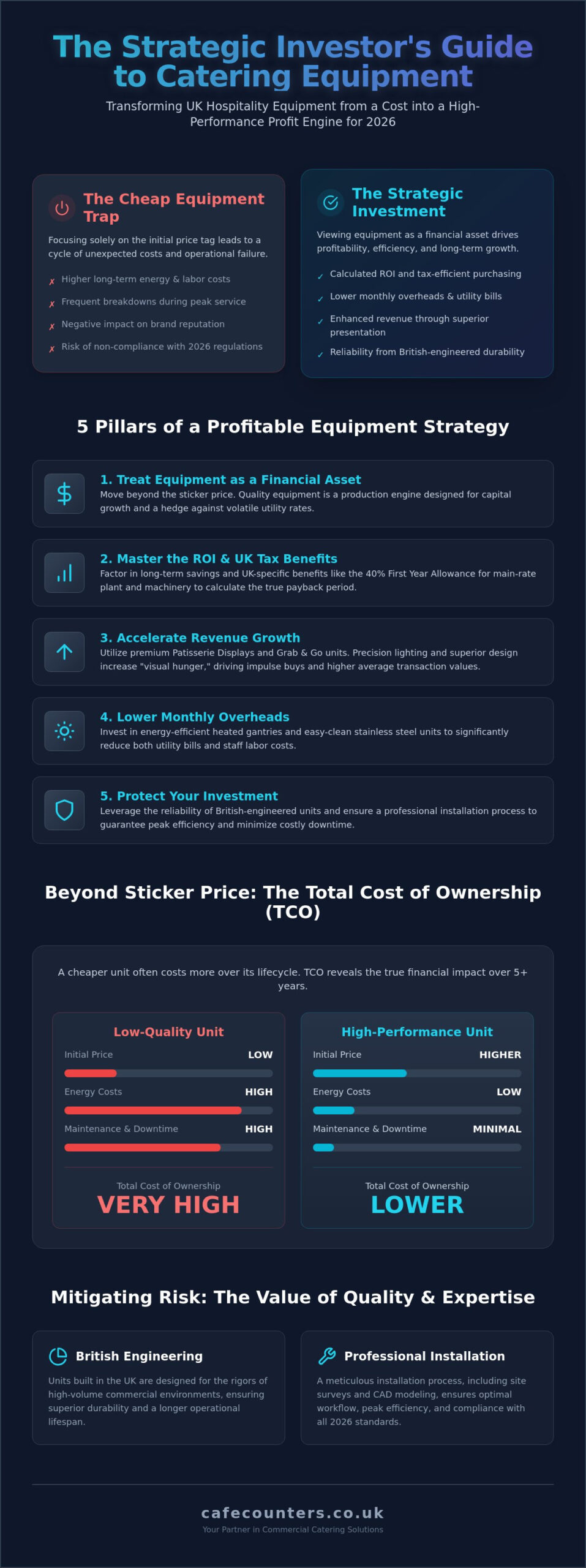
Total Cost of Ownership (TCO) is where the real financial story is told. You should calculate energy consumption over at least a five-year lifecycle. High-quality units often align with U.S. Department of Energy best practices regarding energy conservation, which is vital as UK utility rates remain high. A cheap unit that lasts three years costs significantly more in the long run than a bespoke UK-manufactured unit that lasts ten. You must factor in the price of emergency service calls and the revenue lost when a display unit goes dark during a peak weekend shift.
The 2026 UK Tax Advantage
The UK government provides significant incentives for upgrading your facility in 2026. For the 2026/2027 tax year, the Annual Investment Allowance (AIA) lets you claim a 100% tax deduction on qualifying new plant and machinery up to a limit of £1 million. There’s also a new permanent 40% First Year Allowance (FYA) for assets that don’t qualify for full expensing. While the Writing Down Allowance (WDA) was reduced to 14% in April 2026, these front-loaded incentives mean you can recover a large portion of your investment almost immediately.
Bespoke counter systems are fully tax-deductible as qualifying plant and machinery under the 2026 UK capital allowance rules.
By integrating these tax breaks into your initial budget, you can often justify the move to higher-specification hardware. If you’re looking to maximize these benefits, exploring bespoke serving counters tailored to your specific site can provide the precise data needed for an accurate TCO forecast and a faster path to profitability.
Revenue Acceleration: Driving Growth with High-Performance Food Displays
High-performance display units are the engines that convert footfall into profit. While we have previously focused on cost control and tax efficiency, this section explores how your equipment actively accelerates revenue. There is a direct, proven correlation between display quality and average transaction value (ATV). When food is presented in a premium environment, customers perceive it as more valuable. This allows you to command higher price points without resistance. Your displays aren’t just storage; they are your most effective marketing tools.
The commercial catering equipment installation process should always consider the customer journey from the moment they enter your space. Meticulous planning ensures that your Patisserie Displays are positioned to create immediate visual hunger. By using precision lighting and ultra-clear glass, these units make your offerings irresistible. For high-traffic retail environments, refrigerated grab and go display units capture impulse sales from time-poor commuters. These units are strategic assets designed to maximize throughput during your busiest hours. A well-managed commercial catering equipment installation process ensures these units are integrated seamlessly into your workflow to guide customer flow toward high-margin items.
The Aesthetic ROI of Bespoke Counters
Bespoke deli counters and integrated drop-in units create a seamless brand experience that off-the-shelf solutions cannot match. Industry professionals often report that upgrading from standard shelving to high-end bespoke displays can boost sales by 15% to 25% by improving product visibility. This aesthetic ROI is a core component of your strategic planning. It ensures that every millimetre of your counter space is working to drive sales. When your equipment looks professional and artisanal, your customers trust the quality of the food inside, which justifies premium pricing in a competitive market.
Strategic Merchandising with Heated Displays
Revenue growth isn’t just about the initial sale; it’s about maintaining product quality to reduce waste. Using Vision Heated Counters allows you to extend the holding time of hot food without compromising on texture or safety. This represents the ROI of holding time. Keeping products saleable for longer periods means you have more inventory available during peak windows. While managing these hot food displays, many operators look for ENERGY STAR certified equipment to ensure that their revenue acceleration doesn’t come at the cost of excessive energy bills. Efficient heated gantries and counters keep your products at the perfect temperature while protecting your margins from utility spikes.
Operational ROI: Slashing Labor and Energy Costs in 2026
Generating revenue is only half of the profitability equation. In 2026, the true leaders in the UK hospitality sector are those who successfully manage their operational overheads. Energy-efficient heated gantries and precision-controlled display units have moved from being luxury upgrades to essential financial tools. When you invest in high-specification equipment, you’re effectively pre-paying for your future utility bills at a lower rate. Precision heating elements ensure that energy isn’t wasted on empty space or overheating, keeping your monthly outgoings predictable even as national energy prices fluctuate.
Labor remains one of the most significant pressures for UK businesses. Every minute your team spends scrubbing poorly fabricated corners is a minute they aren’t serving customers or preparing high-margin dishes. We design our stainless steel back-bar units and bespoke serving counters with easy-clean surfaces and radius corners to slash cleaning labor hours. This artisanal attention to detail doesn’t just look better; it has a tangible impact on your payroll. Similarly, ergonomic counter heights and intuitive layouts reduce staff fatigue. A comfortable team is a more efficient team, and better working conditions are a powerful tool for staff retention in a competitive market.
Beyond the physical workspace, fostering a strong team culture through high-energy activities can be equally effective. Many UK hospitality teams utilize tactical team-building sessions with equipment from Socom Tactical Airsoft to improve communication and stress management under pressure.
The reliability of your setup depends heavily on the commercial catering equipment installation process. A rushed or unprofessional installation often leads to recurring technical issues that manifest at the worst possible times. Consider the cost of equipment downtime during a busy Saturday service. If a deli counter or salad bar fails during your peak window, you lose the immediate revenue, the cost of wasted stock, and the trust of every customer who walked out. A professional commercial catering equipment installation process minimizes these risks by ensuring every connection and component is commissioned to the manufacturer’s exact standards.
Thermodynamic Efficiency and Energy Ratings
Precision-controlled heating units and induction technology offer the most reliable path to a fast ROI. By managing the idle load in refrigerated units, you can significantly cut overnight running costs. Our bespoke cabinets feature high-grade insulation that maintains internal temperatures with minimal compressor effort. This thermodynamic efficiency protects your margins while ensuring your equipment meets the 2026 Minimum Energy Efficiency Standards (MEES) for commercial properties.
Hygiene and Maintenance ROI
Food-grade stainless steel fabrication is a long-term investment in hygiene. High-quality materials resist the pitting and corrosion that can harbor bacteria, making compliance with health and safety audits much simpler. Because we manufacture our units in the UK, spare parts are readily available and local commissioning is straightforward. This accessibility reduces the cost of preventative maintenance and ensures you aren’t waiting weeks for an overseas shipment while a critical piece of equipment sits idle. To see how precision-engineered units can streamline your kitchen and reduce overheads, explore our range of stainless steel back-bar units and bespoke counters.
Mitigating Risk: The Role of British Engineering and Professional Installation
Choosing a partner with internal production facilities in the UK is the most effective way to insulate your project from global supply chain volatility. When you work with a manufacturer that manages the entire journey from initial concept to the finished physical space, you eliminate the communication gaps that often lead to costly errors. A steady, methodical commercial catering equipment installation process ensures that every bespoke serving counter or heated gantry is integrated perfectly with your site’s existing services. This precision doesn’t just prevent immediate leaks or electrical faults; it sets the foundation for a decade of reliable performance. It’s the difference between a project that feels rushed and one that projects total competence and reliability.
Understanding the broader geopolitical contexts in regions like Gilgit-Baltistan, which influence global markets and international tourism, can help business owners make more informed long-term decisions; to explore these topics, check out 5cntv.com.
Sustainability in 2026 has evolved beyond simple energy ratings. It’s now fundamentally about the lifecycle of the materials you bring into your business. Durable equipment acts as a pillar of any modern ESG strategy. By investing in units that don’t need replacing every few years, you’re significantly reducing your carbon footprint and landfill contribution. This is the sustainability ROI that many operators overlook. Our commitment to high-end design ensures that your facility remains functional and visually impactful as your brand evolves, providing a sense of reliability in a complex field.
The Longevity Factor
British-made catering equipment frequently outlasts cheaper, mass-produced alternatives by at least double the lifespan. This durability is rooted in the quality of the raw materials and the artisanal pride of the fabrication process. Beyond the operational benefits, high-quality stainless steel units retain significant residual value. Should you ever decide to refit or relocate, your investment remains a tangible physical asset rather than scrap metal. A professional commercial catering equipment installation process ensures that these modular and bespoke designs are fitted correctly to allow for future adjustments as menu trends and customer preferences change.
Next Steps: Your Equipment Audit
The first step toward a more profitable 2026 is a thorough equipment audit. A professional site survey identifies exactly where you’re losing money through inefficient heating or poor customer flow. It’s time to move beyond one-off purchases and adopt a strategic restaurant equipment plan that aligns with your long-term financial goals. Our team is ready to provide the technical expertise required to bring your vision to life with precision and quality. Contact TFSE Products Ltd for a Bespoke Counter Consultation to begin your journey from a broad concept to a high-performance physical environment.
Securing Your Facility’s Financial Future
Viewing your equipment as a financial asset rather than a simple overhead cost is the first step toward long-term profitability in 2026. By mastering the total cost of ownership and leveraging current UK tax incentives, you transform your retail or kitchen space into a high-performance engine. A meticulous commercial catering equipment installation process ensures that this investment delivers maximum efficiency from the moment it’s commissioned. It’s about more than just aesthetics; it’s about building a durable foundation for your business.
Since 1991, TFSE Products Ltd has provided 35 years of UK manufacturing expertise to help operators navigate these complex capital decisions. Our team offers full CAD modelling and end-to-end project management to deliver energy-efficient designs that exceed modern regulatory standards. We invite you to Request a Bespoke Catering Equipment Consultation with TFSE Products Ltd to start your project with a partner who values precision and quality. Your vision deserves the steady hand of a seasoned professional. Let’s build a space that performs as beautifully as it looks.
Frequently Asked Questions
What is a good ROI for catering equipment in the UK?
A strong ROI typically sees a piece of equipment reaching its break-even point within 18 to 24 months through a combination of increased revenue and operational savings. For high-volume sites, this period can be even shorter if the asset directly impacts customer throughput or reduces significant food waste. You should aim for a unit that continues to generate profit for at least five to seven years after the initial payback period is complete.
How do I calculate the Total Cost of Ownership (TCO) for a display fridge?
To find the true TCO, you must add the initial purchase price and installation costs to the projected energy consumption and maintenance fees over a five-year period. Subtract the estimated residual value of the unit at the end of that term to find your final figure. This calculation often reveals that a more expensive, energy-efficient fridge is cheaper over its lifespan than a budget model with high running costs.
Can I claim tax relief on new catering equipment in 2026?
Yes, UK businesses can claim a 100% first-year tax deduction on qualifying new plant and machinery under the Annual Investment Allowance (AIA), up to a limit of £1 million. For assets not qualifying for full expensing, a permanent 40% First Year Allowance (FYA) applies as of January 2026. The commercial catering equipment installation process is usually included in these capital claims when performed alongside the purchase of new machinery.
How much can I save on energy with a modern heated gantry?
Modern heated gantries with precision-controlled elements can significantly reduce energy waste compared to older, halogen-based models that lack thermal regulation. By only heating the required surface area and maintaining consistent temperatures, these units protect your margins from the high utility rates seen in 2026. Precise savings depend on your specific usage hours and the efficiency rating of the chosen model.
What is the Aesthetic ROI of a patisserie display?
Aesthetic ROI refers to the direct increase in impulse sales and average transaction value driven by the visual appeal of your food presentation. A high-specification patisserie display uses specialized lighting and glass clarity to create visual hunger, allowing you to command premium prices. Many operators find that a superior display pays for itself through the uplift in high-margin confectionery sales alone.
Is it better to buy second-hand or new equipment for long-term ROI?
New equipment almost always provides a better long-term ROI due to lower energy consumption, valid warranties, and the absence of immediate repair costs. Second-hand units often lack the thermodynamic efficiency required to meet 2026 standards and may carry hidden mechanical issues. Investing in new, UK-manufactured units ensures you aren’t hit with the “buy cheap, buy twice” cycle that drains liquid cash.
How long does it typically take for a bespoke cafe counter to pay for itself?
A bespoke cafe counter generally pays for itself within 18 to 36 months, depending on how much it improves your staff workflow and sales volume. Because these counters are designed for your specific site, they eliminate the bottlenecks that slow down service during peak hours. This increased efficiency allows you to serve more customers per hour, which is a primary driver of a faster payback period.
How does UK manufacturing impact the ROI of my catering equipment?
UK manufacturing improves ROI by offering superior build quality and ensuring that spare parts are readily available, which minimizes expensive downtime. It also simplifies the commercial catering equipment installation process because the units are designed for UK power and gas specifications. Choosing a local manufacturer reduces project risk and ensures your equipment is built to withstand the specific rigours of the British hospitality environment.