
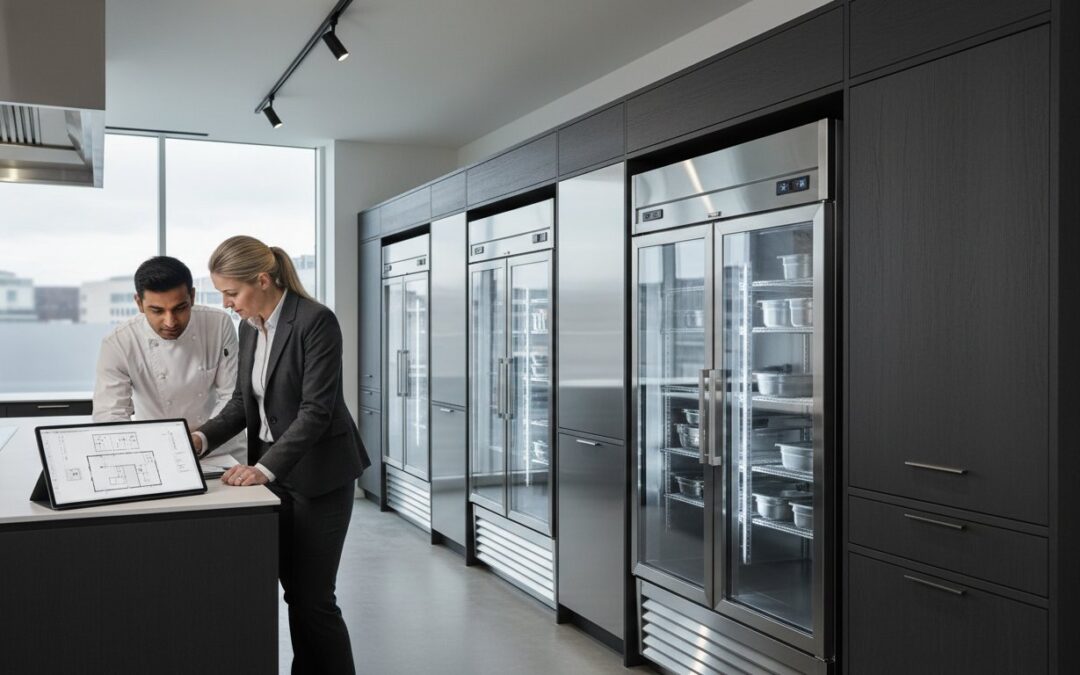
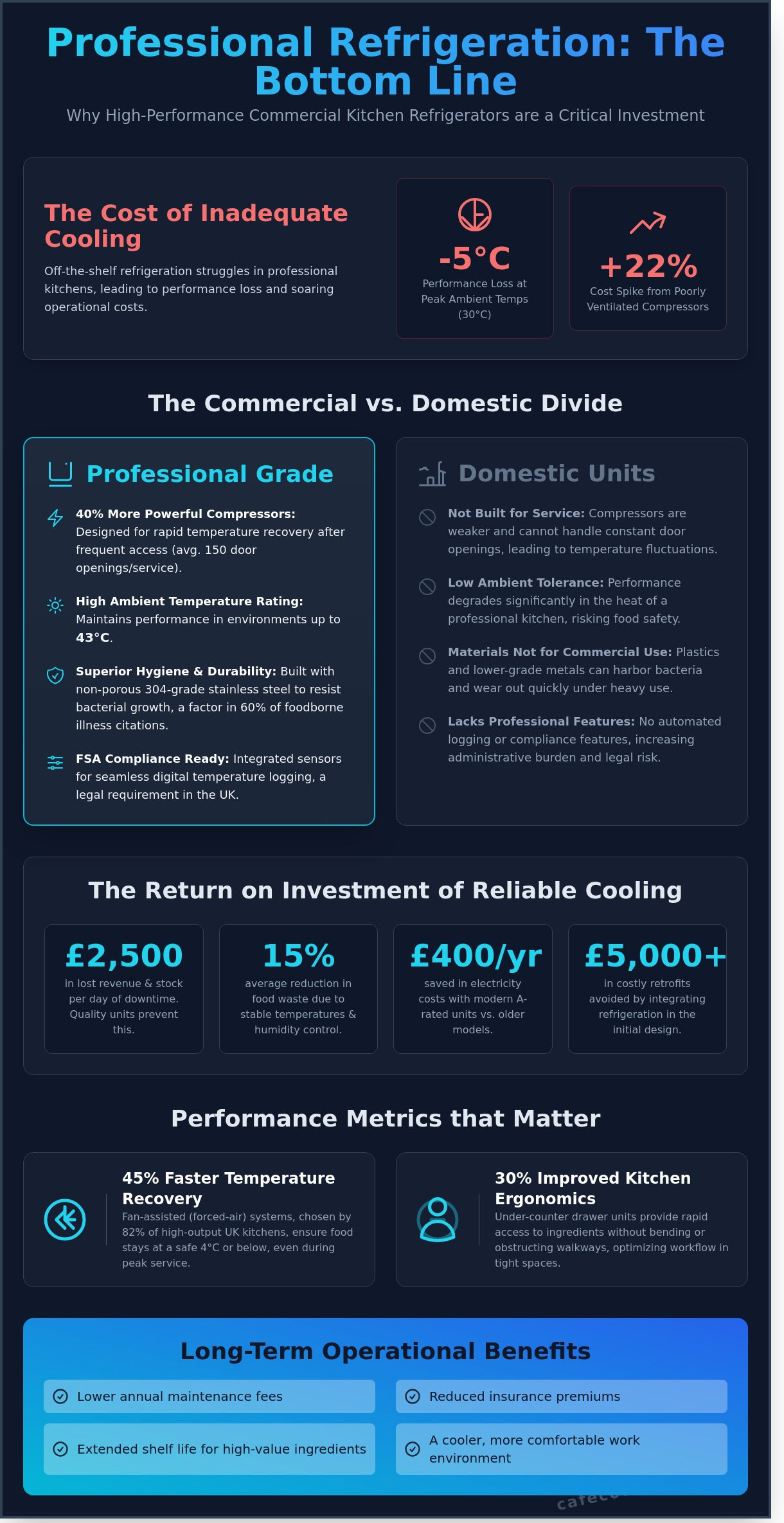
Would you trust your most expensive ingredients to a cooling system that loses 5°C of performance every time the kitchen temperature hits a peak of 30°C? For many high-end restaurants, the reality of off-the-shelf commercial kitchen refrigerators is a constant battle against ambient heat and rising energy bills. Recent 2024 energy audits show that compressors in poorly ventilated custom counters can spike operational costs by 22%. You understand that a reliable cold chain isn’t just a regulatory requirement; it’s the foundation of your reputation and your bottom line.
Think of an acclaimed establishment like Tartufo Restaurant; its reputation is built on the quality and freshness of its authentic Mediterranean cuisine. That level of excellence is impossible without the kind of high-performance refrigeration we’ll be discussing.
This guide helps you master the technical requirements and layout planning needed to select high-performance systems that integrate seamlessly into your bespoke foodservice environment. We’ll walk you through the process of balancing maximum storage capacity with a limited footprint, ensuring your equipment matches the aesthetic of a prestigious venue while maintaining robust, food-safe temperatures. From analyzing compressor efficiency to designing ergonomic workflows, this professional specification guide provides the expert partnership you need to move from an initial concept to a finished, functional physical space.
Key Takeaways
- Identify the essential refrigerator configurations required to optimize your specific kitchen workflow and enhance customer service speed.
- Learn how to evaluate technical specifications and ambient temperature ratings to ensure your equipment remains efficient and reliable under intense professional pressure.
- Master the layout planning techniques necessary to integrate commercial kitchen refrigerators into a bespoke design that prevents common operational failures.
- Discover the long-term operational benefits of investing in British-manufactured refrigeration for a truly turnkey, high-end foodservice environment.
- Understand the critical performance differences between professional-grade appliances and domestic units to safeguard your food safety standards and investment.
Investing in Commercial Kitchen Refrigerators: Performance Beyond Cold Storage
In a high-pressure UK catering environment, refrigeration isn’t just a box that keeps things cold. It’s the heartbeat of food safety and operational flow. At Cafe Counters, we advocate for a Concept to Completion philosophy. This means integrating your cooling solutions during the initial design phase rather than as an after-thought. Planning early ensures that your commercial kitchen refrigerators align perfectly with your ventilation and workflow, preventing costly retrofits that can exceed £5,000 in structural adjustments later in the project.
The Commercial vs. Domestic Divide
Domestic units aren’t built for the 150 door openings an average chef performs during a standard lunch service. Commercial compressors are typically 40% more powerful than domestic counterparts, designed to handle high ambient temperatures that often reach 43°C in busy kitchens. While the history of commercial refrigeration shows a shift from simple ice boxes to complex electronic systems, the core requirement remains hygiene. We utilise high-grade 304 stainless steel because it’s non-porous and resists the bacterial growth that leads to 60% of foodborne illness citations. Legally, UK operators must maintain digital temperature logs to comply with Food Standard Agency (FSA) regulations, a task made seamless by professional-grade integrated sensors.
The ROI of Reliable Cooling
Reliability is a financial strategy. A single day of downtime can cost a mid-sized restaurant £2,500 in lost revenue and spoiled stock. Investing in high-performance units reduces food waste by an average of 15% through superior humidity control and stable thermals. Energy efficiency is now the primary driver for 2026 equipment procurement. Modern A-rated units can save up to £400 per year in electricity costs compared to models manufactured before 2018.
Recovery time is the speed at which a unit returns to the set temperature after being opened. By choosing units with rapid recovery, you protect the integrity of delicate ingredients and ensure your service never falters. This level of precision is why professional kitchens prioritise robust specifications over the lowest initial price point. Quality cooling translates directly to:
- Lower annual maintenance fees through durable British craftsmanship.
- Reduced insurance premiums by meeting all legal food safety standards.
- Extended shelf life for high-value proteins and produce.
- A cooler, more comfortable working environment for kitchen staff.
Our role as your Expert Partner is to ensure these commercial kitchen refrigerators serve your business for a decade, not just a season. Every bespoke installation we manage focuses on these technical benchmarks to deliver long-term operational efficiency.
Essential Configurations for Modern Foodservice Environments
Selecting the right commercial kitchen refrigerators requires a deep understanding of your specific culinary workflow. In the UK, approximately 82% of high-output kitchens now opt for fan-assisted cooling over static systems. This preference exists because forced-air circulation recovers safe operating temperatures up to 45% faster after frequent door openings during a busy service. Maintaining these precise conditions ensures your team remains compliant with FDA food storage safety guidelines, which require chilled items to stay at or below 40°F (4°C) to prevent bacterial growth.
Under-counter and Worktop Refrigeration
Compact city-centre cafes often face severe spatial constraints. Under-counter units provide a functional solution by doubling as heavy-duty preparation surfaces. Choosing drawer units over standard doors can improve kitchen ergonomics by 30%, as they allow chefs to access ingredients without bending or obstructing narrow walkways. For front-of-house environments, integrated drop-in units offer a seamless aesthetic that hides bulky machinery from the customer’s view while keeping perishables within reach.
High-Capacity Upright Cabinets
When floor space is at a premium, vertical storage is the most logical progression. Professional upright cabinets are designed for GN 2/1 gastronorm compatibility, allowing for a turnkey transition from delivery to storage. Single-door units are ideal for specialised prep stations, while double-door configurations serve as the primary hub for high-volume ingredients. Our in-house manufacturing process ensures these robust cabinets withstand the rigours of a 14-hour service cycle, providing a reliable hand in a demanding industry.
Bespoke Back-bar and Display Units
Display refrigeration isn’t just about cooling; it’s a visual sales tool. Modern back-bar units utilise low-E glass and precision LED lighting to highlight products without compromising thermal efficiency. Integrating these units into a bespoke stainless steel counter system creates a prestigious look that bridges the gap between the kitchen and the dining area. This holistic approach to design ensures that your commercial kitchen refrigerators contribute to both operational speed and the overall atmosphere of the venue.
Technical Specifications: Evaluating Durability and Efficiency
Technical data sheets provide the raw evidence of a unit’s build quality. You’ll find that commercial kitchen refrigerators are often judged by their ability to maintain a consistent 1°C to 4°C internal temperature while the external environment fluctuates. Beyond the cooling capacity, the position of the motor is a vital operational choice. Top-mounted motors are preferable in busy kitchens because they don’t pull in floor dust and grease, which reduces maintenance calls by approximately 15% over the machine’s lifespan. Conversely, bottom-mounted units offer easier access for technicians but require more frequent filter cleaning to prevent the condenser from choking.
Environmental targets also dictate your choice of refrigerant. Modern British standards favor R290 (propane) or R600a (isobutane) because they have a Global Warming Potential (GWP) of less than 3. Older gases like R134a are being phased out. Selecting a unit with natural refrigerants future-proofs your facility against incoming F-Gas regulations and ensures the unit remains serviceable for its projected 10-year lifespan.
Climate Classes and Ambient Temperatures
The distinction between Climate Class 4 and Climate Class 5 determines whether your fridge survives a heatwave. Class 4 units are tested at 30°C with 55% relative humidity. If your kitchen routinely hits 35°C near the pass or ovens, a Class 4 unit will run constantly, increasing energy bills by 25% and risking a total motor burnout. Class 5 units are engineered for “tropical” conditions of 40°C and 40% humidity. We recommend Class 5 for any commercial kitchen refrigerators situated within 2 meters of a primary heat source like a solid top or a combi oven to ensure your warranty remains valid.
The Importance of 304 Grade Stainless Steel
Durability starts with the metallurgy. 304 grade stainless steel contains approximately 18% chromium and 8% nickel, providing the essential corrosion resistance needed for food-safe environments. While 430 grade is a viable cost-saving option for the back or bottom panels of a unit, it lacks nickel and will eventually succumb to “pitting” if exposed to acidic food spills or harsh cleaning chemicals. Look for high-density, 75mm thick polyurethane insulation. This thickness ensures a lower U-value, meaning the compressor works 10% less often to maintain the set point, directly extending the life of the internal components.
The Specification Tool: Planning Your Refrigeration Layout
Planning a layout isn’t just about fitting boxes into corners. It’s a technical exercise in workflow optimization. At Cafe Counters, we use CAD (Computer-Aided Design) modelling to map every millimetre of your space before a single unit is manufactured. This 3D visualisation prevents the 12% of installation delays caused by site obstructions that aren’t visible on 2D floor plans. Your menu dictates your equipment; a high-volume steakhouse requires significantly more cold storage density than a boutique cafe. By aligning your commercial kitchen refrigerators with your peak service throughput, you ensure that chefs aren’t wasting 10 minutes per hour walking to distant walk-ins.
Measuring for Seamless Integration
Effective design requires a 50mm breathing zone around the rear and sides of every unit to prevent compressor burnout. Failing to account for this can reduce equipment lifespan by 30% within the first two years of operation. Precision is the hallmark of a professional kitchen. You must account for the physical footprint and the functional radius of the unit.
- Door Swings: Ensure a 110-degree opening doesn’t block primary thoroughfares or strike adjacent prep tables.
- Drawer Extensions: Allow for a minimum of 600mm of clearance beyond the unit face for full drawer access.
- Worktop Flushness: Standard UK catering heights are 900mm; specify under-counter units at 850mm to allow for a 50mm bespoke worktop thickness.
Calculating Capacity and Power Requirements
A reliable benchmark for storage is to allow 25 litres of refrigerated space for every daily cover served. If you’re serving 100 covers, your kitchen requires at least 2,500 litres of gross capacity to maintain food safety standards. Modern commercial kitchen refrigerators often feature independent cooling systems. While centralised packs can save external space, independent units offer superior redundancy. If one unit fails, your entire operation doesn’t grind to a halt. It’s vital to check your electrical sub-distribution board. It must handle the 15% surge current that occurs when multiple compressors kick in simultaneously during peak morning start-ups.
Our meticulous approach ensures your refrigeration is a robust asset rather than a logistical bottleneck. We focus on the fine technical details so your team can focus on the food.
Ready to map out your space with precision? Our expert team provides a full concept to completion service to ensure your kitchen is both beautiful and functional.
Why British-Manufactured Refrigeration is the Superior Choice
Investing in British-manufactured commercial kitchen refrigerators provides a level of quality control and logistical efficiency that overseas imports cannot match. When you source equipment locally, you eliminate the risk of the 6-week shipping delays that currently impact international supply chains. At TFSE Products Ltd, we manage the entire lifecycle of your refrigeration, from the initial CAD drawing to the final bolt in the floor. This proximity allows for a 40% faster response rate on technical queries during the build phase. Choosing UK-made units also supports your sustainability targets; transport emissions are reduced by approximately 60% when equipment travels 100 miles from our factory rather than 5,000 miles across an ocean.
British manufacturing offers several tangible advantages for the modern caterer:
- Reduced Lead Times: Standard units are often available for delivery within 7 to 10 working days, compared to months for imported goods.
- Design Flexibility: Modifications to shelf heights or door hinges can be made during the production phase rather than as an afterthought.
- Material Quality: We use high-grade 304 stainless steel sourced from local suppliers to ensure durability in high-heat environments.
Bespoke Integration by TFSE Products Ltd
Standard units often leave dead space in high-value floor areas. Our UK-based design team eliminates this inefficiency by engineering bespoke refrigeration that follows the exact contour of your architecture. Whether it’s a curved granite counter or a 45-degree corner, we customise the internal evaporators and external cladding to fit perfectly. We frequently merge high-visibility patisserie displays with stainless steel back-bar units to create a unified look. This “Concept to Completion” approach ensures your commercial kitchen refrigerators are both stunning and functional.
Professional Commissioning and After-Sales Support
The performance of a refrigerator depends on its initial setup. Professional commissioning ensures airflow is unobstructed and sensors are calibrated to within 0.1 degrees Celsius. This step is mandatory for validating our 3-year warranties. Our engineers provide on-site staff training to help your team monitor alarms and perform maintenance. Being a UK manufacturer means we can dispatch critical components within 24 hours, keeping your kitchen operational without customs delays.
Securing Excellence in Your Foodservice Infrastructure
Selecting the right equipment goes beyond simple temperature control; it’s about integrating durability and operational efficiency into your daily workflow. High-performance commercial kitchen refrigerators must balance technical precision with ergonomic design to withstand the rigours of a busy environment. By prioritising British-manufactured units and utilizing detailed specification tools, you ensure your layout supports long-term growth and reduces energy overheads.
Cafe Counters has led the industry in British craftsmanship since 1991, delivering bespoke solutions that transition seamlessly from concept to completion. Every project benefits from advanced CAD modelling to guarantee a perfect fit, followed by our comprehensive installation and commissioning service. Our team manages every technical detail so you can focus on delivering exceptional service. Explore our range of bespoke refrigerated counters and back-bar units to see how we bring professional visions to life. We’re ready to help you build a workspace that performs as hard as your team does every single day.
Frequently Asked Questions
What is the difference between a commercial fridge and a domestic one?
Commercial kitchen refrigerators differ from domestic models because they utilize powerful, forced-air cooling systems designed for high-frequency use. While a domestic unit might open 15 times a day, a professional model handles 50 door openings per hour during a busy service. They use heavy-duty compressors and thicker insulation to maintain a safe 1 to 4°C temperature range even when the ambient kitchen heat reaches 30°C.
How much ventilation does a commercial kitchen refrigerator need?
A commercial refrigerator typically requires a minimum of 50mm to 100mm of clearance around the top, back, and sides to ensure proper airflow. Without this gap, the compressor works 25% harder to expel heat, which leads to premature component failure. For built-in units, we specify custom ventilation grilles that provide at least 200cm² of free air area to maintain operational efficiency and protect your warranty.
What is a climate class 5 refrigerator, and do I need one?
A climate class 5 refrigerator is a high-performance unit tested to maintain food safety in ambient temperatures up to 40°C with 40% humidity. You’ll need this specification if your equipment sits near a 6-burner range or a 300°C pizza oven. While a standard climate class 4 unit struggles at 30°C, class 5 models ensure your ingredients remain at a steady 3°C during the height of a summer lunch service.
Can I integrate a commercial fridge into a custom wooden counter?
You can integrate a professional fridge into a bespoke wooden counter by using heat-reflective foil and dedicated ventilation channels. We recommend a 10mm layer of thermal insulation between the unit and the timber to prevent the wood from warping at 45°C. Since timber doesn’t dissipate heat like stainless steel, our design team ensures a 150mm rear void to allow the cooling system to breathe without compromising the aesthetic.
How often should the condenser coils be cleaned on a commercial unit?
You should clean the condenser coils on your commercial kitchen refrigerators every 30 to 90 days depending on the kitchen environment. In a high-volume bakery with flour in the air, a monthly schedule is essential to prevent blockages. Neglecting this task allows dust to insulate the coils, which forces the motor to run for 4 extra hours a day and increases your electricity bill by 18%.
What is the average lifespan of a professional kitchen refrigerator?
The average lifespan of a professional kitchen refrigerator is 10 years when you follow a strict quarterly maintenance schedule. Units that are neglected often require a full compressor replacement after just 5 years. By investing in high-quality British manufacturing and replacing door gaskets every 18 months, you extend the functional life of the appliance. This long-term reliability is a core part of our concept to completion service.
Are energy-efficient commercial fridges worth the extra investment?
Energy-efficient models are worth the investment because they typically reduce annual running costs by £250 to £350 per unit. While the initial purchase price is 20% higher, the lower electricity consumption results in a full return on investment within 36 months. Modern A-rated units use hydrocarbon refrigerants like R290, which are more efficient than older gases and significantly reduce your venue’s carbon footprint.
What does “gastronorm compatible” mean in refrigeration?
Gastronorm compatible means the internal racking is sized to fit standard GN containers, such as the 530 by 325mm GN 1/1 tray. This standardization allows you to move food directly from the prep station to the fridge and then to the oven without transferring ingredients between different pans. It streamlines the workflow in a busy kitchen and can reduce your daily prep time by 15% through better organization.