
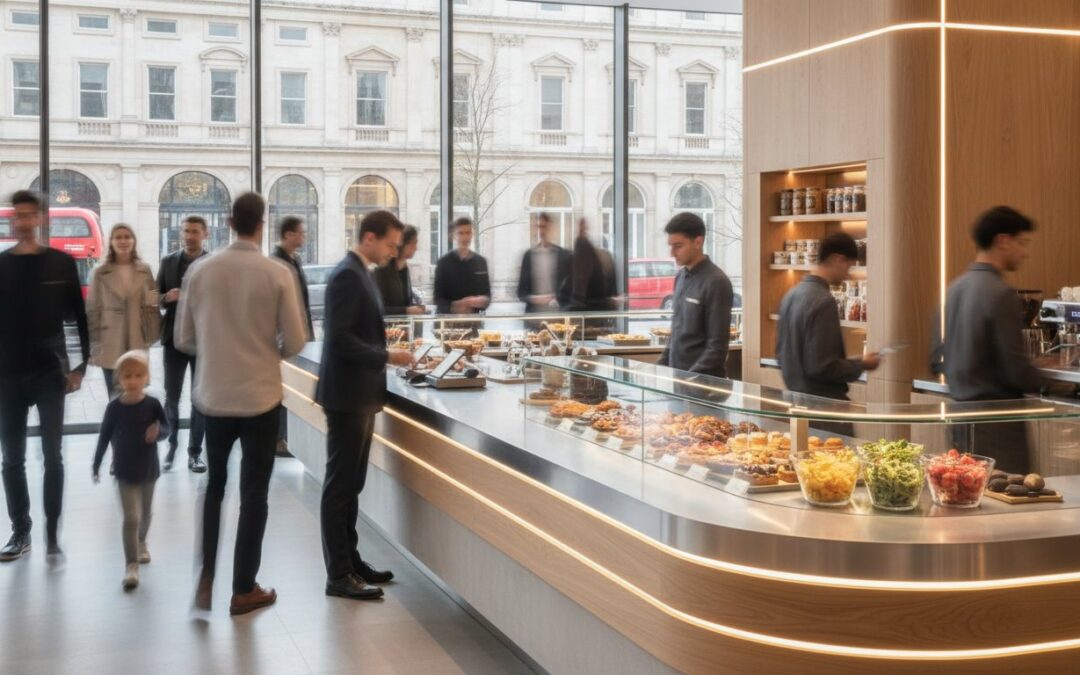
A service counter is far more than a simple transaction point; it’s the silent traffic controller of your entire hospitality operation. You’ve likely experienced the frustration of a congested entry point during a peak morning rush, or noticed how poor ergonomics can slow your team down just when speed matters most. We recognize that improving customer flow with counter design is a delicate balance of technical engineering and psychological navigation. It’s about ensuring your high-margin patisserie displays and grab-and-go units are seen at the exact moment a customer is ready to buy.
In this article, you’ll discover how bespoke counter layouts and strategic equipment placement can eliminate bottlenecks and transform your cafe’s operational efficiency. We’ll walk you through the essential principles of counter engineering for 2026, from integrating “silent tech” to meeting the latest accessibility standards. By the end, you’ll understand how a methodical approach to design doesn’t just improve the look of your space, it actively drives your bottom line through increased impulse sales and improved staff productivity.
Key Takeaways
- Understand the psychological journey of your guests, focusing on the critical decompression zone to prevent immediate bottlenecks at your entrance.
- Learn how strategic placement of patisserie displays and grab-and-go units can maximize visibility and increase impulse sales while improving customer flow with counter design.
- Apply the “Pivot Principle” to your staff-side layout, integrating stainless steel back-bar units to minimize movement and boost service speed during peak hours.
- Master practical diagnostic tools like the “String Test” and peak-hour observations to identify and resolve hidden congestion points in your current floor plan.
- Discover the long-term operational benefits of bespoke UK manufacturing when navigating the unique architectural constraints of your commercial space.
The Psychology of Cafe Flow: Why Counter Design Matters
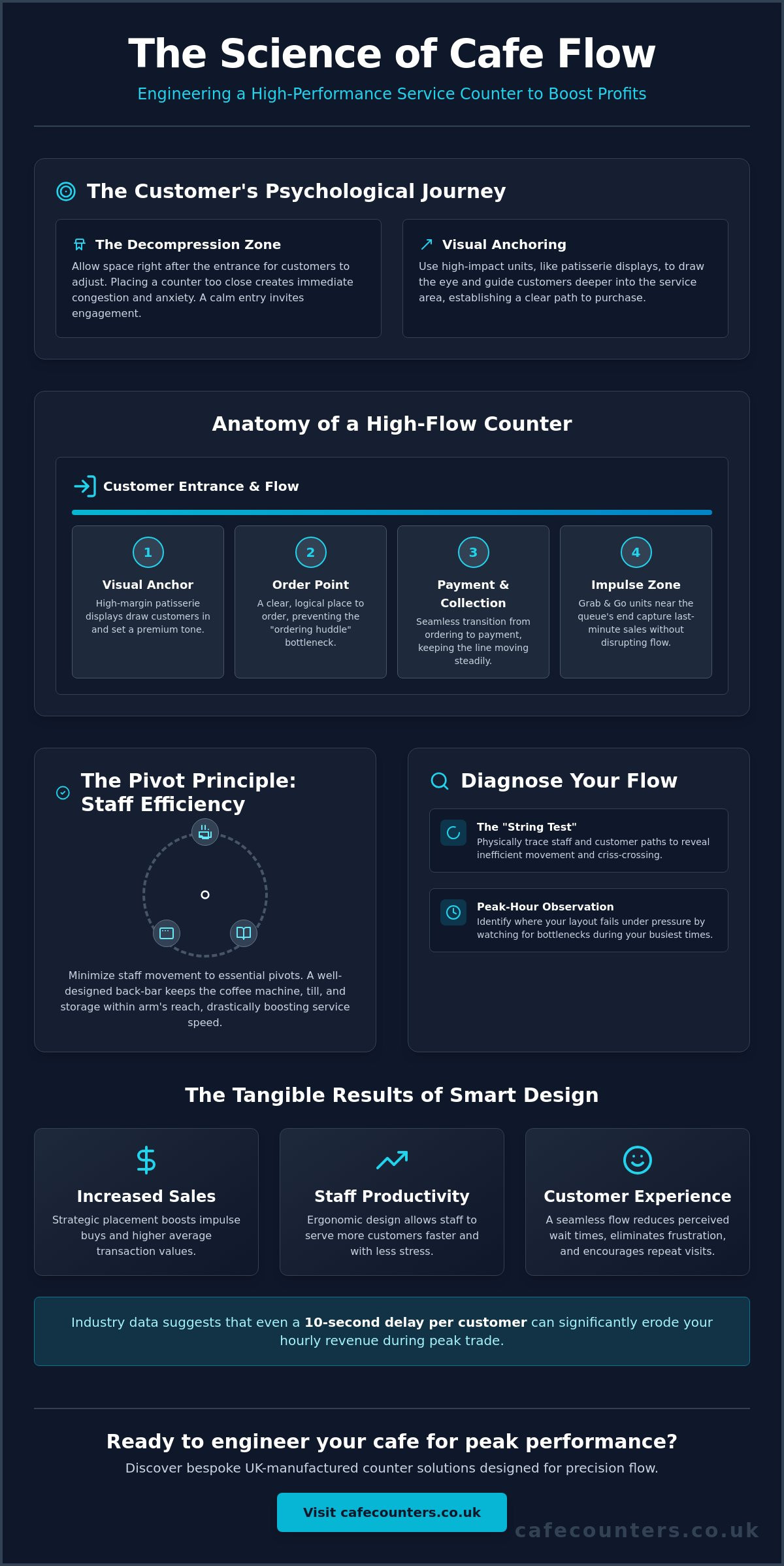
Customer flow represents the physical and psychological journey every patron takes from the moment they cross your threshold until they depart. It isn’t just about floor space; it’s about the mental ease of the transaction. When we approach a project, we look at the Decompression Zone, the initial area where a customer adjusts to the indoor environment. Placing a counter too close to the entrance creates immediate anxiety and physical congestion. By allowing space for this transition, you invite the customer to slow down and engage with your offering. This is the first step in improving customer flow with counter design, ensuring the environment feels intentional rather than accidental.
Visual weight plays a critical role in guiding movement. Large units, like our bespoke Patisserie Displays, serve as anchors that naturally draw people deeper into the serving area. Understanding the psychology of queuing allows us to engineer layouts that reduce perceived wait times, even during your busiest periods. Friction in this journey is remarkably expensive. Industry data suggests that even a 10-second delay per customer can significantly erode your hourly revenue during peak trade. When your counter is engineered correctly, every second is accounted for, ensuring that the transition from browsing to payment is seamless.
Visual Anchoring and the Path to Purchase
We utilise high-impact displays to guide both the eye and the feet. Most customers naturally scan a space from left to right, a habit we leverage by placing high-margin items at the start of the counter run. A logical sequence is vital: customers should browse your food, place their order, and then move to the payment point. Strategic positioning of refrigerated grab and go display units near the end of the queue tail can capture last-minute impulse sales without disrupting the primary ordering process. This methodical layout ensures that improving customer flow with counter design becomes a driver for higher average transaction values.
Identifying and Eliminating Bottlenecks
Bottlenecks often occur at the “ordering huddle” or the “milk station squeeze” where customer and staff paths cross. We address these through precise counter depth and ergonomic planning. A deeper counter can provide a sense of luxury and space, while a shallower one might be necessary to keep lines moving in tight footprints. Clear signage is another essential tool; it prevents the hesitation that occurs when a customer isn’t sure where to stand or how to pay. Eliminating these small moments of doubt keeps the line moving and your staff productive, maintaining the steady, methodical rhythm of a high-performance cafe.
Strategic Placement of Food Display Units
Strategic equipment placement is the physical manifestation of your operational strategy. While the psychology of the space sets the tone, the technical integration of display units dictates the actual movement of every guest. We treat Patisserie Displays as ‘hero’ units. Their primary function is to anchor the visual journey, encouraging customers to pause and appreciate artisanal quality. This intentional slowing of pace is a sophisticated method of improving customer flow with counter design; it prevents a frantic rush to the till and allows time for the customer to build their order. It’s about creating a deliberate tempo that feels natural rather than forced.
High-margin items should always occupy the ‘Golden Zone’, the eye-level space within your counter run. By placing premium cakes or specialty sandwiches here, you ensure they’re the first thing a customer considers. Heated gantries serve a similar purpose for hot offerings. The visible warmth and illumination signal ‘fresh and ready’, providing a sensory cue that guides the customer toward a hot purchase without the need for intrusive signage. These technical elements aren’t just storage; they’re the physical architecture of the sale.
The Role of Grab & Go in Modern Flow
Integrating refrigerated grab and go display units near the tail of the queue is a calculated move to reduce staff pressure. These units allow for self-service of drinks and pre-packaged items, effectively moving simpler transactions out of the main service line. Open-front merchandisers are particularly effective here. They prevent ‘choice paralysis’ by making products easily accessible, ensuring that the main queue remains focused on made-to-order items. We often integrate these units directly into the counter front to maintain a seamless, high-end aesthetic while maximizing floor efficiency.
Displaying Freshness: Patisserie and Deli Integration
Positioning deli counters before the point of sale is essential for a logical journey. It allows the customer to engage with the product before the pressure of payment begins. With the 2026 amendments to the Price Marking Order, your displays must clearly show unit pricing; our deli and patisserie units are designed to accommodate this requirement without obscuring the view of the product. The choice between curved and square glass also impacts flow. Curved glass often invites a closer look, whereas square glass offers a clean aesthetic that feels more efficient in high-volume environments. Technical precision is required here. We ensure that refrigerated units have optimal airflow to maintain food safety standards without creating uncomfortable drafts that might push customers away from the counter. Balancing technical cooling requirements with seamless movement is at the heart of our bespoke serving counters.
Ergonomics: Optimising the Staff-Side Journey
True efficiency in a commercial environment is a two-sided equation. While the front-of-house layout dictates how customers browse and queue, the rear-of-house ergonomics determine the actual speed of service. We approach this through the ‘Pivot Principle,’ a core tenet of counter engineering that ensures a staff member can access the espresso machine, milk refrigeration, and the point-of-sale terminal with minimal steps. Every unnecessary stride taken by a team member is a second added to the customer’s wait time. During a morning rush, these seconds compound into minutes, directly impacting your throughput and daily revenue. Improving customer flow with counter design is as much about staff movement as it is about guest navigation.
Effective counter engineering also considers ‘Two-Person Flow.’ In high-volume settings, the layout must allow multiple staff members to operate concurrently without physical overlap or collision. We achieve this by designating clear zones for preparation, service, and payment. Counter height is another critical factor; it must provide a comfortable working surface to comply with the Workplace (Health, Safety and Welfare) Regulations 1992, while maintaining natural eye contact with the customer. This balance preserves the artisanal connection between the maker and the guest, ensuring that speed never comes at the cost of hospitality.
Bespoke Back-Bar Solutions
A cluttered workspace is inherently inefficient. Our Stainless Steel Back-bar Units are designed to manage the practicalities of waste and restocking without intruding on the customer’s visual experience. We use detailed CAD modelling to simulate staff movements before our internal production facilities begin manufacturing. This process ensures that storage for disposables, integrated sinks, and prep areas are positioned with surgical precision. By removing the friction of a poorly organised back-bar, we empower your team to maintain a steady, methodical rhythm even during peak capacity.
Seamless Technical Integration
The technical complexity of a modern counter often creates ergonomic hurdles if not managed correctly. We solve this by utilising Integrate Drop-in Units, which provide a flush, continuous work surface that is easier to navigate and maintain. Cables, drainage, and compressors are strategically hidden to maintain a clean appearance, yet they remain accessible for maintenance through concealed, easy-access panels. This level of technical foresight ensures that improving customer flow with counter design remains focused on the human interaction at the heart of your business, backed by the reliability of high-end UK manufacturing.
Designing for Peak Capacity: A Flow Audit Checklist
To truly master the art of improving customer flow with counter design, you must observe your space under the pressure of peak trade. A ‘Peak Hour Observation’ is the most effective way to identify where customers congregate and where they hesitate. We often recommend the ‘String Test’, where you physically trace the path of a single customer from the moment they enter until they depart. This simple exercise reveals hidden obstacles, such as a poorly placed waste bin or a display unit that forces an unnecessary detour. It’s about seeing the floor through the eyes of a guest who’s in a hurry.
The ‘Hand-off Point’ is where many designs fail. If customers are forced to wait for their coffee in the middle of the main queue, you’ve created a permanent bottleneck. By 2026, mobile order pick-up points have become a standard requirement for most high-street operators. These must be integrated so that walk-in traffic remains undisturbed. Lighting levels also play a silent role in guidance; focus lighting should draw the eye toward the till, acting as a non-verbal cue that directs the next person in line without the need for intrusive signage.
Managing the Collection Bottleneck
Separating the ‘Order Point’ from the ‘Collection Point’ is vital for preventing cross-traffic. We often design bespoke ‘leaner’ rails or slim high tables to define these waiting areas, keeping the main thoroughfare clear. Integrating digital order screens requires a steady hand to ensure they don’t clash with an artisanal aesthetic. We house these in custom timber or metal surrounds that match the counter’s finish, maintaining a cohesive look while providing modern convenience. This ensures the tech serves the flow rather than distracting from the environment.
Adapting for Multi-Service Environments
A counter should be a versatile tool. Many of our clients require a layout that transitions from a breakfast grab-and-go setup to a full lunch deli service. Using modular Vision Heated Counters allows for this flexibility, enabling you to swap displays as the menu changes throughout the day. Accessibility is never an afterthought; we ensure every layout complies with the Equality Act 2010. This includes maintaining clear, unobstructed routes with a minimum width of 1200mm and providing lower counter sections for wheelchair users. If you’re ready to refine your layout, our team can help you commission a professional site survey to identify your specific flow constraints.
Designing for true inclusivity means considering the specific needs of all patrons; for those using advanced mobility equipment from specialists like Etech Motion, a well-planned, unobstructed flow is the difference between a stressful visit and a seamless one.
The Bespoke Advantage: UK Manufacturing for Precision Flow
UK commercial properties, particularly those in historic regional markets, rarely conform to standard dimensions. Using off-the-shelf counters in these unique footprints often results in wasted space or awkward gaps that actively hinder service. These dead zones become magnets for dust and clutter, undermining the professional image you strive to project. The most effective way of improving customer flow with counter design is to start with a professional site survey. This initial step allows us to identify hidden architectural constraints, such as structural pillars or uneven floor levels, before the design phase begins. By accounting for these quirks early, we ensure the final installation fits perfectly into your specific environment. Similar principles of bespoke spatial planning apply when businesses explore Office Fit-outs to optimize their broader commercial or corporate workspaces.
Our approach moves through a methodical progression from initial idea to a finished physical space. We don’t just supply equipment; we manage the entire journey. This includes the seamless integration of technical components like Integrate Drop-in Units or Heated Gantries into a single, cohesive structure. When every millimetre is accounted for, your staff can move with the confidence that their environment is supporting, rather than obstructing, their daily tasks. This technical precision is the hallmark of a truly professional operation, ensuring that the physical layout matches your operational requirements exactly.
From CAD Modelling to Physical Reality
Visualising the customer journey in 3D is a standard part of our professional process. Before a single piece of steel is cut in our production facility, we use CAD modelling to simulate the physical integration of all equipment. This allows you to walk through the layout and make adjustments to the sequence of service before manufacturing. Bespoke fabrication also offers the freedom to select materials that align with your brand identity, whether that involves specific stone finishes or high-durability surfaces. We ensure that all refrigerated components, including those in our Patisserie Displays, meet the latest UK energy efficiency standards, balancing high-end aesthetics with long-term operational costs.
Partnering with a British Manufacturer
Choosing a UK-based manufacturer provides a level of quality control and transparency that imported alternatives cannot match. You benefit from direct communication with the design and production team, ensuring your vision is translated accurately into the final product. Local fabrication significantly reduces lead times and simplifies the logistics of installation and commissioning. We take pride in our heritage and our internal production capabilities, positioning ourselves as a steady, reliable hand in a complex field. If you’re ready to transform your space and start improving customer flow with counter design, contact TFSE Products Ltd for a bespoke counter consultation today. Our team is prepared to bring your vision to life with the technical expertise your project deserves.
Future-Proofing Your Service Environment
Mastering the physical layout of your cafe requires a blend of psychological insight and technical precision. By prioritizing the “Pivot Principle” for your team and utilizing strategic equipment placement to guide your guests, you create an environment that feels effortless even during the morning rush. Improving customer flow with counter design isn’t just about aesthetics; it’s a fundamental investment in your daily throughput and long-term operational success. When your space is engineered to handle peak capacity, your staff can focus on delivering the artisanal quality your brand is known for.
Since 1991, we’ve provided high-end, UK-based manufacturing to help operators navigate the complexities of commercial design. We utilize advanced CAD modelling for every project to ensure millimetre-perfect results, backed by a full installation and commissioning service nationwide. Our team is ready to help you translate your vision into a durable, high-performance reality that stands the test of time. Request a professional site survey for your bespoke cafe counter and take the first step toward a more efficient service journey. We look forward to partnering with you on your next project.
Frequently Asked Questions
How does counter design affect customer psychology?
Counter design acts as a silent guide for guest behaviour by managing the transition from the busy street to your artisanal environment. A well-planned layout reduces the “choice paralysis” that often slows down service. By creating a clear path with visual anchors, you ensure guests feel relaxed. This methodical approach often leads to higher average transaction values as customers spend more time browsing your Patisserie Displays without feeling rushed.
What is the best counter layout for a small cafe?
For smaller footprints, a linear layout often provides the most efficient use of space. We recommend integrating Grab & Go Displays directly into the counter front to keep the floor clear for guest movement. This approach utilizes the “Pivot Principle,” allowing your team to serve efficiently from a central point. Bespoke engineering ensures every millimetre of your unique building footprint is utilized, preventing the dead zones common with modular units.
Should the till be at the start or end of the counter?
Positioning the till at the end of the counter run is generally the most effective strategy for hospitality environments. This sequence allows customers to browse your Deli Counters and heated displays before they reach the point of payment. It encourages impulse buys and ensures the “ordering huddle” doesn’t block the entrance. A logical flow from browsing to ordering to payment keeps the line moving steadily even during peak rushes.
How can I reduce the queue length without increasing staff?
You can significantly reduce queue length by optimizing staff-side ergonomics and reducing physical friction. Improving customer flow with counter design ensures your team can reach everything they need within a single pivot. Additionally, self-service Grab & Go Displays allow customers seeking simple items to bypass the main ordering line. This dual approach increases your hourly throughput without the need for additional payroll costs, maintaining high operational efficiency.
What are the benefits of bespoke cafe counters over modular units?
Bespoke counters offer a level of precision that modular units cannot match, especially in historic UK buildings with structural pillars or uneven walls. Our CAD-led design process ensures that equipment like Salad Bars and refrigerated units are integrated with millimetre perfection. This eliminates awkward gaps where clutter accumulates. You also gain the freedom to select specific materials that reinforce your brand’s regional pride and ensure long-term durability.
How do I integrate refrigerated displays into a custom counter?
Successful integration starts during the CAD design phase to account for essential airflow and drainage requirements. We utilize Integrate Drop-in Units to create a flush, professional work surface that is both ergonomic for staff and visually clean for customers. By engineering the technical housing within the bespoke structure, we hide compressors and cables. This maintains a high-end aesthetic while ensuring your refrigeration meets all UK food safety and energy standards.
What role does lighting play in customer flow?
Lighting serves as a non-verbal navigation tool that directs the customer’s eye and physical movement. High-intensity focus lighting on your Patisserie Displays or the payment point naturally draws people through the service journey. In 2026, many operators are also using circadian lighting to create a more inviting atmosphere. By highlighting the “hero” products and the till, you prevent hesitation and keep the flow moving at a methodical, steady pace.
How often should I review my cafe’s layout for flow efficiency?
While a full interior refresh is typically recommended every three to five years, you should conduct a “flow audit” annually. Use the “String Test” mentioned earlier in this article to identify new bottlenecks that may have emerged as your menu or customer habits change. Regular reviews ensure that improving customer flow with counter design remains a proactive part of your business strategy, allowing you to adapt to new 2026 regulations and trends.