
An Environmental Health Officer’s inspection shouldn’t feel like a gamble with your business’s reputation. We understand that staying on top of UK food display temperature regulations can feel like a moving target, especially when you’re balancing the 4-hour rule for chilled displays against rising energy costs. It’s a common frustration for operators who want to showcase their products with pride but find themselves bogged down by complex compliance logs and inefficient equipment.
This guide provides the clarity you need to master the legal 8°C and 63°C thresholds, ensuring your food stays safe and your business remains EHO-compliant. We’ve drawn on our heritage in British manufacturing to simplify these technical requirements into actionable steps. We’ll walk you through the essential temperature limits for 2026, the practicalities of the 2-hour and 4-hour windows, and how selecting the right bespoke equipment can turn regulatory stress into long-term operational confidence.
Key Takeaways
- Identify the specific legal thresholds for UK food display temperature regulations, including the mandatory 8°C limit for chilled items and 63°C for hot-held products.
- Learn how to correctly apply the 2-hour and 4-hour rules to safely manage high-risk foods during service without compromising safety or compliance.
- Establish a professional standard for record-keeping by integrating twice-daily monitoring into a bespoke HACCP framework tailored to your specific layout.
- Discover how precision-engineered British manufacturing and CAD thermal modelling can eliminate cold spots and improve the energy efficiency of your display units.
- Understand the operational benefits of adopting the 5°C industry gold standard to provide an extra layer of protection against bacterial growth.
The Legal Framework for Food Display in the UK (2026)
Understanding the legal architecture of your commercial space is the first step toward total operational confidence. In 2026, the bedrock of UK food display temperature regulations remains Retained Regulation (EC) 852/2004. This legislation didn’t vanish after the UK’s exit from the European Union; instead, it was woven into domestic law to ensure a seamless transition for food business operators (FBOs). It mandates that every food business must identify and control risks through a management system based on Hazard Analysis and Critical Control Point (HACCP) principles.
The Food Safety Act 1990 provides the overarching structure for these rules. It grants authorities the power to inspect premises and ensure that food is neither injurious to health nor unfit for human consumption. In the context of a deli, cafe, or retail environment, temperature control is almost always designated as a ‘Critical Control Point’ (CCP). If a display unit fails to maintain the required thermal environment, the risk of rapid bacterial growth becomes a direct threat to public safety. Precision in your equipment isn’t just about food quality; it’s a fundamental legal safeguard.
Failing to meet these standards carries heavy weight. Environmental Health Officers (EHOs) have the authority to issue hygiene improvement notices or, in severe cases, hygiene emergency prohibition notices that can close your doors immediately. Prosecution and significant fines are the final tier of enforcement. We view compliance not as a hurdle, but as a product of rigorous management and high-quality British manufacturing.
Primary Legislation Governing UK Food Safety
The Food Safety and Hygiene (England) Regulations 2013, alongside regional equivalents in Scotland, Wales, and Northern Ireland, translate high-level acts into daily requirements. As an FBO, you have a non-negotiable duty of care to ensure your equipment is fit for purpose and capable of maintaining specific thermal thresholds. These British standards align with international safety protocols, ensuring that a patisserie display or salad bar meets the same rigorous safety benchmarks found in any global high-end catering environment.
The Role of the Environmental Health Officer
When an EHO enters your premises, they look beyond the visual impact of your serving counters. They’re looking for evidence of ‘Due Diligence,’ which serves as your primary legal defence. This proves you’ve taken every reasonable precaution to avoid a safety breach. They’ll check the calibration of your probes, the accuracy of your digital readouts, and your staff’s understanding of the ‘danger zone.’ Maintaining a consistent, manual or digital record of thermal performance is a legal requirement for every commercial food display counter to demonstrate that food has been held at safe temperatures throughout the service period.
Chilled Food Display: The 8°C Limit and the 4-Hour Rule
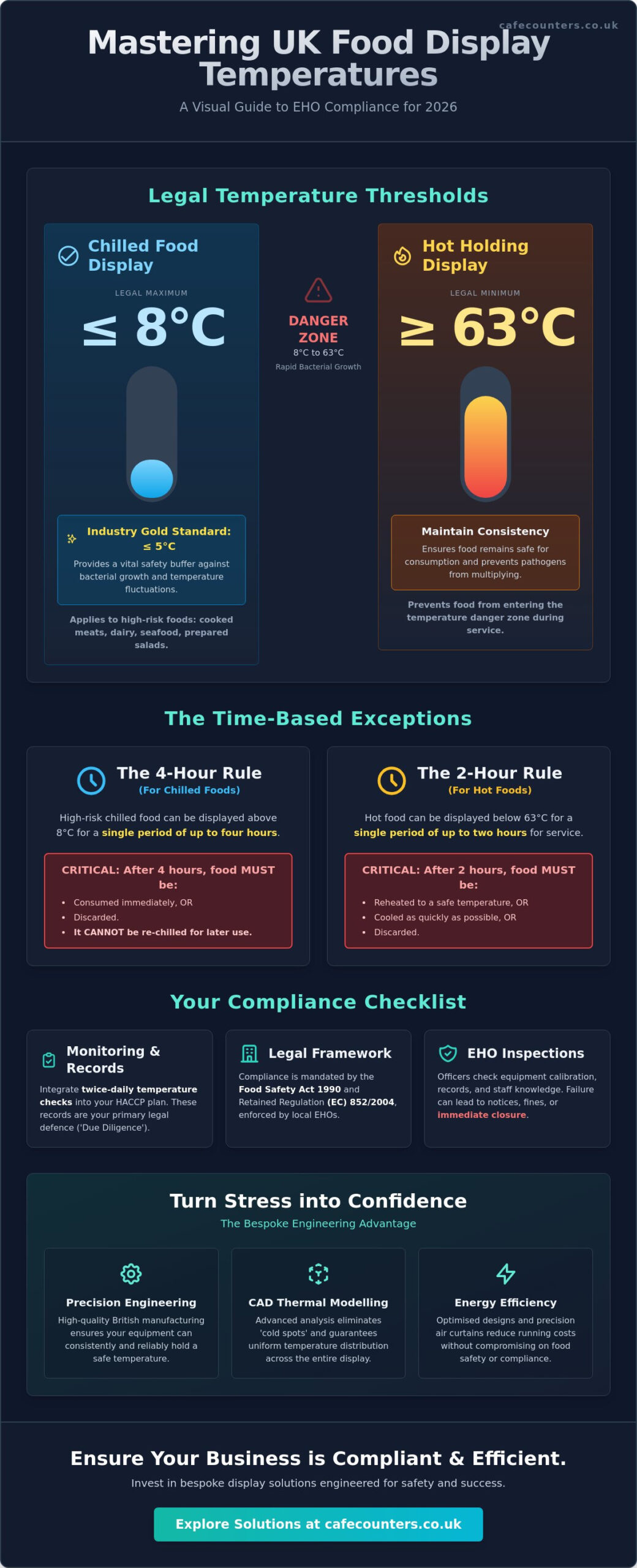
Precision is the hallmark of any professional kitchen; it’s especially critical when managing the thermal environment of chilled displays. Under current UK food display temperature regulations, high-risk foods must be held at or below 8°C. This category includes items that support the rapid growth of pathogenic bacteria, such as cooked meats, dairy products, seafood, and prepared salads. While 8°C is the legal ceiling, we always advise our clients to aim for the industry gold standard of 5°C or lower. Maintaining this tighter margin provides a vital safety buffer that accounts for frequent door openings or fluctuations in ambient room temperatures during a busy lunch service.
The statutory basis for these requirements is found in The Food Safety and Hygiene (England) Regulations 2013. For operators, this means equipment must be robust enough to hold these temperatures consistently. In a high-traffic retail environment, refrigerated grab and go display units rely on precision-engineered air curtains to maintain this stability. These invisible barriers of recirculated cold air prevent warmer ambient air from infiltrating the display area, protecting the product without obstructing the customer’s access. It’s a delicate balance of engineering that ensures your stock remains safe and visually appealing from the first customer to the last.
Understanding the 4-Hour Display Exception
The law provides a specific exemption for displaying chilled food above 8°C for a single period of up to four hours. This is particularly useful for temporary buffets or events where constant refrigeration isn’t practical. However, the criteria are strict. Once that four-hour window expires, the food must be used immediately or discarded. It can’t be returned to the refrigerator for later use. To remain compliant, you must keep clear records that document exactly when the food was removed from temperature-controlled storage, providing a transparent audit trail for any visiting Environmental Health Officer.
Equipment Factors for Chilled Compliance
Effective temperature control starts with the physical design of the counter. In a deli counter, internal airflow must be meticulously balanced to eliminate ‘warm spots’ that could compromise food safety. Professional units feature digital thermostats and external temperature displays, allowing your team to monitor performance at a glance. When we design bespoke serving counters, we integrate high-specification refrigeration systems that are perfectly tuned to the specific layout and heat load of your space. This tailored approach ensures that your equipment isn’t just functional, but remains a reliable partner in your compliance strategy.
Hot Holding Regulations: Maintaining Safety at 63°C
Transitioning from chilled storage to hot service requires a different set of precision engineering and management protocols. In England, Wales, and Northern Ireland, the legal requirement for holding hot food is a minimum core temperature of 63°C. This threshold is a non-negotiable pillar of UK food display temperature regulations, designed to keep food well out of the “danger zone” where bacteria thrive. Maintaining this temperature consistently is the only way to ensure that your business remains safe and compliant during busy service periods.
One of the greatest challenges for operators is achieving temperature uniformity across the entire display area. Many standard units suffer from cold spots, where food can quickly dip below the legal limit even if the thermostat suggests otherwise. Our Vision Heated Counters are engineered to provide even thermal distribution, ensuring that every portion of food is held at a safe and consistent temperature. This level of control doesn’t just satisfy the EHO; it also helps manage food quality. By using precision-tuned heating elements, you can avoid the common problem of food drying out or overcooking while it sits in the display, preserving the prestigious look and taste of your menu.
The 2-Hour Exception for Hot Food
There are times during service when food may fall below the 63°C limit. The law allows for a single period of up to two hours for displaying hot food below the legal threshold. It’s vital to remember that this is a “once only” rule. You cannot reheat this food and return it to the display, nor can you put it back into hot holding once the window has closed. If the food isn’t sold or consumed within that two-hour period, it must be discarded. We recommend a simple, colour-coded labelling system to track these windows, providing a transparent audit trail for your staff and inspectors alike.
Choosing Between Dry and Moist Heat
The method you choose to maintain heat has a significant impact on both compliance and the longevity of your food. Bain maries utilize moist heat, which is often preferred for delicate items like sauces or stews to prevent them from seizing. In contrast, heated gantries and dry-heat units are ideal for plated meals and high-volume service. We often integrate overhead quartz lamps into our bespoke serving counters to provide targeted surface heat and a warm, inviting glow. A heated food display must be commissioned by a professional to ensure thermal accuracy. This ensures that the equipment is calibrated perfectly for your specific environment and heat load.
Monitoring, Record Keeping, and HACCP Integration
A high-performance display unit is only one half of the compliance equation. To satisfy UK food display temperature regulations, your business must operate under a robust Hazard Analysis and Critical Control Point (HACCP) plan. This system isn’t just a folder on a shelf; it’s a live framework that identifies where food safety risks occur in your display and how you mitigate them. While some basic templates suggest daily checks, the professional standard is twice-daily monitoring. This frequency allows you to catch equipment fluctuations early, before they compromise the safety of your high-risk stock or lead to costly food waste.
The choice between digital and paper logs often depends on the scale of your operation. Paper records are simple and require no technical setup, but they’re prone to human error and physical damage. Digital systems, often integrated into modern display units or managed via mobile apps, provide real-time alerts and more reliable data for an EHO. Regardless of the format, your records must be accurate, chronological, and readily available for inspection to prove your commitment to food safety.
Effective Temperature Monitoring Protocols
Consistent monitoring requires more than just reading a dial on a display unit. Your team should use calibrated probe thermometers to conduct regular checks throughout the day. This involves several critical steps:
- Between-pack testing: This is ideal for grab and go displays, allowing you to check temperatures by placing the probe between two items without piercing the packaging.
- Core temperature probing: This remains the most accurate method for hot-held items or deli products, ensuring the centre of the food meets the required safety threshold.
- Sanitisation: Probes must be cleaned with food-safe disinfectant wipes before and after every use to eliminate the risk of cross-contamination between different food groups.
If a reading falls outside the safe range, your HACCP plan must dictate immediate corrective actions. This might involve moving food to a backup unit, adjusting the thermostat, or discarding items that have exceeded the 2-hour or 4-hour windows discussed in previous sections.
Calibration and Equipment Maintenance
An uncalibrated probe is a liability. We recommend using the ‘Ice Point’ method, ensuring the probe reads 0°C in a slurry of crushed ice and water, or the ‘Boiling Point’ method, checking for a 100°C reading in boiling water, at least once a month. Beyond the probes, the refrigeration and heating systems themselves require professional attention. Regular servicing isn’t just about longevity; it’s a legal safety requirement to ensure mechanical components can reliably sustain the necessary thermal environment. When we design your bespoke serving counters, we ensure that monitoring points are ergonomically placed, making it easier for your staff to maintain these vital records as a seamless part of their daily workflow.
Engineering for Compliance: The TFSE Bespoke Advantage
Compliance with UK food display temperature regulations is fundamentally an engineering challenge. While management protocols and record-keeping are vital, they rely entirely on the physical capability of your equipment to sustain specific thermal environments under pressure. Our British manufacturing heritage allows us to build robustness into every weld and join. We use high-grade, food-grade stainless steel for our internal components and back-bar units, ensuring that hygiene is built into the very structure of the counter. This material choice isn’t just about aesthetics; it’s about creating a non-porous, easily sanitised surface that stands up to the rigours of commercial use.
Before we begin manufacturing, we utilize advanced CAD modelling to predict thermal performance. This allows us to visualize airflow and identify potential cold or hot spots during the design phase. By simulating the internal environment of a patisserie display or a heated gantry, we ensure that every unit is capable of maintaining the strict 8°C or 63°C thresholds required by law. This methodical approach transforms a conceptual design into a high-performance physical space, giving you total confidence in your equipment’s reliability.
Bespoke Design Meets Regulatory Rigour
Standard off-the-shelf units often struggle during high-ambient UK summers, where rising room temperatures can cause standard refrigeration to fail. We customise insulation levels and refrigeration power to suit your specific site conditions. Whether you’re operating in a glass-fronted retail unit or a high-traffic education canteen, your equipment needs to be tuned to its environment. Our Concept to Completion service includes professional installation and commissioning, ensuring your equipment is calibrated perfectly from the moment you switch it on. This eliminates the guesswork and provides a solid foundation for your due diligence defence.
Sustainable and Compliant Solutions
Modern catering environments demand energy efficiency, but this should never come at the cost of safety. We integrate sustainable technologies, such as low-energy fans and high-density insulation, to reduce your operational costs while maintaining total compliance with UK food display temperature regulations. TFSE Products Ltd supports businesses across the country with national installation services, providing a steady, reliable hand in a complex industry. If you’re planning a new build or a renovation, contact us for a bespoke counter consultation to ensure your vision meets the highest safety standards.
Securing Your Operational Excellence for 2026 and Beyond
Navigating the complexities of UK food display temperature regulations requires a balance of diligent management and high-specification equipment. By mastering the 8°C and 63°C legal thresholds and correctly applying time-limited display exceptions, you protect both your customers and your professional reputation. Compliance is not merely a box-ticking exercise; it’s the foundation of a successful, safe, and prestigious catering environment.
Since 1991, we’ve partnered with businesses across the UK to translate these regulations into functional, beautiful physical spaces. Our UK-based manufacturing facility utilizes expert CAD modelling to ensure every bespoke unit delivers the thermal stability your menu demands. From initial concept to final installation, our project management team provides the steady hand needed to alleviate the stress of regulatory compliance. Explore our range of compliant commercial food display counters to see how precision engineering can transform your service. With the right technical partner, you can stop worrying about EHO inspections and focus on what you do best: delivering an exceptional dining experience.
Frequently Asked Questions
What is the legal temperature for displaying cold food in the UK?
The legal requirement for high-risk chilled foods is 8°C or below. Under UK food display temperature regulations, this applies to items like cooked meats, dairy, and prepared salads. While 8°C is the law, we recommend maintaining a best-practice temperature of 5°C. This lower target provides a safety buffer during busy periods when display doors are frequently opened, ensuring your stock remains within the safe zone.
How long can food be left out of the fridge for display?
Chilled food can be displayed above 8°C for a single period of up to four hours. This exception helps with service in environments like buffets or temporary retail events. Once this four-hour window has passed, you must either serve the food immediately or discard it. You cannot return these items to the refrigerator to be sold later or on the following day.
What is the 2-hour rule for hot food display?
The 2-hour rule allows hot food to be displayed below the mandatory 63°C threshold for a single two-hour window. This is a “once only” provision to allow for flexibility during service. If the food isn’t sold within those two hours, it must be disposed of safely. You aren’t permitted to reheat this food or return it to hot holding, as this increases the risk of bacterial growth.
Do I legally have to keep temperature records for my cafe display?
Yes, maintaining accurate temperature logs is a legal requirement under your HACCP plan. These records serve as your primary evidence of due diligence during an Environmental Health Officer inspection. We suggest logging temperatures at least twice daily. This practice ensures your equipment, such as grab and go displays, is performing correctly and that you’re actively monitoring your critical control points.
What temperature should a hot display counter be set at?
Your hot display counter must maintain food at a core temperature of at least 63°C. To achieve this, the unit’s thermostat is often set slightly higher, depending on the ambient conditions and the type of food being held. Using precision-engineered equipment like heated gantries ensures even heat distribution. This prevents the top layers of food from cooling down while the base remains hot, keeping you compliant.
Can I display cakes and pastries at room temperature?
You can only display cakes and pastries at room temperature if they don’t contain high-risk ingredients. Items with fresh cream, meat fillings, or soft cheeses must be held in refrigerated units to meet UK food display temperature regulations. For ambient goods, ensure they’re protected from contamination using high-quality glass screens or covers, which also helps maintain the visual impact of your display.
What happens if my fridge display hits 9°C during a busy service?
If your display exceeds 8°C, you must trigger your corrective action plan immediately. You can keep the food on display for up to four hours from the time it first rose above the limit. If you can’t prove when the temperature spiked, you should discard the high-risk items. Regular servicing of your deli counters helps prevent these mechanical fluctuations during peak trading hours.
How often should I calibrate my food temperature probe?
You should calibrate your food temperature probes at least once a month to ensure total accuracy. This involves testing the probe in a crushed ice slurry for a 0°C reading and in boiling water for a 100°C reading. Recording these results in a calibration log is essential for your safety audit. Accurate probes are the only way to verify that your bespoke serving counters are operating within legal limits.