
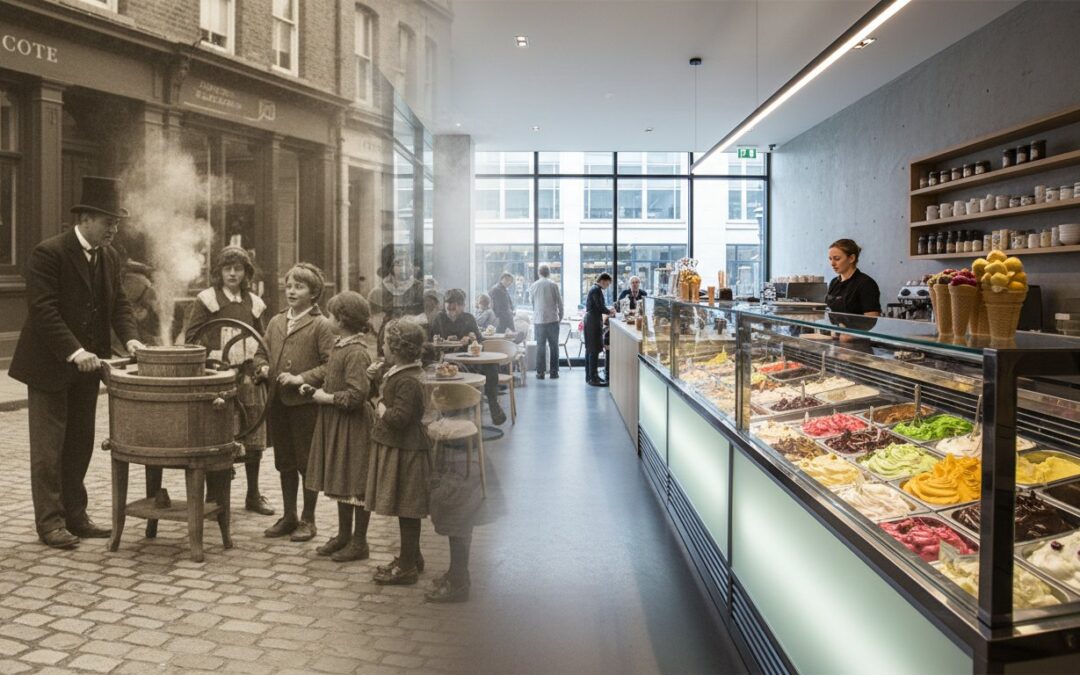
How did a luxury once reserved for Tang Dynasty emperors and 17th-century royalty become the £1.4 billion industry that powers British high streets today? While many operators find themselves caught between conflicting myths when trying to pin down exactly where and when was ice cream invented, the reality is a fascinating tale of engineering and ambition. You likely recognize that your customers value a compelling story as much as a high-quality scoop, yet finding professional context for these historical milestones can be a challenge. We understand that your cafe is more than just a shop; it’s a space where heritage meets modern functionality.
This article uncovers the true origins of ice cream, tracing its path from the chilled honey-waters of ancient Persia to the first UK ice cream parlour opened in the mid-1800s. You’ll gain authoritative knowledge to share with your patrons and understand how the evolution of cooling technology transformed an ancient luxury into a robust cafe staple. We’ll examine the journey from the earliest hand-cranked churns to the bespoke, high-performance refrigeration units that define successful commercial spaces today.
Key Takeaways
- Trace the true origins back to the Tang Dynasty in China to understand where and when was ice cream invented and how early recipes utilised buffalo milk and camphor.
- Separate historical fact from Victorian fiction by debunking popular myths surrounding Marco Polo and Catherine de’ Medici’s role in European ice cream history.
- Learn how British innovations and the 19th-century Industrial Revolution transitioned this frozen delicacy from an exclusive royal luxury into a commercial high-street staple.
- Discover how the invention of mechanical refrigeration and the hand-cranked freezer paved the way for the bespoke, high-performance display solutions used in modern cafes today.
- Understand why precision temperature control remains the cornerstone of product quality and how a robust display counter serves as a vital storytelling tool for your brand.
The Ancient Origins: Where and When Was Ice Cream First Invented?
Understanding the heritage of your product is a vital step for any cafe owner looking to build a premium brand. When we look at the technical evolution of frozen desserts, the consensus among historians is clear. The definitive answer to where and when was ice cream invented points to China during the Tang Dynasty, which lasted from 618 to 907 AD. While earlier civilisations enjoyed chilled delicacies, this era marked the transition from simple ice-based treats to the complex dairy structures we recognise today.
The creation of these early desserts required a sophisticated logistical operation. It relied on a dedicated team of “ice-men” who harvested mountain snow and stored it in deep pits. This was not merely a culinary feat; it was a demonstration of engineering and resource management. To achieve the necessary temperatures for freezing, ancient creators utilised saltpetre mixed with water. This process created an endothermic reaction, lowering the freezing point of the mixture and allowing for a consistent, chilled texture that would otherwise be impossible in a warm climate.
The Tang Dynasty Innovation
The true breakthrough in dairy-based frozen treats is often attributed to the court of King Tang of Shang. He reportedly employed a staff of 94 ice-men to ensure a steady supply of frozen ingredients. The base of this ancient ice cream was a mixture of buffalo, cow, and goat milk, which was thickened with flour to provide structure.
Unlike the vanilla or chocolate profiles common in modern UK parlours, this version used camphor as a primary flavouring agent. Camphor is a resin harvested from evergreen trees; it provided a sharp, cooling sensation that complemented the creamy texture. The mixture underwent a primitive fermentation process, resulting in a yoghurt-like consistency that was then frozen. This meticulous method highlights a level of craftsmanship that mirrors the bespoke approach we take in modern commercial kitchen design.
Ancient Rome and the Persian Sharbat
It is essential to distinguish between true dairy ice cream and its precursors. Centuries before the Tang Dynasty, Emperor Nero (37–68 AD) famously dispatched runners into the mountains to retrieve snow. This ice was mixed with honey and fruit juices to create a refreshing treat. However, these were “water ices” rather than dairy products. You can find more detail on these early variations in this Comprehensive History of Ice Cream
The European Renaissance: Ice Cream Reaches the United Kingdom
The journey of frozen treats shifted significantly during the 16th century as European trade routes expanded. While early iterations existed in Asia, the question of where and when was ice cream invented as a refined dairy product leads us directly to the courts of Italy and France. During this era, creating ice cream wasn’t just about flavour; it was a demonstration of scientific mastery. Confectioners used the endothermic effect, mixing salt with ice to lower the freezing point of liquids. This process was often viewed as a chemist’s party trick rather than a standard culinary practice. You can read more about The Ancient Origins of Ice Cream to see how these early experiments evolved from simple chilled drinks. Elite confectioners in Florence and Naples refined these methods, moving from basic snow-cooled beverages to the structured, creamy textures we recognise today.
Royal Patronage and the First UK Mentions
In the United Kingdom, the first official record of the term “ice cream” appears in 1671. It was served at a Feast of St. George for King Charles II at Windsor Castle. At this specific event, only the King was served the delicacy; the other guests at the table watched him eat it. This exclusivity remained for over 130 years. To maintain such a luxury, British country estates built elaborate Ice Houses. These were brick-lined, subterranean structures designed to store ice collected from ponds during winter. The technical precision required to build these functional spaces mirrors the standards we apply when designing bespoke cafe interiors today. Without these robust storage solutions, ice cream would have remained a fleeting seasonal novelty for the ultra-elite.
The Italian Influence on Modern Gelato
The 1660s marked a turning point in Naples and Florence with the rise of “water ices” or sorbetto. Antonio Latini, a steward to a Spanish Viceroy in Naples, published the first written recipe for a sorbet in 1692. These Italian techniques eventually reached the British public through skilled immigrant confectioners who established shops in London. By the late 17th century, recipe books began to standardise dairy-based ices, moving away from simple frozen water. These early pioneers prioritised quality and consistency, much like a modern cafe operator focuses on reliable equipment and ergonomic layouts to ensure a seamless service. The transition from a royal curiosity to a commercial product required both culinary innovation and the right physical infrastructure to support it.
- 1671: First recorded use of the term “Ice Cream” in UK royal records.
- 1692: Antonio Latini publishes the first sorbet recipes in Naples.
- 1700s: Ice Houses become a standard feature on prestigious British estates.
- 18th Century: Italian confectioners begin standardising dairy-based recipes for wider European distribution.

Debunking the Myths: Marco Polo and Catherine de’ Medici
For any cafe owner planning a bespoke gelato station or a traditional ice cream parlour, distinguishing between marketing folklore and historical fact is essential. Many popular stories regarding where and when was ice cream invented rely on romanticised Victorian narratives rather than verified archival evidence. These legends often simplify a complex process of scientific evolution into a single “eureka” moment involving famous historical figures.
The Marco Polo Legend
The claim that Marco Polo returned from China in 1295 with recipes for water ices is a persistent legend. However, his original manuscripts contain no mention of these frozen desserts. This specific origin story gained traction through 20th-century marketing campaigns, particularly those in the 1920s, designed to popularise ice cream in the United States. While China had developed chilled dairy products, the technology for modern ice cream has more documented roots in Arab medical texts. These texts described the use of saltpetre to lower the freezing point of water centuries before Polo’s travels. Professional historians now view the Polo narrative as a charming but baseless fabrication that obscures the actual scientific contributions of Middle Eastern scholars.
The Medici Myth
Another common myth suggests Catherine de’ Medici introduced ice cream to the French court in 1533 upon her marriage to Henry II. Historians now recognise this as a 19th-century fabrication by culinary writers who sought to romanticise the history of French cuisine. There is no mention of ice cream in French royal records until the late 1600s, over a century after Catherine’s arrival. Relying on verified culinary records is vital for anyone in the hospitality sector who values authenticity. Instead of a royal introduction, the shift from chilled drinks to solid frozen desserts came from anonymous 16th-century confectioners and scientists who perfected the endothermic effect of salt and ice.
The transition from these early experiments to a commercial staple was a slow, technical journey. To understand how these early experiments evolved into a high-street product, one can look at The Industrial Revolution of Ice Cream, which details the technological shift from royal luxury to a scalable business model. This historical accuracy is vital when considering where and when was ice cream invented, as it highlights that the industry was built on technical innovation rather than royal decree. Modern cafe owners can take pride in this heritage of craftsmanship, knowing that the “perfect scoop” is the result of centuries of refinement by dedicated makers.
- 1295: The year Polo allegedly returned, though no ice cream records exist.
- 1533: The debunked date for Catherine de’ Medici’s influence on French frozen desserts.
- 17th Century: The actual period when solid frozen desserts began appearing in European culinary texts.
The Industrial Revolution: Making Ice Cream a Commercial Staple
The 19th century transformed ice cream from an elite luxury into a global commercial powerhouse. While earlier history focuses on royal banquets, understanding where and when was ice cream invented as a mass-market product requires a look at the Victorian era. Between 1840 and 1900, a series of British and American innovations moved production out of private kitchens and into steam-powered factories. This era replaced slow, manual labour with mechanical precision, allowing the hospitality sector to scale operations for the first time.
From Hand-Cranking to Automation
Nancy Johnson changed the industry forever in 1843 when she patented the “Artificial Freezer.” Before this, making a single batch required hours of “pot-freezing” by hand. Her design used a hand-cranked handle and a geared paddle that simultaneously stirred and aerated the mixture. This created a smoother, more consistent texture than ever before. It didn’t take long for entrepreneurs to see the potential for profit. In 1851, Jacob Fussell established the first wholesale ice cream factory. By utilising surplus cream from his dairy business, he slashed production costs. This shift was monumental; it democratised the dessert, making it affordable for the average worker rather than just the aristocracy.
- 1843: Nancy Johnson patents the hand-cranked freezer, improving aeration.
- 1851: Jacob Fussell opens the first wholesale plant, creating the industrial model.
- Cost Reduction: Mass production lowered retail prices, sparking a surge in high-street demand.
The Birth of Modern Refrigeration
The reliance on harvested lake ice remained a major bottleneck until the late 1870s. Carl von Linde’s invention of the ammonia refrigerator in 1876 provided the temperature stability that modern cafe owners now take for granted. This technology ended the era of the “ice house” and allowed for the creation of dedicated ice cream parlours. Instead of keeping products hidden in insulated pits, retailers could finally showcase their offerings to customers. This evolution led directly to the development of sophisticated refrigerated grab and go display units, which remain essential for driving impulse purchases in British cafes today.
By the 1890s, the emergence of the “Soda Fountain” solidified ice cream’s place in the commercial landscape. These venues weren’t just shops; they were social hubs that required bespoke counters and functional layouts. The transition from hidden storage to front-of-house display meant that aesthetics began to matter as much as the product itself. For the modern operator, this historical shift highlights the importance of a seamless, professional fit-out that balances technical cooling needs with visual appeal.
If you’re looking to upgrade your service area with professional-grade equipment, contact the experts at Cafe Counters to discuss your bespoke installation.
Modern Display Standards: Preserving the Legacy in Your Cafe
Understanding where and when was ice cream invented provides more than just a historical footnote; it establishes a standard of luxury that your equipment must uphold. While the Tang Dynasty ice-men used saltpetre and snow, the modern cafe owner relies on sophisticated thermodynamic engineering to protect their margins. Temperature control is the single most critical factor in preserving the integrity of your product. If your display unit fails to maintain a consistent environment, the delicate balance of fats and sugars breaks down. This leads to recrystallisation, creating a grainy texture that alienates discerning customers. Choosing the right equipment is about honouring a 1,400-year history by ensuring every scoop is served exactly as intended.
Visual Appeal and Temperature Stability
The science of the perfect scoop depends on preventing the growth of ice crystals through stable, forced-air cooling. Modern units must maintain a precise serving temperature, typically between -14°C and -16°C, to ensure the product remains pliable yet firm. Integrating patisserie display counters alongside dedicated gelato units creates a high-impact visual destination that drives impulse purchases. For the “soda jerks” of 2026, ergonomics are equally vital. Well-designed counters reduce the physical strain on staff during peak hours, allowing for faster service without compromising the presentation of the product.
The Future of Ice Cream Displays
The UK market is moving away from “off-the-shelf” solutions in favour of bespoke cafe counters that reflect a brand’s unique heritage. These custom installations allow you to blend traditional aesthetics with energy-efficient technologies that would have baffled ancient innovators. Modern hydrocarbon refrigerants and low-emissivity glass can reduce energy consumption by up to 35% compared to older models. This shift toward sustainable, high-performance manufacturing ensures your business remains profitable while maintaining the highest quality standards. At Cafe Counters, we provide a complete Concept to Completion service, ensuring your vision is backed by robust British craftsmanship.
Investing in a professional display isn’t just a purchase; it’s a commitment to quality that spans centuries. Don’t leave your reputation to chance with inferior cooling systems. Consult with a food display manufacturer UK to build your legacy and ensure your cafe remains a destination for years to come.
Transforming Frozen History Into Your Cafe’s Future
From the chilled honey-and-rice delicacies of China’s Tang Dynasty in 618 AD to the industrial innovations of the 19th century, the evolution of frozen desserts is a story of constant refinement. Understanding where and when was ice cream invented provides the context needed to appreciate the high-quality products you serve your customers today. Transitioning from ancient snow-pits to modern commercial staples required centuries of engineering and culinary curiosity. Now, the challenge for cafe owners is to preserve that heritage using equipment that balances aesthetic appeal with operational efficiency.
Since 1991, TFSE Products has provided the UK hospitality industry with decades of manufacturing expertise. We offer a comprehensive Concept to Completion service for bespoke fit-outs, ensuring every detail of your space is handled by a single, reliable partner. Our energy-efficient, British-made refrigerated display solutions are built to last; they combine robust functionality with the prestigious finish your brand deserves. Design your perfect ice cream or patisserie display with TFSE Products and give your business the professional foundation it needs to thrive. We’re ready to help you turn your vision into a physical reality that stands the test of time.
Frequently Asked Questions
Who is credited with inventing ice cream?
No single individual is responsible for the invention, as the dessert evolved across different cultures over several centuries. Historical records credit the Tang Dynasty in China with creating the first milk based frozen treat between 618 and 907 AD. Later, in 1686, Francesco Procopio dei Coltelli opened Café Procope in Paris, where he refined the recipe into the creamy consistency we recognise today.
Was ice cream really invented in China?
Historical evidence confirms that early versions of frozen desserts originated in China during the Tang Dynasty, which spanned from 618 to 907 AD. Emperors enjoyed a mixture of buffalo milk, flour, and camphor that was frozen in metal tubes submerged in an ice and salt pool. This discovery is a vital part of understanding where and when was ice cream invented before it transitioned to European royal courts.
When did ice cream first arrive in the UK?
Ice cream made its official debut in the UK in 1671 during a prestigious feast for the Knights of the Garter at Windsor Castle. At this exclusive event, King Charles II was the only person served the rare delicacy, which was documented as “one plate of ice cream.” It remained a luxury for the elite until the mid 19th century when production became more accessible.
Did Marco Polo bring ice cream to Europe?
While popular legend suggests Marco Polo brought ice cream recipes from China to Italy in 1295, most historians find little evidence to support this claim in his writings. It’s more likely that the knowledge of chilled desserts travelled through established trade routes from the Middle East. Despite the myth, Italian artisans played a crucial role in developing the techniques that define modern professional confectionery.
How was ice cream kept cold before electricity?
Before mechanical refrigeration was developed in the mid 19th century, ice cream was stored in insulated ice houses built deep underground. Workers harvested large blocks of ice from frozen lakes during winter and packed them with straw for insulation. To freeze the dessert, chefs used the “pot-in-pail” method, mixing ice with salt to lower the temperature enough to solidify the cream.
What is the oldest ice cream flavour?
The oldest recorded flavours were based on floral and spiced ingredients like honey, saffron, and rosewater, which were used in Persia as early as 400 BC. Regarding modern dairy recipes, chocolate was actually documented before vanilla. A recipe for a chocolate frozen treat appeared in the 1692 Italian book, “The Modern Steward,” reflecting the robust and adventurous tastes of the era’s culinary pioneers.
When was the first ice cream cone invented?
Italo Marchiony was granted a patent for a machine that made edible ice cream cups in 1896, but the conical shape became famous at the 1904 St. Louis World’s Fair. During the fair, a waffle vendor named Ernest Hamwi rolled his thin pastries to assist an ice cream seller who had run out of clean glass bowls. This ergonomic solution quickly became a staple for high street vendors.
Why was ice cream once considered a luxury for royalty?
Ice cream was a status symbol because the cost of harvesting, transporting, and storing natural ice was prohibitively high for most people. Only royal households possessed the land and wealth to maintain dedicated ice houses and employ the manual labour required for constant churning. This exclusivity lasted until 1851, when the first wholesale ice cream factory opened, making the treat affordable for the public.