
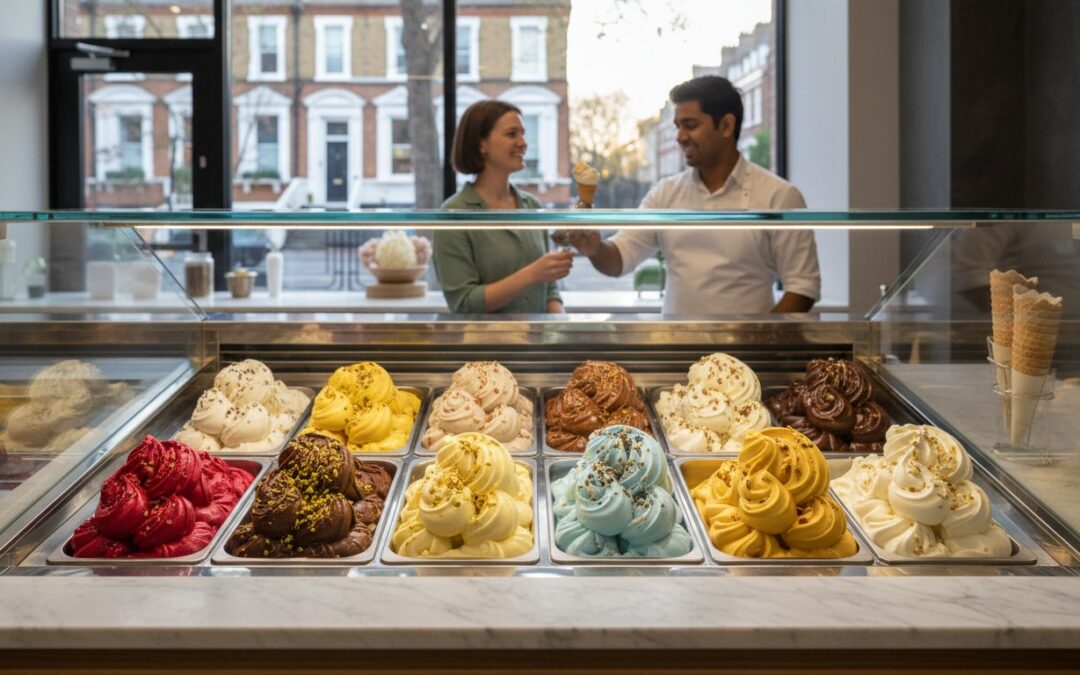
For centuries, the secret to a perfect frozen dessert was more guarded than the crown jewels, reserved exclusively for the elite tables of Roman emperors and Persian royalty. You likely recognise ice cream as a reliable staple of the British high street, yet the question of who made the ice cream often leads to a tangled web of myths involving figures like Marco Polo or Catherine de’ Medici. It’s often difficult to find a clear narrative that connects these ancient origins to the high-performance standards required by a modern catering business.
We agree that understanding your product’s heritage is essential for building a premium brand that resonates with discerning customers. This article promises to clarify the timeline of ice cream’s evolution, showing how British manufacturing expertise transformed a rare luxury into a sophisticated retail masterpiece. We’ll examine the transition from 400 BC Persian cooling pits to contemporary bespoke displays, giving you the technical knowledge to present your own dessert range with absolute professional confidence.
Key Takeaways
- Trace the journey of the world’s favourite dessert from ancient snow-chilled delicacies to the global retail powerhouse it is today.
- Uncover the true origins of who made the ice cream a commercial success, highlighting the 19th-century innovations that transformed it from an elite luxury into a high-street staple.
- Understand how modern glass-fronted display units drive impulse purchases by prioritising visibility and aesthetic appeal over traditional “blind” storage.
- Master the technical standards of temperature control necessary to prevent heat shock and preserve the smooth, premium texture of your product.
- Learn why bespoke British manufacturing is essential for creating a prestigious retail environment that aligns with your brand’s unique vision.
The Early History: Who Truly Invented Ice Cream?
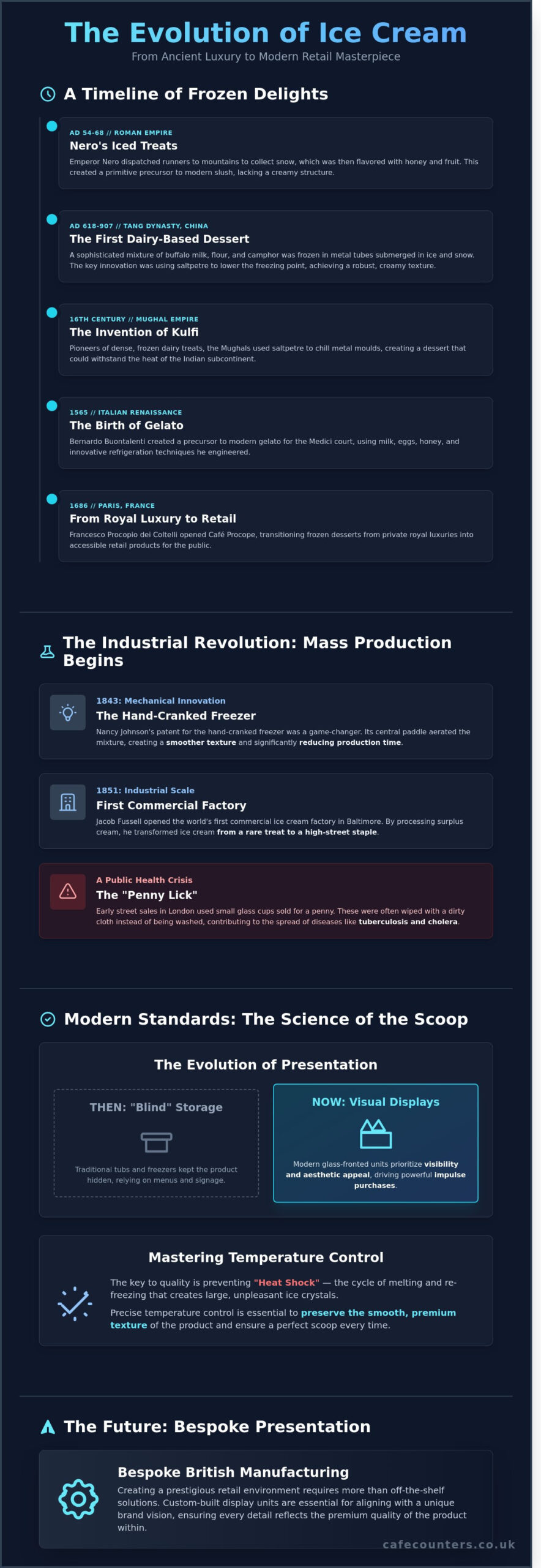
Pinpointing exactly who made the ice cream we enjoy today is less about identifying a single inventor and more about tracing a global technical evolution. For centuries, diverse cultures experimented with temperature control and ingredients to create frozen delicacies. Records from the Roman Empire suggest that Emperor Nero, reigning between AD 54 and 68, frequently dispatched runners into the mountains to collect snow. This ice was subsequently flavoured with honey and fruit, creating a primitive precursor to the modern slush. However, these early attempts lacked the creamy structure that defines the contemporary product.
The Mughal Empire played a critical role in the 16th century by refining the production of kulfi. By utilizing saltpetre to chill metal moulds, they achieved a dense, frozen dairy treat that stood up to the heat of the Indian subcontinent. While legend often credits Catherine de’ Medici with introducing frozen desserts to the French court upon her marriage to Henry II in 1533, many historians view this as a romanticised myth. The reality is that the transition from chilled fruit water to dairy-based cream was a gradual process driven by culinary professionals seeking to impress the European aristocracy with bespoke creations.
Ancient China and the First “Ice Cream”
The most credible evidence of an early dairy-based frozen dessert originates from the Tang Dynasty, which ruled China between AD 618 and 907. Court records describe a sophisticated mixture of buffalo milk, flour, and camphor, which was placed into metal tubes and lowered into pools of ice and snow. This period marked a significant shift in food preservation and luxury dining. The technical breakthrough involved the use of saltpetre, a mineral that, when added to water, lowers the freezing point. This chemical reaction allowed Chinese confectioners to freeze their milk mixtures more effectively, providing a robust texture that earlier snow-based recipes could not achieve.
The Italian Renaissance Influence
The 16th century Italian Renaissance serves as the foundation for the commercial ice cream industry. In 1565, the Florentine architect Bernardo Buontalenti is credited with inventing a precursor to modern gelato for the court of Cosimo I de’ Medici. Buontalenti utilised his skills in engineering to design innovative refrigeration techniques, creating a frozen cream made from milk, eggs, and honey. This paved the way for the commercialisation of the craft, which reached a turning point in 1686 when Francesco Procopio dei Coltelli opened Café Procope in Paris. By refining his recipes and serving them in a prestigious public setting, Procopio transitioned frozen desserts from private royal luxuries into accessible retail products. Sorbetto functions as the essential historical bridge connecting ancient crushed ice with the structured dairy creams of the modern era.
Understanding who made the ice cream requires acknowledging this journey from Chinese innovation to Italian craftsmanship. Each stage of development focused on improving the stability and mouthfeel of the product, much like the precision engineering we apply to modern commercial kitchen builds. These historical milestones ensured that by the time the dessert reached British shores, the technical groundwork for a global industry was already firmly in place.
The Industrial Revolution: Making Ice Cream a Global Business
The 19th century marked a pivotal shift in the production and accessibility of frozen desserts. Before this era, ice cream remained an exclusive luxury for the elite. The question of who made the ice cream transitioned from private chefs in royal kitchens to industrial pioneers who utilised new mechanical technologies. In 1843, Nancy Johnson patented the hand-cranked freezer. This device used a central paddle to aerate the mixture, creating a smoother texture than previous manual methods. It reduced production time significantly, allowing smaller vendors to enter the market with more consistent results.
By 1851, Jacob Fussell established the first commercial ice cream factory in Baltimore, though his influence quickly crossed the Atlantic. He realised that surplus cream could be processed into a frozen product with a longer shelf life. This move towards wholesale production shifted ice cream from a rare treat to a high-street staple. However, early street sales faced significant hygiene challenges. The “Penny Lick,” a small glass cup sold for one penny, became popular in London. Because these glasses were often wiped with a dirty cloth rather than washed between customers, they contributed to the spread of tuberculosis and cholera. This public health risk eventually spurred a demand for more hygienic, robust serving solutions and disposable options.
British Innovations in the 19th Century
Agnes Marshall, often called the “Queen of Ices,” revolutionised the UK market. Her 1885 publication, The Book of Ices, provided domestic and professional cooks with technical instructions for complex moulds and flavours. Marshall even suggested using liquid oxygen to freeze ice cream, a precursor to modern molecular gastronomy. While the 1904 World’s Fair in St. Louis popularized the edible cone, British hospitality providers were already organising dessert service into formalised, ergonomic workflows. For businesses looking to emulate this historical excellence with a modern touch, investing in a bespoke shopfitting service ensures that traditional quality meets contemporary efficiency.
The Advent of Mechanical Refrigeration
The reliance on natural ice harvested from frozen lakes ended with Carl von Linde’s 1876 ammonia refrigeration patents. This technology allowed for consistent temperature control without the logistical burden of ice houses. It enabled the birth of the modern ice cream parlour layout. Retailers could finally install permanent, seamless display counters that kept products at the perfect serving consistency throughout the day. This shift from temporary street stalls to fixed, functional retail spaces allowed for the prestigious interiors we recognise today. When considering who made the ice cream accessible to the masses, the engineers who designed these cooling systems were just as vital as the confectioners themselves. This era established the blueprint for the modern catering environment, where technical reliability supports culinary creativity.
The Evolution of Presentation: From Tubs to Stunning Displays
The journey of ice cream retail has moved from functional storage to high-end theatre. In the early 1920s, vendors kept products hidden in opaque, top-loading “blind” freezers. Customers couldn’t see the texture or colour of the dessert until the lid was lifted, limiting sales to those who already knew what they wanted. This changed significantly in the 1950s with the introduction of glass-fronted cabinets. Visibility is now the primary driver of impulse sales. Industry data indicates that visual appeal accounts for approximately 70% of food selection decisions in retail environments. When patrons ask who made the ice cream, they’re often influenced by the artistry of the display before they’ve even tasted the product. Integrating these units into a bespoke cafe counter ensures the equipment doesn’t just work well, it looks like a natural extension of the brand’s identity.
The Psychology of the Visual Display
Commercial success depends on stimulating the senses. Modern refrigerated grab and go display units have transformed how luxury gelato is sold by placing it at eye level. High-end patisseries use curved “jewellery box” glass styles to create a sense of prestige. This framing tells the customer the product is a premium treat. Internal LED lighting with a Colour Rendering Index (CRI) of 90 or higher is now the industry standard. It makes colours pop and highlights the creamy textures that define high-quality desserts. This visual clarity turns a simple purchase into an experience, encouraging customers to try new flavours they might have otherwise ignored.
Material Choice and Durability
The shift from wooden cabinets to food grade stainless steel in the mid-20th century revolutionised hygiene and longevity. Stainless steel provides a non-porous surface that resists bacterial growth, which is critical for dairy products. Modern manufacturers balance this utility with energy-efficient double-glazed glass that reduces heat gain by up to 40%. This ensures the ice cream stays at a consistent -14°C to -18°C, preventing the formation of ice crystals. Expertly crafted units use high-density polyurethane insulation to maintain these temperatures even in busy, high-heat commercial kitchens. It’s about finding the perfect middle ground between a stunning aesthetic and the robust needs of a 24/7 catering environment.
- Increased Impulse Purchases: Clear glass displays lead to a 25% average increase in sales compared to blind units.
- Consistency: Modern ventilation systems ensure an even temperature across all tubs.
- Brand Alignment: Custom finishes allow the display to match the wider shopfit effortlessly.
The history of who made the ice cream isn’t just about the recipe, it’s about the presentation. Moving the product from a hidden tub to a lit, glass-encased stage has defined the modern cafe experience. By combining British manufacturing standards with clever design, businesses can turn a simple frozen dessert into a prestigious centrepiece.
Modern Standards: Maintaining Quality in Every Scoop
While historians continue to debate exactly who made the ice cream that first graced royal tables, modern retailers focus on the rigorous technical standards required to serve it. Preserving the integrity of a premium dessert requires more than just a cold box. It demands a sophisticated environment where temperature, physics, and human movement intersect. Today, the industry standard for serving temperature sits strictly between -14°C and -18°C. Dropping below this range makes the product too hard to scoop, while rising above it invites the dreaded phenomenon of heat shock.
Heat shock occurs when ice cream undergoes minor surface melting and subsequent refreezing. This process creates large, jagged ice crystals that destroy the smooth mouthfeel customers expect. Modern British shopfitting prioritises high-specification insulation and high-torque compressors to eliminate these fluctuations. Reliable equipment ensures that the artisanal quality intended by the producer remains intact from the first scoop to the last.
Advanced Temperature Control
The latest refrigeration technology allows for dual-zone cooling within a single footprint. This enables a business to showcase traditional hard-pack dairy ice cream alongside softer gelato or sorbet, each held at its specific ideal temperature. Digital thermostats and integrated alarm systems provide 24-hour monitoring, alerting staff instantly if a door is left ajar or if a component fails. Consistent airflow is the secret to perfect gelato texture because it prevents localised warm spots and maintains a uniform microclimate across the display. These systems ensure compliance with the Food Safety Act 1990, providing a digital paper trail for environmental health inspections.
Ergonomic Counter Design
A busy parlour in the height of a UK summer requires a layout that supports rapid service without exhausting the team. Reducing physical strain through intelligent ergonomic counter design is a hallmark of a professional build. We position work surfaces at heights that prevent repetitive strain during heavy scooping periods, typically around 900mm, while ensuring reach distances for toppings and cones remain within a comfortable 400mm radius.
- Workflow Efficiency: We align the point of sale with the natural movement of the customer to prevent bottlenecks during peak hours.
- Seamless Integration: Scooping wells, heated chocolate taps, and condiment stations are recessed into the counter to create a flush, easy-to-clean surface.
- Hygiene Compliance: Using non-porous materials like 304-grade stainless steel ensures the unit meets the strictest FSA standards for cleanliness.
Maintaining these standards ensures that the legacy of whoever made the ice cream originally is honoured through perfect presentation and food safety. If you are looking to upgrade your facility with a bespoke, high-performance serving area, explore our British-made commercial counters today.
Bespoke Solutions: The Future of Ice Cream Presentation
History books provide various accounts of who made the ice cream, but they rarely address the complexities of modern retail presentation. While early pioneers used simple ice and salt, today’s prestigious brands require more than a basic freezer. Off-the-shelf units often fail to meet the rigorous standards of high-end hospitality. These mass-produced cabinets lack the unique brand identity needed to stand out; they frequently result in a disjointed aesthetic that clashes with carefully curated interiors. TFSE Products eliminates this friction through a “Concept to Completion” approach. We manage every stage of the process, ensuring your equipment isn’t just a functional tool, but a central design feature that drives sales.
Designing Your Dream Dessert Station
Visualising a new layout can be challenging for any business owner. We use advanced 3D CAD modelling to bring your vision to life before fabrication begins. This allows you to see exactly how your patisserie display counter will sit within your existing architecture. You aren’t limited to standard finishes; we incorporate specific brand colours and bespoke materials like Corian or natural stone into the build. In a recent project, our team transformed a cramped 15-square-metre corner into a high-performance retail centre. By using ergonomic design principles, we increased the client’s serving capacity by 22% without expanding their footprint.
The Value of British Craftsmanship
Choosing British manufacturing is a strategic decision that benefits both your business and the environment. By keeping production local, we significantly reduce the carbon footprint associated with long-distance shipping. It also means your project isn’t subject to the 6 to 8-week delays often seen with international freight. Our expert engineers handle the professional installation and commissioning, providing total peace of mind that your unit meets UK safety regulations. This hands-on approach ensures your equipment remains robust and functional for years to come. If you’re ready to move beyond the question of who made the ice cream and focus on how to best showcase it, we’re here to help.
Our team understands the unique pressures of the UK catering industry. We offer the technical expertise required to turn a conceptual sketch into a physical reality that performs under pressure. Don’t settle for a generic solution that doesn’t fit your brand’s ambitions.
Contact TFSE Products for a bespoke consultation today to begin your journey from concept to completion.
Elevating the Future of Your Dessert Service
The story of who made the ice cream spans from ancient Chinese dynasties to the industrial revolution in 1851. Today, the focus is on maintaining that legacy through superior presentation and uncompromising quality. At Cafe Counters, we’ve championed British-made quality since 1991, offering a Concept to Completion service that removes the stress from your commercial renovation. Our designers use expert CAD modelling for every bespoke build to ensure your counter fits your specific floor plan perfectly. We understand the unique pressures of the modern catering environment and provide the technical reliability you need to succeed. Our team manages every detail of the manufacturing process in-house to guarantee that your installation is both functional and prestigious. Whether you’re operating in high-street retail or the healthcare sector, our robust designs ensure your products stay at the ideal temperature while looking their best.
Explore our range of bespoke food display counters and start your next project with a partner you can trust. We look forward to bringing your vision to life.
Frequently Asked Questions
Who is credited with inventing the first ice cream recipe?
Mrs Mary Eales is credited with publishing the first known recipe in England in 1718, but the question of who made the ice cream first leads back to 200 BC in China. Ancient records show a mixture of rice and milk was frozen by packing it into snow. We draw on this long history of confectionery when designing our modern, high-performance counters for contemporary British retailers.
When did ice cream become popular in the United Kingdom?
Ice cream became a popular street food in the United Kingdom during the 1850s. This shift was driven by Carlo Gatti, an entrepreneur who imported ice from Norway and sold affordable scoops from a cart in London. By 1851, the treat had transitioned from an exclusive luxury for the elite to a staple of the British seaside and high street experience.
What is the difference between gelato and traditional ice cream display?
The primary difference lies in the storage temperature and the density of the product. Gelato requires a serving temperature between -12°C and -15°C, whereas traditional ice cream is held at a colder -18°C. Because gelato has less incorporated air, the display counter must provide precise climate control to maintain its silken texture and prevent the product from hardening or melting unevenly.
How did people keep ice cream frozen before electricity?
People kept ice cream frozen using insulated ice houses and the endothermic reaction of salt mixed with ice. In the 1800s, ice was harvested from frozen ponds during winter and stored in deep underground pits lined with straw. This method allowed confectioners to maintain freezing temperatures for months, long before the 1923 invention of the first electric self-contained cabinet.
What are the most important features of a commercial ice cream display?
A professional display must prioritise consistent airflow and high-visibility glass to drive impulse purchases. We manufacture counters with heated glass to prevent condensation, ensuring customers always have a clear view of the product. Robust insulation and digital thermostats are essential to maintain the strict -18°C environment required for food safety and product integrity.
Can I customise the look of my ice cream counter?
You can fully customise your ice cream counter through our bespoke design and manufacturing service. We offer a range of finishes, from prestigious marble tops to durable powder-coated steel panels that match your brand identity. Our team manages the process from concept to completion, ensuring the final unit fits the ergonomic requirements of your specific cafe layout.
What is the ideal temperature for serving ice cream in a cafe?
The ideal temperature for scooping and serving ice cream is between -12°C and -14°C. While the product is stored at -18°C for long-term preservation, raising the temperature slightly for service ensures the texture is pliable enough for staff to handle. This balance prevents the ice cream from becoming too brittle or losing its structural shape in the cone.
Is stainless steel necessary for a professional dessert counter?
High-grade 304 stainless steel is essential for any professional dessert counter due to its non-porous and corrosion-resistant properties. It provides a hygienic surface that withstands the rigours of a busy commercial kitchen and meets UK food safety standards. We use this material in our British-built frames to ensure long-term durability and a seamless, professional finish for every installation.