
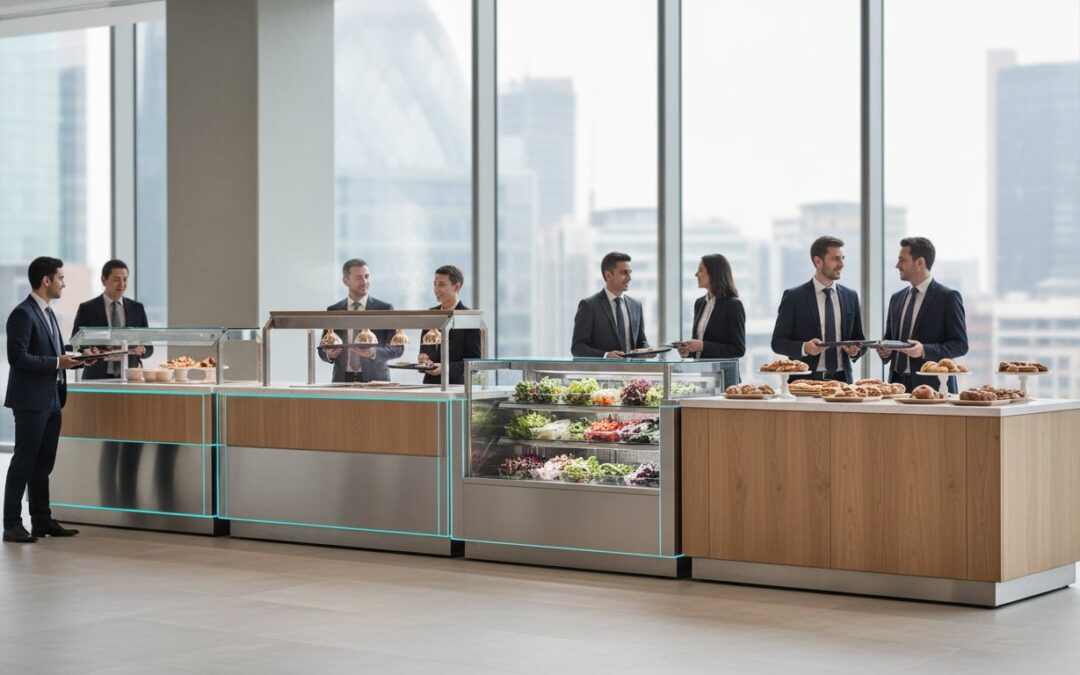
What if your front-of-house layout wasn’t a permanent fixture, but a high-performance asset that could evolve alongside your seasonal menus? Most hospitality operators feel trapped by the rigid nature of traditional fabrication, where a shift in food trends often necessitates a costly and disruptive renovation. It’s a common frustration to find that your static counter cannot accommodate a new range of grab-and-go displays or a shift toward chilled salad bars without a total overhaul.
Modular servery counter systems provide a sophisticated solution to this dilemma, offering the precision of factory-led engineering with the visual impact of a custom installation. As the UK food serving equipment market grows toward a projected £1.3 billion in 2026, the demand for adaptable, British-made infrastructure has never been higher. By choosing a modular approach, you gain the ability to scale your operations while maintaining a high-end, cohesive aesthetic that rivals any bespoke build.
This guide demonstrates how to balance artisanal design with the practicalities of 2026 food safety regulations and tax-efficient investments like the Annual Investment Allowance. You’ll learn how to integrate everything from patisserie displays to heated gantries into a seamless, reliable system that supports long-term operational efficiency.
Key Takeaways
- Understand how modular servery counter systems offer the ideal compromise between the permanence of bespoke builds and the operational agility required for modern menus.
- Identify the core technical components needed for a high-performance line, including integrate drop-in units, salad bars, and specialized heated gantries.
- Evaluate the cost-benefit ratio of modular units versus bespoke fabrication to ensure long-term scalability and better return on investment.
- Learn to design efficient layouts that improve customer flow and ergonomics by choosing between straight-line and free-flow configurations.
- Discover the advantages of a British-made approach that moves methodically from initial CAD design to final physical installation.
What are Modular Servery Counter Systems?
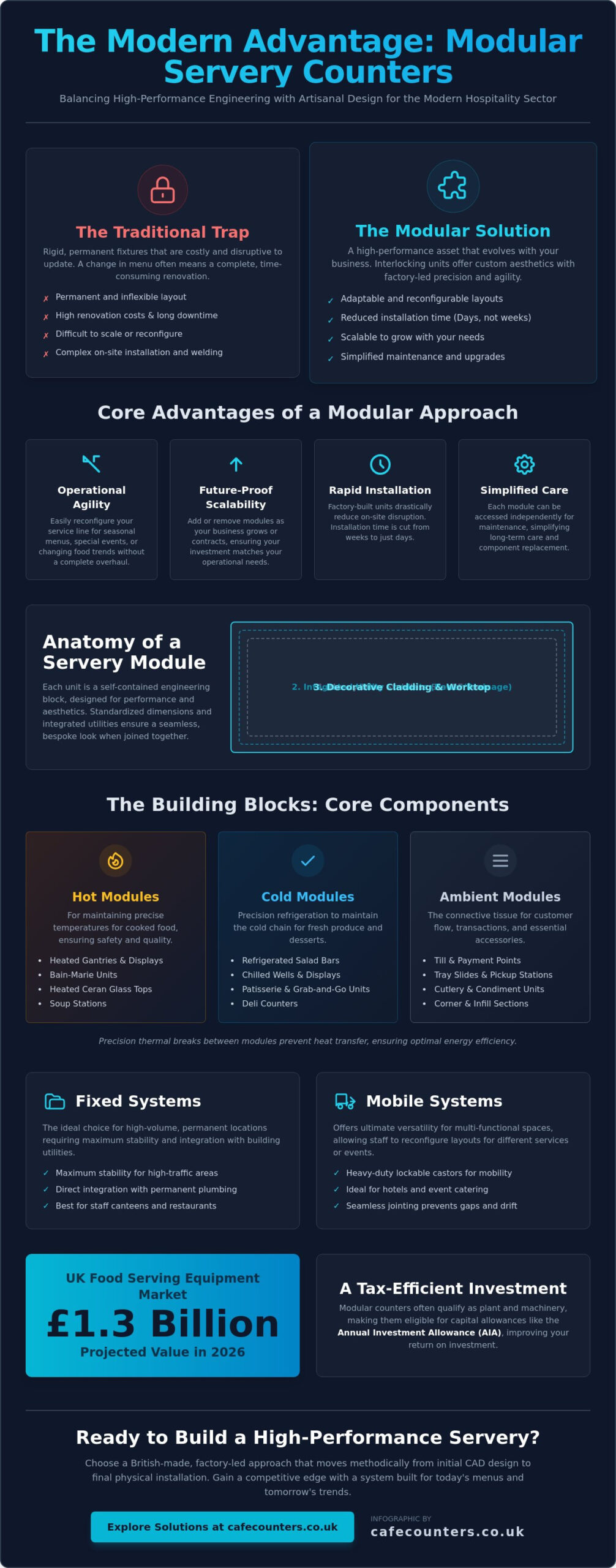
Modular servery counter systems represent a fundamental shift in how professional kitchens manage the front-of-house experience. Unlike traditional fixed counters that require extensive on-site welding and permanent installation, these systems consist of interlocking, standardized units. Each module is a self-contained engineering block designed for specific functions, whether that’s maintaining the precise chill of salad bars or the intense heat of heated gantries. This approach has become the 2026 benchmark for UK hospitality because it eliminates the rigidity of older catering models. Operators don’t have to commit to a single layout for a decade. They can reconfigure their service line as menu trends evolve.
This flexibility is vital for modern buffet-style service, where the variety of food offered might change between breakfast, lunch, and evening service. The benefits extend beyond operational agility. Modular construction allows for better scalability, as you can add or remove units as your business grows. Each module can be accessed independently for maintenance, which simplifies long-term care. Factory-built units arrive ready to connect, which significantly reduces site downtime. Installation windows that once took weeks are now shortened to days.
The Anatomy of a Servery Module
Every professional module begins with a heavy-duty stainless steel frame. This provides the structural integrity needed for high-traffic environments while allowing for a variety of decorative cladding options. You can match the exterior to your brand’s aesthetic without compromising the industrial-grade performance beneath. Standardized dimensions are critical. They ensure that when units are joined, they create an uninterrupted, seamless surface that looks like a single bespoke piece. Integration of utilities is where modularity proves its worth. Modern modular servery counter systems feature internal conduits for power and drainage that connect across multiple units. This plug-and-play capability means your integrate drop-in units and refrigerated displays share a clean, concealed utility path.
Fixed vs. Mobile Modular Solutions
Choosing between fixed and mobile configurations depends on your site’s specific demands. Fixed systems are the preferred choice for high-volume permanent locations, such as staff restaurants or public service canteens. These provide maximum stability and can be integrated into the building’s permanent plumbing. Mobile modules offer a distinct advantage for multi-functional spaces or hotels that host varied events. These units sit on heavy-duty, lockable castors, allowing staff to roll them into position for a busy lunch and then clear the floor for an evening reception. To maintain safety and hygiene, these systems utilize specialized locking mechanisms and seamless jointing. This prevents the units from drifting apart during service and ensures there are no gaps where food debris can accumulate.
Core Components: Hot, Cold, and Ambient Modules
A successful servery line relies on the seamless interplay between distinct temperature-controlled zones. High-performance modular servery counter systems allow operators to place a chilled salad bar directly adjacent to a heated soup station without compromising the efficiency of either unit. This is achieved through the use of precision-engineered thermal breaks. These insulating barriers prevent heat transfer between modules, ensuring that hot plates stay warm and chilled produce remains crisp and safe for consumption. Without these breaks, the energy consumption of your refrigeration units would spike as they fight the ambient heat from neighboring hobs.
The versatility of these systems lies in their ability to house diverse specialized equipment within a unified frame. Ambient sections, such as cutlery stations, tray slides, and till points, serve as the connective tissue of the counter. These non-powered modules are essential for guiding the customer journey and providing the necessary workspace for transactions. By selecting the right combination of hot, cold, and ambient blocks, you create a logical progression that enhances the user experience while maintaining strict operational standards.
Advanced Refrigeration in Modular Units
Maintaining the cold chain is a non-negotiable requirement for food safety and compliance. When selecting refrigerated modules, you must choose between fan-assisted cooling and contact cooling based on your specific menu. Fan-assisted systems are ideal for environments where products are frequently replenished, as they provide rapid temperature recovery. For retail-focused sites, refrigerated grab and go display units can be integrated into the modular line to encourage impulse purchases of pre-packaged items. This configuration ensures full HACCP compliance by providing consistent air curtains and digital temperature monitoring across all integrate drop-in units.
High-Performance Heating Solutions
Hot food service requires delicate balance to prevent ingredients from drying out during peak periods. Operators can choose between dry-heat bain maries for rapid start-up times or wet-heat systems for a gentler, humidified warmth. Our Vision Heated Counters are designed to maximize product visibility while maintaining precise core temperatures. These units often feature energy-efficient heated gantries equipped with quartz heat lamps. These lamps don’t just maintain serving temperatures; they provide an appetizing glow that highlights the textures of the food on display.
Strategic placement of these modules is vital for operational efficiency. According to the food service design guide, the layout must account for both sanitation and the logical flow of staff and diners. If you’re planning a facility upgrade, exploring our range of bespoke serving counters can help you determine the most efficient sequence for your specific environment.
Modular vs. Bespoke: Choosing the Right Strategy
Deciding between a fully bespoke build and a modular system often feels like a choice between aesthetics and convenience. This is a false dichotomy. Modern modular servery counter systems provide a high-performance foundation that can be finished with the same level of artisanal detail as a custom-fabricated unit. The primary difference lies in the underlying structure and the speed of execution. While a bespoke counter is built from the ground up as a single piece, a modular system uses standardized internal “engines” for heating and cooling, which are then dressed to meet your specific design vision.
Modular units are often the faster route to opening a new site because the core engineering is already proven and ready for assembly. This reduces the design phase significantly without sacrificing the final visual impact. Some operators worry that modularity implies a lack of durability, but these systems are built on heavy-duty stainless steel chassis designed for the rigors of high-volume commercial use. They are engineering blocks, not temporary furniture. They offer the perfect balance of initial investment and long-term operational flexibility, allowing you to swap out components if your menu shifts from chilled deli items to hot seasonal specials.
When to Choose Modular
Modular strategies are ideal for environments where future-proofing is a priority. Schools and staff canteens often face changing diner numbers or shifting catering contracts, making the ability to swap a cold unit for a heated gantry invaluable. It’s also the perfect choice for high-street cafe chains that require a consistent front-of-house look across multiple locations. Budget-conscious projects benefit here too. You can achieve a professional, high-end appearance by investing in premium finishes on a modular frame rather than paying for the complex engineering of a one-off bespoke build.
The Hybrid Approach: Manufacturer-Configured Modular
The most effective installations often utilize a hybrid approach that bridges the gap between off-the-shelf and custom. At TFSE, we apply bespoke cafe counter finishing techniques to our modular frames. This means you aren’t limited to a generic appearance. You can specify worktops in Granite, Corian, or high-grade stainless steel to match your interior design perfectly. By integrating unique brand elements, such as custom LED lighting or specific wood claddings, into the standardized module footprints, we create a finished product that looks entirely bespoke but retains the scalability and ease of installation inherent to modular design.
Planning Your Layout for Customer Flow and Efficiency
Designing a high-performance serving area requires more than just selecting equipment; it demands a deep understanding of human movement and psychology. Integrating modular servery counter systems into a space allows you to manipulate customer behavior through strategic geometry. The two primary configurations are “Straight Line” and “Free Flow”. A straight-line layout is the traditional choice for high-throughput environments, such as secondary schools or staff canteens, where speed is the priority. In contrast, free-flow configurations use separate islands for different food types, such as salad bars or deli counters, encouraging diners to browse and reducing the pressure of a single queue.
Ergonomics play a vital role in both the customer experience and staff safety. Tray slides should be set at a standard height, typically between 800mm and 900mm, to ensure accessibility while maintaining a comfortable reach distance for the average user. Bottlenecks often occur at hot beverage stations or cutlery points. Placing cutlery at the end of the line, rather than the start, prevents diners from having to juggle utensils while selecting food. Similarly, high-margin items like bottled drinks or snacks should be housed in grab-and-go modules positioned immediately before the till point to capture impulse sales during the final stage of the journey.
Optimising the Customer Journey
The geometry of your counter should guide the eye toward your most profitable offerings. Using angled modules or varying the heights of heated gantries creates visual interest and highlights specific dishes. Product visibility is further enhanced by integrated LED lighting, which can increase the appeal of fresh produce in refrigerated units. It’s often effective to balance self-service modules, where customers help themselves to salads or snacks, with assisted-service sections for hot proteins. This hybrid approach allows for better portion control on expensive ingredients while maintaining the speed of a self-service environment.
Operational Efficiency Behind the Counter
Staff workflow is just as critical as the diner’s journey. Modules must be positioned to allow for easy replenishment from the rear without interrupting the service flow. This is where the methodical design of modular units proves its worth. Each unit should feature accessible kick plates that prevent food debris from accumulating underneath, ensuring the site remains compliant with the 2026 Food Law Codes of Practice. Integrating waste management directly into the counter system, with concealed bin apertures and tray return sections, keeps the environment tidy and professional throughout the busiest service periods.
If you’re ready to transform your floor plan into a high-efficiency revenue driver, our team can help you design and install bespoke serving counters that perfectly fit your operational requirements.
Expert Implementation: British-Made Solutions by TFSE
The success of high-end modular servery counter systems depends entirely on the precision of their manufacture and the method of their installation. Choosing to work directly with a UK-based manufacturer like TFSE Products Ltd provides a level of quality assurance that third-party distributors simply cannot replicate. By maintaining internal production facilities, we ensure that every stainless steel frame and decorative panel meets our exacting standards for durability and finish. This direct relationship eliminates the stress of commercial projects. You aren’t just buying equipment; you’re partnering with a team that manages the entire journey from the initial concept to the finished physical space.
Precision in the workshop leads to speed on the site. Because we control the manufacturing process, we can guarantee that every module arrives ready for a seamless connection. This methodical approach minimizes disruption to your daily operations, which is critical for busy hospitality environments. Our commitment to high-grade material selection ensures that your investment provides long-term operational efficiency, standing up to the heavy use typical of professional foodservice settings.
The Role of CAD Modelling
Modern project management begins with a digital twin. Before we cut a single piece of steel, we use advanced CAD modelling to visualize your cafe layout design in three dimensions. This step is essential for ensuring that every integrate drop-in unit and internal component fits with millimetre precision. 3D models serve as a vital coordination tool, allowing us to align our designs with other site trades. Plumbers and electricians can see exactly where utility connections are required, preventing costly mistakes during the installation phase. This transparency builds trust and ensures that the physical installation moves forward with a steady, methodical rhythm.
Direct Manufacturing Quality
The “Made in Britain” signature is more than a marker of origin; it’s a guarantee of quality control and authenticity. We can customize our modular frames to meet specialized needs, whether you require a high-performance deli counter or an elegant patisserie display. This internal production capability means we can also provide rapid access to replacement parts and technical support long after the project is complete. The final stage of our process is commissioning. We meticulously test every heated and cooled module within your modular servery counter systems to ensure they meet peak performance levels. This final verification ensures your system is fully compliant with 2026 food safety standards from the moment service begins.
Future-Proofing Your Foodservice Environment
Adopting modular servery counter systems is a strategic decision that bridges the gap between high-end artisanal design and the practical need for operational agility. By integrating precision-engineered components like patisserie displays and heated gantries into a cohesive layout, you create a space that’s ready for the demands of 2026 and beyond. This approach ensures your facility remains compliant with evolving food safety standards while providing the flexibility to adapt to shifting menu trends without the cost of a full structural renovation.
We invite you to leverage our decades of experience as a primary British manufacturer. From initial CAD modelling and comprehensive project management to expert installation and nationwide commissioning, our team provides a steady hand throughout the entire process. We maintain full control over our UK-based production facility to ensure that every module meets our rigorous standards for durability and performance. It’s time to transform your vision into a physical reality that supports your business’s long-term growth.
Discuss your modular servery requirements with our design team today and discover how we can help you build a more efficient, visually striking service line.
Frequently Asked Questions
What is the difference between modular and bespoke servery counters?
Modular systems utilize standardized internal frames and function-specific “engines” while bespoke units are fabricated as a single, unique structure from the ground up. This distinction allows modular servery counter systems to offer the same aesthetic quality as custom builds but with significantly shorter lead times. You gain the ability to reconfigure the layout if your menu trends or business model changes in the future, which is not possible with fixed bespoke fabrication.
Can I mix hot and cold modules in the same serving line?
You can safely mix hot and cold modules in a single line by using precision-engineered thermal breaks between the units. These insulating barriers prevent heat transfer, ensuring that your salad bars remain at the correct chilled temperature even when placed directly next to heated gantries or bain maries. This setup is essential for maintaining food quality, energy efficiency, and strict temperature compliance throughout the service period.
How much space is required for a standard modular servery system?
Space requirements depend on your specific menu and throughput, but standard modules typically range from 600mm to 1200mm in width. When planning your footprint, you must also account for a tray slide width of approximately 300mm and a rear working space of at least 900mm for staff movement. Our CAD modelling service ensures these dimensions fit your site’s physical constraints perfectly before manufacturing begins in our British facility.
Are modular servery counters easy to clean and maintain?
Modular counters are designed for high-hygiene environments and are exceptionally easy to maintain due to their stainless steel construction. We use high-grade materials and accessible kick plates that allow for thorough cleaning underneath the units to prevent debris buildup. Because each module is self-contained, maintenance can be performed on individual components, such as integrate drop-in units, without taking the entire serving line out of service.
Can modular counters be rebranded or recladded in the future?
One of the primary advantages of a modular system is the ability to rebrand or reclad the units without replacing the structural chassis. If your interior design or brand identity changes, we can manufacture and fit new decorative panels in materials like Corian, granite, or wood veneers. This flexibility allows you to refresh your front-of-house aesthetic at a fraction of the cost and time of a full refurbishment.
What utilities are needed for a modular servery installation?
Most modular installations require a combination of electrical power, water supply, and drainage depending on the chosen modules. Heated and refrigerated units typically run on standard 13-amp or 16-amp single-phase power, though some high-capacity hobs may require three-phase connections. We coordinate with your site contractors during the design phase to ensure that floor boxes and drainage points align precisely with each module’s internal utility conduits.
How long does it take to manufacture and install a modular system?
Manufacturing generally takes between four and eight weeks from the approval of CAD drawings, depending on the complexity of your custom finishes. Once the units are built and tested in our UK facility, physical installation is often completed within one to three days. This rapid turnaround is a significant benefit over traditional on-site fabrication, as it minimizes site downtime and allows you to open for business sooner.
Do modular counters comply with UK food safety and HACCP regulations?
All our modular servery counter systems are engineered to exceed current UK food safety and HACCP regulations. We integrate digital temperature controllers and food-safe materials that comply with the Food Safety Act 1990 and the 2026 Food Law Codes of Practice. This ensures that your operation remains compliant with Food Standards Agency requirements and passes risk-based inspections by providing reliable temperature control and easy-to-clean surfaces.