
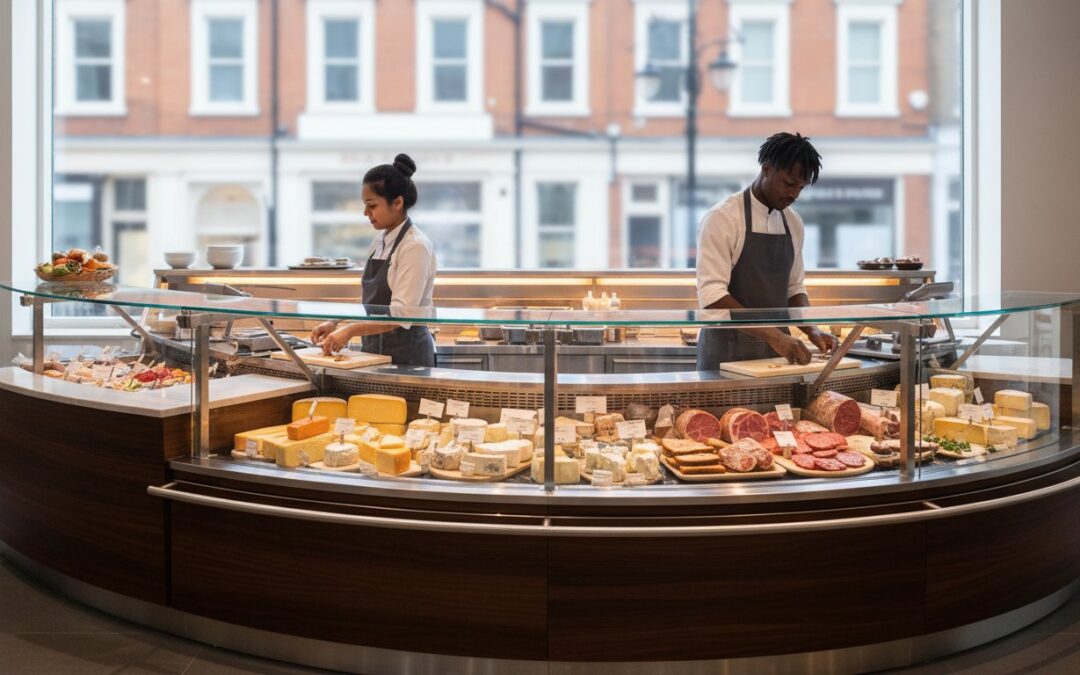
A poorly planned deli counter is more than just an eyesore; it’s a silent drain on your daily margins and staff morale. When queues start to bottleneck and food spoilage increases due to poor temperature control, the physical layout of your space is usually the culprit. You likely already understand that a successful shop floor requires more than just quality produce; it demands a seamless flow that respects both the customer’s journey and the staff’s physical limits. Learning how to design a deli counter layout is the essential first step in transforming a standard retail environment into a high-performance artisanal showcase that reflects your commitment to quality.
In this professional UK guide, we’ll show you how to master the “Operational Triangle” of deli design to ensure your business thrives. You’ll discover how to integrate bespoke serving counters and heated gantries that meet the latest Food Safety Act 1990 requirements while maximizing high-margin sales. We’ll walk you through everything from selecting energy-efficient refrigeration to utilizing “theatre of food” lighting that captures the attention of every passerby. By the end, you’ll have a clear, technical roadmap for building a durable, professional counter system that supports your team and delights your customers.
Key Takeaways
- Identify the “first-glance” zone to capture customer attention immediately and drive high-margin impulse sales from the moment they enter your shop.
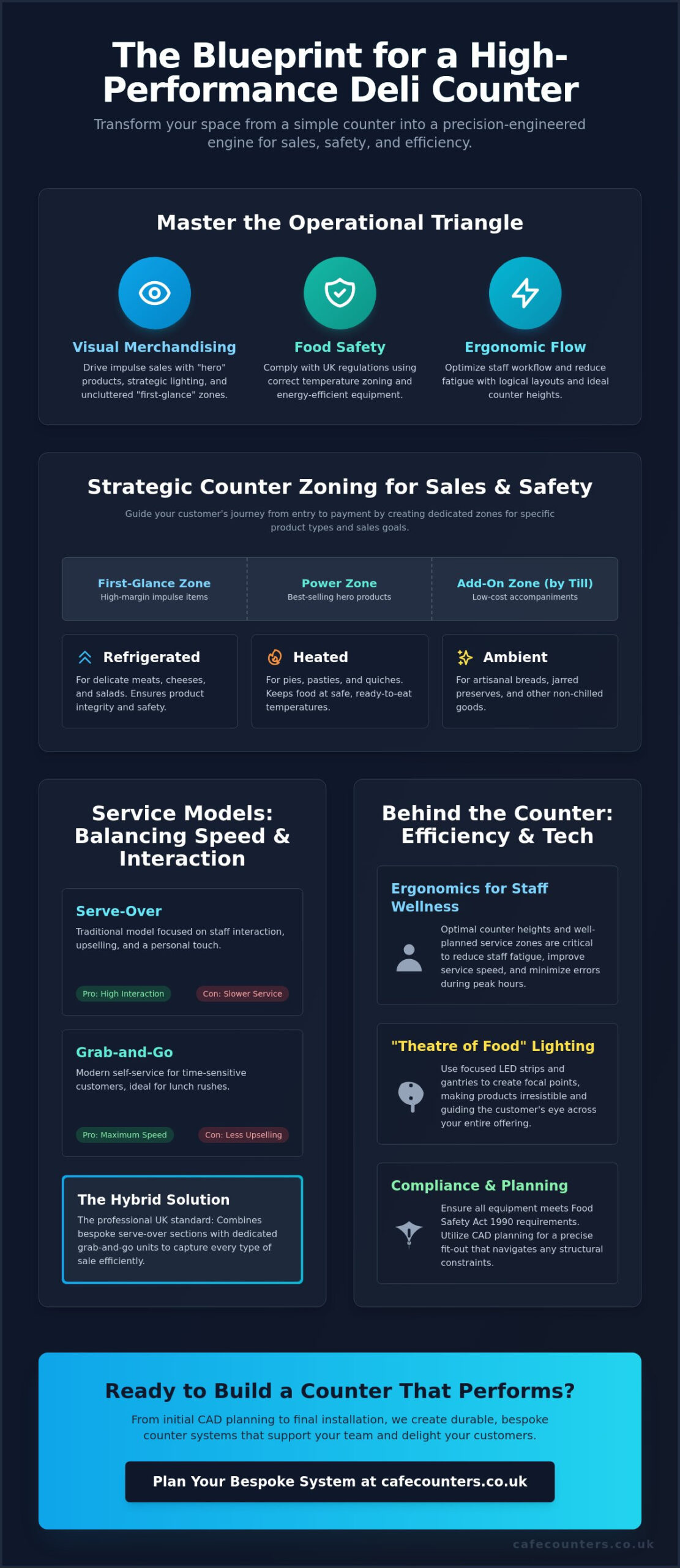
- Master how to design a deli counter layout that seamlessly integrates the “Operational Triangle” of visual merchandising, food safety, and ergonomic flow.
- Calculate optimal counter heights and service zones to reduce staff fatigue and ensure rapid, accurate customer service during your busiest trading periods.
- Evaluate technical specifications for refrigeration and heated gantries to maintain product integrity while complying with modern UK food hygiene regulations.
- Utilise CAD planning and detailed site surveys to navigate structural constraints and ensure a precise, professional fit-out for your bespoke counter system.
The Fundamentals of Deli Counter Layout Design
The modern deli counter is far more than a simple storage unit; it’s a precision-engineered sales engine designed to drive revenue through visual storytelling and operational efficiency. To understand what is a delicatessen in the contemporary UK market, you must view the counter as the heart of the business where artisanal pride meets commercial strategy. When considering how to design a deli counter layout, your primary focus should be the “first-glance” zone. This is the specific area where a customer’s eyes naturally land upon entering your premises. By positioning your most visually striking or highest-margin products here, you create an immediate emotional connection that encourages exploration and increases the average transaction value.
A successful layout meticulously balances refrigerated, ambient, and heated display sections to cater to a diverse menu. If your offering includes hot pies, pasties, or quiches, integrating heated gantries ensures these items remain at safe temperatures while being illuminated to highlight their golden textures. Ambient sections are perfect for artisanal breads or jarred preserves, while refrigerated zones house delicate meats and cheeses. Your layout must reflect your service speed. A high-traffic city centre site requires a different configuration than a relaxed rural farm shop; the former prioritises rapid throughput, while the latter might focus on the theatre of food preparation.
The Role of Visual Anchoring
Effective visual anchoring relies on placing “hero” products at eye level to capture attention instantly. Lighting plays a critical role here. Focused LED strips or overhead gantries can create focal points that guide the customer’s journey across the counter. It’s vital to avoid visual clutter. Overcrowding a display confuses the eye and can lead to decision paralysis. Instead, use clear zoning and varied heights to create a structured, professional aesthetic that makes every product feel curated rather than merely stocked. This methodical approach ensures your customers feel reassured by the quality on display.
Serve-Over vs. Grab-and-Go Models
Traditional serve-over deli counters excel at fostering customer interaction and upselling through expert staff recommendations. However, the modern consumer often demands speed. Incorporating refrigerated grab and go display units into your layout allows you to capture time-sensitive sales without disrupting the flow of your main service line. Understanding how to design a deli counter layout requires a balance between traditional service and modern convenience. Hybrid layouts are becoming the professional standard in the UK. These designs combine bespoke serving counters for face-to-face interaction with dedicated self-service zones, ensuring your business can handle both lunch-hour rushes and leisurely weekend shoppers with equal efficiency.
Zoning Your Deli Counter for Safety and Sales
Strategic zoning is the bridge between a beautiful display and a profitable, compliant operation. When you determine how to design a deli counter layout, you must move beyond simple product placement and adopt a systematic approach to space management. This process begins by categorising your inventory based on strict temperature and hygiene requirements. By grouping products with similar thermal needs, you ensure your refrigeration systems operate at peak efficiency, which reduces energy consumption and extends the shelf life of delicate artisanal goods.
Once your products are categorised, you must map the customer journey from the moment they enter the shop until they reach the payment point. This path should feel intuitive and unhurried. Incorporating established food service design principles helps you create a layout that balances accessibility with high-density merchandising. Your “Power Zone” should be reserved for your best-selling items, typically positioned in the centre of the counter at the primary point of staff interaction. Conversely, the “Add-on Zone” should sit directly adjacent to the till, featuring low-cost, high-margin accompaniments that require little deliberation. Finally, always review your sightlines. A professional layout ensures that products are visible to both adults and children, as well as customers using wheelchairs, ensuring your display is inclusive and effective for every visitor.
Hygiene Zoning: Raw vs. Cooked Separation
In the UK, strict adherence to the Food Safety Act 1990 and the Food Hygiene Regulations 2006 is non-negotiable. Your counter design must provide clear physical or spatial separation between raw and cooked products to eliminate the risk of cross-contamination. In high-end bespoke counters, this is often achieved through internal glass dividers or dedicated refrigerated sections with independent airflow management. This technical precision prevents the migration of bacteria and ensures your business remains compliant during Food Standards Agency inspections. If you are planning a new installation, consulting with an expert on bespoke deli counter solutions can help you navigate these complex regulatory requirements without compromising on aesthetics.
The Impulse Purchase Zone
The area surrounding the payment terminal is your most valuable real estate for driving impulse sales. This is where you should strategically place accompaniments like olives, chutneys, or specialty crackers. For businesses offering hot food, using Vision Heated Counters for hot pies and pasties creates a sensory “theatre” that is hard for hungry customers to resist. Tiered displays are particularly effective here; they allow you to maximise product density and vertical visibility without making the counter feel cluttered. By using varied heights and focused lighting, you turn the final stage of the customer journey into a final opportunity for profit.
Ergonomics and Behind-the-Counter Efficiency
When you investigate how to design a deli counter layout, the focus often stays on the customer side of the glass. However, the efficiency of your operation depends entirely on the physical comfort and workflow of your staff. A layout that ignores ergonomic principles leads to staff fatigue, which quickly translates into slower service and increased order errors. By treating the space behind the counter as a high-performance workstation, you ensure your team can maintain a steady pace even during the most demanding lunch-hour rushes. Professional counter heights are typically set around 900mm for preparation areas to prevent back strain, while service ledges may be slightly higher to facilitate comfortable interaction with customers.
The “Reach Zone” is a critical concept in professional kitchen design. It dictates that the most frequently used items, such as knives, scales, and wrapping materials, should be within a 45cm radius of the staff member’s primary standing position. Minimising unnecessary movement doesn’t just reduce physical exhaustion; it shaves seconds off every transaction. Seamlessly integrating scales, wrapping stations, and POS systems into the counter structure prevents the awkward shuffling that often slows down service. A well-placed stainless steel back-bar unit provides essential secondary work surfaces and storage, keeping the main service line clear of clutter and ensuring every tool has a dedicated home.
Work Surface Material Selection
Selecting the right materials for your work surfaces is a balance of aesthetics and extreme durability. Food-grade 304-grade stainless steel remains the professional standard for internal structures and prep areas because it’s non-porous, easy to sanitise, and resistant to the rigours of a heavy-duty deli environment. While granite or quartz can offer a premium look for customer-facing ledges, they must be specified correctly to withstand constant cleaning. Adhering to Food Standards Agency guidelines regarding hygienic surfaces is essential to ensure your material choices support long-term compliance and food safety.
Storage and Replenishment Flow
A common mistake in how to design a deli counter layout is failing to plan for mid-service restocking. Designing under-counter storage for fast-moving items allows your team to replenish displays without leaving the service area. For refrigerated units, rear-loading access is a superior choice, as it enables staff to load fresh products from the back while maintaining the visual integrity of the front display. Effective layouts also incorporate dedicated space for waste management and easy cleaning access; this ensures that hygiene standards don’t slip during busy periods when time is at a premium.
Technical Considerations: Refrigeration and Lighting
Precision in technical specification is what separates an amateur setup from a professional retail environment. When determining how to design a deli counter layout, your choice of refrigeration technology is the most critical factor in maintaining product integrity and protecting your margins. While a display might look impressive, its primary function is to serve as a climate-controlled sanctuary for your produce. Modern UK delis must now also account for energy efficiency as a core design pillar, selecting units that reduce operational overheads without compromising on the consistent temperatures required by the Food Safety and Hygiene Regulations 2013.
The debate between static and ventilated cooling is central to your counter’s performance. Static cooling relies on natural convection, making it the superior choice for delicate charcuterie and pre-cut meats that are prone to drying out. Ventilated cooling, conversely, uses fans to circulate chilled air, which is excellent for maintaining uniform temperatures across a large deli counter with multiple levels. However, this increased airflow can lead to product dehydration if the humidity levels aren’t meticulously managed. To ensure your technical setup matches your specific menu requirements, you can explore our full range of bespoke deli counters designed for high-performance retail.
Managing Humidity and Freshness
Maintaining the right moisture levels is essential for preserving the weight and texture of artisanal goods. Cheese displays, for instance, require higher humidity than standard chilled goods to prevent the rinds from cracking. Professional layouts often incorporate night blinds or thermal covers; these are simple yet highly effective tools for energy conservation during out-of-hours periods. By specifyng units with advanced electronic controllers, you can fine-tune the defrost cycles and fan speeds to suit the exact seasonal needs of your inventory.
Lighting for Food Appeal
Lighting is the final touch that transforms a functional counter into an enticing showcase. The Colour Rendering Index (CRI) of your LEDs is vital; a CRI of 90 or above ensures that the deep reds of bresaola and the creamy yellows of a mature cheddar are represented accurately. It’s important to use warm tones for breads and cheeses while opting for slightly cooler, crisp lighting for fresh salads. Modern LED gantries are designed to minimise heat transfer to the chilled products below, ensuring your “theatre of food” doesn’t inadvertently accelerate spoilage or force your refrigeration system to work harder than necessary.
The Bespoke Advantage: CAD Planning and Manufacturing
The journey from a conceptual vision to a physical retail space is often fraught with technical challenges that off-the-shelf solutions simply cannot address. When you are mastering how to design a deli counter layout, the use of Computer-Aided Design (CAD) modelling becomes your most powerful tool. This technology allows us to create a digital twin of your environment, ensuring that every millimetre of your bespoke serving counter is accounted for before a single piece of steel is cut. This level of precision is essential for navigating the unique architectural quirks of UK high street properties, where uneven floors and structural pillars often dictate the flow of the room. A professional site survey acts as the foundation for this process, identifying potential constraints early to avoid costly adjustments during the installation phase.
Future-proofing is another critical benefit of the bespoke approach. By designing for modularity, you can ensure your layout remains adaptable to changing consumer trends or future equipment upgrades. Whether you need to integrate additional drop-in units or expand your salad bars, a custom-built system provides the structural flexibility that standard units lack. This methodical planning ensures that your investment remains relevant and functional for years to come, providing a steady, reliable hand in an ever-evolving commercial market.
From Concept to Installation
The transition from a technical drawing to a finished physical space requires seamless coordination between various trades. Detailed CAD plans serve as the master document for electrical and plumbing contractors, ensuring that power points and drainage for your commercial refrigerators are positioned exactly where they are needed. This collaborative approach eliminates the guesswork that often leads to project delays. By managing the project from the initial idea to the final installation, we ensure that every component, from the internal stainless steel back-bar units to the external decorative finishes, integrates perfectly into a cohesive and professional whole.
British Manufacturing Quality
There is a distinct sense of artisanal pride in choosing British-made counters. Manufacturing our products within our own dedicated facility allows for rigorous quality control that is difficult to achieve with imported alternatives. This internal production capability also translates to more reliable lead times and direct access to technical support when you need it most. We invite you to share your vision with a partner who understands the unique pressures of the UK food industry. To take the first step in transforming your retail space, book a consultation with TFSE Products Ltd today and benefit from our decades of experience in high-end commercial design.
Transforming Your Vision into a High-Performance Retail Space
Mastering the balance between aesthetic appeal and technical compliance is the hallmark of a successful UK food business. You now understand that knowing how to design a deli counter layout requires more than just picking equipment; it involves a methodical approach to zoning, ergonomics, and precision engineering. By prioritising the “Operational Triangle” of flow, safety, and visual merchandising, you create an environment that supports your staff while consistently driving high-margin sales. From the specific humidity needs of charcuterie to the lighting that brings your products to life, every detail contributes to a cohesive, professional brand identity.
At TFSE Products Ltd, we’ve been specialists in UK-based manufacturing since 1991, providing the technical expertise required to bring complex commercial visions to life. We utilise advanced CAD modelling for every project to ensure a perfect fit for your unique footprint, paired with energy-efficient display technology that protects both your produce and your overheads. It’s time to move beyond standard solutions and invest in a counter system built for durability and success. Design your perfect bespoke deli counter with TFSE Products Ltd and take the next step toward a more profitable, efficient retail space. We look forward to helping you build a legacy of quality in your local community.
Frequently Asked Questions
What is the ideal height for a deli serve-over counter?
The ideal total height for a professional deli serve-over counter typically sits between 1200mm and 1300mm, with the internal work surface positioned at approximately 900mm. This 900mm height is the industry standard for comfortable food preparation and service, effectively reducing back strain for your staff. The customer-facing ledge should be high enough to allow for clear sightlines into the display while remaining accessible for seamless transaction exchanges during busy periods.
How do I separate raw and cooked meats in a single display?
You must use clear physical barriers or separate refrigerated compartments to prevent cross-contamination between raw and cooked meats. In a bespoke counter, this is often achieved using glass dividers that extend to the full height of the display area to ensure total separation. Maintaining strict spatial separation is a core requirement of the Food Hygiene Regulations 2006, ensuring that bacteria cannot migrate between different product categories during daily service.
Does my deli counter need to be refrigerated or ambient?
Most professional layouts require a combination of both refrigerated and ambient sections to accommodate a full artisanal product range. Chilled deli counters are essential for meats, cheeses, and prepared salads to maintain temperatures below 8°C as required by UK law. Ambient sections are better suited for breads or jarred goods, while integrated heated gantries can be specified for hot pies and pasties to ensure both food safety and visual appeal.
What lighting is best for showing off fresh deli products?
High Colour Rendering Index (CRI) LEDs are the professional choice for showcasing fresh deli products, as they represent colours accurately and vibrantly. You should opt for a CRI of 90 or above to ensure meats look rich and cheeses appear creamy. It’s important to use specialised LED modules that enhance specific food tones without emitting infrared heat, which could compromise the temperature integrity of your chilled display.
How can I improve customer flow in a small deli space?
Improving customer flow in a constrained environment involves creating a clear, linear path from the entry point to the payment terminal. When considering how to design a deli counter layout for small spaces, integrating grab and go displays near the entrance can alleviate pressure on the main serve-over counter. Clear zoning of high-demand items helps prevent bottlenecks and ensures a smooth, unhurried shopping experience even during peak lunch-hour rushes.
What materials are most durable for a high-traffic deli counter?
Food-grade 304-grade stainless steel is the most durable and hygienic material for the internal structures and work surfaces of a high-traffic counter. For customer-facing frontages, solid surfaces or natural stone offer excellent resistance to impacts and scratches while maintaining a premium aesthetic. These materials are non-porous and easy to sanitise, making them ideal for meeting the rigorous demands and hygiene standards of a busy commercial retail environment.
Should I choose a static or ventilated cooling system for my deli?
The choice between static and ventilated cooling depends entirely on your specific inventory requirements. Static cooling is generally preferred for delicate meats and cheeses because it doesn’t circulate forced air that can cause product dehydration and weight loss. Ventilated cooling is better for prepared salads or pre-packed items where maintaining a uniform temperature across multiple levels is the priority. Understanding these technical nuances is vital when deciding how to design a deli counter layout.
How often should a commercial deli counter be serviced?
A commercial deli counter should undergo a professional service at least twice a year to ensure peak operational efficiency and regulatory compliance. Regular maintenance involves cleaning the condenser coils, checking refrigerant levels, and verifying that door seals remain airtight. This proactive approach prevents unexpected equipment failure during peak trading periods and helps extend the lifespan of your bespoke system, ensuring your investment continues to perform reliably for years.