
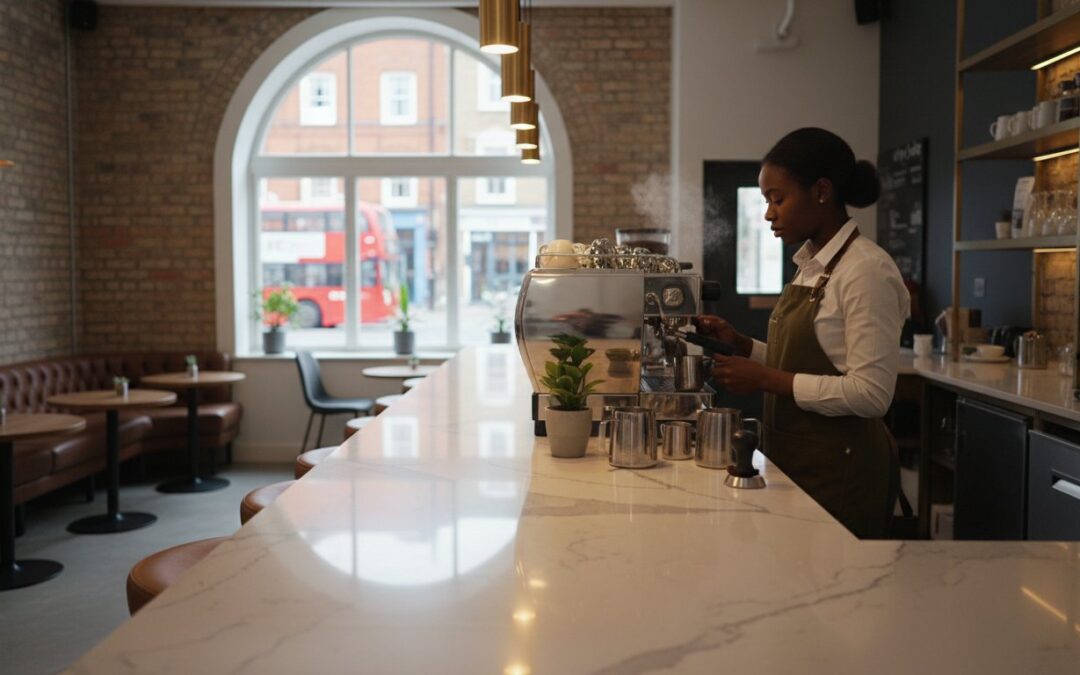
The most expensive mistake a cafe owner can make is choosing a surface based on appearance alone, only to watch coffee oils and acidic syrups etch permanent damage into the finish within weeks. Selecting the best material for a cafe countertop requires a strategic balance between artisanal style and the unforgiving reality of a high-volume service environment. Whether you’re managing a busy barista station or a delicate pastry section, your surfaces must withstand constant impact and rigorous cleaning without losing their professional edge.
We understand that a counter is more than just a work surface; it’s the foundation of your operational efficiency and customer experience. You need a solution that eliminates the stress of chipping edges or unhygienic grout lines while fully complying with the Food Hygiene Regulations 2006 and the Food Safety Act 1990. This guide provides the technical clarity you need to specify durable, commercial-grade materials that integrate seamlessly with refrigerated patisserie displays and grab and go units. We’ll walk you through the performance of quartz, solid surfaces, and dekton to ensure your investment remains pristine for ten years or more.
Key Takeaways
- Learn why viewing your counter as a piece of high-performance catering equipment is essential for calculating true lifecycle costs and long-term operational success.
- Discover the best material for a cafe countertop by evaluating how engineered stone and stainless steel perform under the daily rigours of a high-traffic UK environment.
- Identify how to match specific surface properties to different operational zones, from heat-resistant barista stations to scratch-resistant service and till areas.
- Understand the technical role of professional fabrication in reducing hygiene risks through seamless joins and high-impact edge profiles.
- Explore the advantages of integrating patisserie displays and grab and go units directly into your counter structure for a unified, professional aesthetic.
Why Choosing the Best Material for a Cafe Countertop is a Critical Business Decision
In a professional hospitality environment, the counter serves as the physical interface between your brand and your customers. It’s far more than a decorative surface; it’s an active piece of catering equipment that must facilitate rapid service while maintaining a flawless appearance. Selecting the best material for a cafe countertop is a strategic decision that directly affects your bottom line. While aesthetics draw customers in, the long-term durability of your choice determines whether your operation remains profitable or succumbs to the high costs of premature replacement and operational downtime.
Financial planning for a new fit-out often focuses on the initial price per square metre, yet the true cost is measured over a ten-year lifecycle. High-quality countertop materials may require a higher upfront investment, but they eliminate the recurring expenses associated with repairs or the complete removal of failing surfaces. Beyond the balance sheet, your countertop choice acts as a silent indicator of your standards. A surface that shows stains from coffee oils or chips along the edges can inadvertently signal a lack of attention to detail, potentially undermining customer trust in your food quality.
Compliance with UK health standards is non-negotiable. The Food Safety Act 1990 and the Food Hygiene Regulations 2006 mandate that any surface in contact with food must be smooth, impervious, and easy to disinfect. Choosing the best material for a cafe countertop ensures that your business remains compliant during inspections while providing your staff with a workspace that is genuinely easy to maintain. This technical foundation allows you to focus on service rather than worrying about the integrity of your prep zones.
The “Saturday Rush” Stress Test
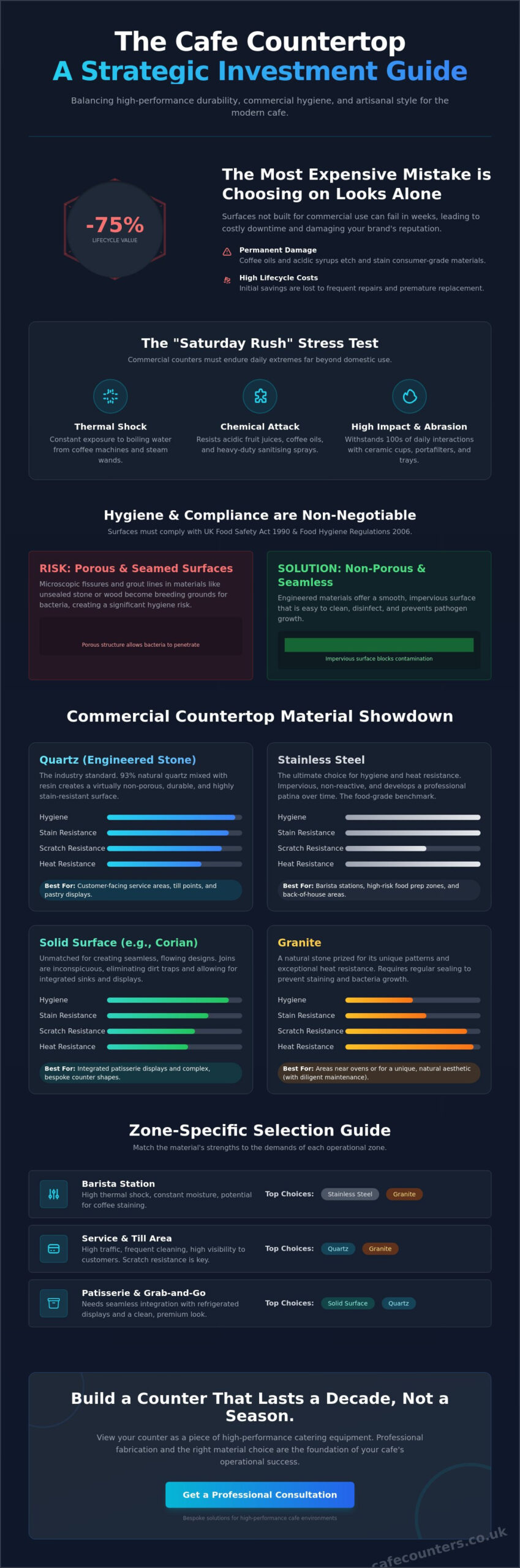
During peak trading hours, your surfaces face extreme conditions that domestic worktops aren’t built to handle. A barista station experiences constant thermal shock as boiling water and steam wands interact with the surface, alongside the chemical challenge of acidic fruit juices and heavy-duty sanitising sprays. Commercial-grade durability is defined by a material’s ability to withstand over 100 high-impact customer interactions and aggressive cleaning cycles every single day for a decade without showing signs of structural fatigue.
Hygiene and Non-Porous Surfaces
Porosity is a significant risk for cafe owners because it allows bacteria to harbour within microscopic fissures, seams, and grout lines. Natural stones often require regular sealing to prevent these issues, whereas engineered or metallic options offer a safer alternative. For high-risk preparation areas, food grade stainless steel remains the industry benchmark because it’s completely non-porous and resists the growth of pathogens. By eliminating joins where dirt can accumulate, you protect your customers and streamline your daily cleaning protocols.
Comparing the Top 5 Commercial Countertop Materials for UK Hospitality
Identifying the best material for a cafe countertop requires moving beyond domestic expectations and looking at technical performance under pressure. In the modern UK market, five primary materials dominate the landscape, each offering a distinct profile of durability and aesthetic appeal. Quartz remains the industry standard for its resilience, while stainless steel and solid surfaces like Corian provide specialized functional benefits. Granite continues to appeal to those seeking natural character, and sintered stone represents the new frontier of high-performance synthetics.
- Quartz (Engineered Stone): Composed of roughly 93% natural quartz and 7% resin, this material is virtually non-porous and resists staining from coffee oils better than natural stone.
- Stainless Steel: This is the ultimate choice for hygiene; it’s impervious to liquids and offers an industrial-chic aesthetic that matures gracefully with age.
- Solid Surface: Materials like Corian allow for inconspicuous joins, creating a single, continuous surface that eliminates dirt traps.
- Granite: While it offers exceptional heat resistance and a unique visual texture, it requires periodic sealing to maintain its resistance to liquids.
- Sintered Stone: Often referred to as ultra-compact surfaces, these materials are forged under extreme heat and pressure to offer unrivalled scratch and UV resistance.
Quartz vs. Sintered Stone: The Battle of the Synthetics
Choosing between quartz and sintered stone often comes down to the specific stresses of your environment. Quartz offers superior impact resistance, making it less likely to chip if a heavy portafilter is dropped on an edge. Sintered stone, however, provides superior heat resistance, allowing for the placement of hot items directly on the surface without risk of thermal shock or resin scorching. These materials offer excellent colour consistency, which is vital for multi-site operators who need to maintain strict brand standards across different locations. While often marketed as maintenance-free, both require daily cleaning with pH-neutral solutions to prevent the buildup of mineral deposits from hard water.
The Resurgence of Stainless Steel in Cafe Design
Modern cafe design has reclaimed stainless steel from the hidden depths of the back kitchen. By utilizing brushed, vibrated, or textured finishes, we can create a sophisticated look that hides fingerprints and minor abrasions. This material is particularly effective when integrated into bespoke serving counters, providing a seamless transition between preparation and service zones. The long-term return on investment for steel is significant; it’s a material that is virtually indestructible and fully recyclable at the end of its life.
For those requiring complex geometries or integrated sinks, following the technical specifications for solid surface ensures that your installation meets the highest structural standards. Selecting the best material for a cafe countertop is often about finding the right compromise between these five contenders. If you’re currently planning a new layout, exploring our range of bespoke serving counters can help you visualize how these materials integrate with professional equipment.
Zone-Specific Selection: Matching Materials to Cafe Operational Demands
The best material for a cafe countertop is rarely a single choice applied across the entire floor plan. Instead, a sophisticated design treats the counter as a series of functional zones, each with unique operational stresses. Applying the same material to a high-heat barista station as you do to a customer seating area can lead to premature wear or unnecessary expense. By zoning your surfaces, you ensure that every square metre of your investment performs exactly as required, balancing industrial durability with high-end aesthetic appeal.
In the service and till area, the primary challenge is mechanical wear. Constant friction from trays, the impact of coins, and the movement of card machines demand a surface with exceptional scratch resistance. While aesthetics are important for this first point of contact, the material must maintain its finish despite hundreds of daily interactions. Conversely, the customer perch—where guests might linger with a laptop or coffee—requires a balance of warmth and comfort, often favouring materials that feel less clinical than those used in preparation zones.
The food display zone presents a different challenge entirely, as it must integrate seamlessly with high-performance equipment. This area often houses refrigerated grab and go display units, requiring the countertop material to be structurally sound enough to support significant weight while allowing for precision-engineered cut-outs.
Designing for Integrated Food Displays
Precision is vital when countertops must support the weight of heavy deli display counters. Our fabrication process ensures that cut-outs for drop-in refrigerated displays are executed with millimetre accuracy to prevent dirt traps and structural weaknesses. We also account for thermal expansion, as the temperature differential between cold refrigeration units and ambient stone surfaces can cause stress fractures in poorly specified materials. Using the best material for a cafe countertop in these zones means selecting a surface that remains stable under these varying thermal conditions.
The “Barista Zone” Requirements
The barista station is the most demanding environment in any cafe. Moisture resistance is non-negotiable near the sink and milk-steaming areas, making waterproof materials like stainless steel or quartz essential to prevent swelling or delamination. Acoustics also play a role; some hard surfaces can amplify the sharp noise of a coffee grinder, while others help dampen the sound for a more pleasant customer atmosphere. We recommend specific edge profiles in this zone to prevent chipping from heavy portafilters and to ensure staff safety during the fast-paced Saturday rush.
The Technical Details: Durability, Hygiene, and Long-Term Maintenance
The performance of even the best material for a cafe countertop depends entirely on the technical precision of its fabrication and installation. While the raw material provides the foundation, the way edges are profiled and joins are managed determines how the surface handles the physical rigours of a commercial environment. A meticulous approach to these details ensures that your counter remains a hygienic, structurally sound asset rather than becoming a maintenance burden within its first year of service.
Structural integrity is particularly vital when integrating heavy professional equipment. Your sub-structure must be engineered to support the substantial weight of stone surfaces alongside integrated units such as Vision Heated Counters. Without adequate reinforcement, the combined weight of the display and the countertop can lead to bowing or stress fractures. Daily cleaning protocols also play a critical role in preservation. We advise staff to avoid abrasive scouring pads and harsh chemicals, opting instead for pH-neutral cleaners that protect the surface’s non-porous finish and maintain its lustre over time.
Edge Profiles and Impact Protection
In a high-traffic UK cafe, sharp 90-degree edges are a significant liability. These crisp corners are highly susceptible to chipping when struck by heavy ceramic mugs, metal trays, or portafilters. A Bullnose or slightly rounded edge profile is far more durable because it deflects impact rather than absorbing it at a single point. For a more contemporary aesthetic, a Sharknose profile provides a slim, tapered appearance while maintaining a resilient leading edge. If you desire the look of a thick, substantial slab, we utilize mitred edges to create visual depth without the prohibitive weight of a solid block.
Joins and Structural Integrity
The science of seams is where professional fabrication truly shines. While materials like quartz require visible, though tightly fitted, joins, solid surface materials can be chemically bonded to create a truly seamless finish. This eliminates the microscopic gaps where bacteria can harbour, significantly improving hygiene in food preparation zones. For large spans or cantilevered sections, we often incorporate steel reinforcement within the counter to prevent sagging. Abrupt temperature changes near espresso machines can cause thermal shock, leading to hairline fractures in stone surfaces if they aren’t properly specified and installed.
Precision engineering is the hallmark of a reliable commercial fit-out. If you’re ready to discuss the technical requirements of your project, you can enquire about our bespoke serving counters to see how our internal production facility handles these complex details.
Bespoke Fabrication: How TFSE Products Crafts High-Performance Cafe Counters
Selecting the best material for a cafe countertop is only the first stage of a successful commercial project. The true value of your investment is realized during the transition from a raw slab to a fully operational serving station. We operate our own internal production facilities, which allows for total quality control from the initial CAD modelling phase through to the final installation. This regional artisanal pride ensures that every bespoke serving counter we produce is built to withstand the unique pressures of the UK hospitality market while maintaining a refined, professional finish.
Our approach differs from standard stone suppliers who often focus solely on domestic kitchen applications. We specialize in the complex engineering required to integrate high-value display units directly into the counter structure. By combining precision stainless steel fabrication with premium stone finishes, we create a workspace that is both visually striking and operationally superior. This ensures that your grab and go displays and heated gantries aren’t just sitting on a surface, but are structurally part of a cohesive, high-performance unit.
From CAD Design to Final Commissioning
Precision is non-negotiable when your layout includes integrated drop-in units. Our methodical process begins with detailed site surveys and professional CAD modelling to ensure that every cut-out is accurate to the millimetre. This level of meticulous planning significantly reduces downtime during cafe fit-outs, as every component arrives ready for immediate integration. We also ensure that all heated and refrigerated components are technically integrated, managing the specific airflow and thermal requirements needed to protect the longevity of your electrical equipment.
The TFSE Difference: Engineering Meets Design
We prioritize long-term operational efficiency over fleeting design trends. A typical high-performance UK cafe counter build might involve a quartz service top for its resilience, integrated with refrigerated patisserie displays and stainless steel back-bar units. This hybrid approach ensures that the best material for a cafe countertop is matched to the specific demands of each zone. Our status as an expert partner means we guide you through every technical detail, providing a steady, reliable hand in a complex field. If you’re ready to bring your vision to life, speak to our experts about your bespoke cafe counter project.
Investing in Long-Term Operational Excellence
Selecting the best material for a cafe countertop is a technical investment that defines your daily operational efficiency and long-term profitability. By zoning your surfaces to handle specific stresses and ensuring total compliance with UK hygiene standards, you create a workspace that supports your staff and impresses your guests. A truly successful installation requires more than just a quality slab; it demands the seamless integration of heated and refrigerated displays within a structurally sound, precision-engineered frame.
We’ve been refining our UK-based manufacturing since 1991, combining advanced CAD modelling for precision fit with deep industry expertise to deliver flawless results. Our team are specialists in integrated food display solutions, ensuring that every join is hygienic and every cut-out is exact. We invite you to share your vision with a partner who understands the unique pressures of the hospitality sector and has the technical capability to bring it to life. Contact TFSE Products for a bespoke cafe counter consultation to begin your journey toward a more durable and stylish commercial space. Your vision deserves the precision of a steady, reliable hand.
Frequently Asked Questions
Which cafe countertop material is the easiest to clean?
Stainless steel is the easiest material to clean and disinfect in a commercial hospitality setting. Because it is completely non-porous, bacteria cannot hide in fissures or microscopic gaps. It withstands the aggressive sanitising sprays required to meet UK food hygiene standards without dulling or degrading. This makes it the practical choice for back-bar units and high-volume preparation zones where speed and sanitation are the primary operational priorities.
Is quartz better than granite for a busy coffee shop?
Quartz is widely considered the best material for a cafe countertop in high-traffic environments because it is non-porous and more resistant to staining than granite. While granite offers natural beauty and high heat resistance, it requires periodic sealing to prevent coffee oils from penetrating the surface. Quartz provides a consistent, durable finish that handles the daily stresses of a busy coffee shop without the long-term maintenance burden of natural stone.
Can I use a wooden countertop in a commercial cafe?
You can use wood in customer-facing areas, but it’s rarely suitable for food preparation zones under the Food Hygiene Regulations 2006. Wood is naturally porous and can harbour bacteria if the protective sealant is compromised. In a professional cafe, wooden surfaces require significant maintenance to prevent water damage and staining. We recommend limiting timber to customer perches or decorative accents rather than using it for heavy-duty service counters.
How do I prevent my cafe counter from staining?
Preventing stains starts with selecting a non-porous material like quartz or sintered stone and implementing a rigorous “wipe-as-you-go” policy. Coffee oils and acidic fruit juices can etch or discolour surfaces if left to sit for extended periods. Establishing a daily cleaning protocol using pH-neutral detergents will preserve the finish. Identifying the best material for a cafe countertop is only half the battle; professional fabrication and smooth finishes are equally vital for long-term stain resistance.
What is the best material to use around a commercial espresso machine?
Sintered stone and stainless steel are the superior choices for use around a commercial espresso machine due to their exceptional thermal shock resistance. These materials handle the constant transition between cold spills and boiling steam without cracking or scorching. Because espresso stations are high-moisture environments, using a waterproof material is essential to prevent structural damage. This technical approach ensures that your most expensive equipment sits on a stable, durable foundation.
How thick should a commercial cafe countertop be?
Most commercial cafe countertops are fabricated at a thickness of 20mm or 30mm to balance structural strength with manageable weight. While 20mm is often sufficient for quartz or stone, we frequently use mitred edges to create the visual impression of a much thicker, more substantial slab. The choice depends on the span of the counter and the weight of integrated equipment like heated gantries, which may require additional sub-structure reinforcement.
Are seamless joins possible with stone countertops?
Truly seamless joins are only possible with solid surface materials like Corian, which are chemically bonded and sanded to create a single continuous piece. Natural stone and engineered quartz will always have fine, visible joins, although professional fabrication ensures these are as discreet as possible. For cafe owners, minimizing joins is a hygiene priority, as every seam represents a potential dirt trap that requires careful daily cleaning to maintain professional standards.
Do I need a special material for a counter with a built-in fridge?
When integrating refrigerated units, you need a material that can handle thermal expansion and the significant weight of the equipment. Sintered stone and reinforced quartz are excellent choices because they remain stable despite the temperature differential between the cold fridge and the ambient room. It’s vital that the countertop fabrication includes precision cut-outs and adequate ventilation to ensure your grab and go displays or patisserie units operate at peak efficiency.