
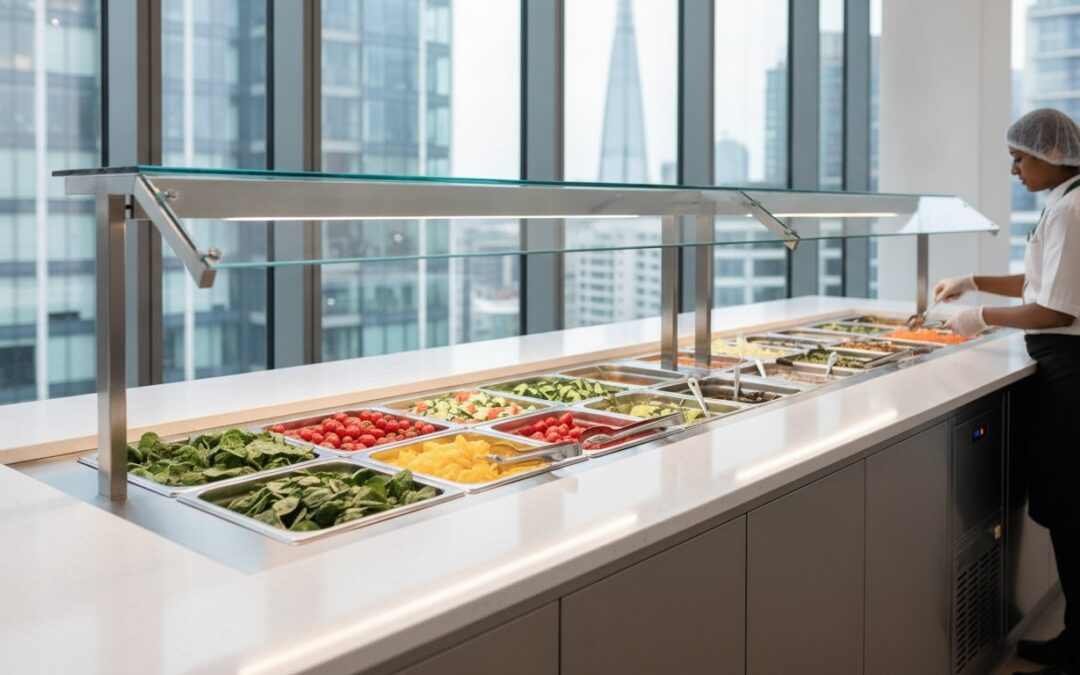
Could a single hidden “food trap” in a mass-produced unit be the silent catalyst for a plummeting food hygiene rating? As an operator, you know that the visual appeal of your fresh produce is only as strong as the engineering supporting it. Finding commercial salad bars UK manufacturers can customise to bespoke counter dimensions shouldn’t feel like a compromise between aesthetics and reliability. You likely feel the frustration of condensation building up in high-ambient environments or the operational drag of a layout that restricts customer flow during the lunch rush.
Key Takeaways
- Understand the role of Gastronorm (GN) standards to ensure your display units are fully compatible with professional kitchen workflows and pan sizes.
- Compare static and fan-assisted cooling technologies to determine which system best maintains food safety and product freshness in your specific service environment.
- Discover how specifying commercial salad bars UK manufactured to bespoke dimensions eliminates the common integration issues and “food traps” found in standard imports.
- Optimise customer flow and staff ergonomics by designing layouts that reduce service bottlenecks and simplify the refilling process during peak hours.
- Identify critical site requirements for electrical and drainage planning to ensure a seamless commissioning process from the initial design to final installation.
What is a Commercial Salad Bar? Beyond the Buffet Table
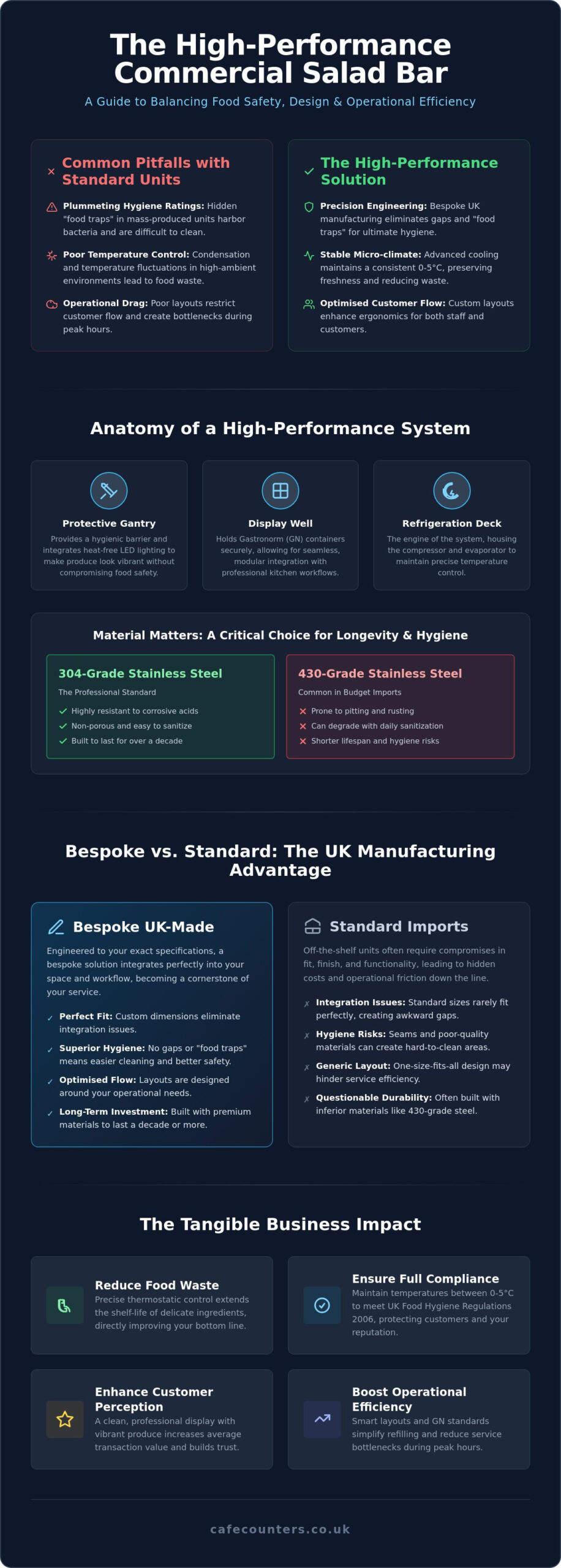
A commercial salad bar is a precision-engineered hub for fresh food presentation and preservation. While the history of the salad bar traces back to simple buffet arrangements, modern commercial salad bars UK operators rely on today are sophisticated, temperature-controlled display units. These systems do more than just hold food; they create a micro-climate that protects the integrity of fresh produce. By maintaining a consistent temperature between 0°C and 5°C, these units ensure full compliance with the Food Hygiene Regulations 2006, protecting both your customers and your reputation.
Standardisation is the backbone of professional catering. By adhering to Gastronorm (GN) standards, high-end salad bars allow for a seamless transition between preparation areas and the service line. Whether you’re using 1/1, 1/2, or 1/3 GN pans, the modular nature of these units ensures that refilling is efficient and organised. This compatibility reduces handling times and limits the window where food might be exposed to ambient temperatures during stock rotation.
Temperature stability is the primary factor in reducing food waste. Fluctuations in the cooling deck lead to wilted greens and spoiled proteins, which directly impacts your bottom line. A stable thermal environment preserves the cellular structure of fresh ingredients, keeping them crisp and vibrant for the duration of a service period. In a high-pressure commercial environment, you need a unit that recovers quickly after lids are opened or pans are swapped, ensuring the “cold curtain” remains unbroken.
The Evolution of Self-Service and Assisted Service
The hospitality industry has moved far beyond the generic buffet troughs of the past. Modern deli-style displays now serve as a visual backdrop for “theatre cooking,” where the salad bar highlights the quality of raw ingredients. Operators must choose between open-access units for high-speed self-service and enclosed, assisted-service units that offer maximum hygiene protection. Both styles require meticulous engineering to prevent condensation and maintain consistent cooling in high-ambient environments like busy food courts or sunlit cafes.
Key Business Benefits of High-Performance Units
Investing in a high-specification unit offers tangible returns. Precise thermostatic control extends the shelf-life of delicate ingredients, meaning you throw away less produce at the end of a shift. Beyond the kitchen, a professional display significantly impacts customer perception. When produce looks vibrant and well-presented in a clean, 304-grade stainless steel environment, it naturally increases the average transaction value. By using bespoke cafe counters that integrate these wells perfectly, you remove operational friction for staff and create a seamless, premium experience for every diner.
The Anatomy of a High-Performance Salad Bar System
A high-performance system is defined by the synergy of three core components: the refrigeration deck, the display well, and the protective gantry. While Section 1 established the importance of temperature stability, the physical architecture of commercial salad bars UK operators select determines how that stability is maintained under pressure. The refrigeration deck acts as the engine, housing the compressor and evaporator. The display well holds the Gastronorm containers in a thermal embrace, while the gantry provides both structural support and a hygienic barrier between the food and the environment.
Material choice is where professional-grade equipment separates itself from budget imports. We utilise 304-grade stainless steel for all internal and external surfaces. Unlike the 430-grade steel often found in cheaper units, 304-grade contains higher levels of chromium and nickel. This makes it exceptionally resistant to the corrosive acids found in vinaigrettes and dressings. It is a non-porous material that withstands rigorous daily sanitisation without pitting or rusting, ensuring your investment remains a hygienic, professional asset for over a decade. Choosing the right materials at the outset prevents the “food traps” and structural degradation that plague inferior units.
Lighting plays a critical role in customer perception without compromising food safety. Modern units integrate LED technology within the gantry to make the natural colours of fresh produce vibrant. These “cold” lights provide high-intensity illumination without emitting infrared heat. This prevents the top layer of delicate ingredients from warming up, which is a common cause of premature wilting in units using traditional halogen bulbs.
Refrigeration Methods: Static vs. Ventilated
Selecting the right cooling method depends on your specific menu. Static cooling relies on natural convection, making it ideal for delicate leafy greens and uncovered items that are prone to dehydration. It’s a gentle refrigeration style that maintains humidity. In contrast, ventilated or fan-assisted refrigeration uses forced air to circulate coldness around the GN pans. This method is superior for high-volume environments where the unit is accessed frequently. It offers rapid temperature recovery, ensuring that even in a busy UK lunch rush, your produce stays within the safe 0°C to 5°C range. If you’re unsure which method suits your menu, consulting with a manufacturer on bespoke serving counters can clarify the best technical fit for your space.
Hygiene and Structural Integrity
In public-facing environments, the gantry must do more than just hold lights. High-specification units feature fully welded stainless steel joints. This meticulous fabrication eliminates the tiny crevices where bacteria can thrive. Sneeze guards and breath guards made from toughened, shatterproof glass are essential for compliance and customer confidence. These glass panels are engineered to withstand the knocks of a busy retail environment while providing a crystal-clear view of your offerings. Every structural element, from the hinges to the glass brackets, is designed to be easy to wipe down, reducing the labour required to maintain a five-star hygiene rating.
Bespoke vs. Standard: The UK Manufacturing Advantage
Standard off-the-shelf units often present significant challenges for operators working within unique architectural footprints or specific brand guidelines. While a mass-produced trolley might offer a quick fix, it rarely aligns with the precise requirements of a high-traffic professional environment. Choosing commercial salad bars UK specialists can manufacture allows you to bypass the limitations of “buying a box” and instead design a system that works for your space. British-made equipment, fabricated in our dedicated facility since 1991, utilises thicker steel gauges and superior weld finishes that standard imports simply cannot match. This artisanal approach to engineering ensures your display remains structurally sound under the heavy weight of full Gastronorm loads and constant daily use.
The most significant benefit of a tailored approach is the ability to create bespoke cafe counters that integrate salad wells seamlessly into the wider service line. Rather than having a standalone unit that creates a visual and operational break, a bespoke solution ensures a continuous, professional aesthetic. This integration eliminates the awkward gaps where debris and bacteria often accumulate. Advanced CAD modelling ensures a perfect fit for every component before a single sheet of steel is cut at our facility, giving you total confidence in the final installation.
CAD Modelling and Precision Engineering
Precision engineering starts long before the fabrication stage. Through 3D CAD modelling, we can visualise the entire customer journey and staff workflow within your specific space. This process allows us to identify and resolve potential bottlenecks in self-service areas before they manifest on-site. We meticulously plan the internal structure to include integrated cable management and drainage routes, ensuring that the technical infrastructure remains hidden from the customer’s view. You can customise the GN layout to match your specific menu requirements, whether you need deep wells for high-volume leafy greens or shallow inserts for delicate toppings.
Material Customisation and Brand Identity
Your food display should be a natural extension of your brand identity. While stainless steel is the gold standard for hygiene, the external finish can be customised to suit any interior design scheme. We offer a range of cladding options, from durable powder coatings in specific RAL colours to premium stone or wood finishes. Coordinating your salad bar with matching deli counters creates a cohesive, high-end look that signals quality to your customers. This sense of regional artisanal pride in the equipment’s construction acts as a powerful trust signal, showing your clientele that every aspect of your operation, from the ingredients to the infrastructure, is handled with expert care.
Operational Efficiency: Layout, Flow, and Ergonomics
Efficiency in a professional kitchen is a game of centimetres and seconds. While we’ve discussed the structural integrity of commercial salad bars UK businesses rely on, the true test of a unit is how it performs during a peak lunch service. A poorly designed layout creates bottlenecks that frustrate customers and exhaust staff. By visualising the customer journey through our CAD modelling process, we ensure that every element, from the tray slide to the dressing station, is positioned to facilitate a smooth, logical progression. This methodical approach to design ensures that the physical space supports your operational goals rather than hindering them.
Staff ergonomics are equally vital for maintaining a high-speed service. High-performance units are designed with optimal reach distances in mind, allowing team members to swap out GN pans without straining or reaching over customers. This operational flow is most effective when your service line is strategically linked to commercial refrigerators located in the back-of-house prep area. This proximity ensures that fresh stock is always within reach, maintaining the cold chain and reducing the time ingredients spend in ambient temperatures during stock rotation.
Energy efficiency shouldn’t be an afterthought in a busy commercial environment. We incorporate features like retractable night covers and thermal curtains into our bespoke designs. These components act as an insulating barrier during out-of-service hours, significantly reducing the load on the refrigeration deck and lowering your operational costs. It’s a practical way to extend the life of your equipment while staying committed to sustainable business practices. By protecting the refrigeration system from unnecessary strain, you ensure the longevity of the compressor and the consistency of the cooling cycle.
Maximising Self-Service Customer Flow
The most successful self-service areas follow a strict logical progression. Customers should encounter plates first, followed by proteins, then the main salad components, and finally dressings and cutlery. This sequence prevents people from doubling back, which is the primary cause of service congestion. Integrating wide, sturdy tray slides into the counter structure provides a stable platform for diners, allowing them to focus on selecting their food. Strategic placement of the salad bar near the entrance or till point can also drive impulse sales, making the fresh display a profitable focal point of your retail space.
Hygiene Compliance and Easy Maintenance
A clean display is non-negotiable for maintaining a five-star hygiene rating. Our use of 304-grade stainless steel ensures that daily cleaning protocols are straightforward and effective. All internal components, including GN pan supports and spacer bars, are designed to be easily removable and dishwasher safe. This eliminates the risk of bacteria building up in hard-to-reach corners. We also ensure that condensers are easily accessible for routine dusting. A clean condenser is essential for maintaining cooling efficiency and preventing the system from overworking. If you are planning a new installation, you can consult with our design team to ensure your layout meets these high operational standards.
Implementing Your Solution: From Design to Commissioning
The journey from a conceptual layout to a fully commissioned service line requires more than just a delivery van. When specifying commercial salad bars UK operators must consider the technical integration of the equipment within the wider architectural environment. For those also managing the structural renovation or wall finishing aspects of a project, you can learn more about PFT Wales for professional rendering and plastering solutions. A professional site survey is the first critical step, as it identifies the precise requirements for electrical loads and drainage gradients. It’s particularly vital when integrating drop-in units into bespoke cafe counters. Unlike standalone units that are simply plugged in, a drop-in system must be perfectly flush and properly ventilated to ensure long-term operational reliability.
The commissioning phase is where the technical specification meets the reality of the kitchen. Our engineers conduct rigorous temperature pull-down tests to ensure the unit reaches its set point within the manufacturer’s parameters. We test the control systems under load, verifying that the “cold curtain” remains stable even when the environment is at its peak ambient temperature. This level of meticulous setup is what prevents the cooling issues and condensation problems often found in units that are merely “sent from a supplier” without professional oversight.
The TFSE Products Ltd End-to-End Project Management Process
We’ve designed our process to alleviate the stress of complex commercial projects by acting as your Expert Partner from day one. It begins with an initial consultation where we deconstruct your menu, volume requirements, and spatial constraints. We then move into technical planning, coordinating directly with your architects and contractors to ensure that all services are correctly positioned. During the professional installation, our team manages every detail of the build, ensuring that the structural integrity of the counter and the electrical safety of the refrigeration deck are never compromised. This methodical progression ensures that the finished physical space perfectly mirrors the initial CAD vision.
Quality Assurance and After-Sales Service
We build reliability into every workflow. Every unit is tested in our UK facility before dispatch, ensuring that it meets our internal quality benchmarks for 304-grade stainless steel fabrication and cooling performance. Following installation, we provide comprehensive staff training on control systems and daily hygiene maintenance, empowering your team to protect the investment. Choosing a long-established UK manufacturer provides the peace of mind that after-sales support is just a phone call away. In a high-pressure hospitality environment, this local expertise is critical for maintaining maximum uptime and ensuring your food display remains a vibrant, profitable asset for years to come.
Elevating Your Food Service Standards
Specifying the right equipment is a strategic decision that bridges the gap between kitchen efficiency and customer satisfaction. By prioritising high-grade 304 stainless steel and precision CAD modelling, you ensure your commercial salad bars UK installation remains a durable, hygienic asset for the long term. A well-designed system doesn’t just hold food; it preserves your ingredients, reduces waste through stable thermostatic control, and facilitates a seamless customer flow that directly impacts your bottom line.
With over 30 years of hospitality expertise and a dedicated manufacturing facility, TFSE Products Ltd provides the technical precision required for complex bespoke projects. We manage every detail from the initial site survey to the final commissioning of your service line. Contact TFSE Products Ltd for a bespoke commercial salad bar consultation to begin transforming your vision into a high-performance reality. Your project deserves the steady hand of a partner who values quality and artisanal pride as much as you do.
Frequently Asked Questions
What is the ideal temperature for a commercial salad bar?
The ideal temperature for a commercial salad bar is between 0°C and 5°C to ensure full compliance with UK food hygiene regulations. Maintaining this range prevents bacterial growth while preserving the crisp texture and vibrant colour of your fresh produce. Precision thermostatic controls are essential to manage these levels, especially during peak service periods when ambient heat and frequent access can cause temperature fluctuations.
Can I customise the GN pan layout in a bespoke salad bar?
You can fully customise the Gastronorm (GN) pan layout when specifying bespoke commercial salad bars UK manufacturers produce. This flexibility allows you to mix various pan sizes, such as 1/1, 1/2, or 1/6 GN, to suit your specific menu and ingredient volume. We use adjustable spacer bars and custom-cut wells to ensure every container fits securely, which eliminates the awkward gaps where food debris could otherwise accumulate.
What is the difference between a drop-in salad well and a standalone unit?
A drop-in salad well is designed to be integrated into an existing or bespoke counter, creating a flush, seamless look that matches your interior design. In contrast, a standalone unit is a self-contained piece of equipment, often on castors, which offers more mobility but less aesthetic integration. Drop-in units are the preferred choice for high-end retail and hospitality environments where a professional, “built-in” appearance is a priority.
How much space do I need for a commercial salad bar installation?
The space required for an installation depends on the number of GN pans you intend to display and the necessary clearance for refrigeration airflow. As a practical estimate, a 3-well GN 1/1 unit typically requires a counter length of approximately 1,200mm, plus additional space for the compressor housing. We use CAD modelling to calculate exact footprints, ensuring the unit fits your architectural constraints without compromising staff movement or customer flow.
Are refrigerated salad bars energy efficient in 2026?
Modern refrigerated units are highly energy efficient in 2026 due to advancements in hydrocarbon refrigerants and high-density insulation. High-specification models utilise low-energy LED lighting and high-efficiency fans that reduce power consumption without affecting cooling performance. Incorporating retractable night covers is a practical way to further lower operational costs by maintaining the cold curtain during out-of-service hours.
Do I need a floor drain for a commercial salad bar?
Whether you need a floor drain depends on the specific cooling system and how it handles condensate. While many modern units use electric condensate evaporators to remove moisture, a direct connection to a floor drain is often recommended for high-volume units to prevent overflow during defrost cycles. We assess your site’s plumbing infrastructure during the initial survey to determine the most reliable drainage solution for your specific space.
What is the best material for a commercial salad bar counter?
304-grade stainless steel is the gold standard material for any professional food display due to its exceptional durability and corrosion resistance. It withstands the acidic nature of dressings and vinaigrettes without pitting, unlike lower-grade alternatives. For the external counter surfaces, you can specify various finishes such as stone, wood cladding, or powder-coated steel to align with your brand’s visual identity.
How often should a commercial salad bar be serviced by a technician?
A commercial salad bar should be professionally serviced by a qualified technician at least every six to twelve months. Regular maintenance includes checking refrigerant levels, cleaning the condenser coils, and verifying the accuracy of the digital thermostats. This proactive approach prevents unexpected downtime and ensures the unit continues to operate at peak efficiency, protecting both your stock and your investment.