
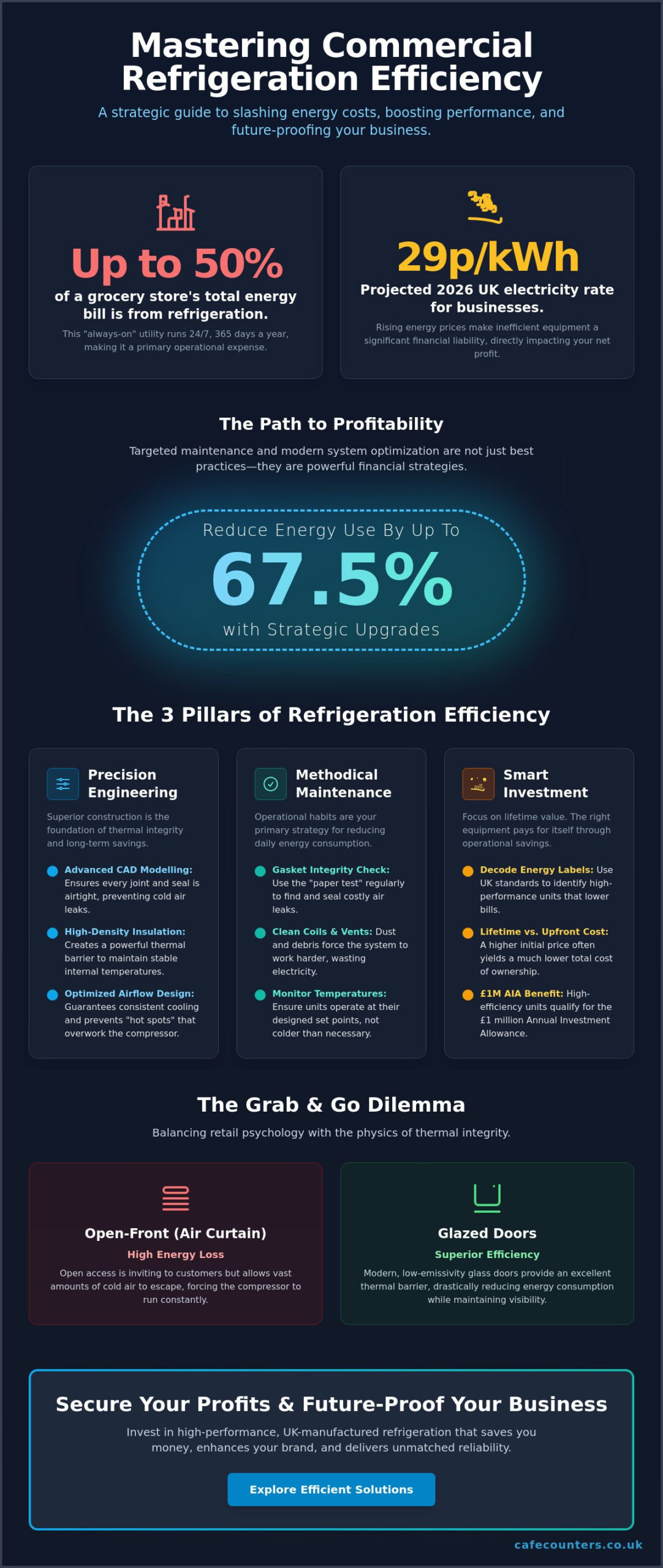
Did you know that refrigeration can account for up to 50% of a grocery store’s total energy consumption? With commercial electricity rates projected to reach 29p/kWh for medium-sized businesses in 2026, the financial pressure of maintaining a high-end retail environment has never been more intense. You’ve likely felt the frustration of watching utility bills climb while managing condensation on glass or the sudden stress of equipment failure. However, reducing energy consumption of display fridges isn’t just about cutting costs. It’s about refining your operational precision. We understand that your Deli Counters and Patisserie Displays are the heart of your presentation, and they must perform flawlessly without draining your bottom line.
It’s understandable to feel overwhelmed by the complexities of F-Gas regulations and the latest Ecodesign energy labels. This guide provides a clear, methodical path to mastering the technical and operational strategies needed to slash your commercial refrigeration costs while keeping your products looking their best. You’ll learn how targeted maintenance and system optimization can reduce energy use by as much as 67.5%. We’ll walk you through everything from the 2026 refrigerant service bans to the practical benefits of the £1 million Annual Investment Allowance, ensuring your business remains both sustainable and profitable.
Key Takeaways
- Analyze the financial impact of “always-on” refrigeration and understand the critical ratio between cooling performance and power input for your facility.
- Discover how precision CAD modelling and high-density insulation materials create the airtight thermal barriers necessary for long-term operational efficiency.
- Master methodical maintenance habits, such as the “paper test” for gaskets, as a primary strategy for reducing energy consumption of display fridges.
- Navigate the latest UK energy labeling standards to identify high-performance units that qualify for the £1 million Annual Investment Allowance.
- Evaluate the balance between retail psychology and thermal integrity by comparing air curtain technology against the advanced glazing found in modern Grab & Go displays.
The Financial Impact: Why Reducing Energy Consumption of Display Fridges is Critical
In the professional kitchen or retail space, refrigeration is the only utility that never sleeps. While lighting and ovens are switched off at the end of service, your Patisserie Displays and Deli Counters must maintain precise temperatures 24 hours a day, 365 days a year. This “always-on” requirement means that refrigeration often accounts for approximately 40% of a cafe’s total energy expenditure. Understanding the principles of refrigeration is essential for any operator looking to protect their margins. At its core, energy efficiency is the mathematical ratio between cooling performance and power input. If a unit requires excessive electricity to achieve a standard set point, it isn’t just a technical flaw; it’s a direct drain on your business’s net profit.
Reducing energy consumption of display fridges has moved from a secondary concern to a primary procurement strategy. In the past, many buyers focused solely on the initial purchase price. Today, the professional standard focuses on the lifetime operational cost. Choosing a high-quality unit might involve a higher upfront investment, but the reduction in monthly utility bills often pays back that difference within the first few years of operation. In a sector where net profit margins are often slim, every penny saved on utilities is a penny added directly to your bottom line.
The Rising Cost of Operational Inefficiency
The volatility of UK energy prices, with some businesses facing rates as high as 29p/kWh, makes inefficient equipment a liability. An underperforming fridge doesn’t just waste electricity; it also vents excess heat into your shop floor. This forces your air conditioning system to work harder, creating a secondary “hidden” energy cost. We’ve seen how this thermal strain leads to accelerated component wear, resulting in frequent breakdowns and costly emergency repairs. By prioritizing efficiency, you ensure your equipment operates within its design parameters, extending its lifespan and maintaining the integrity of your Deli Counters.
Environmental Responsibility and Brand Perception
Modern consumers are increasingly discerning about where they spend their money. They value brands that demonstrate a genuine commitment to sustainability. Investing in energy-efficient Grab & Go Displays or Salad Bars isn’t just about meeting UK carbon reduction targets; it’s about projecting a professional, responsible image. A business that cares for its equipment and its environmental footprint is often perceived as one that cares for the quality of its products. This alignment between operational efficiency and brand reputation creates a competitive advantage that goes far beyond simple cost savings.
Precision Engineering: The Role of Manufacturing in Thermal Integrity
Precision engineering is the silent partner in reducing energy consumption of display fridges. Every millimeter of a unit’s construction influences how effectively it retains cold air and rejects heat. We use advanced CAD modelling to ensure that every seal, joint, and component aligns with absolute accuracy. This level of detail prevents the minute air leaks that force a compressor to run longer than necessary. When a unit is built with precision, it doesn’t just look better; it operates with a level of thermal integrity that mass-produced, thin-walled imports simply can’t match.
High-density insulation is a cornerstone of this process. In our bespoke counter construction, we utilize specialized materials that provide superior thermal resistance. This ensures that the chilled environment inside your Patisserie Displays remains stable, even in high-ambient temperatures. Proper internal airflow design also plays a vital role. By mapping the path of cold air, we ensure consistent temperature distribution. This prevents the compressor from overworking to compensate for “hot spots” within the cabinet. It’s a methodical approach that guarantees your Deli Counters perform reliably under the pressures of a busy retail environment.
Advanced Component Selection for 2026 Standards
The components inside the cabinet are just as important as the frame itself. We’ve transitioned to high-efficiency EC (Electronically Commutated) fans. These use significantly less power than traditional shaded-pole motors. Following Federal Energy Management Program guidance on component efficiency helps in selecting parts that meet the rigorous standards of 2026. The shift to natural refrigerants like R290 is now the professional standard. These gases are more efficient at heat transfer, meaning your equipment runs more economically. Intelligent controllers also manage defrost cycles based on actual frost build-up rather than simple timers, which saves energy during low-use periods.
Bespoke Design vs. Standard Off-the-Shelf Units
Standard units often force you to cool more space than you actually need. The bespoke cafe counter design process allows us to match unit capacity exactly to your stock levels and floor plan. This precision eliminates “cooling empty space,” which is a major source of energy waste. Custom-built units also allow for integrated thermal breaks. These are physical barriers that prevent heat from transferring through the metal frame into the refrigerated area. If you’re looking for a solution that combines high-end aesthetics with technical superiority, our team can help you design a bespoke serving counter tailored to your specific operational needs.
The Grab & Go Dilemma: Balancing Retail Psychology with Energy Savings
Open-front merchandisers are staples of the modern cafe, but they present a significant technical challenge for reducing energy consumption of display fridges. While “air curtains” are designed to act as invisible thermal barriers, they’re easily disrupted by drafts, foot traffic, or improper stocking. This disruption allows cold air to spill out and warm ambient air to enter, forcing the compressor into a continuous, high-load cycle. For many operators, the theatre of an open display comes at a high price in monthly utility expenditure.
The debate often centers on whether glass doors inhibit the “impulse buy” psychology essential to retail success. However, modern high-visibility glazing ensures that product presentation remains the primary focus. In patisserie display counters, the shift from double to triple glazing provides a superior thermal barrier without compromising the visual appeal of delicate cakes or pastries. For many operators, the slight physical barrier of a door is far outweighed by the drastic reduction in the unit’s thermal load. When the shop is closed, the energy drain continues; implementing night blinds or thermal covers is a simple, methodical step that can save up to 20% on energy consumption by sealing the cabinet during non-trading hours.
Open Front vs. Glazed Displays: A Performance Comparison
When comparing thermal loss, open-front units consume significantly more power than sliding or hinged door models. The “barrier effect” of a door is the most effective tool in your efficiency arsenal. High-clarity, anti-reflective glass maintains that essential connection between the customer and the product while keeping the cold exactly where it belongs. If you’re currently running open displays, calculating the ROI of upgrading to glazed models often reveals a surprisingly short payback period driven by energy savings alone.
Optimising Lighting for Visibility and Efficiency
Lighting is a critical component of refrigerated grab and go display units, yet it can be a source of unwanted heat. Traditional fluorescent tubes vent heat directly into the chilled area, forcing the refrigeration system to work harder to compensate. Switching to low-heat, high-CRI LED lighting ensures your products look vibrant and fresh without raising the internal temperature. Placing lighting strategically at the front of the shelves also improves visibility while reducing the overall number of fixtures required. For storage-focused display areas, motion-sensor lighting ensures energy is only used when a customer is actually browsing.
Methodical Maintenance: Operational Habits that Slash Running Costs
Operational discipline is the most cost-effective tool for reducing energy consumption of display fridges. While high-end engineering provides the foundation, your daily habits determine whether that equipment reaches its full efficiency potential. Maintenance shouldn’t be viewed as a chore to avoid breakdowns; it’s a methodical financial strategy. When dust and debris accumulate on the condenser coils, they act as a thick layer of insulation. This prevents the system from rejecting heat effectively, forcing the compressor to work harder. Research indicates that regular coil cleaning can improve a system’s efficiency by 10-15% and prevent a total efficiency drop of up to 30%.
Gasket integrity is another critical factor often overlooked in busy environments. A split or brittle seal allows cold air to escape continuously. You can perform a simple “paper test” by closing the door on a thin sheet of paper; if it pulls out easily, your seal is compromised and your profits are leaking. Strategic loading is also essential for maintaining thermal stability. Overfilling a deli counter blocks the internal air vents, disrupting the cooling cycle and creating warm zones. Even minor temperature miscalibrations can be costly, as running a unit just 1°C colder than necessary can increase its energy use by 2-4%.
The Professional Maintenance Checklist
Precision requires a structured approach. We recommend a tiered checklist to keep your equipment in peak condition:
- Daily: Clear any obstructions from internal air vents and wipe down door seals to prevent sticky residues from tearing the gaskets.
- Weekly: Inspect the “honeycomb” air diffusers in Grab & Go Displays for dust buildup.
- Monthly: Use a soft brush or vacuum to clean the condenser coils.
While staff can handle basic hygiene, professional servicing is vital for checking refrigerant levels and sensor accuracy. Methodical care ensures your commercial refrigerators remain reliable assets rather than becoming mounting liabilities.
Ambient Environment and Placement Strategy
The physical location of your fridge dictates its workload. Placing a chilled display near ovens, dishwashers, or in the path of direct afternoon sunlight is a profit killer. These external heat sources force the motor to run almost constantly. Ensure there’s adequate ventilation clearance around the unit’s vents to prevent heat from recirculating back into the motor. By managing the ambient temperature of your cafe and ensuring your units have room to breathe, you significantly reduce the mechanical strain on the system. If you’re planning a new layout, you can consult our experts for a bespoke serving counter that integrates these thermal considerations from the start.
Investing in the Future: Selecting High-Performance UK-Manufactured Units
Choosing the right equipment is the final, most critical step in reducing energy consumption of display fridges. While operational habits and maintenance are vital, they can only do so much for a unit designed under outdated standards. Since March 2021, UK regulations have mandated an A-G energy labeling scale for commercial appliances with a direct sales function. This transparency allows you to identify units with a lower Energy Efficiency Index (EEI) before you commit to a purchase. Selecting a high-efficiency model can lead to a 15-20% reduction in electricity costs compared to standard alternatives. We believe that true value lies in the synergy between this technical data and high-quality construction.
Our approach at TFSE Products Ltd blends this data-driven efficiency with artisanal pride. By overseeing the entire production process in our UK facilities, we ensure that every Deli Counter or Patisserie Display meets our rigorous internal standards for thermal retention. Professional commissioning is equally important; a unit that’s installed and calibrated correctly from day one will always outperform a generic import that’s simply plugged in and left to run. This methodical installation process ensures that all components, from the compressor to the LED lighting, operate at their designed efficiency levels.
The ROI of Equipment Upgrades
The financial logic for an upgrade is compelling. For the 2026/2027 tax year, the Annual Investment Allowance (AIA) remains at £1 million. This allows your business to deduct the full cost of qualifying energy-efficient units, such as Integrate Drop-in Units or Grab & Go Displays, from your taxable profits in the year of purchase. When you combine these tax savings with lower monthly utility bills, the payback period for a high-performance unit is significantly shorter than most operators expect. A professional refit doesn’t just lower costs; it modernizes your brand and signals your commitment to sustainability.
Bespoke Solutions for Unique Retail Spaces
Every shop floor has different thermal challenges. A partner who understands cafe layout design can help you integrate cooling, heating, and ambient sections into a single, efficient serving counter. This reduces the footprint of your equipment and prevents different units from competing for ventilation space. Whether you’re installing Salad Bars or Stainless Steel Back-bar Units, prioritizing quality and efficiency in your next project is the surest way to protect your long-term profitability. We invite you to share your vision with us, and we’ll provide the technical expertise required to bring it to life with precision and reliability.
Securing Long-Term Profitability through Energy-Efficient Design
Mastering the efficiency of your retail space requires a balance between technical precision and methodical operational habits. We’ve explored how high-density insulation, advanced CAD modelling, and disciplined maintenance schedules work together to protect your margins. By prioritizing equipment that meets modern UK energy standards, you don’t just lower your utility bills; you invest in the long-term reliability of your brand. Reducing energy consumption of display fridges is a strategic commitment that pays dividends through extended equipment lifespan and enhanced product presentation.
Since 1991, we’ve focused on UK-based manufacturing to ensure every bespoke counter we produce offers superior thermal integrity. Our team provides expert CAD modelling for absolute precision, followed by full installation and commissioning services nationwide to guarantee peak performance from day one. We’re ready to help you bring your vision to life with the technical expertise your project deserves. Request a Professional Consultation for Your Energy-Efficient Counter Design and take the first step toward a more sustainable, profitable future.
Frequently Asked Questions
How much can I save by switching to an energy-efficient display fridge?
You can typically achieve a 15-20% reduction in electricity costs by upgrading to high-performance models. In a professional setting, these savings contribute directly to your net profit margins. Over the equipment’s lifespan, the reduction in utility expenditure often offsets the initial purchase price of the unit.
Does turning off the display lights at night really make a difference?
Yes, switching off internal lighting reduces both direct power use and the thermal load on the cooling system. Even modern LEDs generate a small amount of heat that the compressor must work to remove. Using night blinds in conjunction with turning off lights can save up to 20% on energy during closing hours.
What is the most energy-efficient temperature for a cafe display fridge?
Maintaining a temperature between 3°C and 5°C is generally the most efficient range for chilled food safety. It’s vital to avoid setting the thermostat lower than necessary, as running a unit just 1°C colder than the required set point can increase energy use by 2-4%. Precision calibration ensures you don’t waste electricity on unnecessary cooling.
Should I choose a glass door fridge or an open-front merchandiser for my cafe?
Glass door models are significantly more efficient because they provide a permanent physical barrier against ambient heat. While open-front Grab & Go Displays use air curtains, these are easily disrupted by shop drafts and foot traffic. Triple-glazed Patisserie Displays offer the best synergy between high-end product presentation and thermal retention.
How often should I clean the condenser coils on my commercial fridge?
You should clean your condenser coils at least once a month to ensure the system can reject heat effectively. Dust and debris act as insulators, forcing the motor to run longer and harder. Methodical monthly cleaning is a primary strategy for reducing energy consumption of display fridges and preventing a 30% drop in efficiency.
Are there any UK government grants for energy-efficient catering equipment?
While direct grants are often regional, the Annual Investment Allowance (AIA) remains a powerful incentive for UK businesses. For the 2026/2027 tax year, the AIA allows you to deduct up to £1 million for qualifying plant and machinery from your taxable profits. This makes investing in high-efficiency Deli Counters or Salad Bars much more financially accessible.
Will a bespoke counter be more energy-efficient than a standard unit?
Yes, a bespoke counter is often more efficient because it’s engineered to match your specific stock levels and floor plan. This precision eliminates the energy wasted by “cooling empty space” in oversized standard units. Our CAD-designed Bespoke Serving Counters also integrate thermal breaks that prevent heat transfer through the frame, a feature rarely found in mass-produced imports.
How can I tell if my fridge gaskets need replacing?
You can perform the “paper test” by closing the fridge door on a thin sheet of paper; if it pulls out without resistance, the seal is compromised. Damaged gaskets are a major hurdle when reducing energy consumption of display fridges because they allow cold air to leak constantly. Inspecting seals for cracks or stiffness should be a weekly task for your maintenance team.