
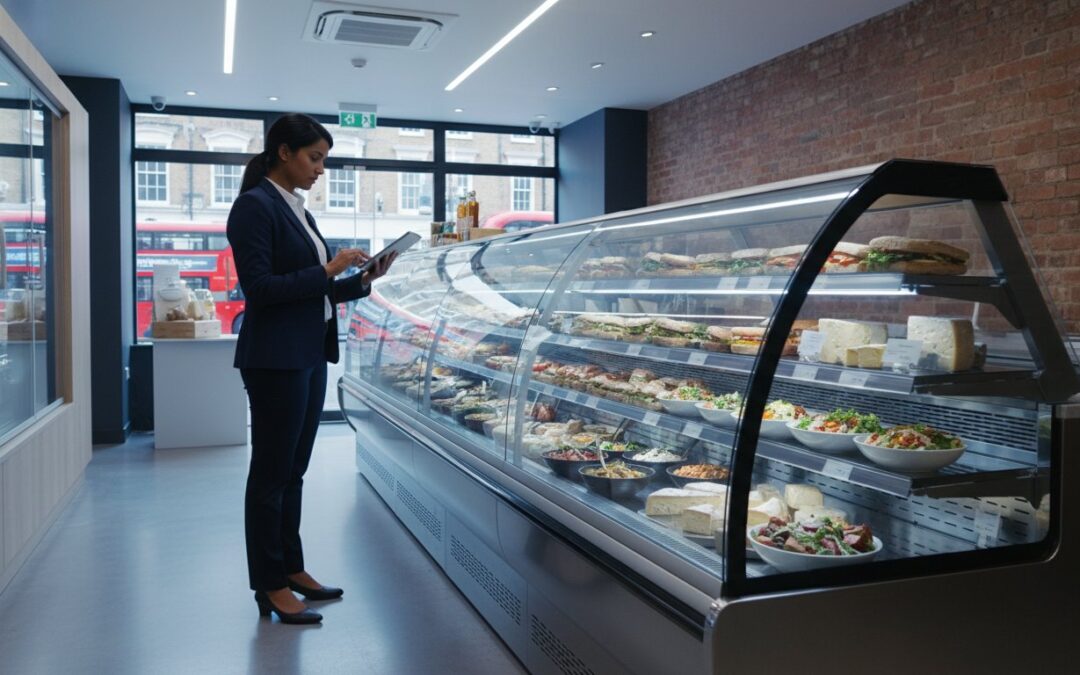
Did you know that refrigeration can account for as much as 50% of total energy consumption in UK grocery and retail shops? This stark reality means that staying ahead of the refrigerated food display regulations 2026 isn’t just a matter of legal box-ticking; it’s a vital strategy for your operational survival. We understand the stress caused by varying regional rules and the looming fear of health inspector penalties, particularly when inefficient equipment drives up your monthly overheads.
It’s natural to feel concerned about how shifting F-Gas restrictions and Energy Efficiency Index ratings affect your daily service. This guide promises to help you master the latest UK food safety standards and temperature requirements, ensuring your grab and go displays or bespoke serving counters remain both compliant and exceptionally reliable. We’ll examine the critical 2026 mandates, covering everything from strict chilled temperature limits to the transition toward lower-GWP refrigerants, providing the technical clarity you need to protect your vision and your business.
Key Takeaways
- Understand the evolving landscape of refrigerated food display regulations 2026 and how the Food Standards Agency oversees enforcement across the UK.
- Identify the critical difference between the legal 8°C limit and the “Target 5” best practice to ensure your high-risk foods remain safe and compliant.
- Learn how to interpret Ecodesign energy labels to select equipment that reduces rising operational costs while meeting strict environmental standards.
- Master a practical daily routine for temperature logging and equipment maintenance that satisfies even the most meticulous health inspector audits.
- Explore the benefits of bespoke serving counters and integrated units that combine high-end design with the technical precision required for long-term durability.
The UK Regulatory Framework for Refrigerated Food Displays in 2026
The cornerstone of British food law remains the Food Safety Act 1990. It provides the essential framework that ensures all food sold is safe for consumption and of the quality consumers expect. In 2026, the Food Standards Agency (FSA) continues to lead the charge, refining how these decades-old principles apply to modern, high-intensity commercial environments. As a Food Business Operator (FBO), the legal responsibility for compliance rests squarely on your shoulders. You aren’t just managing a retail space; you’re overseeing a complex cold chain where every link must hold firm to protect public health.
The refrigerated food display regulations 2026 represent a clear departure from the broad, retained EU legislation of previous years. The UK now prioritizes a more localized approach to energy efficiency and hygiene monitoring. This means your equipment must do more than just stay cold. It needs to meet specific UK-centric benchmarks for performance, data transparency, and environmental impact. Understanding these nuances is the first step toward securing your business against future regulatory shifts.
Primary Legislation and Enforcement Bodies
While the Food Safety Act provides the foundation, the Food Hygiene (England) Regulations 2013 and its regional counterparts in Scotland and Wales dictate the daily specifics. Environmental Health Officers (EHOs) are the boots on the ground during 2026 inspections. They look for meticulous temperature logs and evidence of a robust HACCP-based system. A significant trend this year is the shift toward digital record-keeping. EHOs now prefer seeing real-time data from integrated sensors rather than handwritten notes that are prone to human error. They focus heavily on the physical condition of your equipment, specifically checking if your grab and go displays or salad bars are maintained to prevent cross-contamination.
Legal Consequences of Non-Compliance
Falling short of these standards carries heavy penalties that can destabilize even the most established business. If an EHO identifies a risk, they may issue an Improvement Notice, giving you a set timeframe to rectify the issue. In more severe cases, a Hygiene Emergency Prohibition Order can shut down your operations entirely. Beyond the legal fees and potential fines, the reputational damage of a low hygiene rating is often irreversible. In the age of instant online reviews, a score below a 4 can drive customers straight to your competitors. Investing in high-quality, bespoke serving counters or stainless steel back-bar units reduces this risk significantly. These units are engineered for easy deep-cleaning and precise thermal control, ensuring your equipment supports your compliance goals rather than hindering them.
Critical Temperature Control: The 8°C Rule and Best Practices
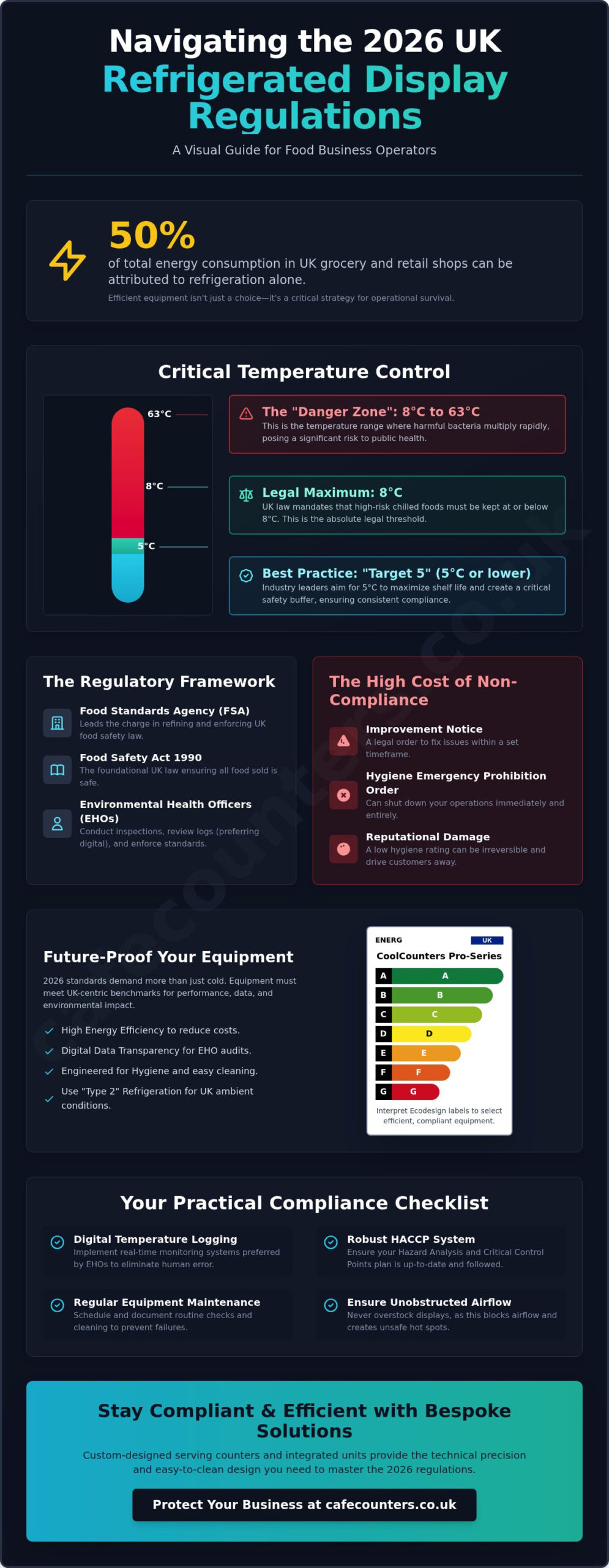
While the broader framework establishes the legal accountability of a business, the physical management of temperature represents the daily reality of compliance. Under the Food Safety (Temperature Control) Regulations, the legal maximum for high-risk chilled food is 8°C. However, the refrigerated food display regulations 2026 emphasize a shift toward more stringent internal standards. This has led to the “Target 5” initiative, where industry leaders aim for 5°C or lower to maximize product shelf life and safety margins. Keeping food at 5°C provides a critical buffer against the “Danger Zone” between 8°C and 63°C, where bacteria multiply with alarming speed.
Practical service often requires flexibility, which is why the 4-hour rule remains a vital exemption. This allows you to display chilled food outside of refrigeration for a single period of up to four hours. Once this window closes, the food must either be consumed, discarded, or returned to a chilled environment until it reaches 8°C. It’s a precise balancing act that requires meticulous timing and reliable equipment to execute safely every day.
Monitoring and Maintaining Chilled Airflow
In a high-pressure kitchen or retail environment, the air temperature inside a cabinet can be misleading. What truly matters is the core temperature of the food itself. Achieving this consistency requires “Type 2” refrigeration, which is specifically engineered to perform in high-ambient UK environments where humidity and external heat fluctuate. The 8°C rule acts as the legal threshold for pathogenic micro-organism growth. To ensure your units meet this, you must prioritize unobstructed airflow. Blocking a single vent with overstocked produce can create warm pockets, rendering even the most expensive unit non-compliant within minutes.
Bespoke Solutions for Temperature Stability
Standard, off-the-shelf units often struggle with the specific thermal demands of a busy shop floor. Choosing a custom deli counter allows for precision-engineered airflow patterns that wrap around the product, maintaining a steady chill regardless of how many times the doors are opened. High-quality insulation and UV-bonded glass play a significant role here, acting as a thermal barrier that keeps the cold in and the heat out. By integrating digital probes and real-time alarms, you gain an extra layer of security. These systems alert you the moment a temperature drifts, allowing for corrective action before a minor fluctuation becomes a legal breach. If you’re looking to upgrade your setup, our team can help you design bespoke serving counters that marry aesthetic appeal with uncompromising thermal performance.
2026 Equipment Standards: Energy Efficiency and Hygiene
Selecting equipment under the refrigerated food display regulations 2026 requires a dual focus on thermal performance and operational economy. The Ecodesign and Energy Labelling Regulations have transformed how we evaluate commercial units, moving away from simple temperature maintenance toward a holistic view of energy consumption. Since refrigeration can account for as much as 50% of total energy consumption in retail and grocery environments, choosing compliant, high-efficiency equipment is now a primary financial imperative. Modern standards demand that units not only protect your produce but also protect your bottom line by meeting strict Minimum Energy Performance Standards (MEPS).
While energy is a major factor, the physical durability of your equipment ensures long-term compliance. Food Grade Stainless Steel 304 remains the industry gold standard for a reason. It provides a non-porous, corrosion-resistant surface that withstands the rigours of daily commercial use. In our bespoke counter fabrication, we prioritize this material to ensure that every patisserie display or deli counter we produce meets the highest hygiene thresholds. A unit that’s easy to clean is a unit that stays compliant, reducing the risk of bacterial buildup in hard-to-reach areas.
Understanding Energy Labels for Commercial Displays
The A-G energy rating scale for commercial refrigerators provides a transparent way to compare the Energy Efficiency Index (EEI) of different units. This index measures a cabinet’s energy use against a standard reference, allowing you to identify models that offer superior temperature recovery. When doors are opened frequently in a busy shop, the ability of a unit to quickly return to its set point is vital for food safety. Choosing bespoke UK manufacturing over mass-market imports allows for the selection of premium components, such as high-efficiency fans and compressors, which are specifically tuned for the unique demands of the British market.
Hygiene by Design: CAD Modelling and Fabrication
Effective hygiene starts long before the first deep clean. We utilize advanced CAD modelling to identify and eliminate potential “dirt traps” during the design phase of custom counter systems. By specifying seamless welding and radius corners, we ensure there are no sharp angles where food particles or moisture can accumulate. This level of precision is especially important when integrating refrigerated grab and go display units into a hygienic workflow. Meticulous fabrication ensures that every component, from the internal fans to the condenser coils, remains accessible for maintenance. Remember that dirty condenser coils can decrease system efficiency by up to 30%, making an “easy-access” design essential for both hygiene and energy performance in 2026.
Achieving Compliance: A Practical Checklist for UK Operators
Legal safety isn’t a static achievement. It’s a methodical, daily discipline that transforms regulatory theory into operational reality. Maintaining compliance with the refrigerated food display regulations 2026 requires a structured approach that goes beyond simply turning on a machine. Your team must be the first line of defence, identifying potential issues before they escalate into health risks or equipment failures. By following a rigorous checklist, you protect your customers and insulate your business from the financial sting of regulatory penalties.
A robust daily routine is essential for any professional environment. We recommend a triple-check system for temperature logs, recording data in the morning, at noon, and before closing. This ensures that any thermal drift is caught early. Your checklist should also include:
- Daily Temperature Logs: Record morning, noon, and evening checks to identify patterns in thermal performance.
- Visual Inspections: Check door seals for splits, glass for integrity, and ensure no stock is obstructing vital airflow vents.
- Cleaning Schedules: Implement weekly deep cleaning protocols for internal fans and monthly checks for condenser coils.
- Staff Training: Verify that every team member understands HACCP principles and knows how to react to a temperature alarm.
- Annual Calibration: Schedule professional service visits to calibrate probes and ensure sensors remain accurate.
Developing Your HACCP Plan
Identifying Critical Control Points (CCPs) is the heart of your food safety management system. In the context of the refrigerated food display regulations 2026, your primary CCP is the point at which food enters the display unit. You must establish clear corrective actions for when temperatures drift above the legal 8°C limit. This might involve moving stock to a backup unit or discarding items that have exceeded the four-hour display window. Documentation is your best ally during an EHO visit; maintain audit-ready records that prove you’ve consistently monitored and managed your cold chain.
Equipment Maintenance and Commissioning
Investing in professional installation and commissioning is a vital step for long-term compliance. A unit that isn’t levelled or vented correctly will struggle to maintain the required 5°C target, especially during the unpredictable peaks of the UK summer. Proper tuning ensures your refrigeration system handles high ambient heat without overworking the compressor. Regular condenser cleaning can improve energy efficiency by up to 25%. To ensure your shop floor meets these rigorous standards, consider investing in high-performance bespoke serving counters designed for long-term reliability.
Navigating 2026 Regulations with TFSE Bespoke Solutions
Generic, mass-produced refrigeration units often fall short when faced with the rigorous scrutiny of modern UK safety audits. These “one-size-fits-all” solutions frequently lack the thermal precision and energy efficiency required to meet the refrigerated food display regulations 2026. At TFSE Products Ltd, we approach compliance as a fundamental design requirement rather than an afterthought. Our commitment to UK manufacturing allows us to maintain total control over the production process, ensuring that every unit leaving our facility exceeds the minimum legal standards for durability and performance.
We guide our clients through a methodical, end-to-end journey that transforms a conceptual vision into a fully commissioned physical space. This process begins with detailed CAD modelling, where we eliminate potential hygiene risks before fabrication even starts. By managing every stage of the project, from the initial idea to the final installation of your patisserie displays or deli counters, we provide a level of technical certainty that off-the-shelf imports simply cannot match. This integrated approach ensures your equipment isn’t just a visual centrepiece, but a compliant, high-performance asset.
Expert Consultation for Complex Fit-Outs
Our site surveys act as a proactive safeguard, identifying potential regulatory hurdles like poor ventilation or restricted airflow before they become costly problems. We specialize in custom engineering for unique architectural spaces where standard units fail to cool effectively. Whether you’re installing integrate drop-in units or expansive salad bars, our technical expertise ensures your layout supports consistent thermal stability. You also benefit from the reassurance of UK-based after-sales support, providing you with direct access to the professionals who designed and built your equipment.
The TFSE Advantage: Quality and Durability
We believe that high-end design and rigorous functional safety should work in perfect harmony. Our bespoke counters utilize advanced, energy-efficient cooling technologies that align with the latest Ecodesign standards, helping you lower operational risks while reducing energy overheads. By choosing a partner that values artisanal pride and internal production capabilities, you position your business as a leader in both food safety and retail aesthetics. We invite you to Contact TFSE Products Ltd today to discuss your compliant counter project and discover how our tailored solutions can secure your operational future under the refrigerated food display regulations 2026.
Securing Your Operational Future in 2026
Mastering the refrigerated food display regulations 2026 is a journey that moves from understanding legal frameworks to implementing meticulous daily habits. We’ve explored how transitioning from the absolute 8°C limit to a “Target 5” best practice protects your stock and your reputation. By embracing Ecodesign energy standards and rigorous hygiene protocols, you transform your food display from a simple utility into a high-performance asset. This proactive approach ensures your business remains resilient against rising energy costs and strict local authority inspections.
As your expert partner, we bring the technical precision of advanced CAD modelling and the heritage of UK-based manufacturing since 1991 to every project. We handle the entire process, from initial site surveys to comprehensive installation and commissioning services; this alleviates the stress of complex commercial fit-outs. We invite you to consult with our expert team on your bespoke, compliant counter design. With the right equipment and a steady, professional hand, you can focus on delivering exceptional quality to your customers with total confidence in your compliance.
Frequently Asked Questions
Is the 8°C rule a legal requirement for all food displays in the UK?
The 8°C rule is a strict legal requirement for all high-risk, perishable foods under current UK legislation. This threshold is specifically set to inhibit the growth of pathogenic micro-organisms that cause foodborne illnesses. While 8°C is the absolute legal maximum, we recommend a target of 5°C or below. This lower range provides a necessary safety buffer and helps maintain the artisanal quality and freshness of your products for longer periods.
How often should I record the temperature of my refrigerated display?
You should record the temperature of your unit at least twice daily, but a three-check system is the best practice for 2026. Recording temperatures in the morning, at noon, and before closing ensures that you catch any thermal drift during peak service hours. This methodical approach to documentation is a core part of meeting the refrigerated food display regulations 2026 and provides clear evidence of your due diligence during EHO inspections.
What is the “Danger Zone” in food safety, and why is it critical?
The “Danger Zone” is the temperature range between 8°C and 63°C, where harmful bacteria can double in number in as little as twenty minutes. It’s critical because most food poisoning bacteria thrive at these ambient temperatures. To keep your customers safe, chilled food must stay below the 8°C threshold, while hot food in units like heated gantries must be kept at 63°C or above to prevent rapid microbial growth.
Are there exemptions for displaying chilled food during service?
Yes, the “4-hour rule” provides a legal exemption that allows you to display chilled food outside of temperature control for a single period of up to four hours. This is particularly useful for temporary displays or buffet service. It’s important to remember that this can only happen once. After the four hours are up, the food must be consumed, discarded, or chilled back down to 8°C or below before it can be served again.
What are the 2026 energy labelling requirements for commercial fridges?
Commercial refrigeration units must now meet Minimum Energy Performance Standards (MEPS) and display a clear energy label with a rating from A to G. These requirements are part of the Ecodesign for Energy-Related Products and Energy Information Regulations. By checking the Energy Efficiency Index (EEI) on these labels, you can identify which units will provide the lowest running costs while still maintaining the rigorous thermal performance required for compliance.
Can a bespoke counter really help me stay compliant with food regulations?
A bespoke counter is a powerful tool for compliance because it’s engineered specifically for the unique airflow and hygiene demands of your retail space. Unlike mass-produced units, our bespoke serving counters and deli counters use CAD modelling to eliminate dirt traps and ensure consistent cooling across the entire display. This high-end customization guarantees that your equipment supports your food safety goals rather than creating hidden risks that could lead to inspection failures.
What should I do if my display fridge temperature rises above 8°C?
If your unit rises above 8°C, you must implement the corrective actions outlined in your HACCP plan immediately. First, determine how long the food has been above the legal limit. If it’s been less than four hours, you can move the stock to a functioning refrigerated space or a back-bar unit. If the food has been in the “Danger Zone” for more than four hours, or if the time is unknown, it must be discarded to ensure public safety.