
Your commercial display refrigerator isn’t just keeping food cold; it’s either selling your products or silently costing you revenue every single day. That’s a perspective many operators miss when they treat refrigerated display as a utility purchase rather than a merchandising decision.
If you’ve wrestled with units that run up energy bills, create inconsistent temperature zones, or simply look out of place in a carefully designed café or deli environment, you already understand the real cost of getting this choice wrong. Finding equipment that balances genuine cooling performance with the kind of refined aesthetic your space demands isn’t always straightforward, particularly when standard off-the-shelf dimensions don’t suit your layout.
This guide cuts through that complexity. You’ll learn how to match the right display refrigeration category to your specific product range, what to look for in energy-efficient specifications, how bespoke sizing works in practice, and what UK food safety compliance actually requires of your equipment. Whether you’re outfitting a patisserie counter, a grab and go run, or a full deli display, the decisions you make here will directly shape your customer experience, your operational costs, and your bottom line.
Key Takeaways
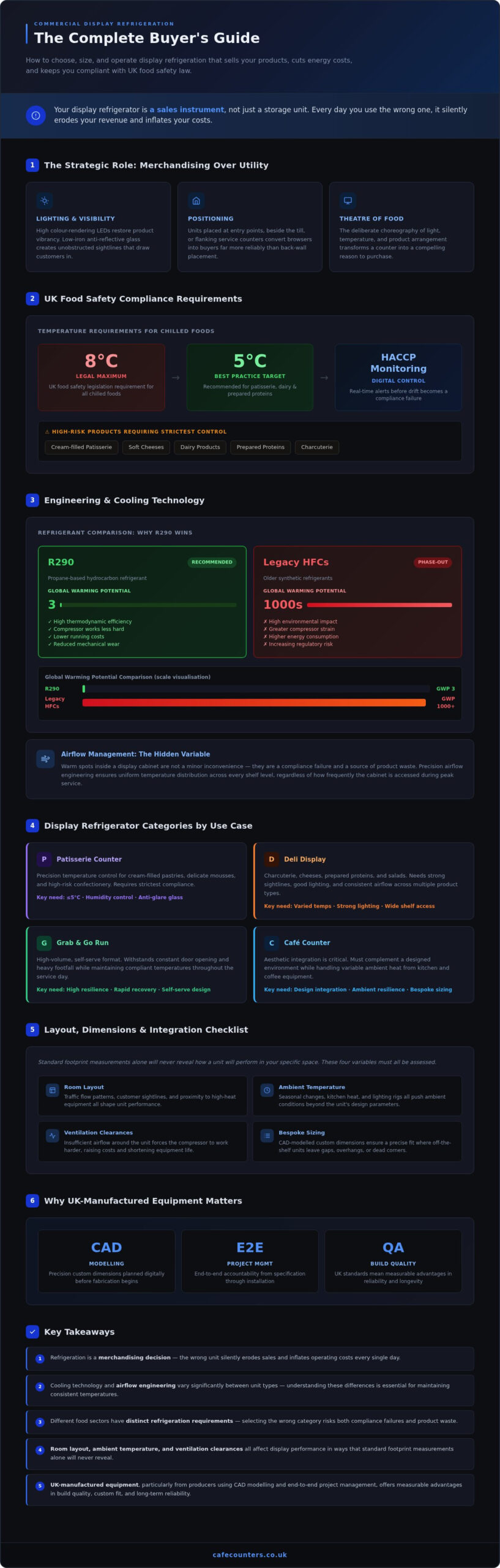
- Choosing the right commercial display refrigerator is a merchandising decision as much as a technical one — the wrong unit can silently erode sales and inflate operating costs every day.
- Cooling technology and airflow engineering vary significantly between unit types, and understanding these differences is essential for maintaining consistent temperatures across your entire display.
- Different food sectors — from patisserie to grab and go — have distinct refrigeration requirements, and selecting the correct category prevents both compliance failures and product waste.
- Room layout, ambient temperature, and ventilation clearances all affect display performance in ways that standard footprint measurements alone will never reveal.
- UK-manufactured equipment, particularly from producers using CAD modelling and end-to-end project management, offers measurable advantages in build quality, custom fit, and long-term reliability.
The Strategic Role of Commercial Display Refrigeration in Foodservice
A commercial display refrigerator is not a storage unit with a glass door. It’s a sales instrument, and operators who treat it as anything less are leaving revenue on the counter every single day. The distinction matters because the design decisions built into professional-grade equipment, from airflow engineering to lighting placement, are specifically calibrated to influence purchasing behaviour at the precise moment a customer is deciding what to buy.
This is where professional refrigeration separates itself from domestic or semi-commercial alternatives. Domestic units are engineered for infrequent access and stable ambient conditions. A commercial environment demands something fundamentally different: consistent temperature maintenance under constant door opening, high-traffic footfall, and variable ambient heat from kitchen equipment, lighting rigs, and seasonal temperature shifts. Semi-commercial units often bridge neither world effectively, compromising on both performance and presentation.
Enhancing Product Visibility to Drive Revenue
Lighting and glass clarity are the two most underestimated variables in food merchandising. Low-colour-rendering LEDs flatten the natural tones of fresh produce, pastries, and charcuterie, making premium products look ordinary. High-quality internal lighting with accurate colour rendering restores the vibrancy that makes a customer reach for an item rather than walk past it. Glass clarity compounds this effect; anti-reflective, low-iron glass allows unobstructed sightlines that draw the eye directly to the product.
Positioning matters just as much as specification. Units placed at natural decision points in a customer’s journey, at the point of entry, adjacent to a till, or flanking a service counter, convert browsers into buyers far more reliably than units tucked against a back wall. In a modern café setting, the theatre of food is the deliberate choreography of light, temperature, and product arrangement that transforms a display counter into a compelling reason to purchase.
Ensuring HACCP Compliance and Food Safety
Aesthetic performance means nothing if the unit can’t hold compliant temperatures under real operating conditions. UK food safety legislation requires that chilled foods are maintained at or below 8°C, with best practice targeting 5°C or below for high-risk products such as patisserie, dairy, and prepared proteins. In high-traffic environments, maintaining consistent core temperatures demands precision-engineered refrigeration systems, not units operating at the margin of their rated capacity.
Professional displays address this through digital controllers with real-time monitoring and integrated alarm systems that alert operators to temperature drift before it becomes a compliance failure. For delicate items like cream-filled patisserie or soft cheeses, this level of control isn’t optional; it’s the difference between product integrity and waste. Equipment built to genuine commercial standards, rather than adapted from lighter-duty categories, carries the thermal resilience to perform consistently across an entire service day.
Understanding the Engineering: Cooling Technology and Efficiency
Behind every well-performing commercial display refrigerator is a set of engineering decisions that most operators never see but feel in their energy bills, product quality, and equipment lifespan every single day. Understanding these decisions doesn’t require a refrigeration qualification; it requires knowing which variables actually move the needle.
Refrigerant choice is one of them. The industry has shifted decisively toward hydrocarbon refrigerants, particularly R290 (propane), and for good reason. R290 carries a Global Warming Potential of just 3, compared to the hundreds or thousands associated with older synthetic refrigerants. Beyond the environmental case, R290 operates with high thermodynamic efficiency, meaning the compressor works less hard to achieve the same cooling output. That translates directly into lower running costs and reduced mechanical wear over time.
Airflow management is the variable that separates adequate equipment from genuinely reliable equipment. Warm spots inside a display cabinet aren’t a minor inconvenience; they’re a compliance risk and a product waste problem. Precision-engineered airflow channels distribute cold air evenly across every shelf level, eliminating the temperature gradient that causes items on upper shelves to run warmer than those at the base. In a high-traffic service environment, where doors open and close repeatedly throughout the day, this engineering discipline is what keeps core temperatures stable rather than reactive.
Double-glazed glass contributes more than visual clarity. The insulating air gap between panes significantly reduces thermal transfer, which means the refrigeration system expends less energy compensating for ambient heat gain through the door. In practice, this insulation quality directly affects both running costs and the unit’s ability to hold compliant temperatures during peak service periods when ambient kitchen temperatures rise.
Internal build quality is where long-term reliability is determined. A compressor running within its optimal load range, supported by clean electrical connections, quality condenser coils, and properly tensioned fan assemblies, will outlast a nominally equivalent unit built to lower tolerances by years. This is precisely why manufacturing provenance matters: equipment produced in a controlled UK facility, with consistent quality oversight from component selection through to final commissioning, carries a reliability advantage that imported alternatives rarely match.
Energy Efficient Refrigeration in 2026
UK energy labelling requirements for commercial refrigeration continue to tighten, and the gap between compliant and optimised is wider than many operators realise. High-efficiency EC fan motors, which adjust speed in response to load rather than running at fixed output, reduce energy consumption compared to older AC motor designs. LED lighting contributes further, generating minimal heat inside the cabinet and reducing the thermal load the refrigeration system must overcome. Bespoke manufacturing adds another lever: when insulation thickness is specified to suit a unit’s exact internal volume and intended ambient environment rather than cut to a standard template, thermal performance improves measurably without increasing the unit’s external footprint. For operators specifying equipment through a manufacturer with in-house CAD capabilities, this level of optimisation is achievable from the outset rather than retrofitted later.
Advanced Airflow and Temperature Stability
Open-front grab and go displays rely on air curtain technology to maintain internal temperatures without a physical barrier between product and customer. A precisely calibrated column of cold air flows continuously across the open face of the unit, creating an invisible thermal boundary. Disruptions to this curtain, caused by incorrect installation height, inadequate clearance in front of the unit, or excessive ambient draughts, degrade performance rapidly. Forced air circulation, where refrigerated air is actively distributed by internal fans rather than relying on passive convection, is essential for high-volume service environments where thermal recovery after door opening must be rapid.
Condensation on glass surfaces is both an aesthetic problem and a signal of thermal inefficiency. Heated glass elements and precision-fit door gaskets prevent the temperature differential between the cold interior and warm ambient air from reaching the dew point on visible surfaces. Well-engineered gaskets also eliminate the micro-gaps that allow warm air infiltration, reducing compressor cycling frequency and extending component life. If you’re specifying a unit for a warm or humid environment, these features aren’t optional extras; they’re fundamental to consistent performance.
For operators who want to explore how bespoke manufacturing can optimise these engineering variables for their specific site conditions, speaking with a specialist counter manufacturer early in the project timeline prevents costly compromises later.
Categorising Your Options: From Patisserie to Grab & Go
Not all chilled display equipment serves the same purpose, and the gap between a unit that’s technically adequate and one that’s genuinely right for your operation is wider than most buyers expect. The category of commercial display refrigerator you choose should be determined by your product range, your service model, and your customer’s purchasing behaviour, not simply by what fits the available floor space.
At the broadest level, the choice falls between serve-over counters and self-service formats. Serve-over units place staff between the customer and the product, which suits environments where presentation quality and portion control matter most. Self-service multidecks prioritise throughput and customer autonomy, making them the natural choice for retail-style grab and go environments. Getting this distinction right before you specify anything else prevents costly mismatches between equipment capability and operational reality.
Patisserie and Cake Displays: Aesthetics Meet Precision
Patisserie demands more from a display unit than any other food category. Delicate confectionery, cream-filled gateaux, and hand-finished pastries are simultaneously high-value, visually fragile, and highly sensitive to humidity fluctuations. Too much moisture and fondant finishes bloom; too little and sponge layers dry at the edges. Units designed specifically for this category maintain stable relative humidity within the cabinet, not just stable temperature, which is a distinction that standard chilled counters don’t address.
The visual presentation standard expected of a patisserie environment also drives different glass specification requirements. Standard framed glass creates visual interruptions that segment the display and reduce the sense of abundance. UV-bonded glass construction eliminates visible framing entirely, producing a seamless, gallery-quality sightline that lets the product command attention without competition from structural elements. For operators integrating patisserie display counters into a considered front-of-house design, this difference in glass specification is immediately legible to customers and directly affects perceived product value.
Grab & Go Units for High-Volume Retail
The priorities shift entirely in a grab and go environment. Here, the unit needs to handle frequent product rotation, rapid customer access, and sustained throughput across a full trading day without temperature recovery becoming a problem. Refrigerated grab and go display units should be specified with restocking workflow in mind: rear-access doors, adjustable shelf heights, and clear internal zoning that allows staff to replenish stock quickly during peak service without disrupting customer flow at the front.
Energy management is a genuine operational variable in this format. Night blinds reduce thermal loss during closed periods and lower compressor cycling overnight. Glass door configurations offer stronger energy performance across the full trading day but can reduce the immediacy of access that drives impulse purchases in high-footfall locations. The right choice depends on your trading hours and the balance between energy cost and sales conversion in your specific environment.
For small café spaces where every square metre carries commercial weight, the footprint-to-display-capacity ratio becomes a critical specification point. A well-engineered unit with multiple shelf levels and a compact base dimension will consistently outperform a larger, shallower unit in terms of revenue per square foot, provided the internal airflow is engineered to maintain consistent temperatures across all shelf positions rather than just at the base.
Planning Your Layout: Dimensions, Ventilation, and Integration
Footprint measurements tell you whether a unit will physically fit. They don’t tell you whether it will perform. The gap between those two things is where operators most commonly make expensive mistakes, and where a more considered approach to cafe layout design pays dividends that compound across the entire lifespan of the equipment.
Every commercial display refrigerator requires unobstructed air intake and exhaust clearances to function within its rated specification. A unit pushed flush against a side wall or recessed into a tight alcove without adequate ventilation will run warmer, cycle its compressor more frequently, and draw more energy, even if its external dimensions appear to fit the space. Before any unit is specified, the installation position needs to account for manufacturer-stated clearances on all active ventilation faces, not just the front and rear.
Ambient room temperature is a variable that deserves far more attention than it typically receives at the specification stage. A unit rated for a maximum ambient of 25°C placed near a commercial oven, a south-facing window, or a busy service pass operating at 30°C will struggle to maintain compliant temperatures during peak service. The solution isn’t always a higher-capacity unit; sometimes it’s a layout adjustment that moves the display to a cooler zone, or specifying a unit with a climate class suited to your actual operating environment.
Ergonomics shape both service quality and staff wellbeing. Counter height, shelf accessibility, and the position of controls all affect how efficiently staff can serve during a busy period and how thoroughly they can clean during close-down. Units that are awkward to access encourage shortcuts in cleaning routines, which creates hygiene risk over time. Specifying the right working height for your team, and ensuring adequate clearance for restocking without obstructing customer flow, is a detail that bespoke manufacturing addresses directly.
Integrating Drop-in Units for a Seamless Look
Drop-in refrigerated displays offer a fundamentally different integration approach. Rather than positioning a freestanding unit within a counter run, the refrigerated module is set directly into a bespoke fabricated counter, creating a flush, continuous surface with no visible joins or mismatched cladding. The visual result is a considered, purpose-built installation rather than assembled equipment.
The technical requirements are specific. Counter-top ventilation must be engineered into the fabrication itself, with correctly sized apertures positioned to allow condenser airflow without compromising the counter’s structural integrity or finished appearance. Drainage routing needs to be planned at the design stage, not resolved after installation. When these elements are handled through a single manufacturer managing both the drop-in unit and the surrounding counter fabrication, the outcome is consistently more precise than coordinating separate suppliers after the fact.
Service Access and Maintenance Planning
A unit that’s difficult to maintain will be maintained less frequently. Condenser coils clogged with dust and grease are one of the most common causes of premature compressor failure in commercial environments, and access to the condenser for regular cleaning should be a specification requirement, not an afterthought. Removable shelving with smooth, non-porous surfaces reduces cleaning time and supports consistent hygiene standards across a full trading week.
Commissioning on day one matters more than many operators expect. A professionally commissioned unit arrives verified: temperatures confirmed across all shelf positions, controls calibrated, alarm thresholds set, and documentation in place for your HACCP records. This is the standard that end-to-end project management from design through to installation delivers, and it’s the difference between a unit that performs from the first service and one that requires reactive troubleshooting during your busiest period.
If you’re planning a new counter installation or reconfiguring an existing space, speaking with a specialist counter manufacturer early in the process ensures that ventilation, drainage, and ergonomic requirements are built into the design rather than worked around after the fact.
The Value of UK-Manufactured Professional Refrigeration
Where a unit is made matters more than most buyers realise at the point of purchase. The difference becomes apparent eighteen months in, when a component fails, a seal degrades, or a control board needs replacing. UK-manufactured equipment, produced in a controlled facility with consistent quality oversight, carries a reliability advantage that extends well beyond the initial specification sheet. TFSE Products Ltd has been manufacturing from a UK facility since 1991, and that continuity of production experience is embedded in every unit that leaves the factory floor.
The practical implications of domestic manufacturing aren’t abstract. Tolerances are tighter when fabrication is overseen directly rather than delegated across international supply chains. Material quality is verifiable. And when something needs attention post-installation, the people who built the equipment are reachable, not separated by time zones and import logistics. For operators running a commercial display refrigerator in a high-volume environment, that proximity to the manufacturer isn’t a convenience; it’s a form of operational insurance.
Bespoke Design vs. Off-the-Shelf Units
Standard units are designed to fit the widest possible range of spaces adequately. A bespoke cafe counter is designed to fit your space precisely. That distinction becomes commercially significant the moment your floor plan includes a curved wall, a structural column, an awkward recess, or a listed building constraint that no catalogue dimension will accommodate cleanly. CAD modelling resolves these problems at the design stage, producing fabrication drawings that account for every architectural variable before a single component is cut.
Material selection in a bespoke build extends beyond aesthetics. Cladding choices, worktop finishes, and glass configurations can all be specified to align with your brand identity while meeting the hygiene requirements of a commercial food environment. Stainless steel, solid surface materials, and custom colour laminates each carry different maintenance profiles and visual characters. Getting this right from the outset means the equipment reinforces your brand rather than contradicting it.
From Concept to Commissioning: The TFSE Process
A site survey conducted before design work begins eliminates the category of errors that only become visible on installation day: floor levels that aren’t true, service routes that conflict with planned unit positions, ventilation constraints that a floor plan alone won’t reveal. Professional project management carries the process from that survey through fabrication, delivery, and installation without the coordination gaps that arise when operators manage multiple suppliers independently.
End-to-end commissioning means the unit is verified to perform correctly before it enters service, with temperatures confirmed across all shelf positions and documentation completed for your compliance records, giving you confidence in the equipment from the first day of trading.
Make Your Display Refrigeration Work Harder From Day One
The right commercial display refrigerator does more than keep food cold; it actively supports every sale your team makes during a busy service. Getting there means aligning cooling technology, unit category, layout planning, and build quality into a single coherent decision rather than treating each variable in isolation.
Three things matter most when you’re ready to move forward. First, be honest about your operating environment before you specify anything. Ambient temperature, ventilation constraints, and service patterns all shape which unit will actually perform. Second, match the unit category to your product range precisely, because a patisserie counter and a grab and go multideck serve genuinely different commercial purposes. Third, don’t underestimate what bespoke manufacturing delivers: a precision fit, optimised insulation, and equipment commissioned correctly from the first day of trading.
TFSE Products Ltd has been designing and manufacturing from a UK facility since 1991, bringing advanced CAD modelling and comprehensive project management to every installation. If your space has demands that standard catalogue units won’t meet, request a bespoke counter consultation with TFSE Products and start with a team that builds the solution around your operation.
Frequently Asked Questions
What is the ideal temperature for a commercial display refrigerator?
UK food safety legislation requires chilled foods to be stored at or below 8°C, but best practice for high-risk products such as dairy, prepared proteins, and cream-filled patisserie is 5°C or below. Your target temperature should be set based on the most temperature-sensitive product in the display, not an average across your range.
It’s also worth distinguishing between air temperature and product core temperature. A well-engineered unit maintains consistent air temperature across all shelf levels, but product core temperature can lag during high-traffic periods when doors open frequently. Digital controllers with real-time monitoring allow you to verify that core temperatures remain compliant throughout a full service day, not just during quieter periods.
How much ventilation does a commercial display fridge need?
Ventilation clearances vary by unit and condenser position, so always follow the manufacturer’s stated specifications rather than applying a general rule. Most units require a minimum of 100-150mm clearance on ventilation faces, but a unit pushed into a tight recess without adequate airflow will run warmer, cycle its compressor more frequently, and draw significantly more energy than its rated specification suggests.
The installation environment matters as much as the clearances themselves. A unit positioned near a commercial oven or a south-facing window may require additional ventilation planning even when physical clearances are technically met. Resolving this at the design stage, before fabrication begins, prevents performance problems that are costly to address after installation.
Are open-front multideck fridges energy efficient?
Open-front multidecks consume more energy than closed-door equivalents because the air curtain technology that maintains internal temperatures requires continuous fan operation and compensates for constant ambient air exchange. That said, modern units with high-efficiency EC fan motors and precisely calibrated air curtains perform considerably better than older designs.
The energy cost needs to be weighed against the sales conversion advantage. In high-footfall grab and go environments, the immediacy of open-front access drives impulse purchases that a glass-door unit may suppress. Night blinds reduce thermal loss significantly during closed periods, which helps balance the energy equation for operators with long daily trading hours.
What is the difference between a serve-over counter and a patisserie display?
A serve-over counter positions staff between the customer and the product, prioritising controlled service and portion management. A patisserie display is engineered specifically around the visual and environmental requirements of delicate confectionery, including stable relative humidity to prevent fondant blooming or sponge layers drying at the edges, which standard chilled counters don’t address.
The glass specification also differs meaningfully. Patisserie displays typically use UV-bonded frameless glass construction to produce uninterrupted sightlines that let the product command full visual attention. A standard serve-over counter uses framed glass that, while functional, introduces structural elements that segment the display and reduce the sense of abundance that premium patisserie presentation depends on.
How long should a professional commercial refrigerator last?
A professionally manufactured commercial display refrigerator, properly maintained and installed within its rated operating conditions, should deliver reliable service for ten years or more. The variables that most influence lifespan are condenser maintenance frequency, compressor load management, and whether the unit was installed with correct ventilation clearances from the outset.
Units operating consistently at the upper limits of their ambient temperature rating, or with condensers that aren’t cleaned regularly, will experience compressor wear at a significantly accelerated rate. UK-manufactured equipment built to tighter tolerances, with quality component selection and consistent factory oversight, tends to sustain performance over time in ways that units built to lower specifications rarely match.
Why is a UK-manufactured display unit better than a cheaper import?
The difference becomes most apparent after installation. UK-manufactured equipment is produced under consistent quality oversight, with verifiable material standards and fabrication tolerances that international supply chains can’t always guarantee. When a component needs attention post-installation, the manufacturer is reachable without time zone barriers or import logistics complicating the process.
Bespoke capability is also a practical advantage. A UK facility with in-house CAD modelling can engineer a unit to your exact spatial and operational requirements, optimising insulation thickness, ventilation routing, and counter integration for your specific site. That level of precision isn’t available from a catalogue import, and the operational benefits compound across the entire lifespan of the equipment.
Do I need a floor drain for my refrigerated display counter?
Most refrigerated display counters produce condensate that requires drainage, and how that’s managed depends on the unit type and installation context. Drop-in units set into a bespoke counter fabrication require drainage routing to be planned at the design stage, because retrofitting drainage channels after installation is both disruptive and expensive. Freestanding units may include internal condensate evaporation systems that reduce the need for a dedicated drain, but this varies by model.
If you’re planning a new counter installation, raise drainage requirements with your manufacturer before fabrication begins. A specialist counter manufacturer handling both the refrigerated unit and the surrounding counter build can engineer drainage into the fabrication itself, producing a clean, functional result that a multi-supplier installation rarely achieves as neatly.
How often should I clean the condenser on my display fridge?
In a commercial kitchen or café environment, condenser coils should be inspected and cleaned at least every three months. In environments with high levels of airborne grease, flour dust, or general particulate matter, monthly cleaning is a more appropriate interval. Clogged condensers are one of the most common causes of premature compressor failure, and the cost of a replacement compressor far exceeds the time investment in routine maintenance.
Access to the condenser should be a specification requirement, not an afterthought. A unit where the condenser is awkward to reach will be cleaned less frequently, regardless of your maintenance schedule intentions. When specifying equipment, confirm that condenser access is straightforward and that your team can complete the task without specialist tools or extended downtime during trading hours.