
Why does a project that promises to transform your customer experience so often stall at the boardroom door? It’s a common frustration for hospitality leaders. You can see the clear potential for increased footfall and smoother service, yet learning how to write a business case for new equipment that translates “visual impact” into a hard financial justification often feels like an uphill struggle. You aren’t alone in fearing that a high upfront cost for bespoke counters or high-end displays might lead to a quick rejection from stakeholders who prioritise the bottom line above all else.
This guide will show you how to bridge the gap between artisanal vision and rigorous fiscal reality. We’ll provide the framework you need to master the art of securing CapEx approval by building a professional, data-backed proposal for your next investment. By following our methodical approach, you’ll learn how to quantify operational efficiency, leverage 2026 tax incentives like 100% bonus depreciation, and compare bespoke solutions against off-the-shelf alternatives. We’ll walk you through the journey from an initial concept to a finished physical space that drives both revenue and long-term operational excellence.
Key Takeaways
- Transition from reactive equipment repairs to proactive strategic investment by understanding the formal requirements for 2026 CapEx approval.
- Master how to write a business case for new equipment that translates aesthetic visual impact into the rigorous financial data required by stakeholders.
- Quantify your return on investment by linking technical features, such as energy-efficient refrigeration, directly to reduced utility overheads and increased impulse sales.
- Utilise professional CAD modelling and site surveys to ensure bespoke serving counters or grab-and-go displays maximise both customer flow and ergonomic efficiency.
- Identify the operational advantages of partnering with a UK-based manufacturer that offers end-to-end project management from initial design through to final installation.
The Strategic Importance of a Business Case for Hospitality Equipment
In the competitive UK hospitality sector, securing funding for a significant project requires more than a verbal agreement. It demands a structured document that justifies the expenditure to those holding the purse strings. Understanding what a business case is allows you to present a logical argument for why a specific investment is necessary for the long-term health of the business. This isn’t just about replacing a broken fridge; it’s about Capital Expenditure (CapEx) approval. Finance teams look for data that proves a clear return, while operational staff need equipment that stands up to the rigours of a busy service. When you learn how to write a business case for new equipment, you shift from reactive “firefighting” to a proactive, strategic mindset.
A critical part of this process is identifying “Opportunity Cost.” This represents the potential revenue or efficiency gains you’re sacrificing by sticking with the status quo. In 2026, where energy efficiency standards for commercial refrigeration are increasingly stringent, the cost of doing nothing often exceeds the cost of the upgrade itself. By presenting a formal case, you ensure all stakeholders, from the CFO to the Head Chef, are aligned on the project’s value and the risks of inaction.
Defining the Problem: Operational Drag vs. Growth Potential
Outdated equipment creates a bottleneck in your daily workflow. It’s often the source of rising energy bills and frequent, costly engineer call-outs that disrupt service. These pain points aren’t just inconveniences; they actively damage your reputation through poor food presentation or slow service times. Operational drag is the hidden cost of maintaining inefficient machinery. Mastering how to write a business case for new equipment helps you articulate these losses in a way that resonates with decision-makers who prioritise fiscal stability and growth.
Aligning Equipment with Business Goals
Your equipment should reflect your brand’s future, not its past. Investing in a high-quality patisserie display counter does more than keep products at the correct temperature; it elevates your brand and encourages impulse purchases. Whether you’re moving into “Grab & Go” or expanding your menu to include more deli options, your hardware must support these shifts. A well-constructed case ensures your investment fits perfectly into your five-year strategic plan. It proves that a bespoke, British-made counter isn’t a luxury, but a vital tool for achieving your commercial objectives.
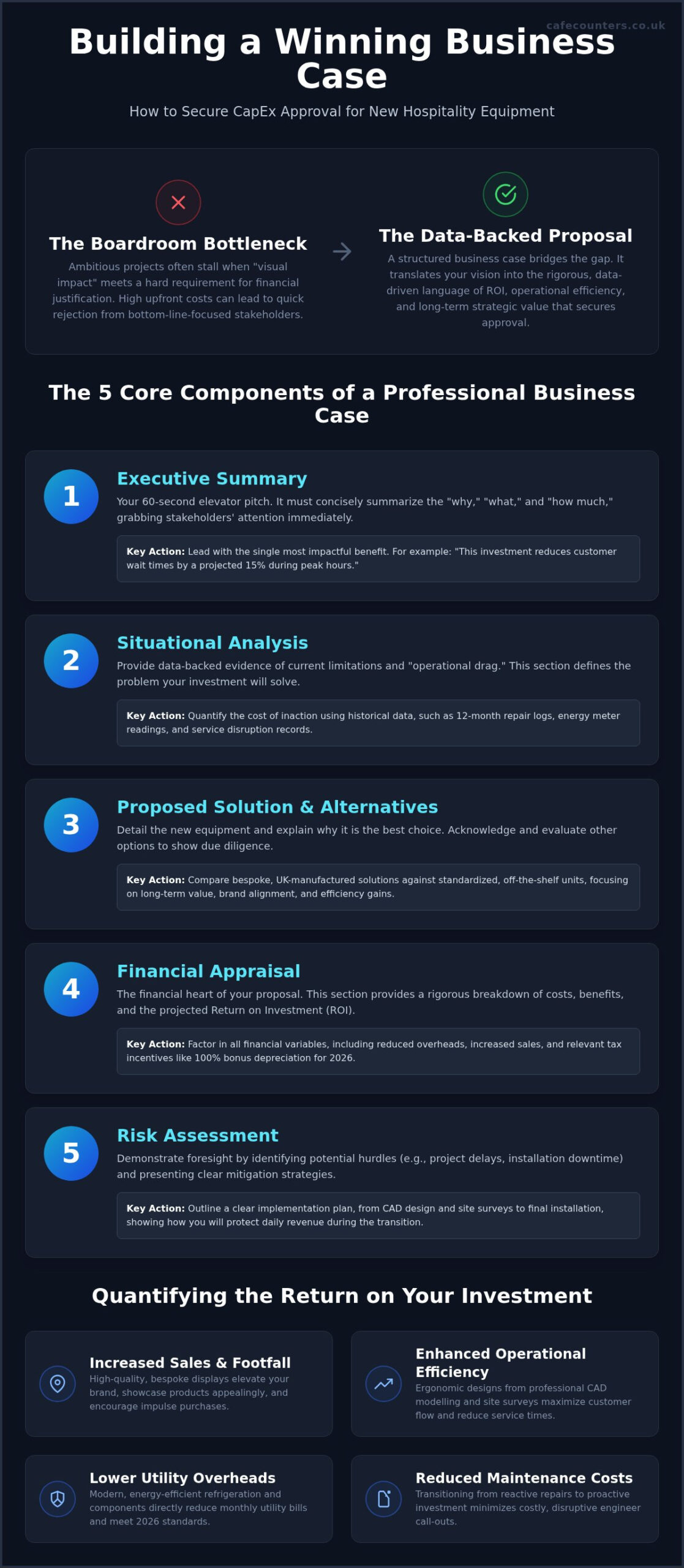
5 Core Components of a Professional Equipment Business Case
A professional business case isn’t a long-winded essay; it’s a structured argument built on five pillars. When you’re learning how to write a business case for new equipment, these components ensure you speak the language of both the kitchen floor and the boardroom. Precision matters. A well-structured document ensures that every penny of your capital expenditure is justified through measurable operational gains. The five essential elements include an executive summary, a situational analysis of current failures, a detailed proposed solution, a rigorous financial appraisal, and a clear risk assessment.
Executive Summary: Securing Approval in 60 Seconds
This is your elevator pitch. It must summarise the “why,” “what,” and “how much” on a single page. Your opening statement should address the board’s top priority directly, whether that is increasing lunchtime throughput or reducing carbon footprints to meet 2026 energy standards. Focus on the primary benefit. If a new heated gantry reduces wait times by 15%, lead with that figure. Decision-makers often decide whether to support a project based on this summary alone, so it must be concise and punchy.
Your situational analysis follows, providing data-backed evidence of current limitations. This might include a log of repair costs over the last 12 months or energy meter readings that show your current deli counters are draining resources. By Quantifying ROI through the lens of historical waste, you make the argument for new units undeniable. Finally, include a risk assessment that identifies potential hurdles, such as installation downtime, and explains how you will mitigate them to protect daily revenue.
Evaluating Alternatives: Bespoke vs. Standardised Units
One of the most common gaps in a proposal is the failure to compare different equipment tiers. You should weigh the long-term value of bespoke cafe counters against modular, off-the-shelf options. While standardised units may have a lower initial price point, bespoke solutions are designed to fit your specific footprint, often leading to better ergonomics and higher customer flow. This is where you justify the choice of a UK manufacturer; local production offers superior quality control and significantly shorter lead times compared to imported alternatives.
When considering how to write a business case for new equipment, don’t forget to mention the flexibility of financing. Whether you opt for a direct purchase to take advantage of capital allowances or prefer a leasing model to preserve cash flow, your partner should guide you through these options. If you are unsure which path suits your site best, consulting with an expert manufacturer early in the process can provide the technical clarity needed to strengthen your proposal.
Quantifying ROI: Calculating the Real Value of New Equipment
The most persuasive part of any proposal is the section that transforms abstract improvements into concrete financial returns. When you’re learning how to write a business case for new equipment, you must shift your perspective. Don’t view hardware as a simple expense. Instead, treat it as a strategic revenue generator. A professional appraisal should account for direct revenue gains, operational savings, and the reduction of stock wastage, alongside the intangible benefits that define your brand’s reputation in a crowded market.
The Impact of Grab & Go on Impulse Sales
Modern consumers prioritise speed and visual appeal. By integrating high-quality refrigerated grab and go display units, you can significantly increase your average transaction value. These units are engineered to remove the physical barriers between the customer and the product, facilitating a seamless purchase journey. Visual transparency in food display directly correlates to trust and sales. Quantifying the conversion rate of customers lured by superior merchandising allows you to present a data-backed argument for how bespoke displays pay for themselves through increased footfall and higher impulse purchase volumes.
Energy Efficiency and Long-Term Operational Costs
Operational savings often provide the most consistent return on investment. Older units are frequently the primary culprits behind soaring utility bills and unexpected maintenance fees. Modern commercial refrigerators utilise advanced insulation and low-Global Warming Potential (GWP) refrigerants that align with 2026 sustainability standards. When calculating the “payback period,” you should factor in the following:
- Reduced monthly electricity consumption through high-efficiency compressors.
- Minimised stock loss due to precise temperature control and IoT-enabled monitoring.
- The elimination of emergency engineer call-out fees associated with legacy equipment.
- Avoidance of “operational drag” caused by kitchen downtime during peak service hours.
Beyond the ledger, consider the intangible value of your investment. Reliable, high-performance equipment boosts staff morale by removing daily frustrations, while sleek, modern counters—or even silent, energy-efficient guest room amenities from PAMIBAR—enhance the customer experience. Learning how to write a business case for new equipment means proving that a professional environment isn’t just a “nice to have”; it’s a fundamental requirement for maintaining a competitive, durable hospitality business. By linking technical features to these functional benefits, you provide the board with a compelling, logical progression from initial expenditure to long-term profitability.
Implementation Planning: From CAD Design to Installation
A business case is only as strong as its ability to be executed. When you’re learning how to write a business case for new equipment, you must include a realistic roadmap for the transition from your current setup to the new installation. This journey starts with a professional site survey. Meticulous measurements ensure that bespoke counters or drop-in units fit perfectly within your existing footprint. This phase identifies potential obstacles early, such as narrow access points or non-standard utility connections, preventing costly delays during the final build.
The Role of CAD Modelling in Risk Mitigation
Advanced 3D CAD modelling acts as a vital bridge between a concept and a physical space. It allows you to visualise how new units will integrate into your cafe layout design before manufacturing begins. By simulating the movement of both staff and customers, you can refine ergonomics to maximise service speed and comfort. Renders provide the visual evidence needed to secure buy-in from aesthetic-focused stakeholders, proving that the investment will elevate the brand’s visual identity while improving operational flow.
Managing manufacturing lead times is the next logical step. By choosing a UK-based manufacturer with internal production facilities, you gain greater control over the timeline. You avoid the unpredictability of international shipping and can coordinate the fabrication process with your broader project schedule. This transparency builds trust with your finance team, as it ensures the capital is deployed exactly when planned.
Installation and Commissioning: Ensuring Day-One Performance
The physical installation must be planned with precision to avoid peak trading hours and protect your daily revenue. Professional integration with electric, water, and drainage services is essential for long-term reliability. For specialised equipment like Vision Heated Counters, the commissioning phase is non-negotiable. This process involves testing all temperature controls and safety features to ensure they meet 2026 standards from the very first service.
The final stage is commissioning and staff training. Your team must be fully conversant with the new equipment’s technical features to ensure it operates at peak efficiency. This training reduces the risk of user error and extends the lifespan of the machinery. Detailing this handover process is a crucial step in how to write a business case for new equipment, as it proves you’ve considered the project’s long-term success. If you’re ready to move from planning to execution, you can book a professional site survey and CAD consultation to ensure your vision is technically sound.
Choosing a Partner for Your Equipment Investment
The final pillar of a successful proposal involves identifying a partner who can translate your vision into a durable, physical reality. When you’re refining how to write a business case for new equipment, the choice of manufacturer acts as a primary risk mitigation strategy. Selecting a partner with a deep understanding of the UK hospitality sector ensures that your equipment meets specific regional hygiene standards and durability requirements. It’s about moving beyond a simple transaction and finding an Expert Partner who offers end-to-end project management, from the initial CAD modelling to the final commissioning on-site.
A manufacturer with a proven track record in diverse environments, from commercial retail to public services, brings a breadth of experience that protects your investment. This expertise allows them to anticipate challenges before they arise, ensuring that your bespoke serving counters or patisserie displays are both aesthetically striking and functionally superior. By having a single point of accountability, you simplify the project for your internal stakeholders and provide the board with total confidence in the delivery timeline.
The Benefits of British-Made Quality
Opting for a UK-based manufacturer with internal production facilities offers superior peace of mind. You benefit from a significant reduction in shipping risks and gain faster access to replacement parts and technical service. This regional artisanal pride isn’t just about heritage; it’s a practical business decision. British manufacturing allows for tighter quality control at every stage of fabrication. It ensures that the high-end materials selected for your project lead to long-term operational efficiency and can withstand the rigours of a high-volume hospitality environment. Supporting local industry also aligns with the sustainability goals often found in modern 2026 corporate strategies.
Comprehensive After-Sales and Maintenance
The relationship with your equipment partner shouldn’t end when the installation team leaves the site. Protecting the return on investment you calculated earlier requires a commitment to ongoing technical support and professional maintenance. Reliable after-sales care ensures that your units continue to operate at peak performance, preventing the “operational drag” mentioned in previous sections. By including a detailed maintenance plan in your proposal, you demonstrate a meticulous approach to the project’s entire lifecycle. This foresight is a hallmark of a professional who knows how to write a business case for new equipment that stands up to scrutiny.
Ready to build your case? You can contact TFSE Products for a bespoke consultation to start the journey from an initial idea to a perfectly finished physical space.
Securing Your Hospitality Investment for 2026 and Beyond
Mastering how to write a business case for new equipment is the definitive step in evolving your hospitality environment from a functional space into a high-performance asset. By quantifying the return on investment of energy-efficient technology and utilising CAD modelling to mitigate installation risks, you provide stakeholders with the technical clarity required to approve significant capital expenditure. Your proposal should reflect a commitment to quality and long-term durability, ensuring that every bespoke counter or display unit contributes directly to both operational efficiency and brand reputation.
Since 1991, TFSE Products has supported national businesses through our UK-based manufacturing facility and comprehensive project management services. We provide expert CAD modelling during the planning phase and offer full installation and commissioning services nationwide to ensure your equipment performs from the very first service. Our methodical approach ensures that your vision is supported by technical expertise and reliable craftsmanship.
Don’t let outdated machinery hold back your growth. Request a Bespoke Counter Consultation and Site Survey to begin your project with a steady, reliable hand. We’ll help you bring your vision to life with the precision your business deserves.
Frequently Asked Questions
What is the most important part of a business case for new equipment?
The Executive Summary is the most critical element. It serves as your elevator pitch, condensing the “why,” “what,” and “how much” into a single, punchy page. When you’re learning how to write a business case for new equipment, you must ensure this section leads with the primary benefit. Whether you’re targeting revenue growth or energy efficiency, this summary is what captures the board’s attention before they delve into the technical data.
How do I calculate the ROI for a bespoke cafe counter?
Calculating ROI requires balancing the total cost of ownership against projected gains. You should quantify direct revenue increases from improved visual merchandising and impulse sales. Additionally, factor in operational savings from energy-efficient refrigeration and reduced maintenance calls. By comparing these long-term benefits against the initial fabrication and installation costs, you can demonstrate a clear payback period that justifies the investment in high-end, British-made quality.
Should I include alternative solutions in my business case?
Including alternative solutions is essential for demonstrating due diligence. You should compare your proposed bespoke solution against modular, off-the-shelf units or even the “do nothing” option. Highlighting why a custom-built UK counter is superior in terms of ergonomics, lead times, and durability helps mitigate perceived risks. This comparison proves to stakeholders that you’ve meticulously evaluated the market to find the most efficient and reliable path forward for your project.
How long should a professional business case document be?
A professional business case should be concise yet comprehensive, typically ranging from four to eight pages. The length depends on the project’s complexity and the level of capital expenditure required. It’s vital to avoid filler; every paragraph should add value. Use clear headings and bullet points to guide the reader through the logic, from the initial situational analysis to the final commissioning and staff training plans for your new equipment.
Can a business case help me secure a bank loan for equipment?
A well-structured business case is a powerful tool when approaching lenders for equipment financing. Banks look for evidence of fiscal responsibility and a clear plan for repayment. By presenting a data-backed document that details how to write a business case for new equipment, you prove that the investment will generate sufficient cash flow. Including professional CAD models and a site survey adds an extra layer of technical reliability to your application.
What are the common mistakes when writing an equipment business case?
The most frequent error is focusing solely on the purchase price while ignoring the total cost of ownership. Many cases fail to account for “operational drag” caused by energy-inefficient machinery or frequent repair downtime. Another mistake is omitting a risk assessment. You must identify potential hurdles, such as installation disruption, and explain how your partnership with an expert manufacturer will mitigate these issues to protect your daily revenue.
How do I quantify intangible benefits like ‘brand image’?
You can quantify brand image by linking it to measurable customer behaviours. For instance, high-end patisserie displays can be correlated with an increase in average transaction value or higher footfall conversion rates. You might also use customer feedback scores as proxies for brand perception. Translating these “visual impacts” into potential revenue growth helps ground your aesthetic vision in the financial reality the board expects during the approval process.
Is a business case necessary for small equipment purchases?
While smaller items might not require a full eight-page report, a mini-business case is still a valuable exercise. It ensures that even minor investments align with your five-year strategic plan. Even for a single heated gantry or drop-in unit, documenting the expected efficiency gains helps maintain a proactive investment culture. This methodical approach prevents wasteful spending and ensures every piece of equipment contributes to your overall operational excellence and durability.