

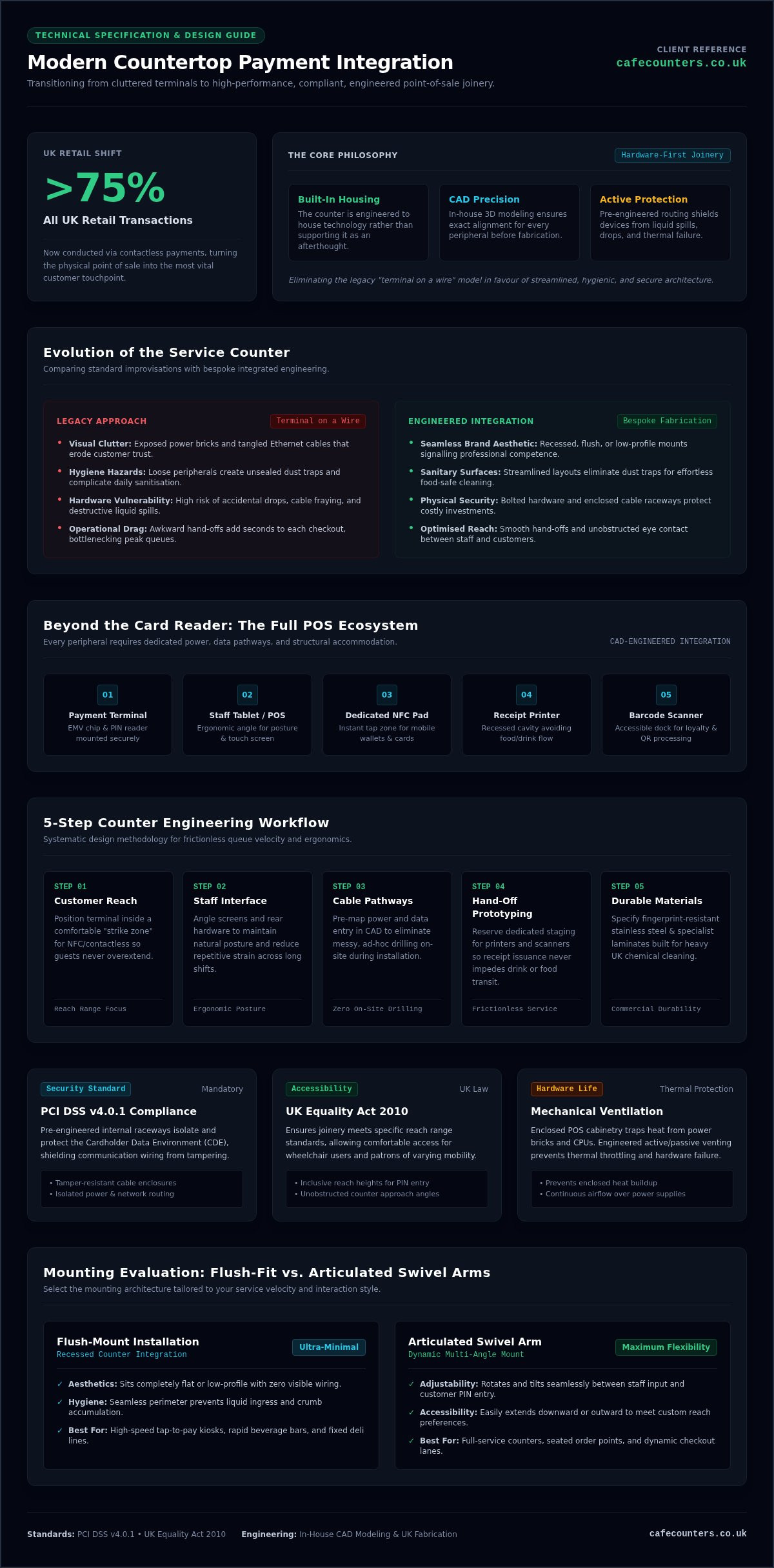
With contactless payments now representing over 75% of all UK retail transactions, the physical point of sale has become the most critical touchpoint in your customer’s journey. You’ve likely spent considerable effort perfecting your brand’s visual identity, only to find that integrating payment systems into counters often results in a chaotic jumble of cables and mismatched hardware. It’s a common frustration for operators who value a clean, professional aesthetic but struggle with the practicalities of modern technology. We believe that successful payment integration is a hardware-first design challenge, where the counter itself is engineered to house the technology rather than just supporting it as an afterthought.
In this guide, you’ll learn how to transition from cluttered surfaces to a seamless, built-in look that prioritises both ergonomics and security. We’ll walk you through the essential technical requirements, from meeting PCI DSS v4.0.1 standards to ensuring your joinery complies with the Equality Act 2010. By utilising precise CAD modelling and UK-based fabrication expertise, you can create a service environment that facilitates faster checkouts and protects your hardware from thermal failure. We will explore how bespoke design choices allow for a future-proofed installation that remains as durable as it is visually striking.
Key Takeaways
- Understand how to balance visual minimalism with accessibility by adhering to the UK Equality Act 2010 and specific reach range standards for service counters.
- Discover the technical essentials for integrating payment systems into counters, including the necessity of mechanical ventilation to prevent hardware from overheating in enclosed cabinetry.
- Evaluate the functional differences between flush-mount and articulated swivel arms to determine the best fit for your specific transaction volume and security needs.
- Learn why the “terminal on a wire” model is obsolete and how pre-engineered cable raceways protect your Cardholder Data Environment as per PCI DSS v4.0.1 requirements.
- Gain insight into how end-to-end project management and in-house CAD modelling ensure your bespoke counters arrive ready for immediate hardware installation.
The Shift Toward Physically Integrated Payment Systems
The traditional approach to point-of-sale setup is failing the modern hospitality environment. For too long, operators have treated electronic payment terminals as an afterthought, resulting in a “terminal on a wire” model that creates visual noise and operational friction. In high-end UK venues, this lack of cohesion is becoming obsolete. A counter is no longer just a piece of furniture; it’s a sophisticated delivery vehicle for technology that requires meticulous planning from the outset.
When a customer approaches a bespoke serving counter, the physical presentation of the payment area immediately signals the brand’s attention to detail. Cluttered surfaces with exposed power bricks and tangled Ethernet cables can inadvertently erode customer trust. By integrating payment systems into counters during the initial fabrication phase, you create a sleek, “built-in” appearance that reinforces a sense of security and professional competence. It’s about transforming a transaction point into a seamless part of the brand experience.
Beyond aesthetics, physical integration serves a critical practical purpose regarding hygiene. Reducing surface clutter eliminates “dust traps” and simplifies the daily sanitisation process. In environments where food is served, such as deli counters or patisserie displays, a streamlined surface with recessed hardware minimises touchpoints. This makes it significantly easier for staff to maintain a hygienic workspace without navigating around loose peripherals and cables.
Beyond the Card Reader: The Full Tech Stack
Well-designed integration removes the physical barriers between staff and customers. When hardware is recessed or mounted on secure, low-profile stands, it facilitates better eye contact and more natural conversation. This reduces transaction friction and speeds up the checkout process. The process of integrating payment systems into counters also protects your investment. Secure mounting protects expensive equipment from accidental drops or liquid spills, ensuring long-term operational reliability. It’s a practical step that ensures your technology works for your staff, rather than against them.
Designing Counters for Ergonomic Payment Flows
Ergonomics in a commercial setting isn’t just about comfort; it’s about transaction velocity and inclusive service. When integrating payment systems into counters, the physical placement of hardware dictates the rhythm of your queue. A poorly positioned card reader can add seconds to every checkout, leading to bottlenecking during peak hours. We approach this as a five-step engineering process to ensure the final product is as functional as it is beautiful.
- Step 1: Assess customer reach. For NFC and contactless payments, the terminal should be positioned within a comfortable “strike zone” that doesn’t require the customer to overextend.
- Step 2: Optimise the staff interface. We design the rear of the counter to support staff posture, ensuring screens and printers are at an angle that reduces repetitive strain during long shifts.
- Step 3: Map cable pathways. By defining where power and data enter the unit during the initial design, we eliminate the need for messy on-site drilling.
- Step 4: Prototype the hand-off. This includes dedicated space for receipt printers and loyalty scanners so they don’t impede the flow of food or drinks.
- Step 5: Select durable materials. We prefer high-grade stainless steel or specialist laminates that resist fingerprints and withstand the heavy chemical cleaning required in UK hospitality.
The Role of CAD Modelling in Integration
Precision is the hallmark of a professional installation. We use in-house CAD modelling for counters to visualise exactly how hardware will sit within the structure before any fabrication begins. This allows us to create millimetre-perfect cutouts for flush-mounted tablets and recessed payment pads. By solving these spatial puzzles digitally, we prevent costly on-site errors and ensure that your technology feels like an organic part of the counter rather than a clunky addition. If you’re planning a new layout, our team can help you visualise your bespoke counter design to ensure total hardware compatibility.
Accessibility and Inclusive Design
Compliance with the UK Equality Act 2010 is a mandatory requirement for any public-facing business. Service counters must include a lowered section, typically between 760mm and 850mm from the floor, to accommodate wheelchair users. While we adhere to these local regulations, we also look to international best practices, such as the ADA standards for sales and service counters, to ensure universal reach ranges are met. This includes positioning contactless pads so they’re accessible to everyone, regardless of mobility. Designing for inclusivity isn’t just a legal duty; it ensures your brand is welcoming to every customer who walks through your door. By integrating payment systems into counters with accessibility in mind, you create a frictionless experience for 100% of your clientele.
Technical Planning: Wiring, Connectivity, and Cooling
While the external finish defines the brand aesthetic, the internal engineering determines the system’s lifespan. Integrating payment systems into counters requires a meticulous approach to what lies beneath the surface. Without a robust infrastructure plan, even the most sophisticated hardware will eventually succumb to connectivity drops or thermal throttling. We treat the internal cavity of every counter as a high-performance server environment, ensuring that every wire has a designated home.
A professional counter build should include a dedicated “Hidden Infrastructure” checklist to prevent operational downtime. This includes dedicated power circuits for POS hardware to avoid surges from heavy kitchen equipment and hardwired Cat6 Ethernet ports for stable, secure transaction processing. We also include integrated cable pathways that adhere to PCI PIN Transaction Security standards for physical tamper deterrence. By planning these elements during the fabrication phase, we ensure that your technology is as secure as it is functional.
Cable Management Strategies
Effective cable management is about more than just tidiness; it’s about signal integrity and maintenance speed. We use internal trunking to physically separate power lines from data cables, reducing electromagnetic interference that can disrupt card processing. Strategic grommet placement allows for clean transitions from the internal housing to the surface terminals. As leading bespoke cafe counter manufacturers, we take pride in hiding the “spaghetti” of modern POS systems within the counter’s frame. This ensures that service panels remain accessible for rapid hardware swaps or repairs without requiring a total strip-down of the unit.
Thermal Management in Enclosed Units
Heat is the silent killer of integrated electronics. Recessed tablets and under-counter CPUs generate significant thermal energy that cannot escape in a sealed environment. To combat this, we integrate passive cooling slats or active fan systems directly into the counter skin to maintain airflow. This is particularly vital when integrating payment systems into counters that sit adjacent to high-heat zones, such as Vision Heated Counters. We engineer thermal breaks into the fabrication process to ensure that the heat from your food display doesn’t transfer to sensitive payment components. This keeps internal temperatures within safe operating limits, protecting your hardware investment.
Finally, we future-proof every installation by using oversized conduits. Technology cycles move faster than counter lifespans; providing extra capacity allows you to upgrade to next-generation cabling or additional peripherals without dismantling your bespoke joinery. This emphasis on structural longevity is shared by master craftsmen like Carpintaria Nunes, who have spent decades perfecting the art of durable commercial woodwork. It’s a methodical approach that ensures your counter remains a reliable asset for years to come.
The choice of mounting hardware is the final step in bridging the gap between digital processing and physical architecture. When integrating payment systems into counters, you must decide between the architectural minimalism of a flush-fit installation and the operational versatility of an articulated arm. Each solution serves a distinct purpose within the UK hospitality and retail sectors. While a quick-service cafe might prioritise the speed of a swivelling stand, a high-end boutique or hotel reception often requires the sleek, uninterrupted lines of a recessed housing.
Security is a non-negotiable factor in this decision. Unlike standard plastic stands that offer little more than a resting place for hardware, professional mounting solutions incorporate anti-theft mechanisms and lockable enclosures. These systems are engineered to withstand the rigours of high-traffic environments while protecting against physical tampering or unauthorised device removal; to further enhance your site’s safety with professional surveillance, check out SOFI-TEC. By selecting the right mounting philosophy, you ensure your technology remains an asset rather than a liability.
Bespoke Recessed Housings
For venues where aesthetics are paramount, a flush-mount approach offers a truly built-in look. We manufacture custom bezels from high-grade stainless steel or solid surface materials to create a seamless transition between the commercial counter materials and the electronic screen. This method doesn’t just look superior; it provides a physical shield for tablet edges, protecting them from accidental impact and liquid spills. It’s a meticulous design choice that signals total brand cohesion to your customers.
Flexible Stand Integration
In environments where staff and customers must interact with the same screen, articulated arms provide the necessary range of motion. However, these mounts exert significant leverage on the counter surface. We reinforce the internal counter substrate during the fabrication phase to prevent the surface from warping or cracking under the weight of heavy-duty arms. Our designs also include integrated rotation limits. These stops prevent the stand from spinning 360 degrees, which would otherwise twist and eventually snap internal data cables. For businesses that require hardware to be removed overnight, we can integrate quick-release systems that maintain security during the day while allowing for easy storage after hours.
Choosing the right mount requires a balance of visual impact and practical durability. To find the perfect configuration for your next project, consult with our bespoke design team today.
The TFSE Approach: End-to-End Counter Integration
At TFSE Products Ltd, we bridge the gap between architectural vision and technical execution. Our UK-based manufacturing facility allows us to control every stage of the fabrication process, ensuring that we don’t just build furniture; we engineer service hubs. By integrating payment systems into counters during the manufacturing phase, we eliminate the risks associated with retrofitting hardware onto a finished unit. This methodical approach ensures your POS technology is supported by a structure specifically designed for its weight, heat output, and connectivity requirements.
A successful installation begins long before the first piece of steel is cut. We conduct thorough site surveys to understand the existing landscape of power outlets and data points. This prevents the common frustration of a beautiful counter arriving on-site only to find that the cabling cannot reach the floor box. We act as your Expert Partner, collaborating directly with your EPOS provider to ensure every cutout and mounting bracket is tailored to your specific hardware SKU. This level of detail guarantees a “plug and play” experience upon delivery.
A Proven Process for Integration
Our workflow is structured to alleviate the stress of commercial projects. Once the initial survey is complete, we move into CAD modelling, where you sign off on every technical detail. We coordinate with your electricians and IT contractors on your behalf, ensuring the necessary infrastructure is ready for the counter’s arrival. This was recently demonstrated in a project involving a high-volume refrigerated grab and go display environment. By aligning the refrigeration’s thermal exhaust with the POS cooling requirements, we created a stable environment for both food safety and digital transactions.
Maintaining Your Integrated System
We design for the long term. A counter must remain hygienic and operational under the pressures of daily use. Our integrated solutions feature smooth, wipe-clean surfaces around sensitive electronics, preventing moisture ingress during deep cleans. Integrating payment systems into counters also involves creating accessible service panels. These allow your IT team to reach internal components or swap out cables without dismantling the entire counter. This focus on durability and accessibility is a signature of our artisanal pride, ensuring your investment remains a steady, reliable hand in your business operations. Our commitment to quality control ensures that when your counter arrives, it’s ready for immediate service.
Future-Proof Your Point of Sale Design
Transitioning from a cluttered service area to a streamlined, integrated environment requires more than just high-end materials; it demands a hardware-first engineering mindset. By integrating payment systems into counters during the initial fabrication phase, you ensure that every cable pathway and thermal vent is optimised for the long-term health of your technology. This approach doesn’t just improve hygiene and brand aesthetics; it creates a frictionless experience for both your staff and your customers.
With over 30 years of hospitality fabrication experience, we understand that the success of a commercial project lies in the fine technical details. Our UK-based manufacturing facility utilises expert CAD modelling to guarantee that your bespoke counters arrive ready for immediate, precise hardware fitment. We act as your Expert Partner, guiding you from the first site survey to the final installation of a durable, professional service hub that reflects your brand’s commitment to quality.
Ready to transform your customer journey with a solution built for durability? Request a Bespoke Counter Consultation for Your Payment Integration and let us help you bring your vision to life with precision and care.
Frequently Asked Questions
Can I integrate my existing payment terminal into a new bespoke counter?
Yes, we can accommodate your current hardware by utilising precise CAD modelling during the design phase. By providing us with the specific model and dimensions of your electronic payment terminals, we can engineer millimetre-perfect cutouts or mounting brackets. This ensures that your technology fits seamlessly into the new structure without the need for on-site modifications. It’s a core part of our project management process to ensure total hardware compatibility before fabrication begins.
How do I ensure my integrated tablet doesn’t overheat during busy shifts?
Thermal management is a priority when integrating payment systems into counters, especially in high-volume environments. We incorporate passive cooling slats or active ventilation fans within the counter skin to maintain consistent airflow around recessed tablets. This is particularly critical if the payment station sits near heated gantries or hot food displays. Our engineering process includes creating thermal breaks to prevent heat transfer from food display units to sensitive electronic components.
What happens if I want to change my payment provider in the future?
We future-proof our bespoke serving counters by using oversized internal conduits and modular mounting solutions. This allows you to upgrade your cabling or swap out terminals as technology evolves without requiring a new counter build. Our accessible service panels ensure that IT contractors can reach internal connections quickly. Designing with flexibility in mind ensures that your physical infrastructure remains a long-term asset, regardless of changes to your software or hardware providers.
Do integrated payment systems meet UK accessibility standards?
Absolutely, our designs strictly adhere to the UK Equality Act 2010 and Approved Document M. We ensure that service counters include a lowered section, typically between 760mm and 850mm from the floor, to accommodate wheelchair users. Payment terminals are positioned within the standard reach zone of 750mm to 1,200mm. This inclusive approach ensures that every customer can complete their transaction comfortably and independently, maintaining high standards of service for all your clientele.
How do you hide the wires for a receipt printer and cash drawer?
We eliminate “cable spaghetti” by engineering dedicated internal trunking and service cavities within the counter frame. Power and data lines are separated to reduce electromagnetic interference, while strategic grommets allow for clean surface transitions. This hidden infrastructure keeps the customer-facing side professional and uncluttered. By planning these pathways during the CAD modelling stage, we ensure that receipt printers and cash drawers are fully powered and connected without a single wire being visible.
Is it possible to integrate contactless payment pads directly into the counter surface?
Yes, we can create flush-mount housings that allow contactless pads to sit level with the counter surface for a minimalist aesthetic. For certain non-metallic materials, we can even explore under-counter mounting to allow for NFC pass-through. This level of customisation is a key benefit of integrating payment systems into counters during the fabrication phase. It ensures that the tap-and-go experience is intuitive for the customer while maintaining the sleek lines of your bespoke design.
What is the best material for a counter with integrated touchscreens?
High-grade stainless steel and specialist solid surfaces are the most reliable choices for counters with integrated technology. These materials are non-porous and highly durable, making them ideal for the heavy cleaning routines required in UK hospitality. They provide a stable substrate for mounting articulated arms and can be precisely cut to house flush-fit screens. We select materials that resist fingerprints and impact, ensuring the counter maintains its professional appearance even under high-traffic conditions.
How does physical integration affect the security of my POS hardware?
Physical integration significantly enhances security by making hardware much harder to tamper with or remove. We utilise lockable enclosures and anti-theft mounts that are bolted directly to the reinforced counter substrate. This adheres to PCI DSS v4.0.1 requirements for point-of-interaction device security. By concealing cables within internal raceways, we also protect them from accidental damage or intentional tampering, providing a secure environment for your cardholder data and expensive electronic assets.