
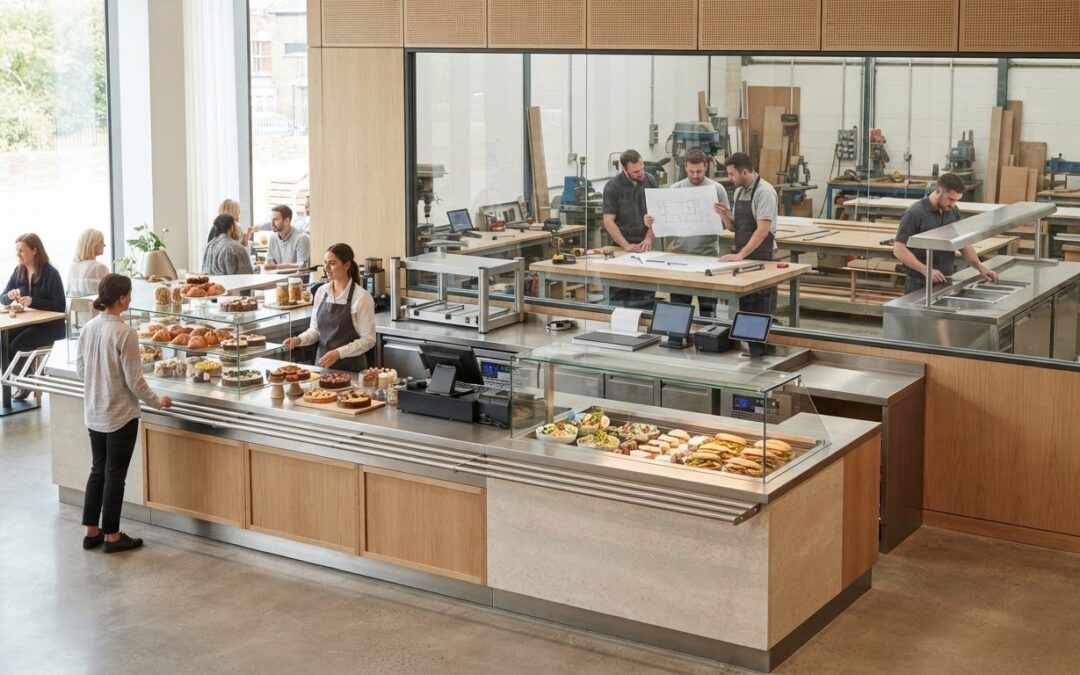
What looks right on a plan may slow service once installed. When comparing catering counter manufacturers UK-wide, look beyond appearance: does the manufacturer understand your operation, and can it carry the agreed specification through to installation?
The choice can be difficult because suppliers have different roles. Some manufacture equipment themselves, while others resell it or provide general fabrication. A standard unit may not suit your menu, workflow, available space or equipment requirements. Design, installation and commissioning responsibilities also vary, so clarify what each proposal includes.
This guide gives you a practical framework for comparing potential partners, specifying counters around your service routine and checking responsibilities at each project stage. TFSE Products Ltd designs and manufactures catering equipment at a UK facility, with options including patisserie displays, salad bars, deli counters and bespoke serving counters. Use the questions and checklists below to prepare your brief and assess what project delivery should cover, from initial discussions to installation and commissioning.
Key Takeaways
- Compare catering counter manufacturers UK-wide by asking who makes the equipment and which project stages they handle.
- Review CAD models for dimensions and design intent before manufacture, and clarify how requested changes will be handled.
- Choose counter types around your menu and service format, including how customers access products and staff replenish displays.
- Prepare site details, equipment needs and service requirements before requesting a proposal to support a coordinated specification.
- Check whether installation and commissioning are included rather than assuming they come with the equipment.
How to assess catering counter manufacturers in the UK
Start by matching your menu and service routine to a supplier’s products and capabilities. A manufacturer makes the equipment, a reseller sells equipment made by another business, and a general fabricator may produce custom work without specialising in catering counters. Any of these arrangements may suit a project, but you should know who is responsible for design decisions, production and resolving specification issues. Ask directly: who will make the counter?
Compare suppliers against four areas: design input, meaning how they turn your requirements into a workable proposal; manufacturing control, including where and by whom the equipment is made; product fit, based on your menu, service style, space and equipment; and delivery responsibility, covering the project stages the supplier will handle. The right partner depends on your scope and requirements, not a universal ranking of catering counter manufacturers UK-wide.
What should a catering counter manufacturer actually do?
A counter project should move from gathering requirements to technical design and manufacture. Ask which activities are completed in-house and which involve external partners. CAD models let you review dimensions and design intent before production. Written responsibilities make it less likely that important details will be left to assumption. Confirm whether site surveys, installation and commissioning are included in your project, rather than treating them as automatic parts of an order.
Which proof points help verify a UK manufacturer?
Ask for examples of projects with a similar counter type, service format or site constraint. A useful example explains why the design suited the operation, rather than simply looking similar. Ask where the equipment is manufactured, what quality checks take place, and who will address any mismatch between the approved specification and the finished counter. TFSE Products Ltd, founded in 1991, designs and manufactures catering equipment at a UK facility.
Check whether the supplier offers site surveys, installation and commissioning for the work you have in mind. These services can help connect the approved design with the finished installation, but confirm their scope and responsibilities before proceeding. If your counter needs to coordinate with other food-service equipment, define those interfaces clearly. A reference overview of cooking appliances can help identify equipment types to discuss.
Use this checklist in initial supplier conversations:
- Who designs and manufactures the counter, and where?
- What relevant project examples can you share?
- How will you check the design against the site, menu and workflow?
- Which stages are included, and which involve external partners?
- Who handles specification queries and confirms changes?
Compare design, manufacturing and project capabilities before choosing
Capability is easier to compare when every supplier answers the same questions. Establish how the design will be developed, who controls production, what can be customised and which delivery stages are included. For catering counter manufacturers UK buyers are considering, a clear written scope makes proposals easier to compare and helps reveal differences in responsibility.
| Area | What to check |
|---|---|
| Design | Will the supplier provide CAD drawings or visualisations for review before approval? |
| Production | Where is the counter made, and who checks it against the approved specification? |
| Customisation | Which dimensions, finishes or configurations can be adapted, and what changes are technically feasible? |
| Installation | Is installation included in this proposal, or arranged separately? |
| Aftercare | What support, warranty terms and response arrangements are confirmed in writing? |
How do CAD design and site surveys reduce uncertainty?
A site survey can capture dimensions and constraints that affect counter placement, access and connections. Ask which drawings or visualisations you will review, then check that the final version reflects the intended service position and equipment interfaces. CAD modelling helps teams assess dimensions and design intent before manufacture, but it does not replace confirmation of actual site conditions and services. Wider equipment coordination may also benefit from this professional restaurant equipment planning guide.
How can buyers assess manufacturing quality and accountability?
Clarify who signs off the final specification and who records and approves changes. Ask which materials and finishes are proposed, and whether they suit the counter’s intended use and cleaning routine. Hygiene requirements depend on the rules applicable to the site. Check the current requirements rather than relying on assumptions. The linked General Food Hygiene Regulations provide legislative context, but confirm which provisions apply to your project.
Do not assume that standards, testing or warranty terms are identical across suppliers. Request the relevant documentation and terms, then compare proposals on the same basis. If a supplier offers installation or commissioning, ask what each stage covers and who is accountable if the finished counter differs from the approved design. For further planning context, you can also review catering counter planning information.
Match catering counter types to your menu and service model
A counter should support how food is presented, served and replenished, not simply fill a space. Begin with the menu and customer journey. Will customers choose items themselves, be served by staff, or use both formats? Then establish the operating conditions and equipment needed for the food and service. These details help catering counter manufacturers UK buyers approach propose equipment suited to its intended use.
Which counter type suits each foodservice operation?
Match the display to the products and service routine. Patisserie displays present cakes and other chilled products, so confirm the operating conditions required for your menu. Grab-and-go displays prioritise product visibility and customer access. Deli counters support staff-served selection and clear presentation, while salad bars need to suit the chosen serving format and replenishment routine. Heated displays, including heated gantries, suit hot-food presentation, but agree the required holding conditions for the operation.
For more detailed product decisions, see this professional guide to refrigerated grab-and-go displays and the deli counter selection guide.
What should a counter specification include?
Give the manufacturer a clear picture of the operation: menu items, service method, product dimensions, customer and staff access, and how often displays are replenished. Include the counter footprint, approach routes and adjacent equipment requirements. Ask the supplier to list assumptions and unresolved technical details in the proposal, so you can confirm them before approving a design.
| Operating need | Question for the manufacturer |
|---|---|
| Chilled patisserie | What operating conditions are required for the products on this menu? |
| Self-service grab-and-go | Can customers see and access products easily while staff can replenish them? |
| Staff-served deli | Does the layout support product presentation, serving and staff access? |
| Salad service | How will the counter suit the serving method and replenishment routine? |
| Hot-food display | What holding requirements and equipment need to be included in the specification? |
Consider how the counter fits the wider equipment plan, too. The UK Government Buying Standards can be a reference when reviewing relevant procurement considerations. Check which criteria apply to your project, and ask the manufacturer to provide any energy or water-related information relevant to the proposed equipment. Do not assume it meets a particular standard.
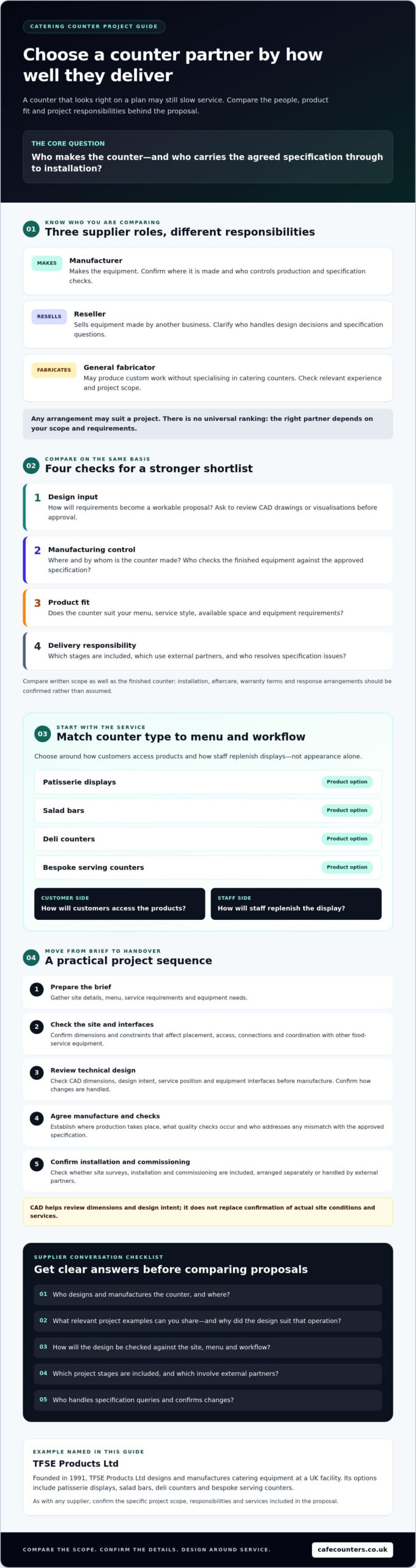
Plan the catering counter project from brief to commissioning
A well-made counter is only one part of a successful project. Agree who owns each decision and milestone before work begins. When comparing catering counter manufacturers UK buyers should check that the proposal explains how the project moves from operating requirements to an installed, commissioned counter, including what information the buyer needs to provide.
Use this five-stage sequence to structure discussions and keep responsibilities visible:
- Brief: Share the menu, service method, site information and operational priorities.
- Survey: Confirm relevant dimensions, access and site conditions with the supplier.
- Design approval: Review and approve drawings, finishes, equipment configuration and responsibilities.
- Manufacture: Proceed against the agreed specification, with a clear process for recording and approving changes.
- Installation and commissioning: Confirm site readiness, installation scope, checks to be completed and handover information.
What information should you share in the initial brief?
Give the supplier menu and service details, approximate dimensions, available plans and known site constraints. Identify the project stakeholders, decision-maker and expected approval stages so drawings and changes reach the right people. List equipment, access, cleaning and day-to-day operational requirements that could affect the counter design. A complete brief helps the manufacturer identify missing information before it becomes a late design query.
What should buyers confirm before approving manufacture?
Before sign-off, check the final drawings, dimensions, finishes and equipment configuration against the approved brief. Confirm in writing who is responsible for site access, service connections, installation and commissioning, along with site-readiness requirements and project contacts. Ask the supplier to verify proposed dates and any service or warranty terms directly. Do not assume they are standard or included.
Set named owners and agreed milestones for design approval, changes, manufacture and site handover. This gives both parties a clear reference if a decision is delayed or the specification needs revision. If installation and commissioning are in scope, agree what the commissioning checks cover and request a documented handover with guidance for operating the equipment. Confirm ongoing support separately, including what is available and how to access it.
TFSE Products Ltd offers site surveys, project management, installation and commissioning for relevant projects. Confirm which stages apply to your order and record the agreed scope in the proposal. Discuss your catering counter project requirements with the team.
Why consider TFSE Products Ltd for catering counters in the UK?
Choosing a manufacturer means finding a supplier whose design and production capabilities can turn agreed requirements into equipment suited to your operation. TFSE Products Ltd manufactures commercial food display and catering equipment in the UK. Its products are designed and manufactured at a UK facility, connecting the design process with production.
How does TFSE’s manufacturing and design capability fit the selection framework?
CAD modelling can help you review dimensions and design intent before manufacture, while a site survey can inform the specification for relevant projects. Together, these steps bring the brief, site information and proposed counter design into view before production approval. TFSE’s range includes patisserie displays, grab-and-go displays, salad bars, deli counters, heated gantries and bespoke serving counters. The suitable option depends on your menu, service approach, available space and equipment requirements.
TFSE also provides project management, installation and commissioning services. Discuss these stages early, but do not assume that every service is included in every order. Ask which activities apply, who is responsible for each, and what information or site preparation your team needs to provide.
What should you prepare before contacting a manufacturer?
A focused brief gives the manufacturer a practical starting point and helps identify questions to resolve before design approval. Gather:
- Available plans and approximate dimensions, including known site or installation constraints.
- Your menu, service style and preferred counter categories.
- Equipment, customer and staff access, cleaning and replenishment requirements.
- Project stakeholders, decision-makers and any approval steps.
- Unresolved technical questions, including details about site services or connections.
You do not need every technical answer before making contact. Share what is known, flag what remains uncertain, and ask how it will be confirmed. As you compare catering counter manufacturers UK-wide, use the discussion to establish how the supplier will develop the brief, confirm the specification and coordinate agreed project stages. Verify project dates and any warranty or service terms directly with the supplier.
A clear brief makes for a more productive conversation about the counter and the work required to bring it into operation. Discuss your requirements and explore catering counter solutions with TFSE Products Ltd.
Make your next counter project a confident one
The right choice among catering counter manufacturers UK comes down to fit and accountability. Assess how well a supplier understands your menu, service flow and site. Then compare who controls design and manufacture and which project stages are included. A clear brief and approved specification help carry those decisions through to installation and commissioning.
TFSE Products Ltd designs and manufactures commercial catering equipment at a UK facility. Its project capabilities include CAD modelling and site surveys, as well as installation and commissioning. Confirm which services apply to your project, along with responsibilities and milestones, before proceeding.
Ready to discuss your plans? Discuss your catering counter requirements with TFSE Products Ltd and explore options suited to your operation. Bring your brief and questions to the conversation, then agree the scope and responsibilities before moving ahead.
Frequently Asked Questions
What should I look for when choosing a catering counter manufacturer in the UK?
Look for a partner whose products and project capabilities fit your menu, service style, premises and equipment requirements. Ask who designs and manufactures the counter, how you will review the specification, and which stages the proposal includes. Compare relevant project examples and clarify responsibility for changes, installation and commissioning. When comparing catering counter manufacturers UK-wide, assess the evidence and agreed scope rather than relying on broad claims about being the best.
How can I tell whether a company manufactures its own catering counters?
Ask where the equipment is designed and made, and whether the company manufactures the counter itself or sources it from another business. Request examples of relevant work and ask who checks the finished equipment against the approved specification. A manufacturer should be able to explain its role in design and production. TFSE Products Ltd designs and manufactures commercial catering equipment at its UK facility.
Can a manufacturer design a bespoke catering counter for my premises?
Yes. Bespoke design can be discussed when a standard option does not suit the site or operation. Share your plans, approximate dimensions, menu, service method and equipment needs, then ask which changes are technically feasible. CAD modelling can help you review the proposed dimensions and design intent before manufacture. TFSE Products Ltd offers CAD modelling and site surveys for relevant projects; confirm what applies to your requirements.
What information should I provide when requesting a catering counter quotation?
Provide available plans and approximate dimensions, plus details of your menu, service style and preferred counter type. Include product sizes, customer and staff access, replenishment routines, cleaning needs, adjacent equipment and known site constraints. Identify project decision-makers and approval stages. If you do not know a technical detail, flag it as unresolved. A clear brief helps the manufacturer identify what needs checking before preparing a proposal.
How much does a bespoke catering counter cost in the UK?
A reliable price depends on the project specification. Cost can vary with the required counter, dimensions, configuration, materials, equipment and agreed project scope. Request a quotation based on your brief, and ask it to show what is included, such as design work, site surveys, installation or commissioning. Compare proposals against the same specification, and confirm exclusions or additional charges directly with each manufacturer.
Does a catering counter manufacturer also install and commission the equipment?
Some manufacturers provide installation and commissioning, but these services are not automatically included with every counter order. Check the proposal for the exact scope, site-readiness requirements, service connections, named responsibilities and commissioning handover. TFSE Products Ltd provides installation and commissioning services, with project-specific arrangements to confirm. Ask what checks are completed, what documentation you will receive and who to contact with questions after handover.
What is the difference between a catering counter manufacturer and a supplier?
A manufacturer designs or produces the equipment, while a supplier sells equipment and may source it from one or more manufacturers. Some businesses do both, so the labels alone do not establish who controls design or production. Ask who makes your counter, where it is made, and who is responsible for specification changes or production queries. Understanding these roles helps you identify who is accountable at each project stage.
How long does it take to design and manufacture a catering counter?
Timescales vary by specification and project, so ask the manufacturer for dates based on your requirements rather than relying on a general estimate. Design approval, bespoke details, site information, changes and installation planning can all affect the schedule. Request proposed milestones in writing, including when your team needs to approve drawings or provide site details. Confirm the current lead time and any dependencies directly with the supplier before committing to project dates.