
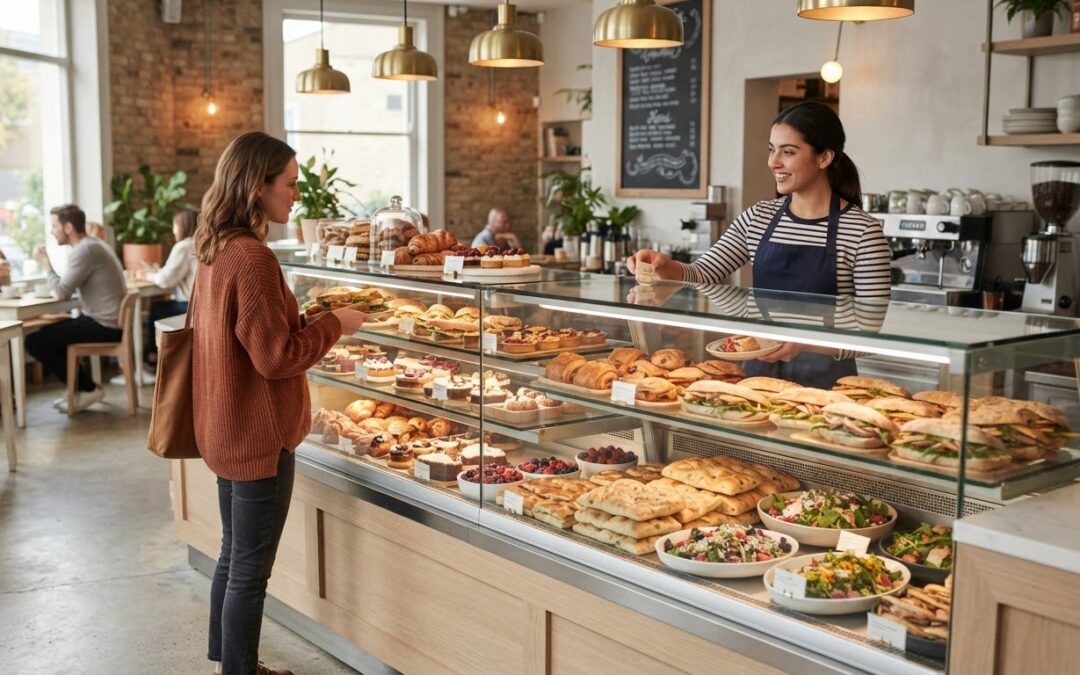
What if the glass isn’t the main cause of glare? Reflections often come from the relationship between lighting, nearby windows and the customer’s viewing angle. That’s why how to reduce glare on glass food displays starts with identifying the source of the reflection, rather than immediately changing the glass or dimming the lights.
If your display looks clear from one position but reflective from another, you’re not alone. Glare can obscure carefully presented food, yet reducing illumination too much may leave products looking flat or unappealing. The aim is to control reflections while keeping the display bright, inviting and easy to view from customer and serving positions.
This guide explains how to identify whether light placement, surroundings, viewing angle or the glass itself is contributing to glare. You’ll find practical adjustments to try first, plus guidance on when a broader design change may be worth considering. TFSE Products Ltd designs and manufactures commercial food displays and bespoke counters, considering orientation, integrated lighting and sightlines as part of counter planning.
Key Takeaways
- Identify whether the distraction is direct glare or a reflection of a window, light fitting, bright surface or customer.
- Check how reflections change between customer and serving positions, and note when they’re most noticeable.
- Learn how to reduce glare on glass food displays by testing light direction, position and output before making larger changes.
- Assess adjustments carefully: dimming a light may lessen reflections but can also make food look less appealing.
- Consider display orientation, lighting and customer sightlines together when planning a counter to help prevent recurring glare.
Why glass food displays develop glare, and when it affects product visibility
Glare occurs when a bright light source or its reflection competes with the view through the glass. It can draw attention away from the food, make labels harder to read or hide part of the serving area. Reflections from transparent surfaces can create a veiling effect. The overview of glare (vision) explains how reflected light can reduce the contrast of what someone is trying to see.
There are two common forms to look for. Direct glare comes from a visible source, such as a spotlight or illuminated sign. Reflected glare is an image of a source or bright surface appearing in the glass, such as a window, ceiling fitting, pale wall or customer standing opposite the counter. Glass can protect food while still reflecting light from the surrounding space.
The reflection depends on the positions of the source, the glass and the viewer. As a customer walks along the counter or changes position in a queue, that relationship shifts. A ceiling fitting reflected towards someone approaching the display might be less noticeable from the serving position. Identifying the source is the first step in how to reduce glare on glass food displays.
Which light sources commonly reflect in a food display?
Inspect the glass from normal customer viewpoints, not only from behind the counter. Look for ceiling fittings, spotlights, windows and illuminated signs. Also check whether bright surfaces opposite the display appear as reflected shapes. Repeat the check during daylight and in the evening: a window may dominate during the day, while artificial lighting becomes more noticeable after dark.
How can you tell whether glare is affecting the display?
Check whether reflections cover food, labels or the serving area, and compare visibility from the entrance, queue and point of service. Then distinguish a reflected image from a mark on the glass. A reflection changes or disappears as you move; dirt, smears or condensation stay in place. Clean the glass and reassess before deciding that lighting or display position is the main issue.
Note where the view is clear and where it becomes obstructed, including the time of day. This gives you a useful baseline for later adjustments and helps avoid assuming that dimming the lights or replacing the glass is necessary. Focus on visibility from the positions customers actually use.
How viewing angles, light placement and surroundings create reflections
Light doesn’t simply pass through display glass. Some of it can bounce off the surface towards a viewer, making the glass show an image of the surrounding space instead of a clear view of the food. The result depends on the positions of the light, the glass and the person looking in. You can see the effect without optical calculations: move to another position and watch whether the reflection changes.
A fitting above or behind a customer can be distracting if its image appears in the glass along their line of sight. The same can happen with a spotlight aimed towards the counter, even if the beam is intended to highlight the products. A bright window, glossy wall or illuminated sign opposite the display can add further reflections. That’s why it helps to assess the whole viewing environment rather than one light in isolation.
Why the same display looks different from different positions
Think of the glass as a surface between a viewer and the food. If a bright source sits at an angle where its light bounces towards the viewer, its reflection becomes prominent. Move a step to one side and the image may shift, weaken or disappear, while another source takes its place. Check sightlines from the usual customer approach, queue and serving position, as well as the staff’s working position behind the counter.
For example, someone approaching a deli counter may see a ceiling fitting reflected across the front panel, while a customer standing at the serving point sees the food clearly. The display hasn’t changed; the viewing angle has. Comparing these viewpoints helps reveal whether counter orientation or light placement is working against visibility.
How daylight and interior finishes influence glare
Daylight changes direction and intensity over the course of the day. A window that causes little distraction in the morning may create a strong reflection later. Artificial lighting can add further reflections as daylight fades. Recheck the display at different trading times, noting whether the issue follows the sun, a particular fitting or a fixed bright background.
Look beyond the glass itself. Glossy worktops, pale walls, illuminated menu boards and bright signage can all appear as reflections, especially when they sit opposite the display. Adjusting the surroundings or viewing line may help, but no glass type or coating should be assumed to eliminate every reflection. Understanding how these elements interact is central to how to reduce glare on glass food displays without compromising the view of the products.
During counter planning, display orientation, integrated lighting and customer sightlines can be considered alongside the practical serving layout. Explore bespoke serving counters designed around the space and how customers approach it.
Which glare-reduction adjustments work best for glass food displays?
Start with changes that are easy to reverse. If a reflection comes from a movable fitting, repositioning it is usually a more controlled first step than dimming the whole display. Adjust the light’s direction so it illuminates the food without sending a bright image towards customer sightlines. If the fitting can’t be moved, a small change in the viewer’s position or approach may help, as long as customers can still see and reach the products comfortably.
Lighting changes: reposition, redirect or dim?
Test one change at a time, then view the display from the entrance, queue and serving position. Dimming may make a reflected source less noticeable, but it can also weaken the food’s appearance or make labels harder to read. Keep the light bright enough for clear, appealing presentation. Concealed or integrated lighting can be considered in a new counter design, but it isn’t a guaranteed cure. Its position and direction still need to work with the glass and viewing angles.
As a practical order of adjustment, try:
- Repositioning a movable fitting that reflects directly in the glass.
- Redirecting its beam away from the main sightlines while retaining useful illumination on the food.
- Changing the viewing angle or customer approach if the layout allows it without disrupting service.
- Reducing output only if the food remains clearly visible and attractively presented.
Once a change looks promising from one position, check the other viewpoints before applying it across the counter. A solution that clears the entrance view could create a new reflection for people waiting to be served.
Can different glass or anti-reflective treatments help?
Glass specification can influence reflections, but the result depends on the material and how it performs in the display’s setting. Specialist treatments may be worth considering when lighting and layout adjustments haven’t resolved a persistent issue. Assess their suitability for the actual display rather than assuming a general product description will predict the result.
Keep practical requirements in view alongside visibility. The glass must suit the display’s use, protect food and support routine cleaning; any treatment also needs to be appropriate for its intended location. For an existing counter, begin with reversible lighting and sightline adjustments. For a new installation or wider redesign, consider glare alongside counter orientation and lighting integration so visual clarity supports day-to-day operation.
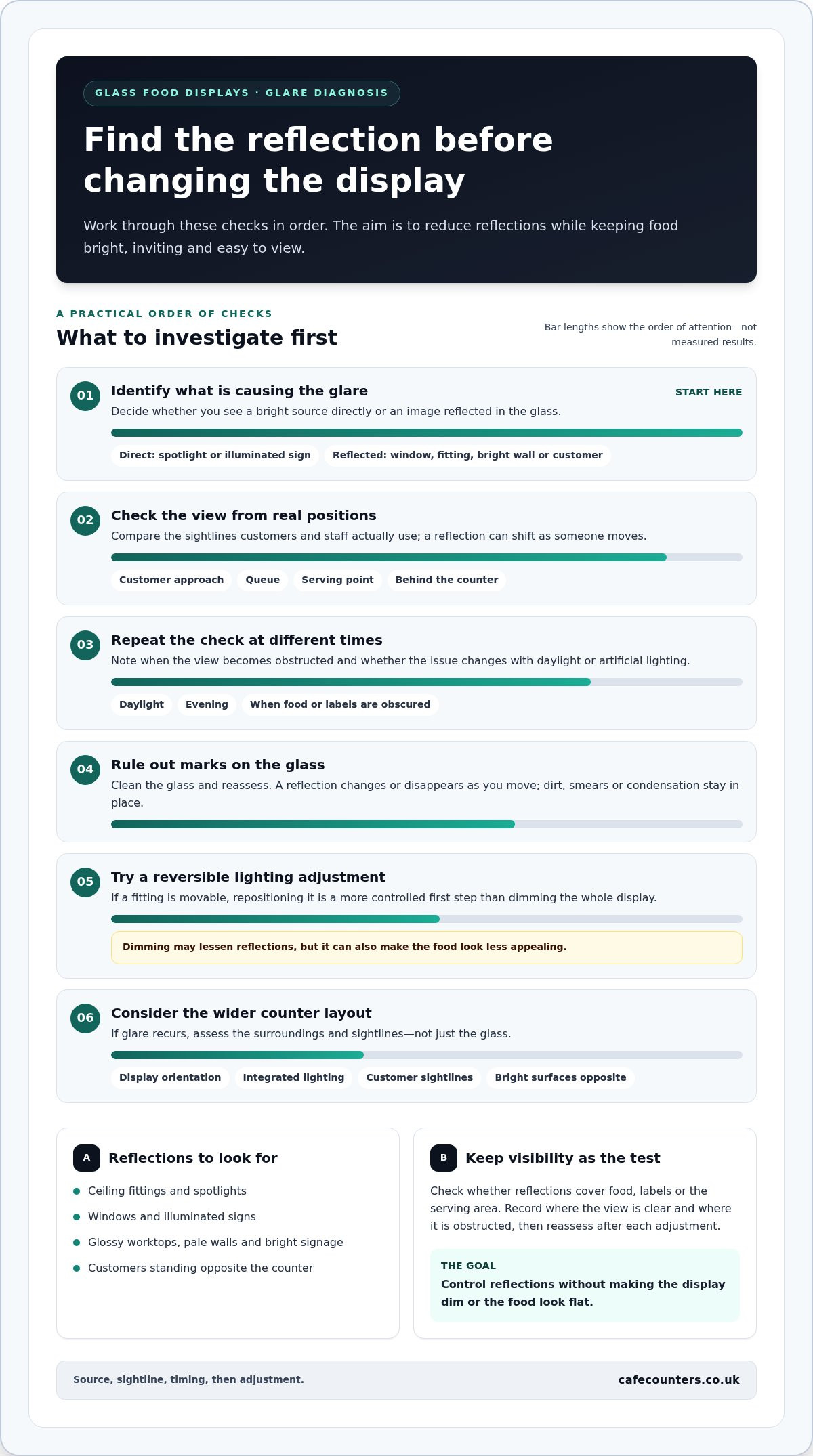
How to test and reduce glare on a glass food display step by step
A repeatable check helps identify the cause before you change the lighting or counter. Assess the display under normal operating conditions, with its usual products and lights in place. Make one adjustment at a time so you can tell what actually improves the view.
A simple glare check during normal operating conditions
- Step 1: Choose regular viewpoints. Look at the display from the entrance, queue and point of service. Include the staff position if reflections affect day-to-day serving.
- Step 2: Check at different times. Repeat the observation in daylight and under artificial lighting, including later in the day if the space changes noticeably as daylight fades.
- Step 3: Record what you see. Note the reflected source, such as a fitting or window, where it appears, and which food, label or section it obscures. A quick sketch can help you compare results later.
Keep the display and surrounding lighting in their usual settings for this first check. The aim is to establish a clear baseline, rather than judge the counter from one convenient position or under conditions that don’t reflect normal service.
Make controlled adjustments and check the result
- Step 4: Address the clearest source first. If a movable fitting is reflected in the glass, reposition or redirect it before changing several lights or reducing overall brightness.
- Step 5: Recheck every viewpoint. Compare the result from the entrance, queue and serving position. Check that the food remains easy to see and that useful illumination hasn’t been lost.
- Step 6: Test another factor only if needed. If the reflection remains, try one further change, such as adjusting a second fitting or the customer’s approach where the layout allows. Record the result before making another adjustment.
Be methodical. A change may clear one part of the glass while shifting the reflection elsewhere, so check the full customer approach and serving area before adopting it across the display. This step-by-step process makes how to reduce glare on glass food displays a practical diagnosis, rather than guesswork.
If the reflection persists because the counter’s orientation, sightlines and lighting need to work together differently, the issue may call for planning beyond a minor adjustment. Counter design can account for the site, customer movement and practical serving requirements as part of one layout. Plan a bespoke serving counter with those requirements in mind.
How counter design can prevent recurring glare problems
Some reflections can be reduced with simple lighting adjustments. If they return because the display faces a bright window, the customer approach crosses a reflected light source, or the counter geometry limits clear sightlines, the wider layout may need attention. Planning sightlines, surroundings, glass panels and lighting together makes product visibility part of the counter’s function, not an afterthought.
What to consider when planning a new or refurbished display
Start with the space and how it operates. Map the main customer approach, queue and serving positions, along with staff working areas, windows and overhead lighting. Then consider how the display will look from those viewpoints, including whether glass panels or visible light sources could interrupt the view of food. The aim is clear presentation while allowing staff to serve and replenish the display efficiently.
Consider lighting integration and display orientation alongside the counter layout and installation planning. A fitting that works in isolation may create a reflection once the counter is positioned in the room. Reviewing these relationships early can help avoid relying on dimmer lighting later, when an appealing presentation still matters.
When a bespoke display layout may be worth considering
If reflections persist after straightforward adjustments, the issue may be specific to the room and counter arrangement. A bespoke layout can account for the customer route, service positions and surrounding light sources. It can’t guarantee that every reflection will disappear, but it allows visibility to be considered as part of the whole working layout.
TFSE Products Ltd designs and manufactures commercial food displays and bespoke counters in the UK. Its UK facility uses CAD modelling in product and counter design, supporting planning around project requirements before manufacture and installation. This makes it possible to consider orientation, sightlines and lighting integration alongside practical service needs, without assuming a particular glass specification or feature is right for every display.
Understanding how to reduce glare on glass food displays can begin with observation and small adjustments, then inform decisions about a new or refurbished counter if the problem continues. Explore bespoke counter solutions designed around your site, customer approach and day-to-day operation.
Make your display clearer with a considered plan
Reducing reflections doesn’t have to mean dimming the display or replacing the glass. Start by identifying which light source appears in the glass, then test one adjustment at a time from the entrance, queue and serving positions. Recheck under different lighting conditions to make sure food remains clear and inviting throughout service.
That practical approach is the foundation of how to reduce glare on glass food displays: understand the relationship between light, surroundings and sightlines before considering broader design changes. If reflections keep returning, plan counter orientation and lighting together around the customer approach and the needs of daily operation.
TFSE Products Ltd designs and manufactures commercial food displays, with planning and installation support. Explore food display and counter solutions to plan a display around your space and day-to-day operation.
Frequently Asked Questions
How do you reduce glare on a glass food display?
Start by identifying what’s reflected in the glass, then adjust the most obvious source before changing anything else. Reposition or redirect a movable light, and check the result from the entrance, queue and serving position. If the reflection remains, assess whether the customer approach or surrounding bright surfaces contribute. Make one change at a time, and confirm the food still looks clear and appealing before settling on an adjustment.
Can changing the lighting stop reflections on display glass?
Changing the lighting can reduce a reflection, but it may not remove every one. Try redirecting a fitting so it illuminates the food without shining towards the main customer sightlines. Repositioning a movable fitting may also help. Check the result from different points around the counter, since an adjustment that improves one view can shift the reflection for another customer. Keep enough useful light on the products.
Does anti-reflective glass eliminate glare completely?
No glass choice should be assumed to eliminate glare completely. The effect depends on the glass specification and the surrounding light, including windows, fittings and bright surfaces. Specialist treatments may be considered for a persistent reflection, but their suitability should be assessed for the display and its intended use. Also keep practical needs in mind, including food protection, routine cleaning and the clarity of the view across customer positions.
Why does my food display look reflective from some angles?
The reflected image changes as the relationship between the viewer, glass and light source changes. From one position, a ceiling fitting or window may appear directly across the food; from another, that reflection may shift out of view. Walk along the customer approach and check from the queue and serving point. Comparing these sightlines helps identify whether the issue is linked to a particular position or source.
Can I dim display lighting without making food look unappealing?
You can test a lower light output, but check the products carefully before deciding it works. Dimming may make a bright reflection less prominent, while also reducing the light that makes food easy to see. Compare the display from several customer positions and check that colours, labels and product details remain visible. If presentation looks flat or less clear, restore the previous level and try redirecting or repositioning the fitting instead.
How do you test a food display for glare during the day?
Inspect the display during normal trading conditions from the entrance, queue and serving position. Repeat the check at different points in the day, as daylight and its reflections can change. Note what appears in the glass and where it obscures food or labels. If artificial lighting is used, compare the view while those lights are on too. Record each observation so you can assess adjustments against the same viewpoints.
Does cleaning glass reduce glare?
Cleaning can improve visibility if smears, dirt or condensation are clouding the view, but it won’t remove a reflection caused by a light source or bright surroundings. Clean the glass using the appropriate routine for the display, then look again from the same positions. A mark stays in place as you move; a reflection shifts or changes. This check helps separate a cleaning issue from a lighting or sightline problem.