
Brexit has changed more than the route goods take into the UK. The impact of Brexit on catering equipment supply includes additional customs processes, possible delivery delays and higher costs for some equipment and parts. For buyers, these changes can affect project planning as well as the final equipment specification.
It is understandable to expect trade barriers to affect prices and lead times. The effect depends on where equipment and components are made, how they enter the UK and whether manufacturers can adapt their supply networks. As a result, the impact varies between products and projects.
This article explains how Brexit has affected catering equipment prices, delivery, paperwork and supply networks in the UK. It also outlines how customs duties may apply to equipment imported from the EU, and why UK manufacturing can be relevant when planning a commercial space. Understanding these factors helps you make informed sourcing and scheduling decisions.
Key Takeaways
- Understand how post-Brexit border processes can affect delivery schedules and the paperwork involved in EU trade.
- See why equipment and component costs can rise when manufacturers face added trade friction or more expensive inputs.
- Learn how changes to sourcing can reshape supply networks, from short-term adjustments to longer-lasting shifts.
- Find out which factors determine whether customs duties apply to equipment imported from the EU.
- Explore how UK-manufactured display equipment, including patisserie displays, can fit into commercial project planning.
Border controls, delays and paperwork
Brexit added customs processes to UK-EU goods trade, affecting delivery planning and paperwork. The impact depends on the shipment’s route, origin and product details.
Border Checks and Customs Delays
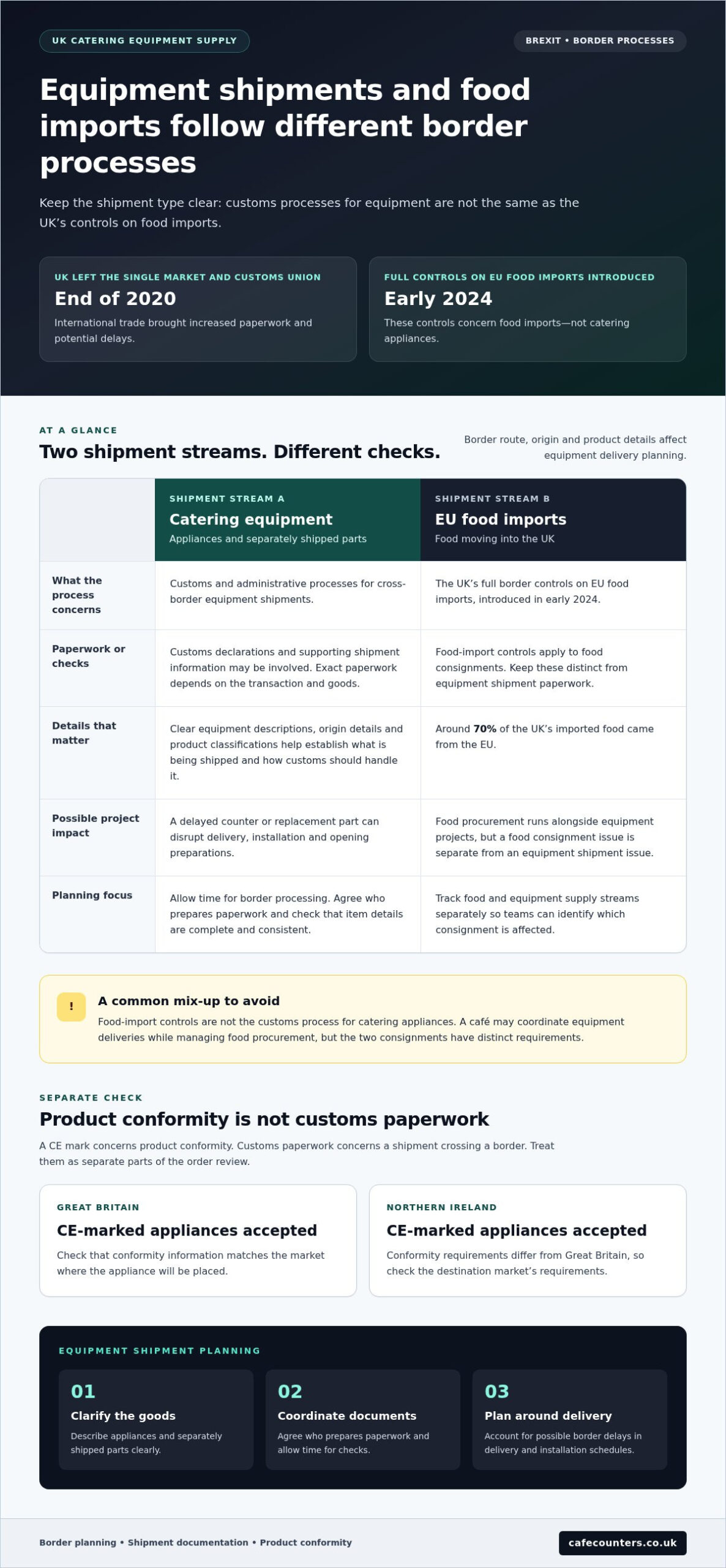
Border checks are customs and administrative processes that can delay cross-border equipment shipments. The UK left the Single Market and Customs Union at the end of 2020, and firms trading internationally have faced increased paperwork and delays.
For a catering project, a delayed counter or replacement component can disrupt the sequence of delivery, installation and opening preparations. Allow time for border processing, especially when equipment or parts are coming from an EU supplier. The impact of Brexit on catering equipment supply is felt not only at the border, but also when a late shipment disrupts the work planned around it.
Equipment Paperwork and Delivery Planning
Cross-border orders can involve customs declarations and supporting shipment information. The exact paperwork depends on the transaction and the goods. Equipment descriptions, origin details and product classifications help establish what is being shipped and how it should be handled through customs.
Incomplete or inconsistent details can prompt questions that need resolving before a shipment proceeds. For example, a consignment containing a complete appliance and separately shipped parts needs clear item descriptions. Agreeing who prepares the paperwork and allowing time for checks helps buyers and suppliers coordinate delivery, rather than treating a border crossing like an ordinary domestic transfer.
EU Food-Import Controls
The UK introduced full border controls on EU food imports in early 2024. Around 70% of the UK’s imported food came from the EU. These controls concern food imports, not catering appliances, so they should not be confused with the customs processes that apply to equipment shipments.
These processes matter to catering businesses because equipment projects run alongside food supply planning. A café fitting out a kitchen, for instance, may coordinate equipment deliveries while managing food procurement. Keep the supply streams distinct: food-import controls affect the movement of food, while equipment shipments have their own cross-border processes. Separating them helps teams identify which delivery issue relates to which consignment.
CE Mark Acceptance Across the UK
Yes. CE-marked catering appliances are accepted in Great Britain and Northern Ireland, although conformity requirements differ between the two markets. Buyers should consider where the appliance will be placed on the market, not just where it was manufactured.
This matters when selecting equipment for a business with sites in both Great Britain and Northern Ireland. A CE mark concerns product conformity, while customs paperwork concerns a shipment crossing a border. They are separate considerations. Confirm that the appliance’s conformity information matches its destination, and keep shipment planning separate from product-compliance review. This gives project teams a clearer view of the paperwork and checks involved in ordering equipment from the EU.
Product and manufacturing price increases
Brexit-related trade challenges can make catering appliances more expensive to manufacture and buy in the UK. The effect depends on how a product is made, where its inputs come from and how those inputs reach the manufacturer. A finished appliance may contain components sourced through several supply routes. Added friction at any stage can influence manufacturing decisions and the eventual price.
Products used as production inputs account for two-thirds of international trade. For catering equipment, inputs can include metals, electrical components and refrigeration parts. If a manufacturer faces higher costs or reduced access to an input, it may need to change suppliers, alter production plans or absorb some of the extra expense. Each response has different implications for product cost and availability.
Import dependence is one factor. A UK manufacturer using EU-sourced components may face different sourcing and trading conditions from one relying on domestic inputs. Switching suppliers can bring adjustment costs, while retaining an established EU supply route may mean accepting higher long-term costs for those inputs. These pressures do not affect every appliance equally. Design, component mix and material origin all matter.
Trade changes can also influence competition and customer choice. Imports can give buyers access to cheaper goods and a wider variety, while disruption to input supplies can make some products or parts less available or more costly. That creates a practical trade-off for commercial projects: a lower initial equipment price may not be the only relevant factor if component sourcing affects availability or production timing.
What UK product safety and conformity rules apply to EU-made catering equipment after Brexit? EU-made equipment must meet the safety and conformity requirements that apply in its UK destination market. The applicable marking and documentation depend on whether the product is placed on the Great Britain or Northern Ireland market, so include conformity requirements in the specification review.
The impact of Brexit on catering equipment supply is therefore not a single price increase applied across the market. To assess a quote, consider the equipment’s specification, the origin of key inputs, and any sourcing changes affecting production. Compare equivalent specifications, then assess how the chosen equipment fits the project’s operational needs. For a refit, reviewing commercial catering equipment options alongside those requirements can help connect equipment selection with the wider project plan.
Brexit-related supply chain disruption
The UK left the Single Market and Customs Union at the end of 2020. Since then, trade changes have affected how some equipment businesses source inputs and plan supply routes. For buyers, the effects can show up as altered availability, extra cost or longer waits for components.
Imports from the EU fell for products used as production inputs in many UK industries. Catering equipment manufacturers that rely on imported parts may need to adjust sourcing, production schedules or stock levels. Some changes reflect short-term adjustment costs; others may signal a lasting increase in the cost of EU inputs. This distinction matters when a project depends on a particular component.
How do Brexit rules for catering equipment differ between Great Britain and Northern Ireland? The UK left the Single Market and Customs Union, but trade arrangements for Northern Ireland differ from those for Great Britain. The UK’s temporary no-deal tariff plan, for example, would have applied no tariffs to imports into Northern Ireland from the Republic of Ireland. When planning cross-border orders, account for the equipment’s destination and route.
How has Brexit affected availability of catering equipment parts, servicing and warranties? Brexit-related trade challenges can make some equipment and parts less available or more costly in the UK. If a replacement part crosses a border, sourcing and customs processes may affect its arrival. Review warranty terms separately for parts, labour and claims procedures.
Risk reduction starts with visibility. Map the equipment and components that could interrupt service if unavailable, then identify their origin and supply route. For a critical refrigeration component, for example, establish whether its supply depends on an EU shipment or another source. This helps distinguish a general delivery concern from a specific vulnerability.
- Plan lead times: Allow for cross-border processing when scheduling equipment installation or replacement parts.
- Review stock: Set practical stock levels for critical parts, guided by operational need and replenishment routes.
- Assess sourcing: Consider alternative inputs where a single EU supply route creates a material dependency.
- Budget for VAT: Catering equipment suppliers trading across the EU should calculate the working capital needed to cover VAT costs and manage their administration.
These steps cannot remove every disruption, but they make dependencies easier to manage. For a new fit-out, a bespoke serving counter can be planned around the site layout and service requirements, helping teams coordinate equipment decisions with the wider project schedule.
Separate UK and European distribution networks
A distribution network is the route connecting manufacturers, warehouses and buyers. Since the UK left the Single Market and Customs Union at the end of 2020, businesses planning UK-EU trade have had to account for a different trading environment. Some may choose separate stock and delivery arrangements for UK and European customers; others may retain shared operations where those remain practical.
Before Brexit took effect, free movement of goods within the EU made trade smoother for UK businesses. A shared warehouse could serve customers across several EU markets without the same post-Brexit trading processes. A UK supplier serving British and EU customers may now assess whether one stock location still meets both markets’ delivery and administration needs.
Separate stock can bring operational advantages. Holding equipment or parts in the UK can make them available for domestic orders without first routing each item through an international distribution chain. European stock can serve EU customers closer to their destination. The trade-off is that dividing inventory can tie up more working capital and make demand forecasting more complex.
Network decisions also depend on where suppliers and customers are located. For example, distribution hubs in Poland are concentrating within 100 kilometres of the German border. Labour costs in Germany run roughly double those in Poland, illustrating how operating costs can influence hub locations. These are European logistics examples, not evidence that every catering equipment supplier uses the same model.
Businesses can compare network options by mapping product origin, storage location, customer destination and replenishment route. Consider a UK buyer ordering a replacement part from EU-held stock: the route affects the practical delivery plan and the processes involved. If the same part is held in UK stock, the domestic leg may be simpler, although the supplier still needs to maintain that inventory.
Changes in competition also shape these decisions. Brexit has made non-EU competitors more competitive in the UK market, while UK domestic businesses have gained greater freedom to increase market share and expand into new fields. For buyers, this can widen the range of potential sourcing routes. Network design is therefore a commercial choice, not simply a warehouse decision.
For a catering business, the useful question is how a supplier’s distribution setup supports the project’s location and timing. Ask for clarity on stock origin, dispatch location and the route for replacement components. Compare those details against the equipment specification, rather than treating “UK stock” or “European stock” as a complete measure of delivery suitability. For operators planning alfresco dining setups, partnering with UK-based retailers such as The BBQ Experts can similarly ensure reliable access to specialist outdoor cooking gear and fuel without cross-border customs friction.
A resilient plan connects purchasing decisions with the site schedule. If equipment is needed before a planned opening, identify which items depend on cross-border replenishment and build the delivery sequence around those dependencies. This helps teams understand where separate UK and European networks can support the project, and where shared stock arrangements may still work.
What Brexit customs duties apply to catering equipment imported into the UK from the EU?
There is no single duty figure for every catering equipment shipment from the EU. After Brexit, UK businesses trading goods with the EU may need to clear customs and pay import duties, rather than using the EU’s acquisition and dispatch network for VAT. Customs duties and VAT are separate considerations in the landed cost of equipment.
The product and its trade route matter. A complete appliance, a replacement component and equipment brought into Northern Ireland from the Republic of Ireland are distinct examples. Their treatment should not be assumed to be identical simply because each shipment involves EU trade. The importer needs to understand what goods are moving, their origin and their route into the UK.
The UK lodged WTO tariff schedules in 2018 for imports after Brexit. That provides context for how the UK prepared its tariff arrangements, but it does not mean every EU-origin appliance automatically carries a duty. Nor does the existence of a tariff schedule establish the applicable charge for a particular product. Buyers should distinguish the general customs framework from the treatment of their specific consignment.
A separate temporary plan covered a possible no-deal Brexit. It would have applied for up to a year and made the majority of imports tariff-free. This was a contingency plan, not a general statement that all EU catering equipment is currently duty-free. The plan also proposed no tariffs on imports into Northern Ireland from the Republic of Ireland. Keep that scenario separate from the rules governing an actual shipment.
For a UK project, address customs as part of procurement before agreeing delivery arrangements. Ask the importer or seller who handles customs clearance and how duties and VAT are treated in the transaction. Clarify whether the quoted amount includes import charges or whether they are accounted for separately. This helps the project team understand the full purchasing commitment without assuming that an EU dispatch point determines the shipment’s final treatment.
A practical review can focus on four details:
- Product description: Record whether the shipment is a complete appliance, a component or multiple goods.
- Origin and route: Identify where the goods originate and whether they enter Great Britain or Northern Ireland.
- Import arrangements: Establish which party handles customs declarations and any applicable import duties.
- VAT treatment: Keep VAT administration distinct from customs duty when assessing the transaction.
These points help buyers compare offers on a like-for-like basis. For example, two EU-dispatched appliances may have different origins, shipment routes or import arrangements. A clear breakdown makes those differences visible before procurement decisions are finalised. It also helps project planners assess whether cross-border processes fit the installation schedule, rather than treating the advertised equipment price as the only cost consideration.
TFSE Products Ltd: Patisserie Displays
TFSE Products Ltd manufactures Patisserie Displays for commercial food-service spaces, providing a UK-made option to consider when planning equipment requirements. Its UK manufacturing facility and project-specific approach help buyers assess equipment alongside layout, service needs and procurement planning.
For a bakery or café fit-out, Patisserie Displays can showcase pastries, while Integrate Drop-in Units, Grab & Go Displays and Salad Bars address other display requirements. The right choice depends on the menu, customer flow and available counter space. Including these practical needs in the equipment brief keeps purchasing decisions connected to how the finished space will operate.
If you’re planning a commercial display project, contact TFSE Products Ltd or visit cafecounters.co.uk to discuss your requirements.
Make Your Next Equipment Decision with Confidence
The impact of Brexit on catering equipment supply is best managed as part of a wider project brief. Before procurement begins, align your operational priorities, site layout and delivery sequence so equipment choices support the way your business will work. This gives your team a clearer basis for comparing specifications and planning the finished space.
For display requirements, TFSE Products Ltd offers Patisserie Displays, Integrate Drop-in Units and Grab & Go Displays. Consider each in relation to the products you serve, customer flow and available counter space, keeping the design practical as well as visually cohesive.
A well-defined brief makes the next conversation more productive. Share your project requirements and explore how the equipment can fit your plans. Contact TFSE Products Ltd for supply advice and take the next step towards a commercial space designed around your operation.
Frequently Asked Questions
What Has the Impact of Brexit Been on the UK Catering Equipment Market?
The impact of Brexit on catering equipment supply includes additional trade processes and possible changes to the cost or availability of some products. Its effect varies with equipment origin, components and sourcing route. For a planned fit-out, map which items depend on cross-border supply. This can help identify procurement risks early and focus decisions on the equipment most important to your opening schedule and day-to-day operations.
How has Brexit affected catering equipment imports into the UK?
The impact of Brexit on catering equipment supply is also reflected in how import orders are administered. EU-to-UK shipments can involve customs processes, so establish who handles the declaration and how the shipment is described. For example, list an appliance separately from replacement components. Clear records help distinguish the goods in a consignment and coordinate purchasing, delivery planning and site preparation.
What customs paperwork is required to import catering equipment from the EU to the UK?
Import paperwork depends on the goods and shipment. The importer or appointed party needs the information required for customs clearance. Provide a clear description of each item, its origin, value and destination, and clarify who submits the declaration. For a consignment containing a complete appliance and separate parts, itemised details explain what is crossing the border. Keep VAT administration distinct from customs duty.
How have Brexit border checks and delays affected catering equipment delivery times?
Border checks and related administration can make an EU shipment’s arrival less predictable than a domestic delivery. If a component is needed before equipment can be installed, a delay may affect the work sequence on site. Coordinate delivery access and installation readiness around the shipment’s route, and allow the schedule to account for border processing rather than planning solely from dispatch.
How have Brexit-related costs changed prices of catering equipment in the UK?
The impact of Brexit on catering equipment supply can include higher manufacturing or purchasing costs, but the effect varies by product. Imported inputs, supplier changes and trade administration can influence costs along the supply chain. Compare quotations for equivalent specifications and clarify how delivery and import charges are treated. This gives buyers a more useful basis for evaluating equipment and its suitability for the project.