
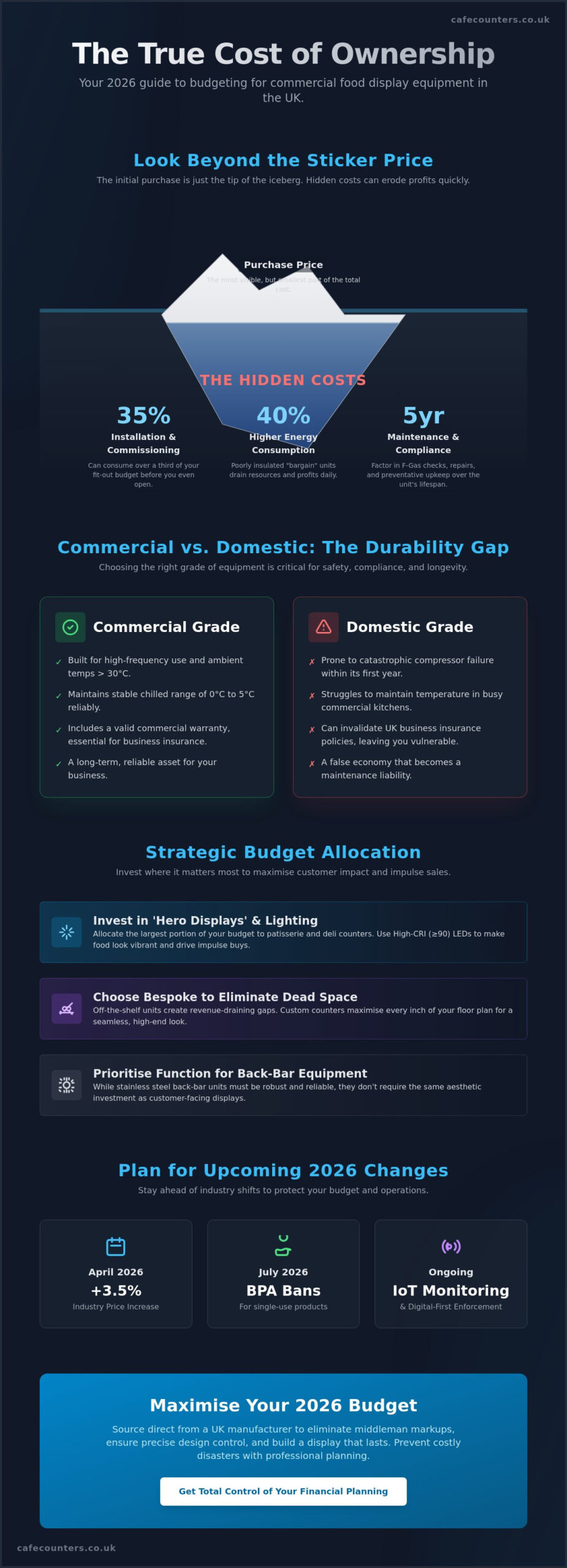
Did you know that installation and commissioning fees can silently consume up to 35% of your total hospitality fit-out budget before a single customer walks through the door? When you’re budgeting for commercial food display equipment UK projects in 2026, it’s easy to focus solely on the sticker price while overlooking the long-term impact on your bottom line. You’ve likely felt the sting of unpredictable maintenance costs from cheap units or the stress of miscalculating the precise floor space needed for a bespoke counter. It’s a common hurdle, but one that expert planning can easily clear.
This guide promises to give you total control over your financial planning by breaking down the true cost of ownership, from the 3.5% industry price increases effective April 2026 to the upcoming BPA bans for single-use products in July. We’ll provide a clear framework for your investment, ensuring you choose robust, British-made solutions that drive impulse sales and deliver significant energy savings. You’ll learn how to navigate the shift toward Digital-First enforcement and IoT monitoring while building a space that balances prestigious aesthetics with functional, long-term durability.
Key Takeaways
- Look beyond the initial purchase price to calculate the Total Cost of Ownership, accounting for energy efficiency and long-term maintenance.
- Identify your ‘Hero Displays’ to strategically allocate funds where they’ll have the greatest impact on customer impulse sales.
- Master the art of budgeting for commercial food display equipment UK by choosing bespoke counters that eliminate revenue-draining dead space.
- Prevent costly delivery day disasters by incorporating professional site surveys and commissioning into your early financial planning.
- Maximise your 2026 budget by sourcing direct from a UK manufacturer to eliminate middleman markups and ensure precise design control.
The True Cost of Commercial Food Display: Beyond the Purchase Price
When you begin the process of budgeting for commercial food display equipment UK projects, the initial invoice is merely the starting point. Savvy operators understand that the true value of a patisserie display or a grab and go unit is measured through its Total Cost of Ownership (TCO). This comprehensive figure includes the purchase price, professional installation, energy consumption, and long-term maintenance. Selecting a unit based solely on a low upfront cost often triggers a cycle of escalating operational expenses that can erode your profit margins within the first eighteen months.
The 2026 energy landscape in the United Kingdom demands a meticulous approach to equipment selection. With commercial electricity rates remaining a significant overhead, a poorly insulated display counter acts as a literal drain on your resources. Units with thin insulation or single-glazed glass forced to work harder to maintain the required 0°C to 5°C chilled range will consume up to 40% more power than premium, British-built alternatives. These “bargain” units often represent a false economy, as the savings made at purchase are quickly swallowed by monthly utility bills. Understanding the broader food processing overview within the hospitality sector highlights why temperature stability is non-negotiable for both safety and financial viability.
Domestic vs. Commercial Grade: The Durability Gap
It is a mistake to assume that high-end domestic appliances can withstand the rigours of a professional catering environment. Commercial-grade compressors are designed for high-frequency use, maintaining internal temperatures even when doors are opened dozens of times per hour. In a busy UK kitchen where ambient temperatures can exceed 30°C, a domestic-grade unit will likely suffer catastrophic compressor failure within its first year. Furthermore, commercial warranties are a mandatory requirement for many UK business insurance policies. Operating without equipment that carries a valid commercial guarantee can leave you vulnerable to uncovered losses during a breakdown.
Calculating Your 5-Year Operational Budget
To build a robust financial plan, you must project costs over a five-year horizon. Start by examining the kW ratings of your chosen deli counters or salad bars to estimate annual power draw. You must also account for mandatory UK compliance, such as annual F-Gas inspections and preventative maintenance visits to ensure door seals and condensers remain efficient. Total Cost of Ownership (TCO) is the sum of purchase, power, and upkeep over a unit’s lifespan. By allocating funds for these recurring costs now, you ensure your display remains a high-performing sales tool rather than a maintenance liability.
Strategic Budget Allocation for Maximum Customer Impact
Effective budgeting for commercial food display equipment UK projects requires a shift in perspective. You shouldn’t view every unit as a simple expense. Instead, identify your ‘Hero Display’. This is the focal point of your shop, typically a patisserie or deli counter, where premium margins are won or lost. Allocating a larger portion of your budget here ensures that your highest-value products are presented with the prestige they deserve. While stainless steel back-bar units must be robust and functional, they don’t require the same aesthetic investment as the units your customers interact with daily.
Lighting is another critical area where strategic spending yields high returns. High-CRI (Colour Rendering Index) LEDs, specifically those with a rating of 90 or above, transform the visual appeal of food by rendering colours more accurately. This isn’t just about brightness. It’s about making a strawberry tart look vibrant and a cut of roast beef look succulent. We utilise advanced CAD modelling to help you visualise these details during the design phase. This ensures every pound is allocated purposefully before we begin the manufacturing process, avoiding costly mid-build changes that often plague poorly planned renovations.
Investing in Patisserie and Deli Displays
Temperature stability is non-negotiable for high-margin cakes and delicatessen items. Fluctuations of even a few degrees can lead to spoilage or unappealing textures that turn customers away. When reviewing the ultimate guide to deli counters, you’ll see that glass choice impacts both cost and visibility. Curved glass offers a classic, prestigious look that minimises reflections, while square glass provides a modern, architectural feel and often allows for more shelf space. For a truly tailored solution, you might consider our bespoke serving counters to perfectly fit your unique floor plan and brand identity.
Budgeting for Grab & Go Efficiency
For high-traffic environments, refrigerated grab and go display units offer the best return on investment by removing physical barriers to purchase. Open-front merchandisers drive impulse sales more effectively than glass-door units, though they require more power to maintain temperature. To mitigate this, ensure your budget includes high-quality night blinds. These simple additions can reduce energy consumption by up to 20% during closing hours, paying for themselves within the first year of operation. Balancing these functional requirements with stunning design is what sets a professional fit-out apart from a standard installation.
Bespoke vs. Off-the-Shelf: Evaluating the Financial Trade-offs
Choosing between a mass-produced unit and a custom-built solution is a pivotal decision when budgeting for commercial food display equipment UK. While an off-the-shelf fridge might appear to be a bargain on a spreadsheet, it often creates “dead space” in your layout. In the UK’s compact high-street retail environments, every square centimetre must generate revenue. A bespoke counter allows you to integrate heated, chilled, and ambient sections into a single, seamless footprint. This consolidation doesn’t just save valuable floor space; it reduces the number of separate electrical points and service contracts you’ll need to manage over the next five years.
One of the most significant financial advantages of a bespoke approach is the Concept to Completion model. By working directly with a British manufacturer, you can often bypass the 15% to 20% markup typically added by third-party distributors or equipment middle-men. This turnkey service streamlines the entire process, from the initial CAD design to the final commissioning. It eliminates the risk of “finger-pointing” between different contractors if a unit doesn’t fit or a power supply is misplaced. This integrated management style provides a level of budget certainty that standard procurement simply cannot match.
The Hidden Labour Savings of Bespoke Design
Bespoke design is a direct investment in your staff’s productivity. By planning an ergonomic layout that places high-turnover items within easy reach, you reduce the physical strain and “step count” of your team. Seamless stainless steel fabrication also plays a vital role in your operational budget. Unlike standard units with awkward gaps and visible joints, bespoke counters are designed for rapid sanitisation, potentially saving your business 15 to 20 minutes of labour every single day. Bespoke design eliminates the need for expensive on-site modifications that frequently occur when trying to force standard equipment into unique physical spaces.
Material Selection and Budget Impact
The materials you choose have a direct impact on your long-term financial risk. While thin-gauge imports might lower your initial expenditure, they are prone to denting and structural fatigue in high-volume environments. We utilise robust, high-grade food-safe materials that comply with the latest UK health and safety standards, protecting you from potential fines or compliance issues. Investing in premium finishes, such as prestigious stone tops or custom powder-coated panels, ensures your display remains stunning for years. British-manufactured units are built to a standard that handles the heavy usage typical of the education and healthcare sectors, providing a durability that standard retail units rarely offer.
Planning for Installation, Commissioning, and UK Compliance
Securing the right unit is only half the battle. Successful budgeting for commercial food display equipment UK must account for the transition from our manufacturing facility to your physical shop floor. Overlooking installation logistics can lead to “day of delivery” disasters where equipment simply doesn’t fit through the door or the existing power supply is insufficient. These oversights result in costly delays and emergency trade call-out charges that quickly inflate your project spend. A professional fit-out requires a methodical approach to ensure that every heated gantry or refrigerated multideck is integrated correctly into your utilities.
Professional commissioning is another critical budget line item that many operators overlook. It’s the process where a qualified engineer verifies that the equipment is operating within the manufacturer’s specified parameters. This step is essential for validating your warranty. Without a commissioning certificate, many manufacturers will refuse to honour parts and labour claims if a fault occurs. This is particularly important for integrated drop-in units, which require precise cut-outs and specific electrical and plumbing connections to function reliably over a long lifespan. Ensuring these connections meet current UK building and safety regulations is a cornerstone of our Concept to Completion service.
The Site Survey: A Budget Protection Tool
A rigorous site survey is your primary defence against hidden extras. Before a single sheet of steel is cut, we verify door widths, floor levels, and specific power phases to ensure a seamless fit. For refrigerated sections, we meticulously plan for adequate ventilation and drainage to prevent compressor strain and water pooling. This proactive approach allows us to provide a fixed installation quote, ensuring your budget remains protected from the common pitfalls that plague less experienced shopfitting projects. We check everything from the load-bearing capacity of your counters to the proximity of heat sources that could compromise chilled display efficiency.
Compliance and Food Safety Standards
UK food safety is evolving toward a “Digital-First” enforcement model, placing a greater emphasis on data-driven compliance and remote audits. Budgeting for integrated digital temperature monitoring systems is now essential for robust HACCP record-keeping. Whether you are installing chilled units or Vision Heated Counters, professional installation is a prerequisite for most UK commercial insurance policies. Finally, your financial plan should include the ethical removal and disposal of any existing units in accordance with UK WEEE regulations. If you’re ready to secure a turnkey solution that covers every technical and compliance detail, book a professional site survey to begin your journey with confidence.
The Manufacturer-Direct Advantage: Maximising Your 2026 Budget
The final pillar of effective budgeting for commercial food display equipment UK is selecting the right procurement route. Many hospitality businesses unknowingly pay a premium by purchasing through third-party resellers or equipment distributors. These intermediaries typically add a markup of 15% to 20% to the manufacturer’s price to cover their own overheads and sales commissions. By choosing to work directly with a British manufacturer like TFSE Products Ltd, you eliminate these middleman costs. This direct relationship doesn’t just save money; it ensures that the technical expertise of the person designing your counter is the same expertise used to build it. Our in-house CAD design capabilities allow for precise budget control, as we can adjust material specifications and dimensions in real-time to meet your financial targets without compromising on quality.
Sourcing locally also provides a significant logistical advantage. With global shipping costs remaining volatile in 2026, the financial impact of transporting heavy stainless steel units from overseas can be substantial. British-made equipment bypasses these expensive freight fees and avoids the long lead times associated with international ports. This means your project stays on schedule, allowing you to begin trading and generating revenue sooner. From a sustainability perspective, reduced “food miles” for your equipment also aligns with the growing consumer demand for environmentally responsible business practices.
Leasing and Financing Your Counter Solution
Preserving cash flow is essential for any new build or renovation, especially when you need to allocate funds for initial stock and staffing. Leasing your equipment is an increasingly popular strategy in the UK market. It allows you to spread the cost of prestigious patisserie displays or deli counters over three to five years, making high-end equipment accessible without a massive upfront capital outlay. Under current 2026 UK tax regulations, many businesses can take advantage of Full Expensing or similar capital allowances. These incentives often allow you to deduct the full cost of qualifying plant and machinery from your taxable profits in the year of purchase, providing a significant immediate tax saving.
Why British Craftsmanship Wins on ROI
The long-term return on investment for British-manufactured equipment is rooted in reliability and support. When a unit fails, every hour of downtime represents lost sales. Because we manufacture our counters in the UK, spare parts are readily available and don’t require weeks of international transit. This ensures your grab and go displays or salad bars remain operational and profitable. Our comprehensive after-sales service is built into our Concept to Completion promise, providing a steady hand throughout the unit’s entire lifecycle. If you’re ready to maximise your investment with a partner who values durability as much as you do, contact TFSE Products Ltd for a bespoke counter consultation today.
Secure Your Commercial Future with Precision Planning
Mastering the complexities of budgeting for commercial food display equipment UK requires a partner who understands both the technical and financial stakes of the hospitality industry. You’ve seen how shifting your focus from the initial sticker price to the Total Cost of Ownership can prevent the long-term drain of high energy bills and maintenance fees. By investing in bespoke, British-made solutions, you eliminate revenue-draining dead space and ensure your ‘Hero Displays’ drive the impulse sales your business depends on. Whether you’re navigating the 2026 digital-first compliance shift or seeking the tax efficiencies of capital allowances, the right equipment is a strategic asset, not just a line item.
As a leading UK manufacturer since 1991, TFSE Products provides the steady hand you need throughout your renovation or new build. Our in-house CAD modelling and engineering teams ensure every deli counter or patisserie display is designed for your specific ergonomic needs. With our national installation and commissioning service, we bridge the gap between initial concept and a physical space that delivers results. It’s time to build a space that reflects the quality of your brand and the durability of British craftsmanship.
Request your bespoke Concept to Completion consultation with TFSE Products and take the first step toward a prestigious, high-performance fit-out.
Frequently Asked Questions
How much does a bespoke cafe counter cost in the UK in 2026?
Bespoke counter costs vary based on the complexity of the design and integrated services, but industry data indicates that buffet display counters often range from £6,000 to over £7,000. For a comprehensive project, equipment typically accounts for 40% to 50% of the total fit-out expenditure. Investing in a tailored solution ensures every square centimetre of your floor space is revenue-generating, providing better value than standard units that leave unusable gaps.
Is it better to lease or buy commercial food display equipment?
Leasing is an excellent strategy for preserving cash flow as it allows you to spread the investment over a three to five year period. This approach is particularly beneficial for new ventures that need to maintain liquidity for staffing and stock. Established businesses may prefer outright purchase to take advantage of 2026 UK capital allowances, which can offer significant tax efficiencies in the year of acquisition.
What are the hidden costs of installing refrigerated display units?
Installation and labour can account for 25% to 35% of your total budget beyond the equipment’s purchase price. You must factor in professional commissioning to validate your manufacturer warranty and ensure the unit operates within FSA temperature guidelines. Other common hidden costs include specific electrical phase upgrades, plumbing for drainage, and the ethical disposal of old units in compliance with UK WEEE regulations.
How can energy-efficient displays help my cafe’s budget?
High-efficiency units can reduce your annual running costs by approximately 20% compared to lower-spec models. When budgeting for commercial food display equipment UK, choosing units with premium insulation and integrated night blinds directly protects your profit margins. These features mitigate the impact of 2026 energy prices, ensuring that your display remains a profitable sales tool rather than an escalating operational liability.
Do I need a site survey before budgeting for a food counter?
Yes, a professional site survey is essential to prevent costly “day of delivery” disasters and hidden extra charges. Allocating 10% to 15% of your budget to the design and planning phase ensures that all access routes, floor levels, and utility connections are verified before manufacturing begins. This methodical approach provides budget certainty and ensures your installation complies with all relevant UK health and safety standards.
Why is British-made catering equipment considered a better long-term investment?
British-made equipment offers a superior return on investment by eliminating volatile international shipping fees and ensuring faster lead times. Because we manufacture in-house, spare parts are readily available, which prevents the weeks of downtime often associated with imported units. This reliability is crucial in the hospitality sector, where a single day of equipment failure can result in hundreds of pounds of lost revenue.
What is the typical lead time for a custom-built food display unit?
Lead times for bespoke counters typically range from six to ten weeks from the final approval of CAD drawings. This schedule allows for meticulous in-house engineering and rigorous testing to ensure the unit meets our prestigious quality standards. Planning your project with these timelines in mind helps you avoid the 3.5% industry price increases scheduled for April 2026 by securing your order early.
Can I integrate heated and chilled sections into one counter to save money?
Yes, integrating multiple temperature zones into a single counter footprint is a highly effective way to maximise your revenue per square metre. This bespoke approach reduces the number of separate electrical connections required and simplifies your long-term maintenance contracts. It also creates a seamless, stunning visual impact for your customers while ensuring that both hot and cold items are held in strict accordance with FSA regulations.