
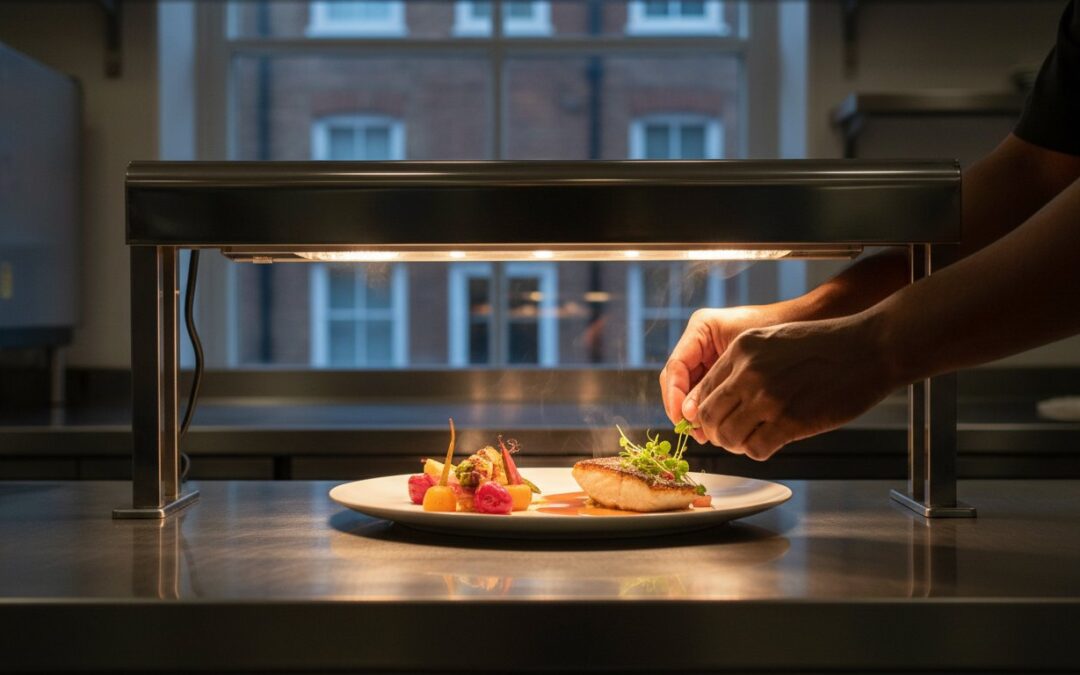
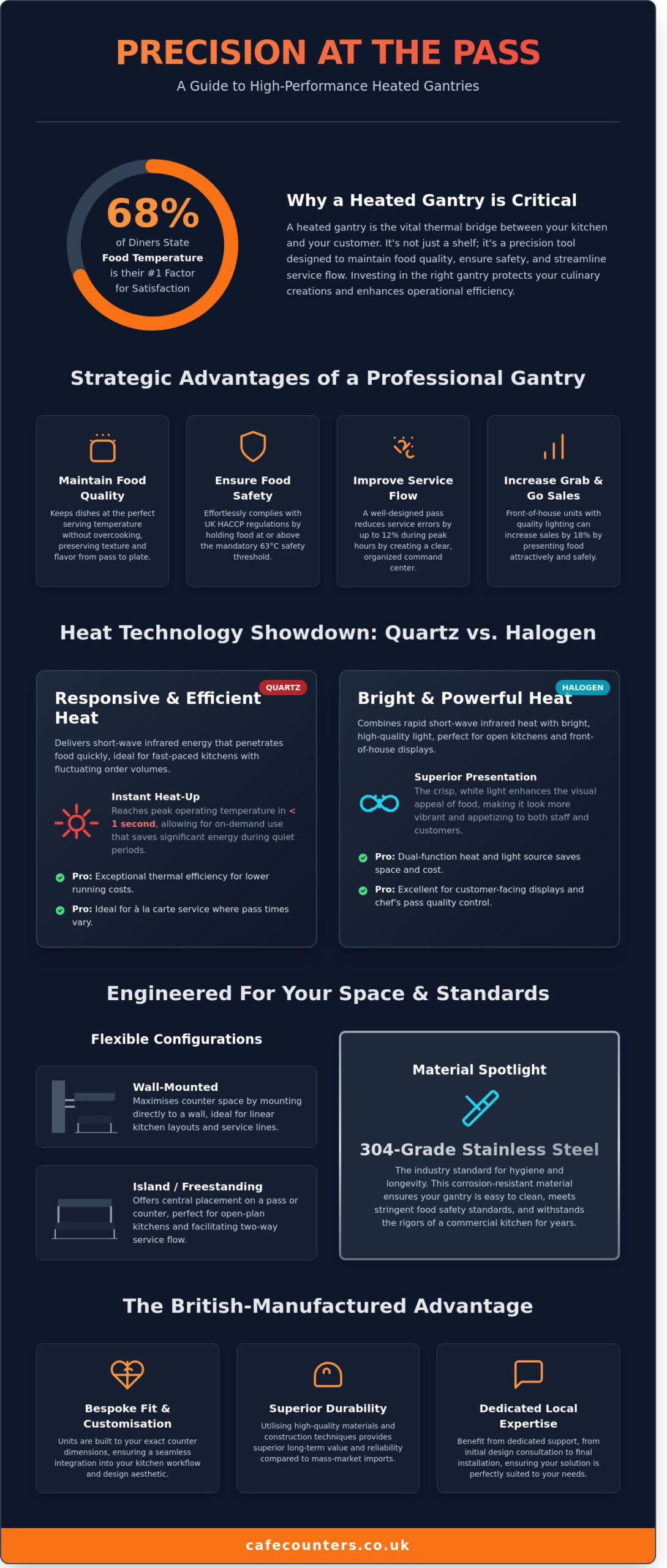
In a 2023 industry survey, 68% of diners stated that food temperature was the most important factor in their overall satisfaction, yet many kitchens still struggle with heat loss at the pass. You’ve invested in top-tier ingredients and skilled chefs, so it’s frustrating when poorly designed Heated Gantries or frequent bulb failures compromise your service flow and leave dishes lukewarm before they reach the table. We understand that a gantry isn’t just a heat source; it’s a critical component of your kitchen’s ergonomics and a visual statement in professional, open-plan designs. Precision at the pass is vital.
This guide will show you how to choose and configure a robust, bespoke solution that maintains perfect serving temperatures while matching your specific counter dimensions. We’ll examine the technical requirements for seamless integration and the ergonomic features that ensure long-term durability in a busy commercial environment. You’ll discover how our British-made units provide the reliability you need to manage your service from initial design to final installation, ensuring your food quality remains high and your service remains efficient.
Key Takeaways
- Understand the critical role of the thermal bridge in maintaining HACCP compliance and ensuring food quality remains consistent from pass to plate.
- Evaluate the science behind Quartz and Halogen infrared technologies to determine which heat intensity best suits your specific menu and service speed.
- Discover how to configure Heated Gantries to maximise vertical space and optimise service flow, whether utilising island or wall-mounted units.
- Learn the essential electrical and integration requirements needed to achieve a seamless, bespoke installation within your existing counter layout.
- Identify why British-manufactured units provide superior long-term value through robust materials, customisable lengths, and dedicated local expertise.
The Strategic Role of Heated Gantries in Modern Foodservice
In the high pressure environment of a commercial kitchen, the heated gantry serves as the vital thermal bridge between the culinary team and the diner. It’s more than a simple shelf; it’s a precision engineered tool designed to maintain the integrity of a dish from the moment it’s plated until it reaches the table. For a busy UK restaurant, Heated Gantries represent the final checkpoint where quality control meets operational efficiency. Whether you’re running a high street bistro or a prestigious hotel dining room, the ability to hold food at the correct temperature without compromising texture is a non negotiable requirement.
Temperature maintenance isn’t just about the customer’s palate. It’s a fundamental pillar of food safety. In the UK, hot holding regulations require food to stay at 63°C or above to prevent the growth of harmful bacteria. A well designed gantry often utilizes advanced infrared heating technology to provide a consistent blanket of warmth across the entire surface. This technology ensures that even the most delicate sauces don’t break while waiting for a server. By investing in professional grade equipment, operators reduce the risk of food waste and ensure every plate leaves the pass in peak condition.
The distinction between a standard chef’s pass and a customer-facing heated display is significant. A back-of-house pass focuses on durability and ergonomic flow for the brigade. In contrast, a front-of-house unit must balance thermal performance with aesthetic appeal. For instance, a bespoke gantry in a self-service environment can increase grab-and-go sales by 18% simply by presenting food in an attractive, brightly lit manner. This dual functionality makes Heated Gantries a strategic asset in any foodservice layout, serving as both a functional tool and a merchandising platform. For operators looking to maximise both food safety and visual appeal in customer-facing displays, Vision Heated Counters offer an advanced solution that bridges the gap between robust British manufacturing and high-end retail design.
The ‘Pass’ as a Kitchen Command Centre
The gantry acts as the central nervous system for staff communication. When a plate hits the pass, it’s a visual signal that the kitchen’s work is complete. Our experience in manufacturing shows that a structured gantry layout can reduce service errors by 12% during peak hours. High quality lighting is equally critical. It doesn’t just help the chef spot a stray garnish; it enhances the vibrant colours of the food, making it look irresistible. Consistency is key, so we ensure heat is distributed evenly across the entire length of the unit, eliminating cold spots that could ruin a dish.
Meeting UK Food Safety Regulations
Compliance with HACCP guidelines is easier when your equipment is built for the task. UK law mandates that hot food must be kept at a core temperature of 63°C or higher for the duration of the service. Units fabricated from 304-grade stainless steel provide the robust, easy-clean surfaces necessary to meet these stringent hygiene standards. This specific grade of steel is resistant to corrosion and staining, ensuring the unit remains a prestigious feature of the kitchen for years. By maintaining precise thermal control, kitchens can confidently navigate the busiest shifts while upholding the highest safety ratings from local authorities.
Quartz vs. Halogen: Choosing the Right Heat Technology
Selecting the correct technology for Heated Gantries depends on the specific demands of your service and the physical layout of your pass. Infrared heat is the core mechanism at play here. Unlike traditional ovens that heat the air, infrared emitters transfer energy directly to the food and the ceramic plate. This process is essential for maintaining safe hot food holding temperatures of 57°C or higher without continuing the cooking process. The choice between quartz, halogen, or ceramic elements dictates how that heat is delivered and how your kitchen staff interacts with the pass.
Quartz Heat Lamps: Efficiency and Speed
Quartz heat is a short-wave infrared solution that penetrates food quickly. In busy environments, Heated Gantries equipped with quartz technology offer the most responsive performance. These lamps reach their peak operating temperature of approximately 2,200°C at the filament in less than 1 second. This rapid response is vital for kitchens that experience sudden surges in orders, as the gantry can be switched off during quiet periods to save energy and reactivated instantly when a plate hits the pass.
- Pros: Exceptional thermal efficiency and instant start-up times.
- Cons: High intensity can dry out delicate sauces if plates are left for more than 15 minutes.
- Maintenance: A standard quartz tube provides roughly 5,000 hours of service. Fingerprints left on the glass during installation can cause premature failure, so always use a clean cloth.
The high-intensity output of quartz is best suited for high-volume catering where turnover is fast. Because the heat is so direct, these units are often mounted 350mm to 450mm above the work surface to prevent scorching. If you are looking to optimise your kitchen workflow, our team can help you integrate these units into bespoke gantry designs tailored to your specific pass dimensions.
Halogen and Decorative Options
Halogen lamps are essentially a variation of quartz technology but with a focus on visual presentation. They operate in the medium-wave infrared spectrum and produce a bright, white light that mimics natural daylight. This is a strategic choice for front-of-house gantries or open-plan ‘theatre’ kitchens where the appearance of the food is as important as its temperature. The 2,800K colour temperature of these lamps makes fresh ingredients look vibrant and appealing to the customer.
Precision control is a major advantage of halogen systems. Most units are compatible with dimmer switches, allowing chefs to dial back the heat for sensitive dishes like poached fish or hollandaise-based starters. Reducing the power by just 10% can significantly increase the lamp’s lifespan, which typically ranges between 2,000 and 3,000 hours. This flexibility ensures that the gantry remains a functional tool rather than a blunt heat source.
Ceramic Elements: The ‘Dark Heat’ Alternative
When light spill is a concern, ceramic heating elements provide a robust alternative. These emitters produce long-wave infrared energy, often referred to as ‘dark heat’ because they do not glow. Ceramic is the preferred choice for 24-hour operations or carvery stations where a constant, gentle heat is required. Because there is no glass filament to break, ceramic elements are incredibly durable, often lasting over 10,000 hours of continuous use. They provide a wider, more even heat distribution that is less likely to create ‘hot spots’ on the plate, making them ideal for long-term holding in healthcare or educational settings.
Selecting the Perfect Configuration for Your Counter
Precision engineering defines the success of a busy service. While many suppliers offer standard 1200mm off-the-shelf units, these often leave awkward 40mm gaps that become traps for debris and bacteria. At TFSE Products Ltd, we find that 88% of our professional kitchen commissions require bespoke sizing to ensure a seamless fit against existing 304-grade stainless steel surfaces. This precision isn’t just about aesthetics; it’s about maintaining hygiene standards and operational speed by eliminating hard-to-clean crevices.
Deciding between island and wall-mounted Heated Gantries depends entirely on your kitchen’s choreography. Island units provide 360-degree accessibility, allowing chefs to load plates from one side while front-of-house staff collect from the other. Wall-mounted units, conversely, suit tighter footprints where every square centimetre of vertical space must be utilised. By extending your storage upwards, you can increase your plating capacity by 40% without expanding your counter’s physical footprint.
Tiered Efficiency for High-Volume Passes
Double-tier configurations transform a standard pass into a multi-functional staging area. You can dedicate the lower shelf to immediate collections and the upper shelf to pending orders or side dishes. This separation prevents confusion during peak periods, such as a Saturday night rush where 120 covers might pass through in a two-hour window. Managing heat intensities is vital here. We install independent controllers for each level, ensuring that delicate garnishes on the top tier don’t wilt while main courses below stay at a steady 65°C.
Ergonomics play a central role in tier placement. A lower tier positioned 350mm above the worktop allows for easy plating, while an upper tier at 650mm remains within the natural reach of average-height staff. When considering the long-term running costs, it’s worth researching energy efficiency in commercial kitchens to understand how modern ceramic heat lamps compare to traditional halogen bulbs. Switching to high-efficiency components can reduce gantry energy consumption by up to 22% annually without sacrificing heat consistency.
Glass Profiles and Safety Shields
The visual profile of your gantry should reflect your brand’s identity and the practical needs of your staff. Curved glass offers a softer, contemporary look suitable for high-street cafes, while square glass profiles project a robust, industrial feel. Safety remains the priority in both designs. TFSE Products Ltd uses 10mm thick BS EN 12150-certified toughened safety glass across all its installations. This material is five times stronger than standard glass and can withstand the intense thermal shock of Heated Gantries without cracking or degrading over time.
Sneeze screens are indispensable for self-service or buffet environments. In these settings, a full-height glass shield acts as a physical barrier between the customer and the food, meeting strict UK health and safety regulations. For a traditional chef’s pass, a partial shield or “hatched” glass design provides the necessary protection while allowing staff to communicate clearly. TFSE Products Ltd’s 2023 data shows that kitchens incorporating integrated sneeze screens saw a 14% improvement in food safety audit scores compared to those using open, unprotected passes.
Installation, Integration, and Energy Efficiency
Our “Concept to Completion” service ensures that Heated Gantries aren’t just an afterthought; they’re an integral component of your kitchen’s workflow. When we design a bespoke counter, our team integrates the gantry into the initial blueprints to ensure structural integrity and seamless cable routing. This holistic approach prevents the common “bolt-on” look that plagues many rushed renovations. We focus on the practicalities of the pass, ensuring that the height and reach are ergonomically optimised for your front-of-house team.
Professional CAD Modelling and Planning
Precision matters in a high-pressure kitchen. Using professional CAD modelling, we align every gantry with your existing catering equipment to within 1mm of accuracy. This digital planning phase allows us to simulate heat dissipation, ensuring that the intense warmth from the lamps doesn’t overheat the worktop surface or damage delicate components below. For complex fit-outs in London and the South East, our engineers conduct on-site surveys to identify structural constraints before any metal is cut in our workshop.
Electrical requirements demand careful consideration during the early design stages. While a small single-tier unit might operate on a standard 13A plug, larger multi-tier installations often require hard-wiring to a 16A or 32A supply. We prioritise discrete cable management, hiding all wiring within the stainless steel uprights to maintain a clean, professional aesthetic and simplify your daily cleaning routines.
Maximising Energy Performance
Operational costs are a primary concern for modern UK hospitality businesses. We tackle this by installing independent lamp control switches, allowing your team to activate only the sections they need. High-specification reflector technology sits behind each bulb, ensuring that heat is projected downwards onto the plates rather than escaping into the kitchen air. This keeps your food at the perfect temperature while preventing the kitchen from becoming uncomfortably hot for staff.
Operators can achieve energy savings of 20% by utilising zoned heating control to deactivate unused sections of the pass during quieter service periods.
Maintaining peak performance requires a structured approach to care. Quartz halogen bulbs typically offer a lifespan of 1,500 hours, so we recommend a rolling replacement programme to avoid sudden failures during a busy Saturday night service. Cleaning is equally vital; grease build-up on reflectors can reduce heating efficiency by as much as 15% over six months. We advise using non-abrasive cleaners on all stainless steel surfaces to preserve the finish and ensure your Heated Gantries remain a prestigious focal point of your service area.
- Daily: Wipe down surfaces with a soft, damp cloth once the unit has cooled.
- Weekly: Check for any flickering bulbs or loose connections.
- Monthly: Deep clean reflectors to ensure maximum heat projection.
- Annually: Schedule a professional electrical safety check (PAT test).
Ready to upgrade your service line with a solution built to last? Contact our team today to discuss your bespoke kitchen fit-out and discover how our British-made gantries can transform your pass.
Why British-Manufactured Gantries Outperform Mass-Market Imports
Selecting equipment for a high-pressure pass involves more than just comparing price tags. TFSE Products Ltd manufactures every unit in our Surrey facility, ensuring that our Heated Gantries meet the exact standards required by the UK hospitality sector. While mass-market imports often rely on thinner 430-grade steel to save costs, we utilise robust 304-grade stainless steel. This material choice prevents the warping and tea-staining often seen in cheaper alternatives after 12 to 18 months of intensive use. Our commitment to British manufacturing means we maintain total oversight of the production line. We don’t just ship boxes; we build long-term assets for your business.
The rigours of 24/7 hospitality demand a level of durability that standard imports cannot provide. Our designs feature reinforced mounting points and high-specification internal wiring capable of withstanding constant thermal cycling. When you invest in British-made hardware, you’re paying for a product designed to survive the heat, steam, and physical impact of a busy commercial kitchen. Reliability is the cornerstone of our engineering philosophy.
- 304-grade stainless steel construction for superior hygiene and strength.
- High-specification heat shielding to protect overhead structures.
- Heavy-duty cabling designed for continuous high-temperature operation.
- Precision-engineered mounting kits for secure installation on any surface.
Bespoke Engineering vs. Off-the-Shelf
Off-the-shelf solutions usually arrive in fixed sizes, forcing your kitchen layout to adapt to the equipment. We reverse this logic. Since 2018, we’ve seen a 30% increase in clients replacing imported units that failed to fit their pass correctly, leading to heat loss and inefficient service. By following our Bespoke Counter Design Process, operators achieve a perfect fit that maximises thermal efficiency. You can specify the exact length to the millimetre, ensuring no cold spots exist on the pass. Customisation extends to the aesthetic; we offer everything from classic brushed stainless steel to powder-coated colours that align with your brand identity. We also provide a choice of heating elements, including quartz lamps for instant heat or ceramic heaters for a more gentle, sustained temperature.
The Pride of British Craftsmanship
Investing in local engineering provides a level of security that overseas suppliers simply cannot match. If a lamp fails or a controller needs replacing on a busy Friday night, you need parts that are available immediately. We stock 95% of our spare parts at our Surrey base, ensuring minimal downtime for your kitchen. Our turnkey service handles every stage of the journey, from the initial site survey to the final commissioning on-site. This end-to-end management removes the stress of coordinating multiple contractors and ensures the final installation is seamless. Supporting British industry ensures that high-end quality control remains at the heart of your kitchen. If you’re ready to upgrade your pass with a solution built to last, you should Contact TFSE Products for a Bespoke Gantry Quote to discuss your specific requirements with our expert team.
Elevate Your Service with British Engineering
Selecting the right equipment is about more than just heat; it’s about long-term operational reliability. Since 1991, Cafe Counters has refined the art of UK manufacturing to ensure your service line remains efficient. Whether you opt for the instant response of halogen or the durability of quartz, choosing bespoke Heated Gantries over mass-market imports ensures you aren’t compromising on quality. Every unit is designed via in-house CAD and manufactured at our Surrey facility to guarantee a seamless fit and superior energy efficiency.
Our Concept to Completion service handles every detail from the initial design to the final installation. We’ve spent over 30 years removing the complexity from commercial kitchen builds across the UK. You don’t have to navigate these technical decisions alone. Our team is ready to help you bridge the gap between a design concept and a high-performing physical space that stands the test of time.
Request a Bespoke Heated Gantry Consultation
We look forward to bringing your vision to life with precision and pride.
Frequently Asked Questions
What is the difference between a heated gantry and a pass-through?
A heated gantry is a specific heating unit mounted over a work surface, while a pass-through is the structural opening or hatch between the kitchen and front-of-house. A heated gantry provides the essential overhead warmth via lamps to maintain food quality during the transition. While a pass-through can be unheated, professional kitchens in the UK typically install a gantry to bridge the thermal gap between cooking and service.
Do I need a single or double-tier heated gantry for my cafe?
A single-tier unit is usually sufficient for cafes serving 40 to 60 covers per hour, but a double-tier model offers critical vertical storage for busier periods. If your service volume exceeds 15 orders at any given time, the second tier allows you to separate plated meals from side dishes or garnishes. This configuration maximises the footprint of your pass without requiring extra floor space or costly structural changes.
How do I maintain the correct temperature for hot-holding food in the UK?
You must keep hot food at or above 63°C to comply with the Food Safety and Hygiene (England) Regulations 2013. A heated gantry uses infrared lamps to create a thermal blanket that prevents the core temperature of the dish from dropping into the danger zone. Use a calibrated probe thermometer to check food every 2 hours, ensuring the heat intensity is adjusted to account for ambient kitchen temperatures.
Can a heated gantry be integrated into an existing cafe counter?
Yes, a gantry can be retrofitted into most 304-grade stainless steel or granite counters by drilling mounting holes and securing the uprights. Our engineers typically complete these installations in under 3 hours to minimise service disruption. It’s essential to ensure the existing counter can support the weight of the unit, which ranges from 12kg to 45kg depending on the length and number of tiers selected.
What are the electrical requirements for a commercial heated gantry?
Most standard units up to 1500mm in length operate on a 230V single-phase supply and come fitted with a 13-amp UK plug. Larger bespoke installations or double-tier units exceeding 2000mm may require a dedicated 16-amp or 32-amp hardwired connection. Always check the total wattage; a typical 4-lamp unit draws approximately 1.2kW, which fits within standard domestic-style circuitry without requiring a major electrical overhaul of your kitchen.
Are quartz or halogen lamps better for food presentation?
Quartz lamps provide a more natural light spectrum for food presentation, while halogen lamps offer faster heat-up times, reaching full intensity in 5 seconds. Halogen bulbs are the industry standard for high-volume passes because they provide intense, directed heat. Quartz is often preferred in front-of-house displays where the visual appeal of the ingredients is the primary priority for the customer, rather than rapid heat recovery.
How often should the heat lamps in my gantry be replaced?
You should replace your heat lamps every 3,000 to 5,000 hours of operation to maintain consistent thermal output. For a cafe open 10 hours a day, this equates to a replacement cycle of approximately 12 to 18 months. If you notice a 15% drop in heat intensity or the glass becomes cloudy, it’s time to install new bulbs to ensure food safety standards are consistently met.
What grade of stainless steel is used for professional gantries?
Professional gantries are manufactured using 304-grade stainless steel because it contains 18% chromium and 8% nickel for superior corrosion resistance. This material withstands the high humidity and heat of a busy kitchen pass better than the cheaper 430-grade alternative. Using 304-grade ensures your equipment remains hygienic and rust-free for its 10 to 15-year lifespan, providing a robust return on your initial investment.