
Did you know that recent shifts in the Energy Efficiency Index have effectively removed nearly 20% of the least efficient open-fronted models from the British market? For many UK business owners, the challenge isn’t just finding a unit that works; it’s finding one that won’t bankrupt the shop through skyrocketing electricity unit costs. You’ve likely felt the frustration of deciphering confusing energy labels while trying to balance the accessibility of “Grab & Go” service with the need for thermal efficiency. It’s a delicate trade-off that requires more than just off-the-shelf solutions.
By investing in high-performance energy efficient refrigerated display counters UK businesses can slash monthly utility bills and ensure full compliance with 2026 environmental regulations. This guide provides a clear path through the complexities of Ecodesign standards and F-Gas requirements. You’ll discover how British-manufactured, CAD-engineered refrigeration technology offers a reliable way to reduce heat output and improve food shelf life. We’ll walk you through the transition from initial design to final commissioning, ensuring your investment delivers both aesthetic impact and long-term operational durability.
Key Takeaways
- Learn how the 2026 Ecodesign regulations and stricter Energy Efficiency Index (EEI) standards impact your equipment selection and long-term operational costs.
- Identify the technical hardware features that define high-performance energy efficient refrigerated display counters UK businesses use to maintain thermal stability.
- Understand the vital distinction between energy labels and climate classes to ensure your refrigeration performs reliably during peak British summer temperatures.
- Discover how bespoke CAD-modeled counter designs optimize airflow and ventilation, solving the efficiency losses common in off-the-shelf installations.
- Recognize why UK-based manufacturing and professional commissioning are essential for ensuring equipment longevity and meeting strict environmental targets.
The 2026 Landscape: Why Energy Efficient Refrigeration is Non-Negotiable
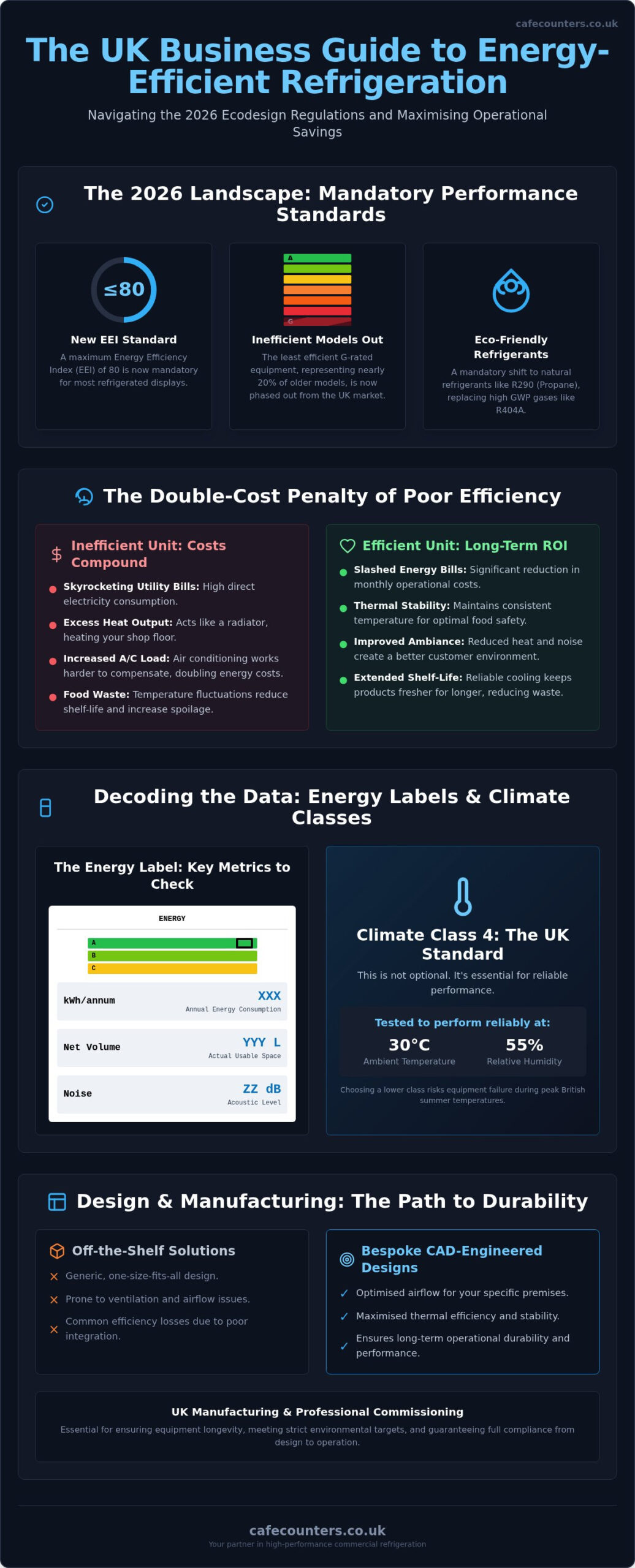
The 2026 commercial cooling landscape is defined by a shift from voluntary efficiency to mandatory performance. Energy efficient refrigerated display counters UK operators select now must face the strictest Energy Efficiency Index (EEI) targets in the industry’s history. As of late 2023, the maximum EEI for most refrigerated displays is 80, which has effectively removed the bottom tier of inefficient G-rated equipment from the market. This regulatory tightening isn’t just a hurdle; it’s a necessary response to the UK’s commitment to net-zero targets and the reality of high electricity unit costs.
Modern equipment relies on advanced energy efficient refrigerated display counters UK businesses use to maintain thermal stability while reducing carbon footprints. A major part of this evolution involves the transition to natural refrigerants. R290 (propane) has become the gold standard, replacing older, high-GWP gases like R404A. This shift aligns with the UK’s service ban on virgin HFCs with a Global Warming Potential of 2,500 or more, ensuring that your equipment remains serviceable and compliant for the long term. Understanding the underlying principles of refrigeration is essential for choosing hardware that manages heat exchange effectively without wasting power.
The Hidden Costs of Inefficient Cooling
Inefficient units don’t just consume more power; they act as radiators. A compressor that overworks to maintain temperature dumps excess heat directly onto your shop floor. This forces your air conditioning systems to work harder, creating a double-cost penalty on your monthly utility bills. Furthermore, poor thermal insulation leads to temperature fluctuations. These micro-climates inside a cabinet can significantly reduce the shelf-life of delicate patisserie or fresh deli items, leading to increased food waste and lost revenue. Reliable cooling keeps your products fresh and your ambient environment comfortable for customers.
UK Regulatory Compliance and Sustainability
The Office for Product Safety and Standards (OPSS) acts as the market surveillance authority, ensuring all equipment meets the Energy Related Products (ErP) directive. Choosing compliant hardware is no longer optional. It’s a fundamental requirement for avoiding future compliance penalties. Beyond the legalities, high-performance displays contribute directly to a brand’s green credentials. As the UK hospitality sector moves toward more transparent sustainability reporting, having A-rated refrigeration provides a measurable data point for your carbon reduction targets. It shows your clients that you value quality and environmental responsibility as much as you value the food you serve.
Understanding Ratings: Energy Labels and Climate Classes
Selecting energy efficient refrigerated display counters UK operators can rely on requires looking beyond the bold letter on the sticker. While the A to G scale provides a quick visual reference, the true value lies in the data behind the label. Since the 2023 regulatory updates, the least efficient G-rated models have been phased out, meaning the current market is more competitive than ever. An A-rated unit represents the pinnacle of engineering, but its performance is always tied to how it handles the specific heat and humidity of your shop floor.
Decoding the Energy Label
The most critical figure on any label is the annual energy consumption, measured in kWh/annum. This number allows you to calculate a realistic return on investment by comparing the upfront cost against long-term running expenses. When reviewing these figures, check the UK Government’s Energy Technology List to verify which models meet the highest standards. You should also distinguish between Gross and Net volume; efficiency ratings are calculated on Net volume, which is the actual usable space for your products. For customer-facing areas, don’t overlook noise level ratings, as a loud compressor can disrupt the artisanal atmosphere of a high-end cafe.
Why Climate Class 4 and 5 Matter
A common pitfall is choosing a refrigerator commercial unit based solely on its energy rating without checking its Climate Class. Climate Class 4 is the industry standard for most UK environments, tested at 30°C and 55% relative humidity. However, if your display is positioned near a busy kitchen or an oven, you likely need a Climate Class 5 unit, which is engineered to perform at 40°C. A “cheap” A-rated unit designed only for Climate Class 3 will struggle in professional heat, leading to overworked compressors and premature failure. It’s a false economy that leads to higher bills and spoiled stock.
Modern energy efficient refrigerated display counters UK manufacturers produce now include LED lighting and high-efficiency fans as standard. These components generate less heat than traditional alternatives, reducing the overall cooling load on the system. If you’re planning a new layout, choosing the right technical specification is the first step toward a durable, cost-effective installation. You can explore our full range of professional display solutions to find the perfect match for your specific climate needs.
Bespoke vs. Off-the-Shelf: Designing for Thermal Efficiency
Many business owners view refrigeration as a standalone purchase, yet true operational efficiency is often lost in the gap between the appliance and the counter structure. When selecting energy efficient refrigerated display counters UK retailers should consider how the unit interacts with its surroundings. Off-the-shelf models are designed for open spaces; however, when they’re encased in bespoke joinery without proper planning, their efficiency plummets. This is where the distinction between a generic box and a precision-engineered system becomes clear.
Bespoke patisserie display counters are designed from the ground up to manage airflow within a specific environment. By choosing an integrated approach, you ensure that the refrigeration system isn’t fighting against the counter’s design. Integrated drop-in units, for example, offer a seamless aesthetic but require meticulous engineering to ensure heat is diverted away from the cooling zone. When these elements are harmonised, the result is a display that maintains a steady temperature while consuming significantly less power than a poorly fitted standalone alternative.
The Role of CAD Modelling in Energy Saving
Precision engineering is the foundation of a high-performance counter. We utilise advanced CAD modelling to predict exactly how heat will move through a custom layout. This process allows us to specify optimal insulation thicknesses and ensure airtight seals that prevent cold air from escaping. It’s particularly vital when designing counters that feature both heated gantries and refrigerated zones. By planning the “hot side” and “cold side” during the design phase, we prevent thermal transfer, ensuring your energy efficient refrigerated display counters UK don’t have to work twice as hard to compensate for a nearby heat source.
Ventilation: The Silent Efficiency Killer
Restricted airflow around a condenser is one of the most common causes of equipment failure and high energy bills. The Carbon Trust’s refrigeration guide notes that even a small obstruction can lead to a 20 percent increase in energy use. Our bespoke designs incorporate dedicated intake and exhaust paths, ensuring the refrigeration system breathes easily even in tight UK cafe footprints. For many projects, we recommend front-breathing units. These allow for tighter integration into cabinetry without sacrificing the airflow needed to keep the compressor running at peak efficiency. This methodical approach to ventilation protects your investment and keeps your utility bills predictable.
Key Features of High-Efficiency Food Displays
The technical hardware within a unit determines whether it simply meets regulatory minimums or provides a genuine competitive advantage. Choosing high-performance energy efficient refrigerated display counters UK operators rely on involves inspecting the internal components that manage thermal retention. While external aesthetics draw the customer’s eye, the engineering beneath the surface, such as high-density polyurethane insulation, dictates the long-term running costs. UK-manufactured units often excel here by using superior injection techniques that ensure no “voids” exist in the foam, preventing the thermal leakage common in cheaper, mass-produced imports.
Precision temperature management is another hallmark of 2026 technology. Modern displays now utilise intelligent digital controllers that go beyond simple thermostats. These systems monitor ambient conditions and adjust compressor cycles in real-time, ensuring the unit only draws power when absolutely necessary. This level of control is essential for maintaining food safety while minimising the wear and tear on the cooling system, ultimately extending the equipment’s lifespan.
Glazing and Insulation Standards
Triple glazing has rapidly become the benchmark for high-end deli display counters. By adding a third layer of tempered glass, manufacturers create two insulating gas barriers that significantly reduce the transfer of heat from the shop floor into the cabinet. This is complemented by the use of thermal breaks in stainless steel fabrication. A thermal break is a non-conductive material placed within the metal frame to prevent “sweating” and energy loss. When combined with high-quality, replaceable door gaskets, these features ensure a perfect seal that stands up to thousands of daily openings in a busy commercial environment.
Open Front vs. Glass Doors: The Efficiency Debate
The choice between open-front refrigerated grab and go display units and glass-fronted models often comes down to balancing accessibility with operational costs. Open units are designed for high-volume impulse buys, but they naturally lose more cold air. To mitigate this, modern merchandisers employ high-efficiency air curtains. These precision-engineered fans create a laminar flow of cold air across the front of the unit, acting as an invisible barrier. For non-trading hours, the use of night blinds is essential; they can reduce energy consumption by up to 20% by sealing the unit when customer access isn’t required.
Identifying the right balance of features requires a methodical approach to your specific site needs. If you are ready to upgrade your shop floor with the latest technology, you can view our full range of British-made displays to see these high-efficiency features in action.
The Expert Partner: From UK Manufacture to Commissioning
Investing in high-performance equipment is a significant step toward sustainability, but hardware alone doesn’t guarantee results. To truly realise the benefits of energy efficient refrigerated display counters UK businesses require a partner who manages the entire lifecycle of the project. From the initial site survey to the final commissioning, every stage must be handled with technical precision. This end-to-end approach ensures that your equipment isn’t just a standalone appliance, but a perfectly integrated component of your operational workflow.
Professional site surveys are the first line of defence against energy waste. A seasoned expert identifies potential heat traps, such as proximity to ovens or poor ventilation zones, before the design is even finalised. By positioning your display strategically, you prevent the cooling system from fighting an uphill battle against ambient temperatures. This methodical planning is what separates a standard retail fit-out from a high-efficiency commercial environment.
The Advantage of British Manufacturing
Buying from a UK-based manufacturer offers more than just regional pride; it provides total quality control over every component. Shorter supply chains allow us to specify high-grade UK parts that are engineered for local climate classes. Because we handle our own production, we can implement bespoke fabrication techniques that mass-produced imports simply cannot match. This includes using thicker high-density insulation and more robust stainless steel frames that maintain structural integrity over decades. Should you ever need assistance, UK-based after-sales support ensures that peak efficiency is maintained through expert maintenance rather than generic repairs.
Professional Installation and Commissioning
The first hour of a refrigerator’s life on your shop floor is its most critical. Commissioning is the meticulous process of setting up the unit for its specific environment. It involves more than just plugging it in. Our engineers perform precise levelling, gas pressure checks, and intelligent controller calibration to ensure the system operates at its design equilibrium. DIY or delivery-only setups often skip these vital steps, leading to “short-cycling” compressors, premature component failure, and unnecessarily high electricity bills.
Reliability is built through this professional rigour. Once your energy efficient refrigerated display counters UK are commissioned, regular maintenance contracts act as a safeguard against efficiency creep. Over time, dust on condensers or slightly worn gaskets can cause energy consumption to rise unnoticed. A structured service plan identifies these minor issues before they become costly repairs, ensuring your long-term ROI remains secure and your utility bills stay low. Choosing an expert partner means choosing a steady, reliable hand for the life of your business.
Securing Your Operational Future with Precision Cooling
Navigating the 2026 regulatory landscape requires more than just a new appliance; it demands a methodical approach to design and integration. By prioritising energy efficient refrigerated display counters UK businesses can transform a standard utility cost into a measurable competitive advantage. You’ve seen how the synergy between A-rated hardware and bespoke CAD-driven counter design eliminates the thermal leakage that often plagues off-the-shelf installations. Success in today’s market depends on aligning your equipment with specific UK climate classes and ensuring every unit is professionally commissioned for its unique environment.
Since 1991, we’ve acted as a steady, reliable hand for commercial projects across the country. Our advanced CAD design process and internal UK manufacturing facilities allow us to bring your vision to life with total technical competence. Whether you’re planning a new patisserie display or a high-volume grab-and-go area, we provide the end-to-end expertise required to lower your bills and meet sustainability targets. Take the first step toward a more efficient shop floor today. Request a Professional Site Survey for Your Bespoke Counter Project and let’s build a durable, high-performance space together.
Frequently Asked Questions
Are A-rated commercial refrigerators worth the extra upfront cost?
Yes, A-rated units provide a significant return on investment despite the higher initial purchase price. In the UK, where electricity unit costs remain volatile, the reduction in monthly overheads often offsets the price difference within the first few years. These energy efficient refrigerated display counters UK utilize superior compressors and higher-density insulation, which means they reach target temperatures faster. It’s a choice that favors long-term operational stability over short-term savings.
What is the most energy-efficient type of food display for a cafe?
Glass-fronted cabinets with triple glazing are the most energy efficient refrigerated display counters UK retailers can install. These units create a robust thermal barrier that prevents cold air from escaping and heat from entering. While open-front designs are popular for convenience, a closed-door system reduces the cooling load on the compressor. This leads to lower utility bills and less heat being dumped back into your customer-facing areas.
How does ambient temperature affect my commercial fridge’s energy use?
Ambient temperature has a direct impact on how hard your cooling system must work. If a fridge is placed in a hot environment, such as next to a coffee machine or in direct sunlight, the compressor must run more frequently to maintain food-safe temperatures. This constant cycling increases electricity use and shortens the lifespan of the equipment. Strategic placement during the design phase is essential for ensuring your refrigeration remains efficient.
Can I convert my old display counter to be more energy-efficient?
Retrofitting older units is rarely a viable long-term strategy for energy efficiency. While you can replace worn door gaskets or add night blinds, the underlying compressor technology and insulation levels remain outdated. Modern 2026 standards require a level of thermal performance that older frames simply cannot meet. Investing in new, high-performance equipment usually provides a better return through reduced energy bills and improved reliability compared to patching up old hardware.
What is a Climate Class and why does it matter in the UK?
Climate Class is a rating that specifies the maximum ambient temperature and humidity a refrigerator can operate in effectively. In the UK, Class 4 (30°C and 55% RH) is the standard for most retail environments. If your equipment is positioned near an oven or in a high-heat kitchen, you must specify a Class 5 unit (40°C). Selecting the wrong class leads to overworked compressors and significantly higher energy consumption.
Do open-front grab-and-go fridges use significantly more power?
Open-front units do consume more power because they lack a physical thermal barrier. However, modern designs use high-efficiency air curtains to create an invisible seal of laminar airflow. To manage costs, we recommend using night blinds during non-trading hours, which can significantly reduce the energy load. While they are less efficient than glass-door models, their role in driving impulse sales often justifies the operational trade-off for many busy UK cafes.
How often should I clean my condenser coils to maintain efficiency?
You should clean your condenser coils at least once every month. Dust and debris act as an insulating blanket, forcing the compressor to run hotter and longer to achieve the same cooling effect. Reports from organizations like the Carbon Trust indicate that restricted airflow can increase energy consumption by up to 20%. Regular cleaning is a simple, no-cost way to maintain peak efficiency and prevent premature component failure.
What refrigerants are the most eco-friendly and efficient in 2026?
Natural refrigerants like R290 (propane) and R600a are the most eco-friendly and efficient options available in 2026. These gases have a near-zero Global Warming Potential and offer excellent heat transfer properties. They have largely replaced older HFCs like R404A, which are subject to strict UK service bans. Switching to these modern refrigerants ensures your business remains compliant with environmental regulations while benefiting from more efficient cooling cycles.