
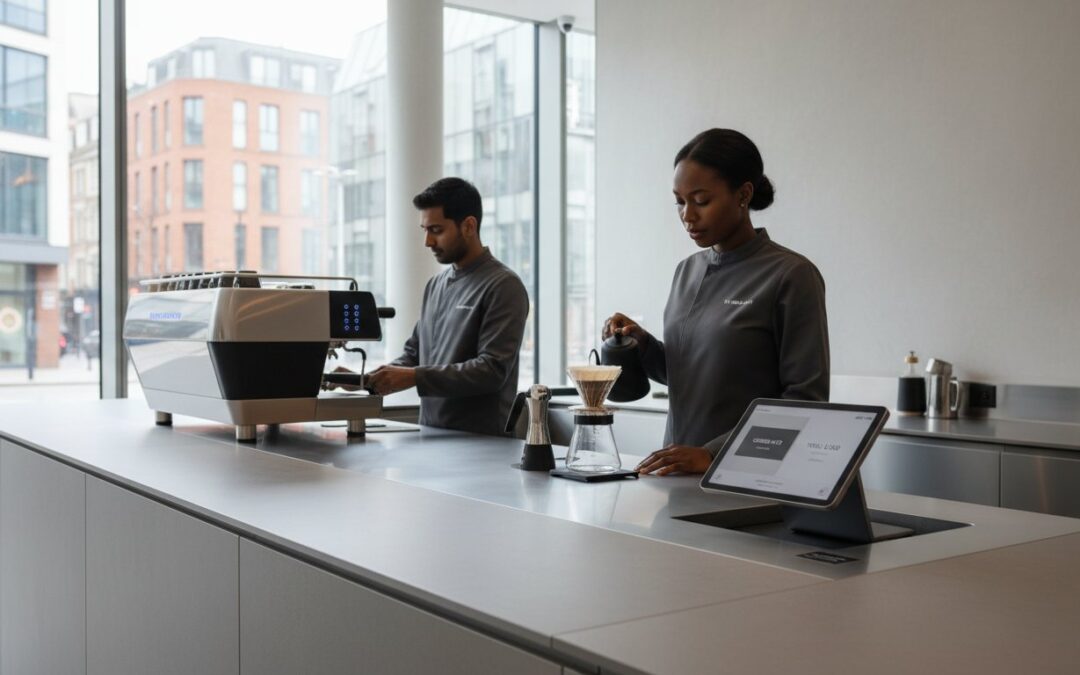
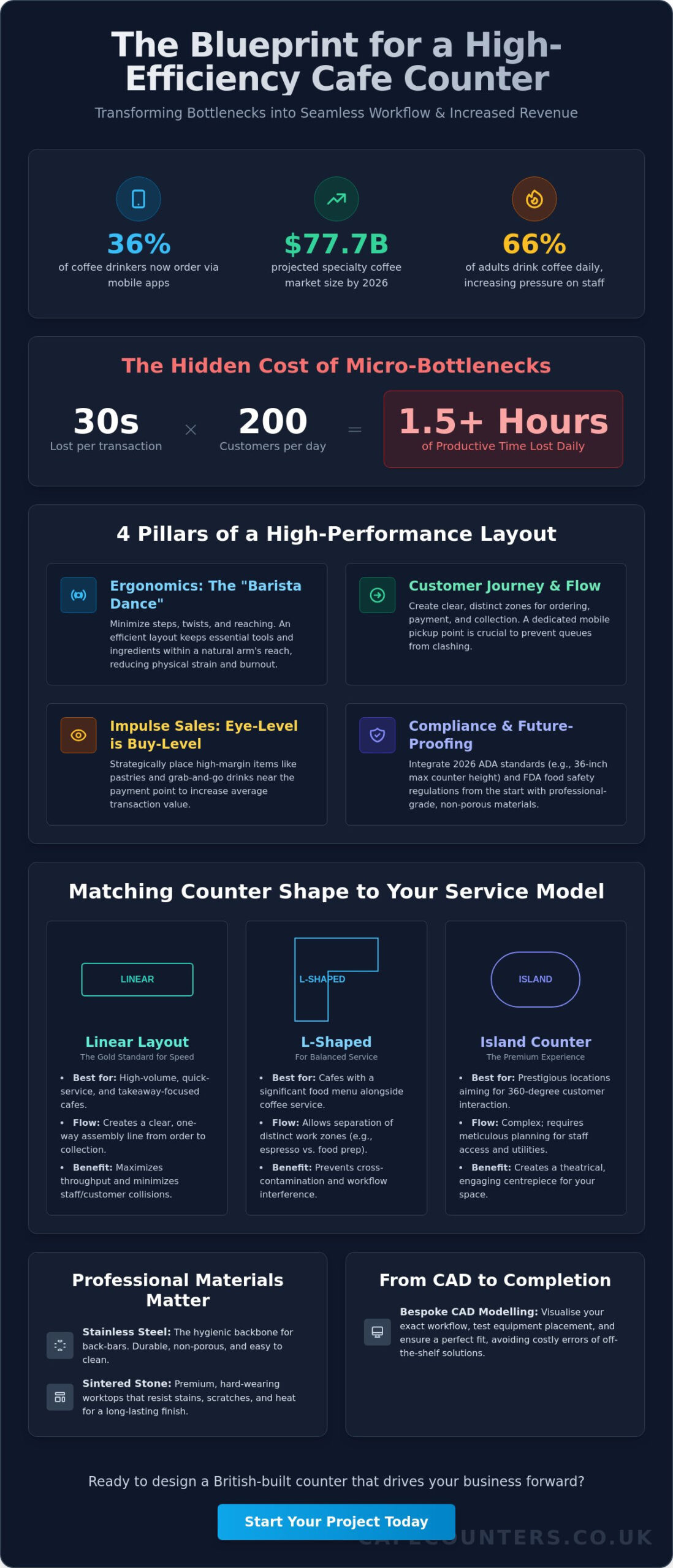
With 36% of coffee drinkers now ordering via mobile apps and the specialty coffee market projected to reach $77.7 billion in 2026, your counter is no longer just a piece of furniture. It’s a high-stakes logistics hub. You likely recognize the daily strain of peak-hour bottlenecks where staff clash in cramped quarters and frustrated customers face long queues. It’s a common challenge that limits your revenue and drains your team’s energy.
Designing an optimal cafe counter layout for efficiency transforms these friction points into a seamless, high-performance workflow. We’ll show you how to eliminate physical bottlenecks, boost staff productivity, and increase impulse sales through strategic merchandising. You’ll discover how to integrate 2026 ADA accessibility standards, such as the 36-inch maximum height for sales counters, alongside the latest FDA food safety updates into a robust, British-built design. We’ll explore everything from precision equipment placement to the long-term value of professional materials like sintered stone and stainless steel, providing a clear path from initial concept to a finished, physical space.
Key Takeaways
- Identify and eliminate the micro-bottlenecks that drain productivity and cost your business valuable minutes during every peak-hour transaction.
- Implement an ergonomic cafe counter layout for efficiency by applying the Barista Dance principle to reduce physical strain and minimize unnecessary movement.
- Increase your average transaction value by mastering the Eye-Level is Buy-Level rule for high-margin impulse items near the point of payment.
- Select the ideal counter shape and back-bar configuration to support your specific service model, from high-speed takeaway to complex dine-in menus.
- Understand why bespoke CAD modelling is essential for visualising your workspace and ensuring a seamless, professional installation that avoids the pitfalls of off-the-shelf solutions.
Why Your Cafe Counter Layout is the Engine of Operational Efficiency
The counter is the engine room of your hospitality business. While aesthetics draw customers through the door, the physical configuration of the workspace determines whether they return. A poorly conceived cafe counter layout for efficiency creates micro-bottlenecks; those small, repetitive delays where a barista must wait for a colleague to move or reach across a high-traffic path to grab a lid. These frictions don’t just slow down service. They actively erode your profit margins. When a transaction takes 30 seconds longer than necessary, and you serve 200 customers a day, you’ve lost over an hour and a half of productive time.
Operational success begins with the ergonomics of the workspace. We draw on decades of ergonomic research in kitchen design to ensure that every cupboard, fridge, and prep station is positioned to support a natural flow. This focus on functionality is a primary driver of staff retention. In an industry where 66% of adults drink coffee daily, the pressure on teams is immense. A workspace that minimizes physical strain and eliminates clashing zones keeps your team focused and reduces burnout. It’s why we insist on planning the counter layout as a functional priority before considering seating or decorative finishes.
Defining the Customer Journey in Your Space
A successful layout guides the customer instinctively. From the moment they enter, visual cues must distinguish the order point from the collection zone. Without clear separation, you risk the dead zone effect, where queuing customers mingle with those waiting for drinks, blocking access to high-margin retail displays. By 2026, with mobile ordering accounting for 36% of transactions, your layout must include a dedicated, frictionless pickup point that doesn’t interfere with the traditional walk-in queue. This ensures a seamless experience for both the digital-first customer and the casual visitor.
The Impact of Counter Shape on Throughput
The geometry of your counter dictates your service capacity and how your team interacts with the public. As a bespoke manufacturer with deep British roots, we’ve found that the following configurations offer the best results for specific service models:
- Linear layouts: These are the gold standard for high-volume, quick-service sites. They facilitate a one-way flow that moves customers rapidly from order to collection.
- L-Shaped configurations: This shape is ideal for sites that balance coffee with a significant food menu. It allows you to separate the high-steam environment of the espresso machine from delicate patisserie or sandwich prep.
- Island counters: While these offer 360-degree customer interaction and a prestigious feel, they require meticulous planning to ensure staff have dedicated utility access without crossing customer paths.
Strategic Counter Shapes: Matching Layout to Your Service Model
Selecting the correct silhouette for your workspace is a decision that dictates your daily throughput capacity. Your choice should reflect the complexity of your menu and the volume of staff you employ. A high-speed espresso bar requires a different architectural approach than a full-service deli. By utilizing bespoke joinery, you can navigate the architectural quirks of historic UK buildings, turning awkward alcoves into functional storage or prep zones. This level of customization ensures that no space is wasted.
The front counter serves as the stage, but the back-bar is the support system. Integrating stainless steel back-bar units provides a durable, non-porous surface that meets 2026 food safety standards while keeping milk, syrups, and cleaning supplies within an ergonomic reach. This setup supports a seamless cafe counter layout for efficiency by ensuring the barista never has to leave their station to restock. Reliability matters here. Professional-grade materials prevent the warping and hygiene issues common with domestic-standard fittings.
The Linear Flow: The Gold Standard for Speed
The linear layout operates like a precision assembly line, moving the customer through a logical sequence. It starts with visual temptation. Placing refrigerated grab and go display units at the very beginning of the journey captures impulse sales before the customer even reaches the POS. This arrangement reduces staff movement because each team member occupies a fixed station. The Point of Sale should sit at the first third of the counter, allowing the remaining space for drink preparation and collection. This prevents the queue from doubling back on itself, a common cause of congestion in high-footfall environments.
L-Shaped and U-Shaped Layouts for Multi-Service Cafes
For businesses that offer both specialty coffee and a diverse food menu, L-shaped or U-shaped counters provide essential zoning. These shapes allow you to separate the “wet” station, where steam and espresso machines operate, from the “dry” station used for pastries and sandwiches. This separation prevents cross-contamination. It also ensures that the heat from coffee equipment doesn’t affect chilled food displays. Proper zoning is vital for maintaining food quality and staff comfort.
To avoid the “corner trap”, where two staff members collide while reaching for the same under-counter fridge, we design these junctions with extra clearance or dedicated storage for low-frequency items. Precision planning eliminates these friction points. If you are planning a complex renovation, our team can help you design a bespoke counter that maximizes every square inch of your floorplan.
Ergonomic Design: Minimising Steps and Maximising Staff Output
Ergonomic design in a commercial setting is the science of movement. In the high-pressure environment of a specialty coffee shop, we focus on the “Barista Dance”, a concept where the workspace is designed to facilitate minimal pivots and steps. A superior cafe counter layout for efficiency ensures that a barista can complete a full drink cycle, from grinding to pouring, without taking more than two steps in any direction. This level of precision reduces physical fatigue and allows your team to maintain a high service tempo during peak hours without sacrificing quality.
Height is a critical factor that many off-the-shelf solutions overlook. While 2026 ADA standards mandate a 34-inch maximum height for service counters to ensure customer accessibility, the internal work surfaces must be calibrated to the specific equipment they hold. For example, an espresso machine should sit at a height that allows the barista to engage the portafilter without shrugging their shoulders or bending awkwardly. We achieve this seamless integration by utilising drop-in refrigerated display units. These systems sit flush with the worktop, creating a continuous, level surface that allows staff to slide milk jugs or plates across the counter rather than lifting them, which significantly reduces repetitive strain injuries.
The Golden Triangle of Coffee Service
Efficiency relies on the strategic positioning of the espresso machine, the grinder, and the sink, often referred to as the golden triangle. These three elements must be close enough to allow a single operator to manage them during quiet periods, yet spaced sufficiently to allow a second person to assist during rushes without crossing paths. Integrated waste management is equally vital. By installing knock-boxes with direct chutes to under-counter bins, you keep the work surface clear of coffee grounds and debris, maintaining a professional appearance and a hygienic environment that aligns with the latest 2026 Food Code updates.
Integrating Technical Equipment Seamlessly
Modern counters are complex technical assemblies. We use precision CAD modelling to ensure a perfect fit for high-performance deli counters and refrigeration units. This process is essential for managing ventilation. Without dedicated airflow paths, integrated fridges can overheat, leading to equipment failure and food safety risks. Furthermore, our bespoke manufacturing process includes hidden cable management systems. By routing power and data through internal cavities, we keep the customer-facing side prestigious and clutter-free, ensuring that the focus remains on your products and not on a tangle of wires.
Balancing Throughput and Impulse Sales: The Customer Journey
A precision-engineered cafe counter layout for efficiency does more than move people. It sells to them. Revenue is the ultimate metric of a successful design, and this requires a delicate balance between rapid throughput and the psychology of impulse purchasing. We apply the “Eye-Level is Buy-Level” rule to every bespoke build, ensuring that high-margin items like artisanal patisserie and seasonal treats are positioned exactly where the customer’s gaze naturally rests while they wait to order. By the time they reach the payment point, the decision to add a secondary item should feel instinctive rather than forced.
To capture the lucrative morning and lunch trade, many operators are now integrating Vision Heated Counters into their primary service line. These units maintain precise temperatures for hot grab and go items, satisfying the 2026 demand for high-quality, convenient meal options. Strategic placement is vital here. Positioning heated displays just before the Point of Sale encourages last-minute additions to a coffee order, effectively increasing your average transaction value without requiring additional staff intervention.
Visual Merchandising with High-End Displays
The technical specifications of your display units directly impact their “crave-ability.” We use high-clarity, low-iron glass in our patisserie displays to eliminate the greenish tint found in standard glass, ensuring that the natural colours of your products are vivid and appealing. Lighting is another critical tool. We employ specialized LED arrays that enhance food textures and tones without emitting heat, which would otherwise compromise the shelf life of delicate creams or chocolates. While open-front displays can marginally increase service speed in high-volume sites, closed-front units often project a more prestigious, hygienic image that justifies a premium price point.
Queue Management and the “Waiting Experience”
With 36% of coffee drinkers now utilizing mobile apps, your layout must accommodate different types of waiting. A common mistake is allowing the “collection point” to overlap with the “ordering point,” creating a chaotic environment that discourages browsing. We design dedicated, leaner spaces for takeaway customers that are physically separated from the main transaction zone. This separation keeps the counter front clear for secondary merchandising, such as retail coffee bags or branded accessories. If you want to maximise your floorplan’s revenue potential, view our range of bespoke merchandising solutions today to see how we can transform your customer journey.
From CAD to Completion: Implementing a High-Performance Bespoke Counter
Off-the-shelf counters often buckle under the relentless pressure of high-footfall UK retail environments. These mass-produced units aren’t designed for the 200+ daily transactions common in modern specialty coffee shops. A truly effective cafe counter layout for efficiency requires a precision-engineered shell capable of housing complex technical systems while maintaining structural integrity over years of heavy use. We use advanced CAD modelling to create a digital twin of your workspace. This allows us to stress-test the workflow and equipment placement before a single piece of timber is cut, ensuring that the physical reality matches your operational vision perfectly.
The Precision of In-House Manufacturing
Our British roots serve as a signature of quality control and authenticity. By manufacturing every component in-house, we maintain total authority over the build process. This bespoke engineering allows us to integrate technical features like heated gantries and cooling zones directly into the counter’s structure, a feat impossible with modular furniture. We select materials such as sintered stone or stainless steel to combine stunning aesthetics with robust functionality. Every unit undergoes rigorous factory testing in our UK facility before installation. This ensures that your counter can withstand the physical demands of the hospitality sector without warping or degrading.
Turnkey Installation and Commissioning
The transition from a construction site to an operational cafe is the most critical phase of any project. Our Concept to Completion journey includes a professional turnkey installation designed to alleviate the stress of a commercial build. We understand that downtime is costly. Our team manages the on-site integration of all technical units, ensuring that plumbing, power, and data connections are seamless and compliant from day one. We don’t just deliver furniture; we commission a high-performance tool tailored specifically to your business needs.
Our final checklist ensures that your cafe counter layout for efficiency is ready for the rigours of peak-hour service. We verify that every drawer, fridge, and waste chute is positioned to support your team’s workflow as planned in the design stage. This methodical approach transforms a broad concept into a finished physical space that projects total competence and reliability. By choosing a partner who manages the entire process from initial idea to final manufacture, you ensure a reliable, professional finish that stands the test of time.
Investing in Operational Longevity
Optimising your cafe counter layout for efficiency is the most direct way to future-proof your business against the increasing demands of the hospitality market. By moving away from off-the-shelf compromises and embracing bespoke, ergonomic design, you transform your workspace into a high-performance tool. We’ve discussed how the combination of strategic equipment zoning, ADA-compliant heights, and precision-engineered merchandising can eliminate the friction that drains your profit margins and exhausts your team.
TFSE Products Ltd has championed British manufacturing since 1991, providing the technical expertise required to handle complex commercial fit-outs with total competence. Our advanced CAD modelling ensures total accuracy during the design phase, while our Concept to Completion turnkey service guarantees a seamless transition from an initial idea to a finished physical space. It’s time to replace operational stress with the confidence that comes from a robust, professionally installed service point that’s built to last.
Take the first step toward a more productive and profitable environment. Book a Bespoke Counter Consultation with TFSE Products Ltd today and let’s build a workspace that reflects the prestige of your brand.
Frequently Asked Questions
What is the best layout for a small coffee shop counter?
A linear layout is the most effective configuration for small spaces because it facilitates a one way flow for both staff and customers. By arranging the POS, espresso machine, and collection point in a single line, you can operate within a footprint as narrow as 2.5 metres. This setup minimises staff cross over and ensures that the 35% of specialty coffee drinkers who consume their beverages away from home can move through the shop quickly.
How much space should be left behind a cafe counter for staff?
A minimum clearance of 900mm is required for a single operator, but 1200mm is the professional standard for multi staff environments. This width allows two team members to pass each other without collision, which is essential for maintaining a high service tempo during peak hours. Providing adequate workspace is a key component of a cafe counter layout for efficiency, as it reduces physical friction and supports long term staff well being.
Where should I place my refrigerated grab-and-go unit for maximum sales?
Position your refrigerated display at the beginning of the queue line to capture impulse purchases before the customer reaches the order point. This placement utilises the waiting period as a merchandising opportunity, encouraging customers to browse chilled items while they decide on their drink. Data from early 2026 suggests that visible, accessible displays at the start of the journey can significantly increase average transaction values through last minute additions.
Should the espresso machine face the customer or the back wall?
The espresso machine should face the customer to foster engagement and showcase the craft of the barista. This “front bar” orientation allows the operator to maintain eye contact with the queue, which helps manage the perceived wait time. It also creates a prestigious, transparent environment where the quality of your coffee preparation becomes a central part of the brand experience rather than a hidden process.
How does bespoke counter design improve staff efficiency?
Bespoke design eliminates the micro bottlenecks found in off the shelf furniture by tailoring every millimetre to your specific equipment. We use CAD modelling to ensure that knock boxes, milk fridges, and grinders are positioned within a natural reach, applying the “Barista Dance” principle. This meticulous approach to a cafe counter layout for efficiency ensures that no steps are wasted, allowing your team to serve more customers with less physical fatigue.
What are the most durable materials for a commercial cafe countertop?
Stainless steel and sintered stone are the premier choices for high footfall environments due to their non porous, hygienic properties. According to 2026 data, stainless steel remains a robust investment with installed costs between $70 and $215 per sq. ft., offering unmatched resistance to heat and acidic coffee spills. Sintered stone provides a prestigious aesthetic that mimics natural marble but offers far superior durability against the daily wear of a busy catering site.
How do I integrate a heated display without disrupting the cooling of other units?
Effective integration requires dedicated ventilation channels and thermal breaks built directly into the counter’s internal shell. Our in house manufacturing process allows for precision cut airflow paths that ensure heat from a hot food display is exhausted away from neighbouring refrigerated units. This prevents equipment overwork and ensures that your site remains compliant with the updated 2026 Food Code safety standards for temperature control.
Can a counter layout help reduce customer wait times during peak hours?
Yes, by physically separating the ordering point from the collection zone to prevent congestion. With 36% of customers now using mobile apps for ordering, a dedicated pickup point is essential for maintaining flow. A well planned layout directs walk in traffic toward the POS while allowing digital orders to be collected from a leaner, non intrusive space, effectively doubling your service capacity during the busiest morning rushes.