
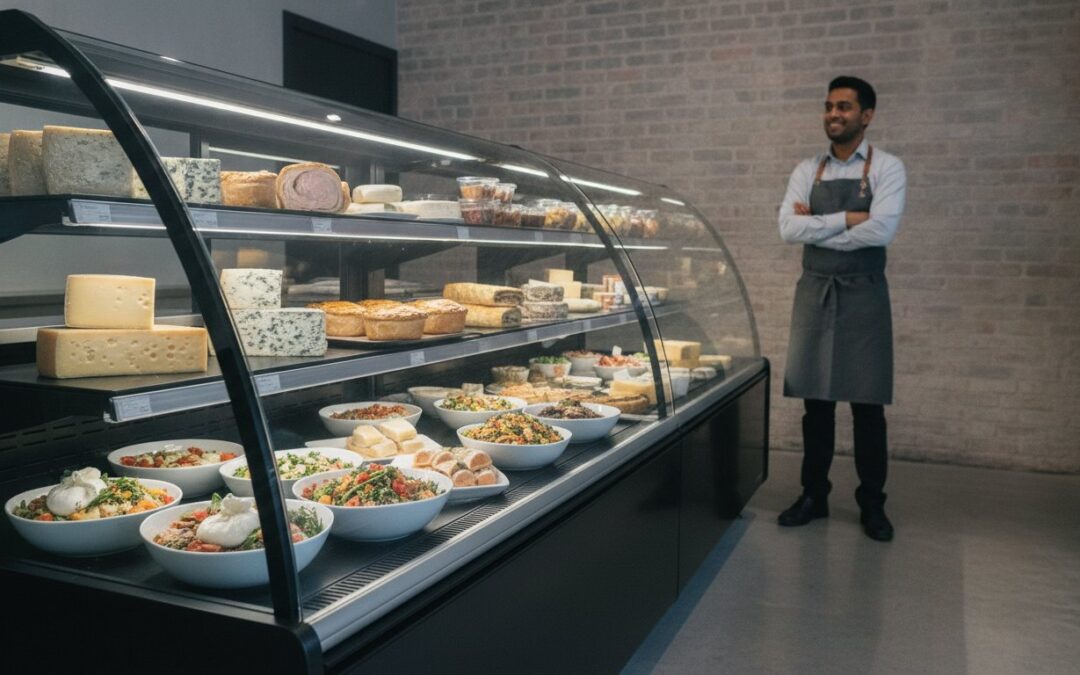
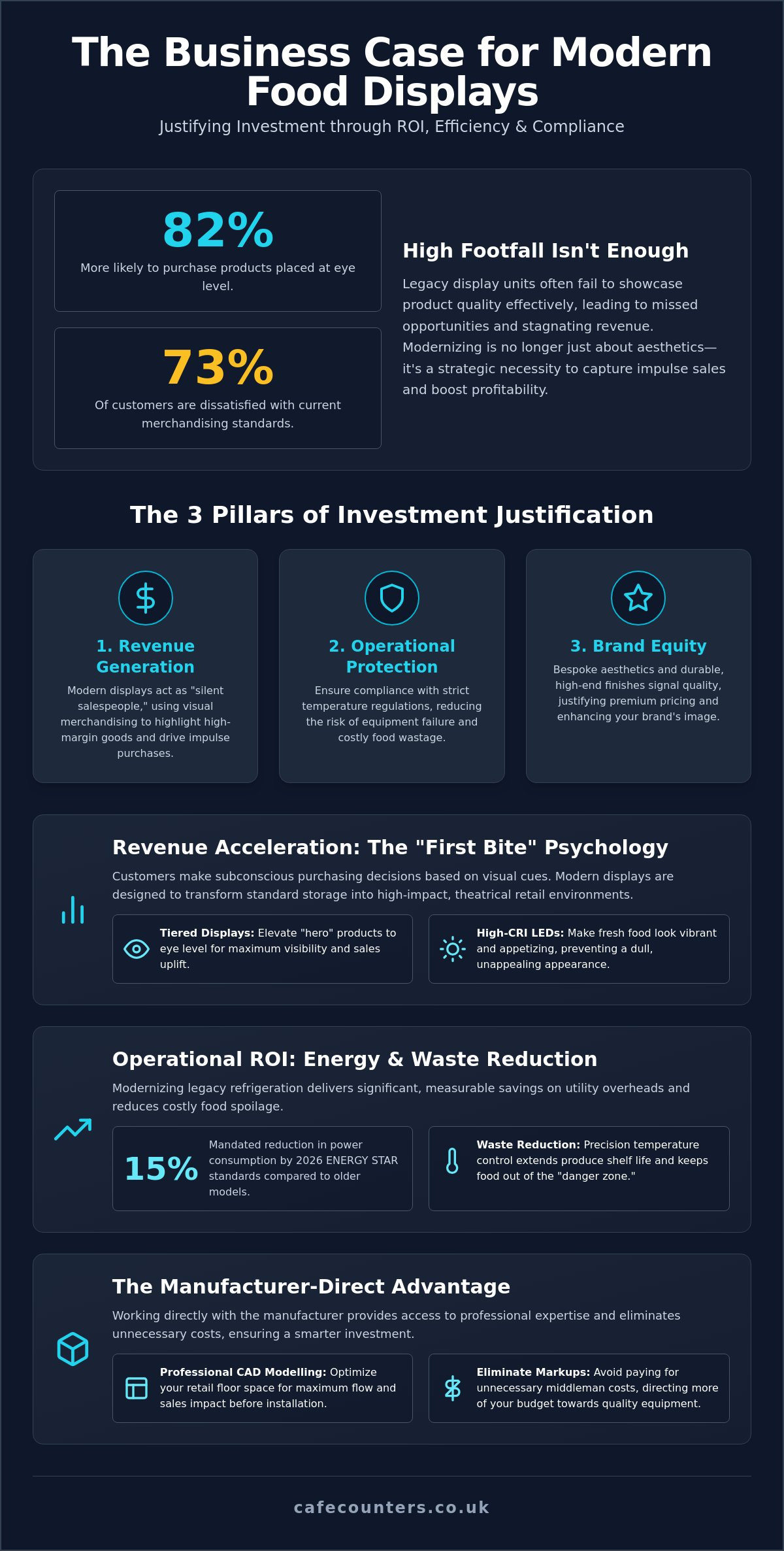
Did you know that 82% of products placed at eye level are significantly more likely to be purchased, yet 73% of customers remain dissatisfied with current visual merchandising standards? For many retailers, high footfall isn’t translating into the expected revenue because legacy units fail to showcase quality effectively. Developing a robust business case for new food display equipment is no longer just about aesthetics; it’s a strategic necessity to capture impulse sales while navigating the 15% reduction in power consumption mandated by 2026 ENERGY STAR standards.
We understand that the pressure of rising operational costs and strict UK food safety compliance can make capital investment feel daunting. You’re likely balancing the need for better temperature control against the reality of thin margins. This article provides a clear framework to justify your investment through measurable ROI and improved operational efficiency. We’ll explore how modernizing your deli counters and grab-and-go displays can reduce food wastage, slash energy bills, and future-proof your business against evolving regulations.
Key Takeaways
- Learn how to construct a robust business case for new food display equipment by balancing initial capital expenditure against projected long-term revenue growth.
- Understand the psychology of the “First Bite” and how tiered display systems transform standard storage into high-impact, theatrical retail environments.
- Identify how modernizing legacy refrigeration can significantly reduce utility overheads and extend produce shelf life through precision temperature control.
- Discover the critical durability and compliance advantages of commercial-grade equipment over domestic-style alternatives for meeting UK food safety standards.
- Explore the manufacturer-direct advantage, utilizing professional CAD modelling to optimize your floor space and eliminate unnecessary middleman markups.
Defining the Business Case for Professional Food Display Equipment
A business case is a strategic document used to justify capital investment through ROI analysis. Developing a robust business case for new food display equipment involves more than just selecting a unit that fits your floor plan; it requires a calculated balance between initial capital expenditure and the projected revenue growth it will stimulate. In the 2026 UK hospitality market, we’ve seen a definitive shift from treating equipment as simple functional storage to embracing “theatrical retail.” This evolution means your counters are no longer just holding food; they’re performing as the primary stage for your culinary craft, designed to engage customers the moment they step through the door. For businesses that require this same level of high-impact visual engagement in portable or temporary settings, a Mobile Light Box offers a modular solution to keep your presentation professional and vibrant.
Successful implementation requires buy-in from multiple stakeholders across the organization. Your CFO focuses on long-term depreciation and energy savings, particularly as 2026 ENERGY STAR standards now mandate a 15% reduction in power consumption compared to older models. Your Head Chef prioritizes the integrity of the produce and ease of access during service, while the Marketing Manager looks for ways to enhance brand visibility. Aligning these perspectives ensures that investments in deli counters or Grab & Go displays support broader business goals, such as capturing the growing off-premise dining market, which is expected to account for 35% of sales by the end of 2026.
The Core Pillars of Investment Justification
Revenue generation stands as the first pillar of your case. By applying proven visual merchandising principles, hero displays act as silent salespeople that highlight high-margin artisanal goods. Operational protection follows closely. Modern systems reduce the risk of catastrophic equipment failure and ensure compliance with strict temperature regulations, protecting your business from the “danger zone” where food must be discarded after four hours. Finally, brand equity is bolstered through bespoke aesthetics. High-end, durable finishes allow you to justify premium pricing by signaling quality to a consumer base where 8 out of 10 shoppers decide based on visual impact.
Setting Benchmarks for Success
To build a persuasive argument, you must establish clear baselines before upgrading your restaurant equipment. Measure current sales data, average basket values, and daily waste percentages over a 30-day period. These metrics become your Key Performance Indicators (KPIs) for the new installation. When you can demonstrate that a tiered patisserie display or a precision salad bar reduces waste by even a small percentage while increasing impulse purchases, the path to a positive ROI becomes undeniable. We’ve found that this methodical approach transforms a daunting purchase into a confident, data-backed strategic move that secures the future of your retail space.
Revenue Acceleration: Quantifying the Sales Impact of Visual Merchandising
Visual appeal is the primary engine of conversion in professional food retail. We often refer to this as the psychology of the “First Bite.” Before a customer ever tastes your product, they’ve already made a subconscious decision based on the visual cues presented at the point of sale. This is why a robust business case for new food display equipment must prioritize visibility and presentation. By utilizing tiered patisserie display counters, you can elevate “Hero” products to eye level. Research indicates that items placed at this height are 82% more likely to be purchased, directly addressing the pain of stagnating sales in high-footfall areas.
Lighting plays a critical role that many operators overlook when evaluating their current setups. High Colour Rendering Index (CRI) LEDs are essential for making fresh food look vibrant and appetizing rather than dull or grey. While aesthetics are vital, the physical construction of these units must also align with rigorous safety standards. Ensuring your equipment meets FDA food equipment regulations regarding non-corrosive materials and accessible surfaces protects your brand’s reputation and your long-term investment. Consider how our professional grab and go displays can be tailored to your specific site requirements to drive immediate results.
Boosting Average Basket Value (ABV)
Increasing the total spend per customer requires thoughtful cross-merchandising and a logical shop flow. Integrated Vision Heated Counters allow you to place warm, savoury items directly alongside chilled accompaniments, encouraging secondary “add-on” purchases. A well-planned CAD layout reduces “analysis paralysis” by guiding the customer through a clear, ergonomic journey. Adding an element of “theatre,” such as finishing a dish behind a bespoke deli counter, builds trust and justifies a premium price point. This strategic approach is a cornerstone of any business case for new food display equipment aiming to maximize unit-level economics.
Capturing the Grab & Go Market
For the time-poor UK commuter, speed is the ultimate currency. Refrigerated grab and go display units with open fronts eliminate the friction of opening doors, allowing for a seamless transition from selection to payment. A well-designed grab-and-go unit can increase impulse sales by up to 30% in high-traffic retail environments. By utilizing vertical space effectively, you can increase product density without needing to expand your physical footprint. This efficiency is vital as 87% of operators anticipate higher labour costs in 2026, making self-service solutions a key part of an operational hedge.
Operational ROI: Energy Efficiency and Waste Reduction
The financial drain of aging equipment is often a silent killer of retail profitability. Many operators overlook the mounting “Hidden Cost” of refrigeration units that have surpassed the decade mark. These legacy systems are significant energy liabilities in 2026, frequently struggling to maintain the thermal stability required for modern food safety. A compelling business case for new food display equipment highlights how precision temperature control prevents the “danger zone” fluctuations that compromise product integrity. We’ve seen that even a 2-degree variance can effectively double the shelf life of delicate produce, transforming a routine equipment check into a vital safeguard for your margins.
Calculating the Energy Savings
Directly comparing the kilowatt-hour consumption of modern high-efficiency units against older models reveals a stark contrast. Modern units are designed to meet increasingly stringent ENERGY STAR efficiency standards, providing a measurable reduction in utility overheads. Incorporating features like night blinds and high-performance glazing ensures that thermal energy remains trapped where it’s needed most. We often recommend leveraging IoT monitoring for proactive maintenance; these smart systems alert you to performance dips before they result in total stock loss. This level of oversight ensures your investment remains an asset rather than a liability on your balance sheet.
Waste Mitigation as a Profit Centre
Reducing daily food waste by just 5% through superior climate control can result in significant annual savings, effectively paying for the equipment over its lifecycle. Our heated gantries are engineered to maintain the precise texture and moisture levels required for hot-held products, ensuring that your last sale of the day is as high-quality as your first. Modern refrigerated counters use R290 natural refrigerants to lower energy costs while maintaining strict temperature stability. This shift toward sustainable technology isn’t just about compliance; it’s a strategic move to future-proof your operation.
Beyond energy and waste, operational ROI includes significant labour savings. We design our units with the daily grind in mind, focusing on features that simplify maintenance:
- Easy-clean surfaces: High-grade stainless steel reduces the time required for deep sanitation.
- Front-loading access: Streamlines the restocking process, allowing staff to focus on customer service.
- Modular components: Simplifies the replacement of wear-and-tear parts without total system downtime.
By choosing high-performance insulation and efficient design, you’re not just protecting your bottom line; you’re actively meeting UK carbon reduction targets. This commitment to durability and efficiency positions your brand as a steady, reliable hand in a complex and competitive market.
Risk Mitigation: Compliance and Brand Protection
Protecting your operation from regulatory scrutiny and brand damage is a central pillar of any business case for new food display equipment. In the UK, meeting Food Standards Agency (FSA) requirements isn’t optional; it’s the foundation of your legal right to trade. While earlier sections focused on revenue and energy, this section addresses the “insurance” value of high-specification units. By investing in professional-grade restaurant equipment, you eliminate the fragility inherent in domestic-style alternatives that aren’t designed for the rigours of a high-volume commercial kitchen. This durability ensures your physical environment consistently matches the premium quality of your menu.
Future-proofing is equally critical as we move through 2026. Planning for upcoming UK regulations on F-gas phase-outs and stricter energy labelling is essential for long-term viability. Investing now in units that already exceed these standards prevents the need for expensive retrofits or premature replacements in the coming years. Developing a robust business case for new food display equipment must account for these hidden risks of failure and non-compliance. It’s a steady, methodical approach to risk that safeguards your capital and your reputation.
Ensuring Long-Term Durability
We prioritize food-grade 304 stainless steel fabrication because it offers the ultimate balance of hygiene and longevity. Unlike porous materials or cheaper alloys, this material withstands aggressive cleaning protocols without degrading over time. Our bespoke UK manufacturing facility provides a distinct advantage through total control over quality and immediate parts availability. This eliminates the weeks of downtime often associated with imported off-the-shelf units. Precision engineering also prevents common issues like condensation and “fogging” in refrigerated displays, which can obscure your products and signal a lack of cleanliness to customers.
The Value of Professional Installation
A successful installation begins long before the equipment arrives on site. Detailed site surveys prevent delivery day disasters and ensure that services like power and drainage are perfectly positioned for your new units. During the commissioning phase, we verify that every unit operates at manufacturer-specified efficiency. This is vital for maintaining the strict temperature logs required by modern inspectors. Integrating drop-in units into a custom counter creates a seamless, easy-to-maintain finish that eliminates “dirt traps” and simplifies daily sanitation. Consult with our team on bespoke serving counters to ensure your next project is built on a foundation of total reliability.
Executing the Business Case: The Manufacturer-Direct Advantage
The final stage of a successful business case for new food display equipment is the transition from data-backed theory to physical installation. Choosing to source directly from a UK manufacturer is a strategic decision that offers immediate financial benefits by eliminating middleman markups. In a landscape where equipment financing rates in mid-2026 range from 5.5% to 25% APR, reducing the base capital expenditure by cutting out distributor commissions is a logical step for any CFO. Beyond the initial purchase price, a direct partnership ensures that the technical expertise required to maintain and optimize your units remains accessible throughout the equipment’s lifecycle.
End-to-end project management acts as a conceptual anchor for our process, effectively reducing the “stress tax” associated with coordinating multiple contractors. When your manufacturer also handles the design and installation, the risk of communication breakdowns—which often lead to expensive delays—is virtually eliminated. This integrated approach ensures that the durability and quality control we maintain in our internal production facilities are carried through to the final fit-out. It’s a methodical, reliable way to bring a complex retail vision to life without the typical friction of third-party procurement. For enterprises that require this same level of reliability across their digital infrastructure, Torch Services provides managed technology solutions that simplify complex operational environments.
The Power of Bespoke CAD Design
A significant portion of the ROI in your business case for new food display equipment comes from space optimization. We use professional CAD modelling to identify and eliminate “dead zones” in your layout, ensuring that every square inch of your floor plan contributes to revenue. For example, tailoring the depth of your deli counters to the specific ergonomic requirements of your staff can boost productivity during peak service hours, reducing customer wait times. This level of high-end customization allows you to create a “Signature Look” that off-the-shelf units simply cannot achieve. In a market where 73% of consumers are dissatisfied with current merchandising standards, standing out with a bespoke, artisanal aesthetic is a powerful competitive advantage.
Next Steps: From Business Case to Installation
Moving from a strategic document to a finished retail space requires a steady, methodical progression. We recommend starting with a comprehensive site survey to validate the technical feasibility of your proposed layout. This step ensures that drainage, ventilation, and power requirements are fully accounted for before any manufacturing begins. Preparing a phased implementation plan is also essential; this minimizes business disruption by allowing you to upgrade your equipment in stages rather than facing a total operational shutdown. By following this proven, professional process, you ensure that your investment delivers the efficiency and visual impact promised in your initial projections.
Ready to build your business case? Contact TFSE Products for a professional site survey and CAD consultation to see how our bespoke engineering can transform your retail environment.
Securing Your Strategic Advantage for 2026
Investing in your retail space is a deliberate act of future-proofing that transforms your service area into a high-performance sales engine. We’ve explored how a data-backed business case for new food display equipment balances initial expenditure against measurable gains in impulse sales, reduced food waste, and significant utility savings. By prioritizing high-efficiency refrigerated and heated solutions, you’re not just purchasing a counter; you’re securing a robust operational hedge against the rising costs of the modern market.
As specialists in UK-based manufacturing since 1991, we understand that durability and precision are the foundations of long-term profit. Our advanced CAD modelling ensures every square inch of your floor space is optimized for maximum customer flow and conversion. We invite you to take the next step in your journey from vision to physical reality with a partner that values artisanal quality and technical excellence. Request a Professional Site Survey & CAD Consultation to begin your transformation today. Your vision for a more efficient, profitable retail environment is within reach, and we’re ready to help you build it.
Frequently Asked Questions
What is the average ROI period for new commercial food display equipment?
The typical ROI period for professional installations often falls between 12 and 24 months. Developing a robust business case for new food display equipment involves balancing these initial costs against the reduction in monthly energy bills and projected revenue growth. By replacing inefficient legacy units, you’re investing in a system that pays for itself through operational savings and increased transaction values.
How much can modern energy-efficient displays save on monthly utility bills?
Modern energy-efficient displays can reduce your monthly utility bills by approximately 15% through the use of advanced compressors and high-performance glazing. These units are engineered to meet the strict 2026 ENERGY STAR standards, which prioritize lower power consumption without sacrificing cooling capacity. For businesses running multiple units, these incremental monthly savings represent a substantial reduction in overheads and a significant boost to your bottom line.
Is it better to buy off-the-shelf or bespoke counters for a new cafe?
Bespoke counters are the preferred choice for operators who need to maximize their footprint or integrate with specific architectural features. While off-the-shelf units are readily available, they rarely offer the same level of durability or space optimization. A custom-engineered solution ensures that your physical environment perfectly reflects your brand’s artisanal pride while providing a seamless, professional finish that standard models cannot match.
How do new food display units help in reducing food wastage?
Modern units help reduce food wastage by maintaining precise temperature stability, which can significantly extend the shelf life of fresh produce. Advanced sensors and high-performance insulation prevent the heat ingress that typically causes spoilage in older displays. This precision ensures that your inventory remains at peak quality for longer, directly improving your margins by reducing the volume of stock you have to discard daily.
What UK food safety regulations should I consider in my business case?
You must prioritize UK Food Standards Agency (FSA) requirements for temperature maintenance and hygienic surfaces. Your business case for new food display equipment should also account for upcoming F-gas phase-outs and mandatory energy labelling to ensure your investment remains compliant for the long term. This proactive approach prevents the risk of future fines or the stress of forced equipment upgrades.
Can new display equipment actually increase my average basket value?
New display equipment can increase your average basket value by using tiered layouts and integrated heated gantries to encourage cross-selling. When customers see high-quality patisserie items or savoury snacks presented at eye level, they’re more likely to make unplanned purchases. A well-designed counter layout reduces friction in the buying process, making it easier for customers to add complementary items to their order.
What are the benefits of buying food display equipment direct from a UK manufacturer?
Buying direct from a UK manufacturer provides total transparency and eliminates the hidden costs of third-party distributors. You gain direct access to the engineers who built your equipment, ensuring that any future maintenance or parts requirements are handled with total competence. This relationship fosters a sense of trust and reliability, as you’re working with a partner who shares your commitment to quality and heritage.
How does CAD modelling help in the planning of a new food service counter?
CAD modelling is a vital planning tool that helps us eliminate “dead zones” and optimize the ergonomic flow of your service area. By visualizing the installation before manufacturing begins, we can ensure that every unit fits perfectly and supports your staff’s productivity. This methodical approach prevents delivery day disasters and ensures that your new counters are positioned to drive the highest possible ROI.