
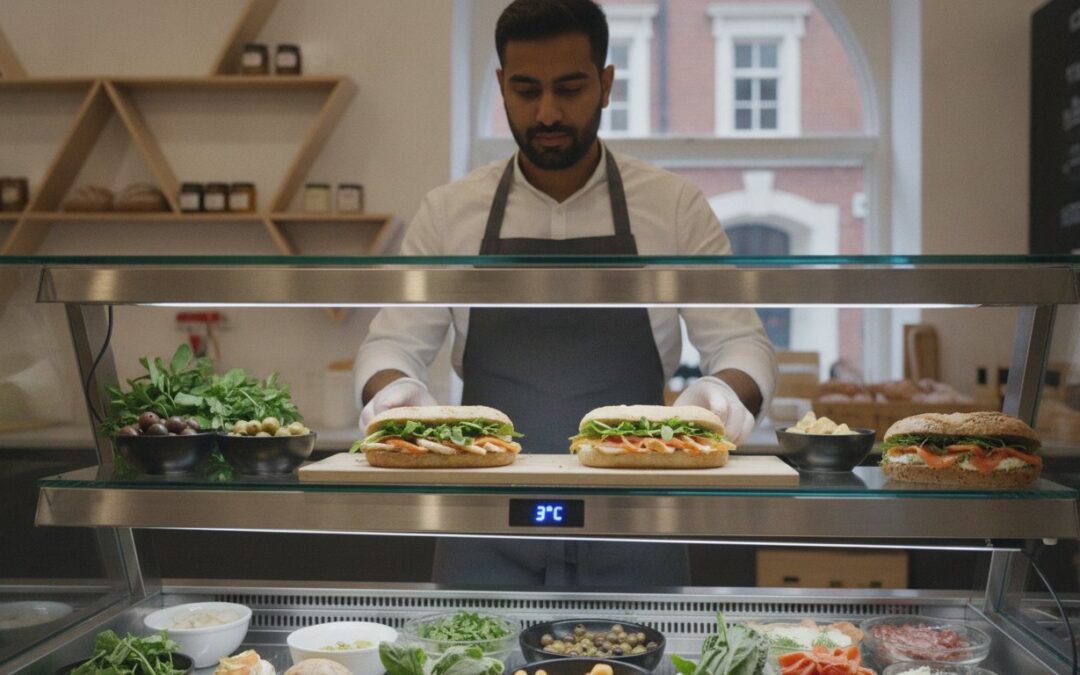
A five-star hygiene rating often hinges on the few millimetres of steel and glass separating your produce from the public. With the Food Standards Agency now moving to make the display of hygiene ratings mandatory in England, just as it is in Wales and Northern Ireland, the pressure to maintain flawless standards has never been higher. Understanding exactly what is HACCP for food display is no longer just a legal box-ticking exercise; it’s the foundation of a successful, safe hospitality environment.
We understand that the technical language of food safety can feel overwhelming, especially when you’re focused on the artisanal quality of your offering. It’s natural to feel anxious about upcoming inspections or to wonder if your current deli counters truly meet the latest requirements. This guide will clarify how HACCP principles apply specifically to your display equipment, ensuring you remain compliant while showcasing your products at their best.
We’ll walk you through a practical list of Critical Control Points for your counters and explain how precision-engineered equipment simplifies your safety protocols. By the end, you’ll have the confidence to manage your food display with the same meticulous care you put into your craft.
Key Takeaways
- Gain a clear understanding of what is HACCP for food display and how these preventative principles protect both your patrons and your professional reputation.
- Identify the specific Critical Control Points within your serving counters to proactively manage risks before they impact your daily operations.
- Master the practical application of temperature controls and the 4-hour rule to ensure the safety and quality of products in patisserie and deli displays.
- Discover how precision equipment design, such as clean-line architecture and food-grade materials, simplifies your hygiene and maintenance routines.
- Understand the benefits of partnering with a UK manufacturer for equipment that is engineered to meet strict British food safety and electrical standards.
Understanding HACCP for Food Display Systems
At its core, the Hazard Analysis Critical Control Point (HACCP) system isn’t just a collection of rules; it’s a systematic approach to identifying and managing risks. For any UK hospitality professional, understanding what is HACCP for food display is essential because front-of-house equipment operates in a far more volatile environment than a back-of-house walk-in fridge. While a kitchen fridge remains closed for most of the day, a display counter faces constant ambient temperature fluctuations and frequent customer interaction. This creates a unique set of variables that require a dedicated safety strategy.
Under current Food Safety Management System (FSMS) regulations, maintaining a HACCP-based plan is a mandatory requirement for every food business in the UK. The goal is to shift your operations from a reactive “check it later” mindset to a proactive strategy. You aren’t simply reacting to a spoiled product after the fact. Instead, you’re identifying potential risks before they ever reach the customer’s plate. This foresight is what separates a high-end, reliable establishment from one that struggles with compliance.
This proactive approach is equally important during the initial production and packaging stages; for those in the supplement, health, and dry food sectors, you can discover Simplepack Ltd to ensure your products are professionally packed to the highest safety and hygiene standards before they ever reach your display.
The Three Main Food Hazards in Display
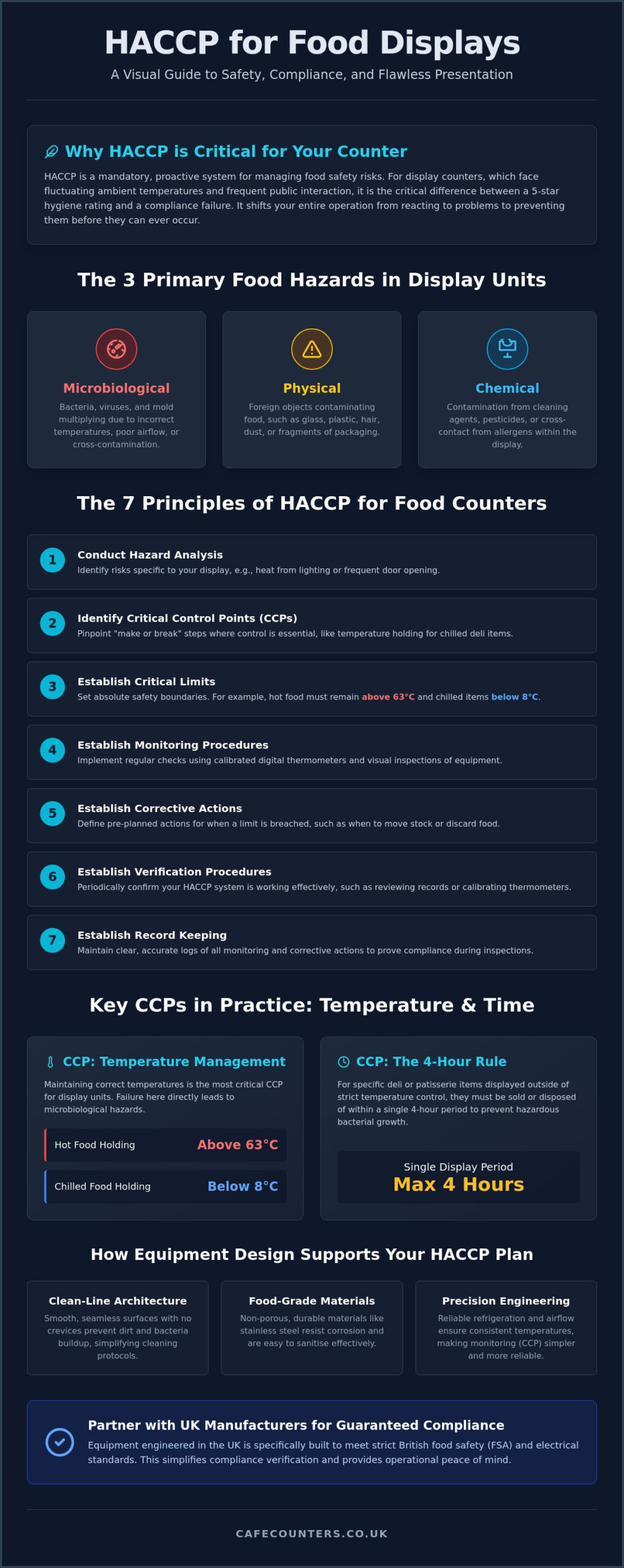
When we analyse the safety of a display unit, we look at three primary categories of risk:
- Microbiological: This is often the primary concern for refrigerated grab and go display units. If airflow is restricted or the unit struggles against high ambient heat, bacteria can multiply rapidly.
- Physical: Open displays or patisserie cases are vulnerable to external debris. This includes everything from broken glass and hair to dust or even packaging fragments from the shop floor.
- Chemical: This involves risks from cleaning agents used on glass or stainless steel surfaces, as well as the critical management of allergen cross-contact within the display space.
HACCP vs. General Food Hygiene
It’s helpful to view general food hygiene as your foundation. These are the “prerequisites” like regular handwashing, pest control, and scheduled deep cleans. HACCP is the specific architectural plan for the food’s journey through your counter. While hygiene keeps the environment clean, your HACCP plan ensures that the specific temperatures and handling procedures for your deli or patisserie items are monitored at every stage. When you combine the two, you create a robust system that provides the evidence needed to pass a local authority inspection with a high rating. It’s about proving that your equipment and your processes are working in perfect harmony to protect the consumer.
The 7 Principles of HACCP Applied to Food Counters
Applying the 7 principles of HACCP to your front-of-house operations requires a shift from general kitchen safety to the specific demands of customer-facing environments. When considering what is HACCP for food display, you must move through a logical progression of risk management. It starts with a thorough hazard analysis. For instance, in a patisserie display, you’re not just looking at the food itself, but at how the constant opening of doors or the heat from nearby lighting might compromise the product’s integrity. By identifying these specific vulnerabilities, you can determine your Critical Control Points (CCPs). These are the “make or break” steps where a failure in control will almost certainly lead to a safety risk.
Once your CCPs are identified, you must establish critical limits. These are the absolute boundaries, such as ensuring hot food remains above 63°C or chilled items stay below 8°C. To manage these limits effectively, consistent monitoring procedures are vital. This involves more than just a cursory glance; it requires the use of calibrated digital thermometers and regular visual checks of your equipment’s built-in displays. If a limit is breached, such as a refrigeration unit failing mid-service, your plan must include pre-defined corrective actions. This ensures your staff knows exactly when to move stock or when food must be discarded, removing the guesswork from high-pressure situations. For those looking to formalise their process, the Food Standards Agency HACCP guidance provides a comprehensive framework for these procedures.
Verification and Record Keeping
The final two principles focus on the long-term integrity of your system. Principle 6, verification, involves proving that your display units are actually performing to the manufacturer’s specifications. This might include annual professional servicing or quarterly thermometer calibrations. Principle 7 is perhaps the most critical for your protection: record keeping. Maintaining a “due diligence” folder filled with daily temperature logs and service records is your best legal defence. In the event of a food safety incident, these documents prove that you took every reasonable precaution to protect your customers. If you are currently planning a new layout, our experts can help you design bespoke serving counters that make this daily recording process as simple as possible.
Setting Realistic Critical Limits
In the UK, the “Danger Zone” for bacterial growth is between 8°C and 63°C. Your HACCP plan should differentiate between a “target” temperature and a “critical” limit. For example, while your critical limit for cold food is 8°C, your target should be 5°C or lower to provide a safety buffer. High-performance equipment like Vision Heated Counters is designed to maintain these precise limits automatically, even in busy environments. This precision engineering reduces the manual burden on your staff and ensures your display remains both enticing and legally compliant throughout the trading day.
Critical Control Points: Managing Temperature and Hygiene
While many safety guides dwell on the storage phase, the front-of-house display is where the most dynamic risks occur. When asking what is HACCP for food display, you’re essentially looking for the specific moments where temperature or hygiene could fail in front of your customers. Temperature control remains the most frequent Critical Control Point (CCP). Whether you’re using heated gantries or chilled wells, the equipment must work to counteract the ambient heat of your dining area. It’s about maintaining that invisible barrier between your product and the surrounding environment.
Time is equally critical. For ambient or chilled displays, the 4-hour rule is a non-negotiable safety standard. Once food is removed from temperature-controlled storage, the clock starts. This is where your HACCP Principles & Application Guidelines become invaluable, helping you map out the exact life cycle of each product on your counter. You need to know exactly how long an item has been displayed and at what point it must be discarded to remain compliant.
In a busy deli counter, cross-contamination and allergen management are paramount. You must ensure clear physical separation between raw and cooked items, as well as distinct labelling for allergens. It isn’t just about the food touching; it’s about shared utensils and the airflow within the unit itself. Meticulous planning in the layout of your display can prevent these risks before they even arise.
Monitoring Temperature in Grab & Go Units
Grab & Go displays rely on air curtains to maintain a stable environment. However, a common mistake is relying solely on the built-in digital display. These often measure the air temperature, which can fluctuate every time a customer reaches in. For true verification, you must use a probe thermometer to check the actual product temperature. This ensures your safety data is accurate and not just a reflection of the unit’s cooling cycle. It’s a small step that provides massive reassurance during an inspection.
Cleaning and Disinfection as a CCP
Your cleaning schedule should be a direct reflection of your HACCP flowchart. Focus on high-touch areas like glass panels and handles, which require sanitisation multiple times per service. We design our units with removable components because we know that if a part is hard to reach, it won’t be cleaned properly. Deep cleaning access is a functional necessity for long-term safety compliance. When the equipment is easy to clean, your team is far more likely to maintain the high standards your business demands. To ensure your kitchen is always supported by professional staff who understand these protocols, Operational Chef Consultant offers expert recruitment for chefs and support personnel.
How Equipment Design Supports Your HACCP Plan
A robust food safety management system is only as effective as the hardware supporting it. When we consider what is HACCP for food display, we must look beyond the paperwork and into the physical engineering of the units themselves. High-quality equipment acts as a silent partner in your compliance strategy, reducing the margin for human error through precision manufacturing. By integrating safety features directly into the design phase, we ensure that maintaining critical limits becomes a seamless part of your daily workflow rather than a constant struggle against inadequate machinery.
Thermal stability is a cornerstone of this support. We utilize high-density insulation and advanced refrigeration cycles to ensure that your display maintains a consistent temperature, even when front-of-house conditions become challenging. This stability is essential for preventing breaches of your established critical limits. Modern units also feature integrated digital controllers that provide real-time monitoring and audible alarms. These systems act as an early warning, allowing your team to take corrective action long before a safety hazard develops. This level of technical oversight is what transforms a standard counter into a professional safety tool.
The Role of Stainless Steel in HACCP
Material choice is perhaps the most significant factor in long-term hygiene. Food-grade stainless steel remains the industry standard because its non-porous surface naturally resists bacterial growth and chemical corrosion. Unlike porous materials that can harbour pathogens, stainless steel can be thoroughly sanitised multiple times a day without degrading. Its durability also eliminates physical hazards; it won’t chip, flake, or crack under the pressures of a busy commercial environment. This is why professional commercial kitchen fabrication is so vital to your safety plan. We use CAD modelling to ensure “clean-line” architecture, intentionally removing the crevices and dirt traps where bacteria typically thrive.
Bespoke Design for Allergen Control
Generic, off-the-shelf units often fail to address the complexities of modern allergen management. Bespoke manufacturing allows you to build specific safety requirements into the very structure of your display. We can customise counters with physical dividers that provide a clear, permanent barrier between different food groups, effectively preventing cross-contact. Furthermore, we design our airflow systems to be directional and controlled. This ensures that crumbs or powders from one section aren’t blown into another, which is a common but often overlooked risk in standard displays. If you want to ensure your next project is built for total compliance, you can contact our design team today to discuss your specific requirements.
Partnering with a UK Manufacturer for HACCP Compliance
Selecting the right equipment is only half the battle. To truly master what is HACCP for food display, your hardware must be backed by expert installation and ongoing technical support. Choosing a UK-based manufacturer ensures that every component meets rigorous British food safety and electrical standards. This local oversight provides a level of quality control that imported units often struggle to match. By working with a domestic partner, you gain direct access to the engineers who designed your counters, ensuring that commissioning and temperature calibration are handled with absolute precision.
Bespoke solutions are particularly effective because they’re tailored to your specific menu and safety flowchart. Whether you’re operating high-volume salad bars or delicate patisserie displays, the equipment should be built to handle your unique requirements. This collaborative process allows us to build safety features into the design, such as specific shelf heights for optimal airflow or integrated probes for digital record-keeping. It’s about creating a system that doesn’t just meet the minimum legal standard but exceeds it through superior engineering.
Quality Assurance and Commissioning
A display unit only supports your safety plan if it’s commissioned correctly within your specific environment. Professional installation is essential to ensure that units reach and maintain their target temperatures under real-world trading conditions. At TFSE Products Ltd, we provide comprehensive technical integration to ensure your safety management is seamless from day one. This isn’t just about meeting a legal requirement; it’s about long-term reliability. Equipment that performs consistently reduces the risk of critical limit breaches, which in turn minimises food waste and protects your bottom line. We take pride in our internal production facilities, using our regional expertise to deliver durability that lasts for years.
Consultancy and Layout Planning
Effective risk management begins with a logical layout. When we consult on a project, we look at the physical journey of the food and the staff. A well-designed counter layout must clearly separate “dirty” return areas, such as tray drops, from “clean” serving areas to prevent cross-contamination. We ensure there’s sufficient space for staff to follow hygiene protocols, such as handwashing and sanitisation, without obstruction. By requesting a site survey, you allow our experts to identify potential safety bottlenecks in your layout before they become operational hazards. This meticulous approach to project management ensures that your physical space works in harmony with your HACCP flowchart, providing a steady and reliable environment for both your team and your customers.
Securing Your Standards with Expert Engineering
Mastering food safety in a front-of-house environment requires a shift from reactive monitoring to proactive precision. As we’ve explored, a robust understanding of what is HACCP for food display transforms your equipment from a simple showcase into a vital safety tool. By identifying Critical Control Points and utilizing equipment designed for thermal stability, you ensure that every item remains within safe limits while looking its best for your customers.
Since 1991, we’ve positioned ourselves as a reliable partner for UK hospitality businesses. Our internal production facilities utilize advanced CAD modelling to create clean-line architecture that eliminates hygiene risks at the design stage. We don’t just manufacture counters; we provide a comprehensive service that includes professional installation and meticulous commissioning to guarantee your units perform to manufacturer specifications from day one.
Take the next step in reinforcing your safety management system. Explore our HACCP-compliant food display counters and discover how our artisanal pride and technical expertise can bring your vision to life with total confidence.
Frequently Asked Questions
Is HACCP a legal requirement for my small cafe?
Yes, implementing a food safety management system based on HACCP principles is a mandatory legal requirement for all food businesses in the UK. This applies regardless of your size, from large commercial retail outlets to small independent cafes. While the complexity of your plan can be scaled to your operation, you must have documented procedures that identify and control food safety hazards effectively.
What are the most common Critical Control Points for food display?
The most frequent Critical Control Points (CCPs) involve temperature regulation, time management, and the prevention of cross-contamination. For chilled displays, the CCP is maintaining food at 8°C or below, while heated units must hold food at 63°C or above. Managing the 4-hour rule for ambient displays also acts as a critical control measure to ensure bacterial growth remains inhibited during service.
How often should I record the temperature of my display counters?
You should record the temperature of your display counters at least twice daily to maintain a robust due diligence record. Many high-end establishments prefer a three-check system, recording temperatures at opening, during the midday peak, and at closing. This methodical approach proves that your equipment remains stable even when doors are frequently opened or ambient room temperatures rise during busy periods.
What is the ‘Danger Zone’ for food temperature in the UK?
The ‘Danger Zone’ is the temperature range between 8°C and 63°C, where harmful bacteria can multiply most rapidly. Maintaining food outside this range is the core objective when considering what is HACCP for food display in any professional environment. To provide a safety buffer, we recommend targeting a chilled temperature of 5°C or lower and a heated temperature well above the 63°C legal minimum.
Can a bespoke counter design help with my food safety rating?
Yes, a bespoke counter significantly supports your Food Hygiene Rating by eliminating the physical dirt traps found in generic units. Custom engineering allows for “clean-line” architecture and dedicated zones for allergen separation, which simplifies the cleaning process for your staff. When an inspector sees equipment designed specifically for hygiene, it projects a level of competence and reliability that positively influences your final score.
What happens if my display fridge fails to stay below 8°C?
You must immediately implement the corrective actions defined in your safety plan, which typically involve assessing the duration of the temperature breach. If the food has been above 8°C for less than four hours, it can be moved to alternative cold storage or sold immediately. If the four-hour limit is exceeded, the food must be discarded. You must document the incident and your response in your records.
Do I need a separate HACCP plan for hot and cold food?
You don’t need entirely separate plans, but your single food safety management system must clearly distinguish between the hazards of hot and cold holding. Your documentation should include specific flowcharts for different food types, clearly stating the distinct critical limits and monitoring procedures for your heated gantries and chilled wells. This clarity ensures that your team can follow the correct protocols for every item on display.
How does CAD modelling improve food safety in counter design?
CAD modelling allows our engineers to identify and eliminate potential hygiene risks in a digital environment before construction begins. We use this technology to ensure that all joints are seamless and that there are no hidden recesses where food debris or bacteria could accumulate. This level of precision is a fundamental part of what is HACCP for food display equipment manufacturing, ensuring your counters are as safe as they are beautiful.