
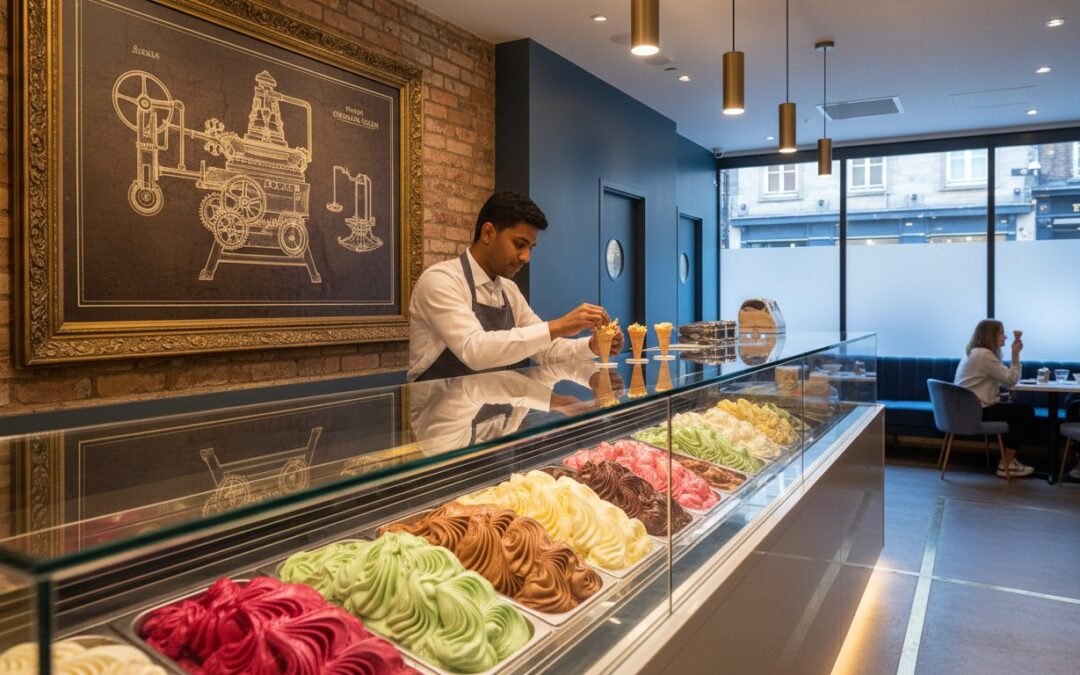
The common belief that Marco Polo introduced frozen treats to Europe in 1295 is a persistent myth that overlooks centuries of genuine engineering. If you’ve ever wondered when was ice cream first invented, the answer lies not in a single moment of discovery, but in the sophisticated cooling methods developed during China’s Tang Dynasty as early as 618 AD. You likely recognise that a great product requires more than just a good recipe; it demands the right environment and technical precision to succeed. At Cafe Counters, we understand that the marriage of heritage and high-end functionality is what truly defines a prestigious catering space.
This article dispels the folklore surrounding figures like Catherine de’ Medici and provides a factual timeline of how early confectioners mastered thermodynamics long before electricity existed. We’ll examine the transition from ancient saltpetre cooling techniques to the robust, functional refrigeration systems that empower today’s catering professionals. You’ll gain a clear understanding of cooling evolution and discover how bespoke presentation has always been the key to commercial success. From the 17th-century courts of Versailles to a modern, turnkey shopfit on a UK high street, we’re walking you through the journey from concept to completion.
Key Takeaways
- Discover exactly when was ice cream first invented, tracing its roots back to the Tang Dynasty’s innovative frozen milk and rice mixtures.
- Learn how ancient Persian cooling techniques and the science of endothermic reactions paved the way for modern, high-performance refrigeration systems.
- Explore the Victorian revolution led by Agnes Marshall, which transformed ice cream from an elite luxury into a staple of the British high street.
- Understand the psychological power of “front-of-house theatre” and how professional presentation directly influences customer purchase intent.
- Gain technical insights into maintaining perfect serving temperatures through energy-efficient, bespoke display engineering designed for long-term operational success.
The Origins of Ice Cream: Separating Fact from Fiction
Pinpointing exactly when was ice cream first invented requires a clear distinction between simple chilled ice and the dairy-based solids we recognise today. While many cultures have enjoyed frozen refreshments for millennia, the transition from flavoured snow to a structured, creamy dessert is a journey through ancient innovation and royal indulgence. At Cafe Counters, we value the precision of craftsmanship, and the history of this dessert reflects a similar dedication to technical evolution.
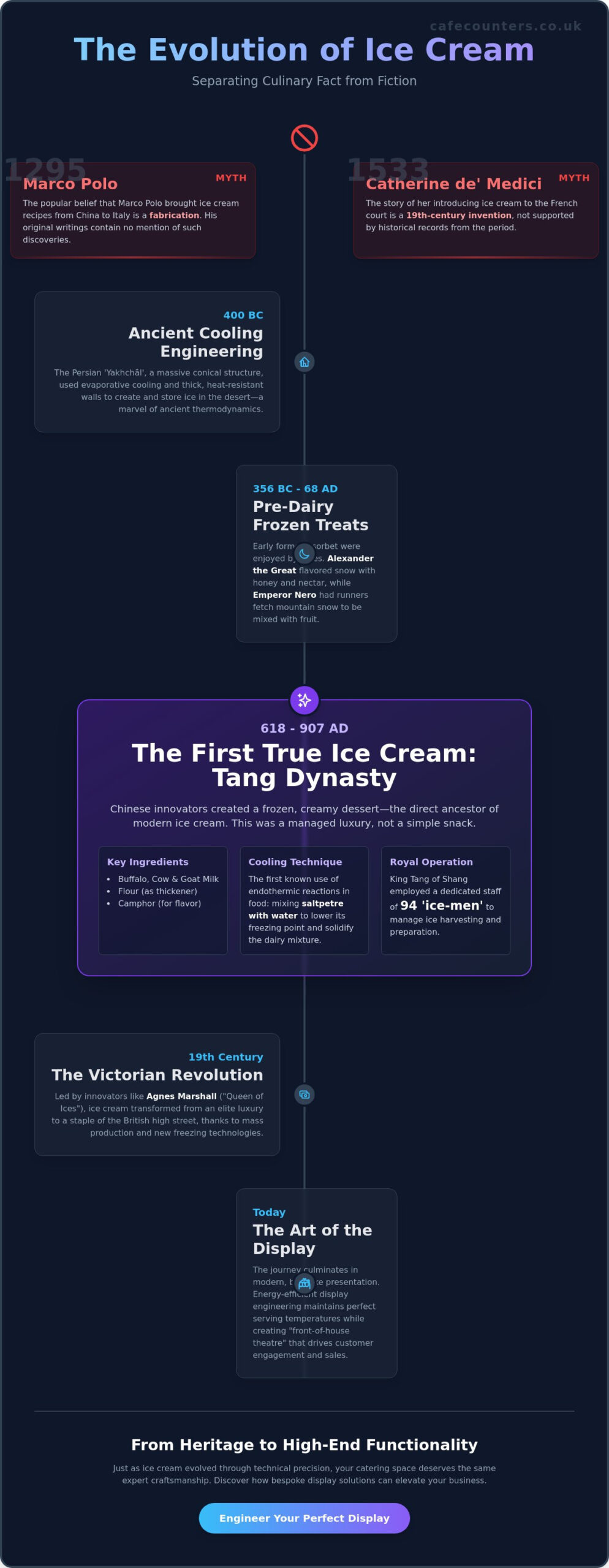
The history of frozen confectionery is often obscured by romanticised legends that lack archaeological or documentary support. Two of the most persistent myths involve Marco Polo and Catherine de’ Medici. Popular stories suggest Polo brought recipes from China to Italy in the 13th century, yet his original writings contain no such specific mention. Similarly, the legend that Catherine de’ Medici introduced ice cream to the French court in 1533, following her marriage to King Henry II, is widely regarded by historians as a 19th-century fabrication. To find the true origins, we must look further back to documented records from the East.
The Tang Dynasty: The First True Ice Cream
The most credible answer to the question of when was ice cream first invented lies in the Tang Dynasty (618-907 AD). During this era, Chinese inventors developed a complex frozen mixture that utilised buffalo, cow, and goat milk. This dairy base was thickened with flour and often enhanced with camphor, a substance harvested from evergreen trees. Camphor provided a unique, cooling flavour profile that has largely disappeared from modern Western palates but was highly prized by the Tang elite.
This wasn’t a casual snack for the masses; it was a highly managed luxury. Records indicate that King Tang of Shang employed a dedicated staff of 94 ‘ice-men’ whose sole responsibility was to manage the harvesting of ice and the preparation of these frozen delicacies. This level of logistical management mirrors the turnkey approach we take in modern commercial builds, where every specialist role is vital to the final result. The use of saltpetre to lower the freezing point of water allowed these early artisans to freeze the dairy mixture, marking the first known use of endothermic cooling in food production.
Ancient Snow and Honey: The Pre-Dairy Era
Before the inclusion of dairy, the history of frozen desserts focused on the manipulation of natural ice and snow. These ancient refreshments were the precursors to sorbet rather than ice cream. Alexander the Great (356-323 BC) is famously documented to have enjoyed snow flavoured with honey and nectar during long military campaigns. These treats provided both hydration and a rare sensory luxury in harsh environments.
Historical accounts also detail the Roman Emperor Nero’s (r. 54-68 AD) obsession with chilled delicacies. He frequently dispatched runners into the mountains to fetch fresh snow, which was then rushed back to the palace before it could melt. This snow was mixed with fruit and honey to create a primitive slush. While these examples demonstrate an early human desire for cold treats, they lacked the structural integrity and fat content that defines true ice cream. Distinguishing between these flavoured ices and the creamy, camphor-scented desserts of the Tang Dynasty is essential for understanding the true timeline of culinary innovation.
The Science of the Chill: How Ancient Cultures Mastered Refrigeration
Understanding temperature control is the foundation of any successful catering operation. Long before we developed modern bespoke serving solutions, ancient civilisations were already engineering complex systems to defy the heat. The Persian ‘Yakhchal’, dating back to 400 BC, is a prime example of this early technical prowess. These massive, conical structures used evaporative cooling and thick, heat-resistant walls made of sarooj to store ice in the middle of the desert. It’s a level of structural foresight that mirrors the precision we value in British manufacturing today.
By the 13th century, Arab historians were documenting the first technical descriptions of using saltpetre to cool water. Determining exactly when was ice cream first invented requires looking at these early refrigeration milestones, as they transitioned the dessert from simple chilled fruit to a manufactured frozen product. This “chemist’s party trick” eventually reached 16th-century Italy, where the discovery of the endothermic process changed the culinary landscape forever. It allowed for a level of consistency that was previously impossible to achieve with natural snow alone.
The Discovery of the Freezing Point
The secret to modern frozen desserts lies in a simple chemical reaction. By mixing salt with ice, you lower the freezing point of water to approximately -14°C. This allows the mixture to absorb heat from its surroundings, freezing any liquid placed within it. In the 1600s, this discovery allowed chefs in Naples and Florence to create the first ‘water ices’ or sorbets. These early successes were more than just treats; they were a demonstration of elite technical capability. Just as we focus on ergonomic design to improve efficiency, these early pioneers used science to overcome the limitations of their environment.
The Ice House: A Pre-Industrial Essential
In the UK, the 17th and 18th centuries saw the rise of the ice house. These were robust, brick-lined structures, often built underground to provide maximum insulation. Ice was harvested from frozen lakes during the winter and packed into these pits, where it could remain frozen for over 12 months. This made ice cream an exclusive luxury for the ultra-wealthy. While the dessert eventually became an industry in America, its early European history was defined by these high-end, private installations that required significant manual labour to maintain.
Planning a modern hospitality space requires the same attention to detail and durability that these early engineers applied to their ice houses. If you’re looking to build a workspace that combines heritage quality with functional performance, our experts at Cafe Counters can guide you through every stage of the design and installation process.
From Elite Luxury to High Street Staple: The 19th-Century Revolution
The 19th century transformed ice cream from a rare delicacy into a commercial powerhouse. This era saw the transition from labour-intensive hand-churning to efficient, scalable production methods. While historians often debate when was ice cream first invented in its earliest frozen-syrup form, the 1840s mark the most significant turning point for the UK market. This was the decade when engineering replaced guesswork, laying the foundations for the modern catering industry.
The Invention of the Ice Cream Machine
In 1843, Nancy Johnson patented the hand-cranked freezer, a piece of technology that changed the industry’s trajectory. Her design used a central agitator to keep the mixture moving, which prevented large ice crystals from forming. This resulted in a smoother, more consistent product than any previous method. Before this patent, production was a domestic chore; afterwards, it became a viable business model for confectioners. This mechanical leap allowed parlours to scale their operations, moving away from small batches toward the high-volume retail environments we see today. The shift ensured that quality wasn’t sacrificed for quantity, a principle that remains central to British manufacturing.
Agnes Marshall and the Victorian Ice Cream Boom
Agnes Marshall, widely known as the “Queen of Ices,” was a visionary in the late 1800s. She published four influential books and ran a successful cookery school in London. Marshall’s work wasn’t just about recipes; she was a pioneer of food technology. She even suggested using liquid oxygen to freeze food as early as 1901, decades before cryogenic freezing became a commercial reality. The origin of ice cream as a street-level staple is also tied to the “Hokey Pokey” men. These vendors sold “Penny Licks” for 1d, making the dessert accessible to the working class for the first time. This democratization of the product drove a massive demand for retail infrastructure.
The revolution was supported by several key practical developments:
- Insulated Ice Boxes: These robust units allowed retailers to store ice harvested in winter or imported from Norway, ensuring year-round availability.
- The Penny Lick: Small glass cups allowed for portion control and affordable pricing, though they were eventually phased out for hygiene reasons.
- Industrial Churns: The transition from hand-cranked pots to steam-powered factory production in the mid-1850s allowed for mass distribution.
By the end of the century, ice cream wasn’t just a treat; it was a fixture of the British high street. The combination of Johnson’s mechanical precision and Marshall’s culinary innovation created a template for the modern dessert parlour. It proved that with the right equipment and a focus on durability, a luxury product could become a reliable commercial staple.
The Art of the Display: How Presentation Transformed the Industry
While historians continue to debate exactly when was ice cream first invented, the shift from a hidden culinary secret to a public spectacle changed the industry forever. Originally, ice cream production happened behind closed doors in royal kitchens or basement dairies. By the late 1800s, the introduction of the first mechanical refrigeration systems allowed retailers to move the product into the customer’s line of sight. This visibility created a powerful psychological trigger. Research suggests that seeing the texture and colour of fresh dairy increases purchase intent by over 40% in retail environments, as the brain processes the visual appeal long before the taste.
The transition from wood to stainless steel counters in the mid-20th century was driven by a growing need for hygiene and operational efficiency. Food safety regulations in the UK became more stringent, and non-porous surfaces became the industry standard for any professional installation. This change didn’t just improve cleanliness; it provided a sleek, professional backdrop that highlighted the vibrant colours of the dessert. Modern displays now combine these robust materials with advanced thermal glass to maintain perfect serving temperatures without obscuring the view. It’s a balance of British engineering and high-end design that ensures the product remains the star of the show.
The Birth of the Soda Fountain and Ice Cream Parlour
The early 20th century transformed the dessert shop into a social hub. These parlours featured ornate marble tops and polished brass fixtures, creating a sense of luxury and permanence. The “soda jerk” emerged as a skilled professional in hospitality, performing a choreographed routine of scooping and mixing behind a central counter. This counter acted as a stage, turning the act of serving into theatre. It wasn’t just about the food. It was about the experience of watching a master at work in a dedicated, high-end environment that felt both prestigious and welcoming.
Visual Merchandising in Modern Hospitality
Modern operators have moved away from the bulky, opaque cabinets of the past. Today, refrigerated grab and go display units are essential for driving impulse sales in high-traffic UK locations. The clarity of the glass and the precision of the lighting directly influence how customers perceive quality. High-end patisseries heavily influenced this trend, proving that visibility equals value in the eyes of the consumer. The transition to bespoke cafe counters allows businesses to integrate hygiene-focused stainless steel with aesthetic finishes that match their brand identity. This evolution ensures that while the core question of when was ice cream first invented remains a historical curiosity, the future of the product relies on the theatre of the display.
Ready to elevate your dessert presentation with British-built quality? Contact the experts at Cafe Counters to discuss your bespoke shopfitting project.
Modern Standards in Ice Cream Presentation: Engineering the Perfect Display
While historians continue to debate exactly when was ice cream first invented, modern hospitality operators focus on a different challenge: the physics of the perfect scoop. Maintaining the ideal serving temperature for gelato and traditional dairy ice cream requires a delicate balance of engineering and design. The industry standard for serving is typically between -12°C and -15°C. If the temperature rises by even two degrees, the structural integrity of the dessert fails. Conversely, if it drops too low, the product becomes too hard to serve, ruining the customer experience.
Energy efficiency has become a primary concern for UK business owners. Commercial refrigeration can account for 40% of a cafe’s total energy expenditure. Investing in high-specification British-made counters ensures superior insulation and more reliable compressors. These bespoke units are designed to last 30% longer than mass-produced imports, providing a robust return on investment for any high-street venture. Our Concept to Completion approach ensures that these technical requirements are integrated into the design from day one, rather than being an afterthought.
Technical Precision: Airflow and Temperature Control
The choice between cooling methods defines the quality of your product. Static cooling relies on natural convection, which often leads to uneven temperature zones within a display. Ventilated cooling uses internal fans to circulate chilled air constantly. This method is essential for preventing the formation of ice crystals. These crystals occur when the surface of the ice cream melts slightly and refreezes, destroying the smooth mouthfeel that defines a premium product.
- CAD Modelling: We use advanced software to map out ergonomic serving areas that reduce staff fatigue.
- Thermal Integrity: Consistent airflow ensures the product at the front of the display is as cold as the product at the back.
- Seamless Maintenance: Our designs include easy-access panels to ensure routine servicing doesn’t disrupt your trade.
The Future of Food Display
The UK market is moving rapidly toward sustainable materials and low-GWP (Global Warming Potential) refrigerants. Modern systems now utilise R290 propane, which has a GWP of just 3, compared to older refrigerants that scored in the thousands. This shift helps businesses meet environmental targets while lowering long-term running costs. A custom-built counter does more than just chill food; it acts as a physical manifesto of your brand’s prestigious identity.
When you’re researching when was ice cream first invented, it’s clear that the journey from ancient ice-houses to modern ventilated displays is one of constant innovation. We invite you to explore our professional shopfitting and counter solutions to see how we can bring your hospitality vision to life with British craftsmanship and technical expertise. Our team manages every stage of the process, ensuring a turnkey solution that’s ready for service the moment we leave the site.
Mastering the Art of the Modern Creamery
From the snow-cooled delicacies of ancient history to the industrial breakthroughs of the 1800s, ice cream’s journey is one of constant technical innovation. Understanding when was ice cream first invented helps us appreciate why it remains a £1.4 billion industry in the UK today. Modern success isn’t just about the heritage of the recipe. It’s about the precision of the display and the reliability of the refrigeration technology used to serve it to a discerning public.
At Cafe Counters, we’ve been refining the art of commercial presentation since 1991. We provide a full Concept to Completion service, ensuring your vision is backed by robust, in-house UK manufacturing. Our team handles every technical detail to ensure your installation is both stunning and functional for long-term operational efficiency. We believe that high-end design should always be grounded in durability and British craftsmanship. Ready to showcase your own creations? Explore our bespoke cafe counter solutions. Let’s build a space that does your culinary craftsmanship justice.
Frequently Asked Questions
Who is officially credited with inventing ice cream?
No single individual holds the official title of inventor, as frozen desserts evolved over thousands of years across different cultures. Records from the Tang Dynasty in China, dating between 618 and 907 AD, describe a chilled mixture of buffalo milk, flour, and camphor. Later, in 1533, Catherine de’ Medici is credited with bringing Italian sorbet techniques to France, which eventually led to the creamy textures we recognise in modern British parlours.
How did they keep ice cream cold before the invention of electricity?
Before electric freezers, ice cream was preserved in purpose-built ice houses or deep underground pits insulated with straw and sawdust. The first recorded ice house in the UK was built in Greenwich in 1619 to serve the royal court. These structures could keep ice frozen for months, allowing chefs to produce chilled delicacies even during the height of summer by utilising natural insulation and thermal mass.
When was the first ice cream parlour opened in the UK?
The first commercial ice cream enterprise in the UK was opened by Carlo Gatti in 1851 at Hungerford Market, London. Gatti sold simple scoops of ice cream for one penny, making a luxury product accessible to the general public for the first time. He imported 10,000 tonnes of ice annually from Norway to sustain his business, proving that a reliable supply chain is the backbone of any successful catering operation.
What is the difference between gelato and traditional ice cream?
The primary difference lies in the fat content and the amount of air incorporated during the manufacturing process. Traditional ice cream contains at least 10% milkfat and is churned quickly to create a light, airy texture. Gelato uses more milk than cream, resulting in a lower fat content of 4% to 9%. It’s churned at a slower speed, which produces a denser consistency and a more intense flavour profile.
Why was ice cream once considered a luxury for only the elite?
Ice cream was a symbol of prestige because the logistics of harvesting, transporting, and storing ice were incredibly labour-intensive and expensive. Only the aristocracy possessed the land and capital to maintain private ice houses and employ the staff required for hours of manual churning. When asking when was ice cream first invented, it’s clear the dessert was originally a high-end display of wealth and technological superiority for royal banquets.
When was the ice cream cone first invented?
The first patent for an edible ice cream cup was filed by Italo Marchiony in December 1903. However, the rolled waffle cone gained global prominence during the 1904 St. Louis World’s Fair when a pastry vendor helped an ice cream seller who had run out of glass dishes. This innovation provided a seamless, portable solution for customers, revolutionising the way we design ergonomic service areas in modern retail environments.
What role did salt play in the history of ice cream making?
Salt was the critical technical component that allowed early confectioners to freeze cream without modern machinery. By adding salt to a bucket of ice, the freezing point of the mixture is lowered through an endothermic reaction. This allows the temperature to drop well below 0°C, which is necessary to transform liquid dairy into a solid, frozen state. It’s a robust scientific principle that remained the industry standard for centuries.
How has modern refrigeration changed ice cream production?
Modern refrigeration has transformed ice cream from a seasonal rarity into a consistent, high-volume industry. Precision temperature control allows for the safe storage of large inventories and ensures that every scoop maintains a uniform texture. Understanding when was ice cream first invented helps us appreciate the transition from manual, salt-based freezing to the sophisticated, turnkey cooling systems that power today’s prestigious catering and hospitality sectors.