

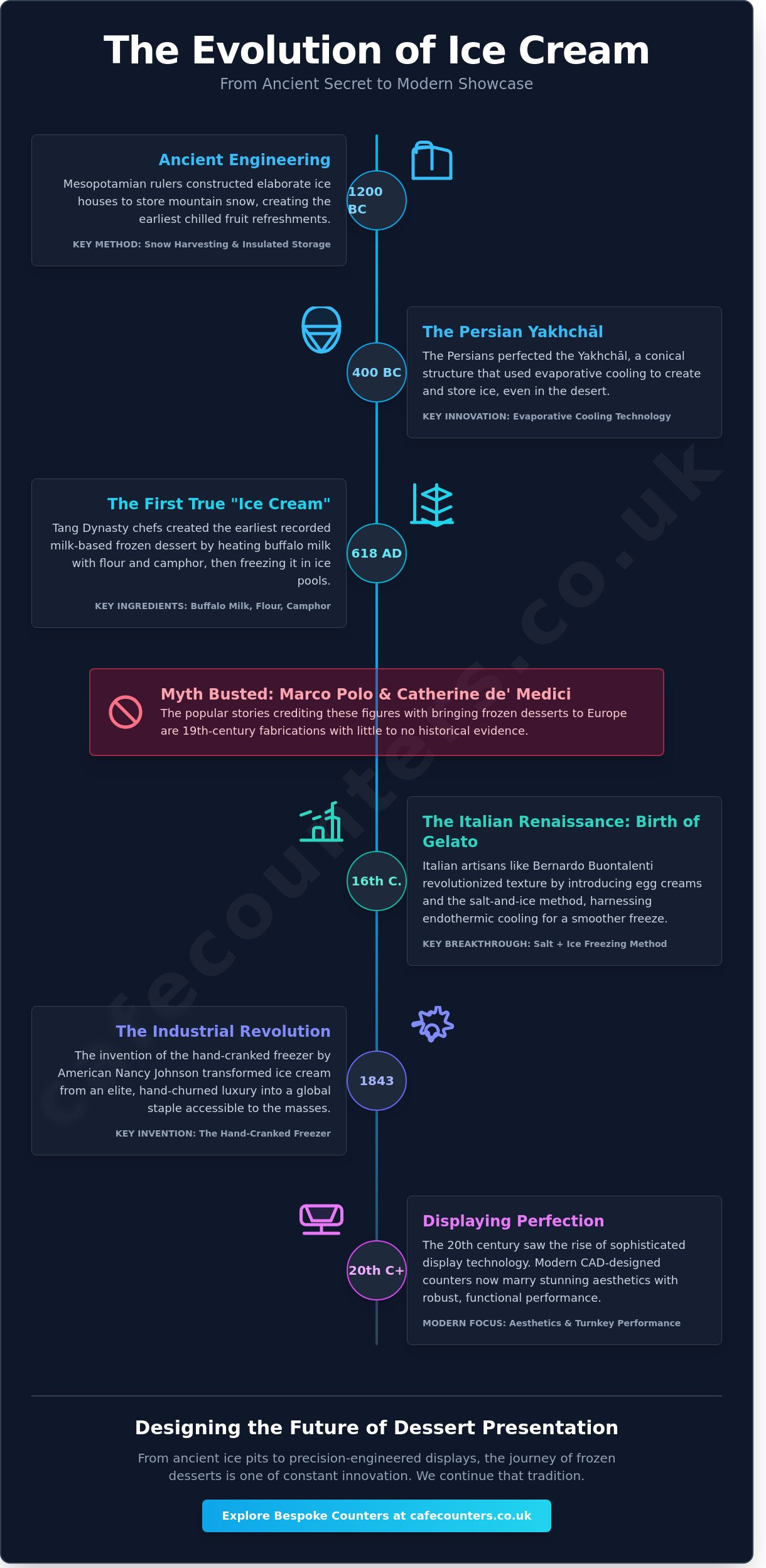
The traditional belief that Marco Polo introduced frozen desserts to Europe is a 19th-century fabrication with little basis in historical fact. If you’ve ever searched to find which country invented ice cream, you’ve likely encountered a maze of conflicting legends and confusing terminology. It’s difficult to distinguish between ancient chilled snow and the dairy-rich, bespoke products served in modern British parlours. We understand that for professionals in the catering industry, historical accuracy and technical clarity are just as important as the quality of the final build.
This guide provides a meticulous, evidence-based timeline of the dessert’s evolution, starting with the Tang Dynasty in 618 AD. You’ll learn the vital distinctions between sorbet, gelato, and modern ice cream, moving beyond myths to discover how Italian and British craftsmanship refined these recipes. We also examine how the leap from simple ice pits to sophisticated display technology in the 20th century allowed the industry to scale. By the end, you’ll have a clear understanding of the journey from an ancient royal luxury to a robust, turnkey commercial success.
Key Takeaways
- Trace the evolution of frozen treats back to the Tang Dynasty to understand the transition from simple flavoured ice to the first recorded milk-based desserts.
- Explore why Italy is credited with the technical breakthrough of the salt and ice freezing method, a pivotal innovation that refined the texture of modern gelato.
- Discover which country invented ice cream by separating documented historical evidence from popular myths involving Marco Polo and Catherine de’ Medici.
- Learn how the Industrial Revolution and British engineering transformed a hand-churned luxury into a global staple through the invention of the hand-cranked freezer.
- Understand the vital role of modern presentation, seeing how CAD-designed display counters have evolved to marry stunning aesthetics with robust, functional performance.
The Ancient Origins: Did China Invent the First Ice Cream?
Pinpointing which country invented ice cream depends heavily on how you define the dessert. If we look for the earliest fusion of dairy and cold storage, the evidence points toward ancient China. Long before the modern commercial kitchen became a reality, royal chefs were experimenting with temperature and texture to create prestigious delicacies for the ruling elite. These early innovations were not merely about cooling a drink; they represented a fundamental shift in food science and preservation.
The distinction between flavoured ice and frozen dairy is vital for historical accuracy. While many civilizations used mountain snow to chill fruit juices, the transition to a creamy, stable texture required technical innovation. This evolution mirrors the modern requirement for robust, functional equipment in a professional catering environment. Early precursors were often simple iced slushes, but by the 7th century, the process became significantly more sophisticated as chefs began to manipulate the properties of milk.
The Tang Dynasty’s Frozen Delicacy
During the Tang Dynasty, which lasted from 618 to 907 AD, chefs developed a method that involved heating buffalo milk with flour and camphor. This created a thickened paste that was then placed into metal tubes and lowered into ice pools. This specific use of camphor, an aromatic substance derived from evergreen trees, provided a unique cooling sensation and a floral scent. The royal courts of King Tang of Shang employed a dedicated team of 94 ice-men who harvested and stored ice year-round to ensure these treats were available during the summer months.
The Tang Dynasty milk-ice stands as the earliest recorded ancestor of modern ice cream because it successfully integrated dairy proteins with thickening agents and sub-zero storage techniques.
Mesopotamia and the Persian Yakhchal
While China pioneered dairy-based mixtures, the engineering required for frozen desserts began much earlier in the Middle East. By 1200 BC, Mesopotamian rulers had constructed elaborate ice houses along the banks of the Euphrates. These structures allowed for the storage of mountain snow, which was used to create the earliest chilled fruit refreshments. These cooling methods were essential for maintaining the comfort and status of the ruling classes in arid climates.
By 400 BC, the Persians had perfected the Yakhchal, a conical structure designed to store ice in the middle of the desert using evaporative cooling. The history of frozen desserts shows a clear progression from simple snow-based treats to the complex textures we manufacture today. These ancient methods laid the groundwork for the temperature-controlled storage systems that are now essential in any bespoke commercial kitchen. Understanding which country invented ice cream requires acknowledging these early engineers who first mastered the transition from liquid to solid states in extreme climates.
The Italian Renaissance: Refining the Art of Gelato
Italy didn’t technically discover the concept of frozen snow, but they engineered the process that made it a global phenomenon. When people ask which country invented ice cream, the answer usually settles on Italy because of the 16th-century technical breakthroughs in Florence. This wasn’t just a recipe change; it was a revolution in cooling technology. By mixing salt with ice, artisans harnessed endothermic cooling to lower freezing points far below zero. This allowed for a consistent, smooth freeze that turned a chemist’s party trick into a reliable culinary staple.
The Italian approach treated dessert production as a form of precision engineering. They moved away from the coarse, granular textures of ancient snow-based treats and focused on creating a seamless, uniform consistency. This era marked the transition from “chilled food” to a manufactured luxury. It required a deep understanding of thermal dynamics and storage, much like the modern requirements for a turnkey commercial kitchen installation that relies on robust climate control.
Bernardo Buontalenti: The Father of Gelato
Bernardo Buontalenti was a 16th-century architect and engineer who brought a designer’s eye to the Florentine court. In 1565, he introduced egg-based creams to the traditional mix, creating a richer, more stable texture than the water-based ices of the past. His contribution wasn’t limited to the ingredients. Buontalenti designed the first sophisticated cold storage cellars, using his architectural expertise to build insulated ice houses that could preserve desserts during the summer. This shift from simple sorbet to fat-rich cream represents the birth of modern gelato as a prestigious, high-end product.
The Expansion to Paris: Café Procope
The transition from royal banquet to public luxury occurred in 1686 when Francesco Procopio dei Coltelli opened Café Procope in Paris. Procopio, a Sicilian entrepreneur, brought Italian techniques to the French capital and refined the freezing process using a “sorbetière.” This device allowed for a more efficient production cycle, making it easier to serve a high volume of customers. According to The History of Ice Cream, this period was the first time the public could access what was once a strictly aristocratic treat. It established the blueprint for the modern café, where ergonomic design and high-quality service meet to create a functional, profitable business space.
By the late 17th century, the debate over which country invented ice cream became more complex as Italian techniques merged with French culinary prestige. The result was a standardised method of production that spread across Europe. It proved that successful hospitality relies as much on the technical infrastructure and the “back of house” cooling systems as it does on the final presentation to the customer.
Myth-Busting: Marco Polo and the Catherine de’ Medici Legends
When clients ask which country invented ice cream, they often expect a simple answer involving a famous explorer or a royal wedding. However, many of the stories we take for granted are actually 19th-century marketing inventions designed to add prestige to commercial products. As experts in bespoke catering environments, we value the distinction between a well-crafted narrative and the robust historical facts that define our industry’s heritage.
One persistent legend involves King Charles I, who allegedly paid his French chef a life pension of £20 per year to keep his ice cream recipe a secret. Historical scrutiny reveals no record of this payment in royal ledgers from the 1630s. These tales often emerged during the Victorian era when retailers sought to elevate frozen desserts from street-vendor snacks to luxury items fit for the British elite. This period of “origin story” creation was less about historical accuracy and more about establishing a brand identity that felt timeless and prestigious.
The Marco Polo Misconception
The story of Marco Polo bringing a recipe for water ices from China to Italy in 1295 is a staple of culinary folklore. Research suggests this narrative didn’t appear in print until the 1920s and 1930s, primarily within trade journals like the Ice Cream Trade Journal. These publications likely conflated the origins of pasta and ice cream to create a romanticised history for Western consumers. From a practical standpoint, the logistics of 13th-century travel made preserving frozen dairy products impossible across thousands of miles of varied terrain. While China certainly pioneered early frozen desserts using snow and saltpetre, the idea of a single explorer “importing” the concept is a modern fiction.
The Medici Myth and French Influence
Another popular claim suggests Catherine de’ Medici introduced ice cream to the French court upon her marriage to Henry II in 1533. Historians find no contemporary evidence for this “culinary ambassadorship.” The myth gained traction in the 1800s as a way to link French haute cuisine to the Italian Renaissance. In reality, the technical evolution of the craft relied on the slow spread of endothermic cooling techniques rather than a single royal arrival. While the debate over which country invented ice cream continues, these legends often overshadow the real technical evolution of the craft.
The shift from these mythical origins to a reliable, scalable industry required more than just royal patronage. It demanded engineering precision. This transition from royal myth to industrial reality was accelerated by 19th-century innovations, essentially Making Ice Cream a Global Staple through the first commercial factories and mechanical patents of the 1840s and 1850s. At Cafe Counters, we respect this journey from concept to completion, acknowledging that true quality is built on technical expertise rather than folklore.
- 1533: The alleged but unproven date of Catherine de’ Medici’s influence.
- 1843: Nancy Johnson patents the hand-cranked freezer, a turning point for production.
- 1920s: The era when many “Polo” myths were first published in trade journals.
The Industrial Revolution: Making Ice Cream a Global Staple
Before the mid-19th century, ice cream was a rare delicacy reserved for the elite. While scholars continue to argue over which country invented ice cream in its earliest form, the Industrial Revolution provided the technical foundation to transform it into a global commodity. The transition from a hand-churned luxury to a mass-market staple relied on engineering breakthroughs that moved production out of private kitchens and into professional factories. This period replaced unreliable methods with precision technology, mirroring the same focus on durability and efficiency we value in modern catering builds.
Innovation in Freezing Technology
The most significant shift began with Nancy Johnson, who patented the hand-cranked ice cream freezer in 1843. Her design featured a central dasher that allowed the mixture to be stirred while it froze, significantly improving the consistency of the final product. By 1851, Jacob Fussell took this technology further by establishing the first commercial ice cream factory. He realised that mass-producing ice cream allowed him to offer it at a lower price point than individual confectioners. Automated churning enabled the consistent, smooth texture expected by the modern consumer by preventing the formation of large ice crystals during the freezing process. This mechanical progress turned an artisanal craft into a robust industrial sector.
The Role of Mechanical Refrigeration
Relying on ice harvested from frozen lakes was a logistical nightmare that limited the growth of the industry. The breakthrough came in 1876 when Carl von Linde developed the ammonia refrigerator. This invention allowed manufacturers to maintain sub-zero temperatures regardless of the season or local climate. It changed everything. The ability to control temperatures precisely meant that the “ice cream parlour” could evolve from a place of immediate consumption into a retail environment capable of long-term display. Determining which country invented ice cream is a matter of ancient history, but the UK and US were the primary drivers of this industrial evolution that made the dessert accessible to the public.
The industrialisation of ice cream manufacturing introduced several key benefits to the hospitality sector:
- Consistency: Mechanical churns ensured every batch met the same quality standards.
- Scalability: Factory production allowed for the supply of multiple retail outlets from a single centre.
- Longevity: Mechanical cooling meant stock could be held for weeks rather than hours.
- Hygiene: Enclosed industrial systems reduced the risk of contamination during the mixing process.
At Cafe Counters, we understand that moving from an initial concept to a finished retail environment requires the same level of technical precision that revolutionised the 19th-century dairy industry. If you are looking to install high-performance displays or need a full turnkey solution for your hospitality business, our team provides bespoke shopfitting and manufacturing services tailored to your operational needs.
Displaying Perfection: The Modern Evolution of Ice Cream Presentation
While the debate over which country invented ice cream often leads back to the Tang Dynasty in China around 200 BC, the modern retail experience is a British engineering triumph. In a competitive high-street environment, visual appeal carries as much weight as the flavour profile itself. The sensory journey begins long before a customer tastes the product; it starts with the clarity of the glass and the precision of the lighting. Modern patisseries understand that a premium product requires a premium stage to justify a luxury price point.
The evolution of the serve-over counter has been dramatic. We have moved from the rudimentary wooden ice boxes of the Victorian era to sophisticated CAD-designed glass structures that offer 360-degree visibility. These contemporary units use anti-condensation technology and high-specification glazing to ensure that delicate gelato remains visible and appetising. British craftsmanship plays a vital role here, as locally manufactured units are built to withstand the specific humidity and temperature fluctuations found in UK retail environments. Choosing a robust, UK-made counter ensures that your equipment is not just a purchase, but a long-term operational asset.
The Science of the Modern Display
Maintaining the perfect scoop-consistency requires a delicate balance of airflow and humidity. Our designs focus on ventilated cooling systems that distribute air evenly across the pans, preventing the formation of jagged ice crystals that ruin the mouthfeel. Ergonomics are equally vital in high-traffic dessert parlours. A counter must be at the correct height to allow staff to serve efficiently while maintaining a clear line of sight for the customer. For businesses looking to expand their range, a versatile deli display counter can often be integrated to showcase complementary pastries or chilled toppings alongside the frozen treats.
Bespoke Solutions for the Connoisseur
A standard unit rarely does justice to a brand’s unique heritage. We believe that a retail space should reflect the quality of the ingredients used in the kitchen. Our concept to completion service guides you through the planning of a prestigious retail space, ensuring every millimetre of floor space is utilised effectively. From the initial 3D render to the final installation, we focus on creating a seamless aesthetic that draws customers in. Investing in a bespoke cafe counter allows you to specify materials that match your interior design, whether that involves traditional hardwoods or contemporary stone finishes. This meticulous approach ensures your display remains functional and stunning for years to come.
Elevate Your Frozen Dessert Presentation
Tracing the lineage of which country invented ice cream reveals a fascinating evolution from the chilled rice and milk mixtures of 200 BC China to the sophisticated gelato developed in 16th-century Italy. This journey highlights how frozen desserts transitioned from rare, hand-churned delicacies into the global industry we see today. Modern success in the hospitality sector now relies as much on visual impact and temperature precision as it does on the recipe itself.
Since 1991, Cafe Counters has supported the UK hospitality industry with premium manufacturing expertise. We use in-house CAD modelling to ensure every bespoke unit fits your specific layout with absolute precision. Our team manages the entire process through a dedicated Concept to Completion service, delivering robust and functional displays for prestigious fit-outs across the country. We’re ready to help you transform your vision into a high-performing retail reality.
Explore our range of bespoke patisserie and ice cream displays to find the perfect solution for your business. We look forward to partnering with you on your next project.
Frequently Asked Questions
Who actually invented ice cream?
China invented the earliest version of what we recognize as a frozen dairy treat. Historical records from 200 BC describe a mixture of buffalo milk, flour, and camphor frozen in snow. While many regions claim the title, China is the specific answer for which country invented ice cream in its most primitive form. It wasn’t until the 16th century that European explorers brought these techniques back to the West.
Did the Romans have ice cream?
The Romans didn’t have ice cream, but they enjoyed chilled desserts. Emperor Nero, who ruled from AD 54 to 68, famously employed runners to fetch snow from the Apennine Mountains. This snow was flavoured with honey, nuts, and fruit juices. While refreshing, it lacked the dairy base and churned consistency that defines the modern product.
Is gelato the same thing as ice cream?
Gelato isn’t the same as traditional ice cream. It features a higher proportion of milk to cream and is churned at a slower speed to incorporate less air. This results in a dense, silky texture that’s served at a slightly warmer temperature than standard ice cream. These technical differences ensure a more intense flavour profile, which is why it’s a staple in high-end UK dessert parlours.
When did ice cream first arrive in the UK?
Ice cream arrived in the UK in 1671. It made its first recorded appearance at a Feast of St George at Windsor Castle for King Charles II. At this time, it was a prestigious luxury reserved for the elite because of the immense labour required to harvest and store ice. By 1851, the first commercial ice cream factory opened, making it accessible to the British public.
How was ice cream kept frozen before electricity?
Before modern refrigeration, ice cream was maintained using ice houses and the endothermic reaction of salt. By mixing salt with ice, producers lowered the freezing point, allowing them to freeze cream mixtures in a pot-in-pail system. The first commercial ice house in the nation was constructed in 1780, providing a robust solution for storing ice harvested from local ponds during winter.
Who invented the ice cream cone?
Italo Marchiony received the first patent for an ice cream cone mould in December 1903. However, the concept gained global traction at the 1904 St. Louis World’s Fair when Ernest Hamwi rolled waffles to help an ice cream vendor who ran out of bowls. This innovation transformed the product into a portable, ergonomic snack, driving the growth of the street-vending sector.
What is the oldest ice cream flavour?
The oldest recorded flavour in a printed recipe is apricot. Lady Anne Fanshawe’s 1665 recipe book detailed a frozen cream flavoured with mace, orange flower water, and ambergris. Before this, ices were typically flavoured with honey, saffron, or rosewater. This transition from simple sweeteners to complex aromatics marked the beginning of modern confectionery design.
Why is Italy so famous for ice cream if China invented it first?
Italy gained its reputation through the refinement of the manufacturing process during the Renaissance. While historical evidence points to China when asking which country invented ice cream, Marco Polo returned to Italy in 1295 with recipes for water ices. Italian chefs then evolved these into creamy textures, establishing the bespoke quality and artisanal standards that still define the global hospitality sector today.