
What if the refreshing scoop your customers enjoy today owes its existence to a 7th-century Tang Dynasty emperor rather than a Renaissance Italian chef? Most hospitality professionals recognise that ice cream is a cornerstone of the British summer, yet the debate over who first invented ice cream remains clouded by conflicting legends and marketing myths. You deserve a clear, factual history that separates folklore from the technical reality of dairy production.
We’ll untangle these historical threads to reveal how ancient snow-cooled delicacies evolved into the sophisticated products we design, manufacture, and display today. You’ll gain the expertise to distinguish between early water-based sorbets and the mid-17th-century arrival of true cream-based desserts. From the earliest records of buffalo milk mixtures in 618 AD to the pivotal British refrigeration breakthroughs of the 1800s, this guide provides a definitive chronological timeline. We’ll also examine how the shift from hand-cranked churns to robust commercial display technology transformed a rare luxury into a global industry staple.
Key Takeaways
- Uncover the historical truth of who first invented ice cream, debunking popular myths to reveal its authentic dairy-based origins in the Tang Dynasty.
- Discover the technical innovations of early confectioners, specifically the salt-and-ice method that revolutionised the science of freezing through endothermic reactions.
- Trace the journey of ice cream through British history, from the exclusive royal courts of King Charles II to the pioneering manufacturing techniques of London’s first ice houses.
- Learn how modern temperature stability and bespoke display solutions are critical for maintaining the precise texture and quality of premium frozen treats.
- Understand the transition from ancient cooling methods to the robust, high-end retail environments that define the modern hospitality and catering sectors.
Debunking the Myths: Who Didn’t Invent Ice Cream?
Identifying the true origin of ice cream requires sifting through centuries of folklore. Many popular stories regarding who first invented ice cream are 19th-century fabrications designed to lend a sense of prestige to the dessert. Before examining the facts, we must separate modern, dairy-based ice cream from its ancient predecessor: chilled snow. Early versions were simply ice or snow flavoured with honey, fruit, or wine. These lacked the creamy texture and stable structure we associate with professional catering and high-end dessert displays today. While these frozen treats date back to antiquity, they aren’t the direct ancestors of the scoop you enjoy at a modern seaside parlour.
The Marco Polo Misconception
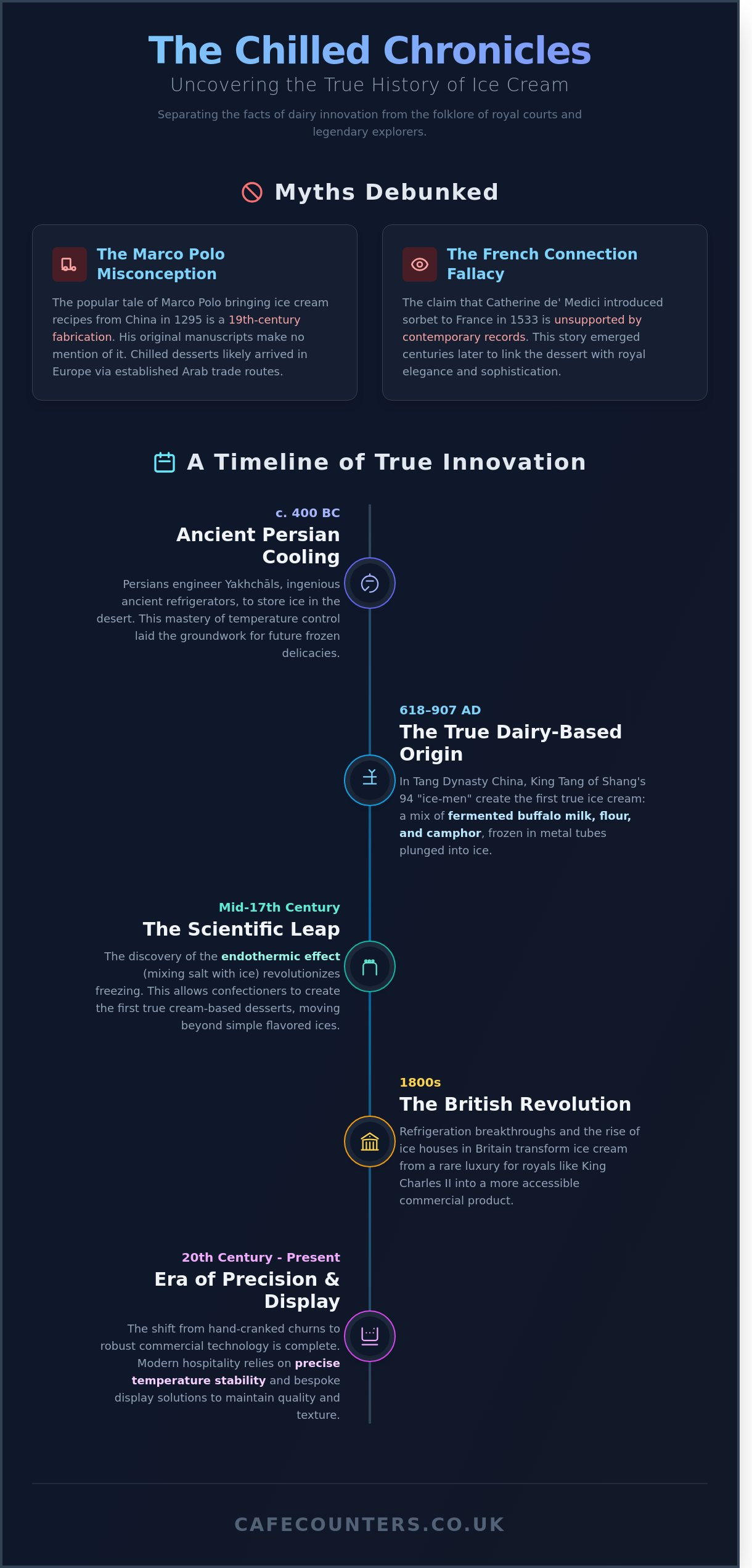
One of the most enduring legends suggests that Marco Polo returned from China in 1295 with a recipe for water ices. However, a close inspection of Polo’s original manuscripts reveals no mention of such a discovery. Historians note that chilled desserts and pasta likely entered Europe through established Arab trade routes long before Polo’s travels. This specific myth gained traction during the 1800s, largely driven by marketing efforts to make the treat feel more exotic to the Victorian public. Understanding the History of ice cream requires looking past these romanticised tales of exploration and focusing on the actual progression of cooling technology across the Mediterranean.
Catherine de’ Medici and the French Connection
Another frequent claim credits Catherine de’ Medici with introducing sorbet to the French court in 1533. The story alleges she brought Italian chefs to Paris for her wedding to Henry II, forever changing French gastronomy. Despite the popularity of this narrative, there isn’t a single contemporary record from the 16th century that supports it. This story emerged centuries later, used to associate ice cream with royal elegance and European sophistication. It’s a classic example of historical revisionism where a “prestigious” figure is retroactively linked to a luxury item to increase its perceived value.
The Victorian era played a pivotal role in cementing these myths. Writers and confectioners in the 1800s sought to provide a grand lineage for what was then becoming a popular commercial product. They preferred a romantic historical narrative over the technical, incremental reality of how cooling techniques evolved. By creating these legends, they turned a technical achievement into a royal one. For a modern hospitality business, focusing on the robust, functional reality of production is far more valuable than relying on these fanciful origin stories. We value the precision of the manufacturing process, and the history of ice cream is, at its heart, a history of technical innovation rather than royal decree.
The True Origins: From Ancient China to the Arab World
To understand who first invented ice cream, we must look beyond the modern gelato parlour and examine the sophisticated culinary practices of ancient civilisations. While the question of who first invented ice cream often leads to myths about Marco Polo or Roman emperors, historical evidence points to the Tang Dynasty in China as the earliest source of a structured, dairy-based frozen treat. These early iterations were not merely accidental discoveries but were the result of deliberate cooling techniques and ingredient blending that required a high level of technical skill.
The Tang Dynasty’s Frozen Confections
King Tang of Shang, who ruled during the Tang Dynasty (618–907 AD), employed a dedicated team of 94 ice-men to manage his royal refreshments. This specialised workforce was responsible for creating a complex mixture of fermented buffalo milk, flour, and camphor. The camphor, an aromatic substance derived from evergreen trees, provided a cooling sensation and a unique flavour profile that differs significantly from modern vanilla or chocolate palettes. This fermented milk mixture was thickened with flour and placed into metal tubes, which were then lowered into pools of ice and salt to freeze. As noted in The History of Ice Cream, this process served as a precursor to the churned methods that would eventually dominate the industry centuries later.
Persian Cooling and the Rise of Sharbats
Ancient Persians mastered the art of temperature control in arid climates as early as 400 BC. They engineered massive conical structures called Yakhchals, which functioned as early evaporative coolers. These architectural marvels used subterranean storage to keep ice frozen throughout the scorching summer months, allowing the elite to enjoy chilled delicacies in the desert. Persian engineers harvested ice from nearby mountains and combined it with rosewater, saffron, and vermicelli to create a treat known as Faloodeh. This was a distinct departure from the dairy-heavy versions found in China, focusing instead on floral aromatics and textural contrast.
The Arab world evolved these recipes into “sharbat,” the direct ancestor of the modern sorbet. These chilled fruit drinks were sweetened with honey or sugar and cooled with snow. As trade routes expanded through the Mediterranean, these techniques reached Sicily and southern Italy, laying the groundwork for the European ice cream revolution. These early water-based ices were prized for their refreshing qualities and represented a significant status symbol due to the logistical difficulty of transporting and storing ice.
Just as these ancient cultures used bespoke engineering to master temperature control, modern operators require bespoke commercial catering solutions to maintain the integrity of their frozen products. The journey from a metal tube in a salt pool to a high-end display counter reflects a long-standing commitment to precision and quality that defines the hospitality sector today.
The Science of Cold: How Early Confections Were Frozen
While the question of who first invented ice cream often leads to ancient legends, the physical reality of the dessert relies on a specific scientific breakthrough. Chinese innovators first realised that adding salt to ice accelerated the cooling process. Arab scientists later refined these methods during the Middle Ages. This wasn’t just a culinary curiosity; it was a sophisticated application of chemistry. Ibn Abu Usaybi, a 13th-century medical historian, provided some of the earliest technical descriptions of these cooling techniques. His work documented how saltpetre or common salt could be used to chill liquids to temperatures impossible with ice alone. What began as a chemist’s party trick eventually transformed into a reliable kitchen method, allowing chefs to freeze sweetened creams and fruit juices systematically.
The Discovery of the Endothermic Process
The endothermic process is the chemical key to ice cream’s creation. When salt is mixed with ice, it lowers the freezing point of the mixture, which forces the ice to melt at a lower temperature than usual. This melting process requires energy, which it draws from the surrounding cream or juice, effectively pulling heat away and cooling the mixture below 0°C. In 1589, Italian scientist Giambattista della Porta published experiments that brought this science into the culinary sphere. These 16th-century developments laid the groundwork for modern refrigeration. For those interested in the broader timeline of these developments, A Brief History of Ice Cream details how these techniques eventually crossed oceans to reach global popularity.
The First “Ice Cream Machines”
Before mechanical refrigeration, the “pot-in-pail” method served as the industry standard for production. A metal pot containing the ingredients was placed inside a larger wooden bucket filled with the salt and ice mixture. This required intense physical labour. Workers had to agitate the mixture constantly to prevent large ice crystals from forming, ensuring a smooth, palatable texture. This historical focus on temperature control and consistency remains vital today. Whether it’s a 17th-century kitchen or a modern commercial space, the goal is the same: maintaining the perfect environment for delicate confections. Choosing a high-quality patisserie display counter is the contemporary equivalent of those early efforts, providing the precise thermal stability needed to keep products fresh and visually appealing for customers.
The British Ice Cream Revolution: From Royal Treat to the Penny Lick
While historians continue to debate who first invented ice cream on a global scale, the British story began as a strictly aristocratic affair. The first recorded service of ice cream in England occurred at a Feast of St George at Windsor Castle in 1671. King Charles II was the only person at the table offered the rare delicacy, which was then a symbol of ultimate prestige. For nearly two centuries, the treat remained confined to royal courts and the kitchens of the wealthy, where private ice houses were required to store the expensive blocks of frozen water needed for production.
The transition from a royal luxury to a national staple was driven by industrial ingenuity and a spirit of British commercialisation. By the mid-19th century, the UK pioneered the infrastructure that allowed ice cream to become the world’s favourite treat. This shift wasn’t just about flavour; it was about the engineering of cold storage and the birth of the modern retail experience.
Carlo Gatti and the Democratisation of Cold
In the 1850s, a Swiss-Italian immigrant named Carlo Gatti revolutionised the London food scene. Gatti understood that to make ice cream affordable, he needed a reliable, low-cost supply of ice. In 1851, he began shipping massive blocks of ice from Norway to London’s Regent’s Canal. He built two enormous ice wells, each capable of holding 1,000 tonnes of ice, which served as the foundation for his business empire.
Gatti’s impact was immediate. He began selling scoops of ice cream for one penny from his fleet of carts, making the product accessible to the working class for the first time. He eventually moved from street vending to opening the first dedicated ice cream parlours in London. These establishments were the ancestors of the modern cafes we design today, proving that a well-managed retail space is essential for commercial longevity.
The Victorian “Penny Lick” and Hygiene
The rise of the Victorian street seller introduced the “Penny Lick,” a small, thick glass cup that held a single penny’s worth of ice cream. While this helped popularise the treat, it created significant public health risks. Vendors would often give the glass a quick wipe with a damp cloth before serving the next customer. This lack of sanitation contributed to the spread of diseases like tuberculosis and cholera, leading to a total ban on the Penny Lick by 1899.
The ban forced a move toward more hygienic serving methods, including the invention of the edible wafer cone and the development of better storage solutions. This historical shift highlights the enduring need for food safety in the hospitality sector. Today, we maintain these standards through advanced technology. A robust deli display counter now provides the precise temperature control and hygienic barriers that Victorian vendors lacked, ensuring that products stay fresh and safe for public consumption.
Our heritage in British manufacturing means we understand the evolution of these standards. If you are looking to install a professional serving area that combines historical charm with modern efficiency, our team offers a comprehensive concept to completion service for your business.
Modern Ice Cream Display: Preserving the Legacy of Quality
The journey from ancient snow-chilled delicacies to the modern refrigerated counter represents a significant leap in food science. While scholars continue to debate who first invented ice cream, the challenge has always remained the same: maintaining the perfect texture. Early pioneers in the 16th and 17th centuries relied on salt and ice to lower freezing points. Today, we use precision engineering to protect the delicate structure of fats and air that give gelato its signature mouthfeel. Transitioning from historical production to a retail environment requires a deep understanding of thermal stability. British craftsmanship in counter design ensures that the legacy of these ancient treats is preserved through consistent, reliable cooling technology.
The Engineering Behind the Perfect Scoop
Precision is vital when displaying frozen confectionery. Modern refrigerated grab and go display units utilise advanced laminar airflow to prevent melting and ice crystal formation. This system creates a protective air curtain that maintains a steady temperature between -14°C and -18°C, even during peak service hours. High-visibility, heated glass is a critical feature, as it eliminates condensation and ensures 100% clarity for customers. TFSE Products employs detailed CAD modelling to ensure every technical component fits perfectly within the available footprint. This meticulous approach to design prevents the mechanical failures that lead to product waste and lost revenue.
- Laminar Airflow: Maintains a consistent temperature barrier across the product face.
- Anti-Condensation Glass: Drives impulse sales by providing an unobstructed view of flavours.
- CAD Integration: Ensures technical components like compressors and fans operate with maximum efficiency.
Bespoke Solutions for the Modern Cafe
A standard, mass-produced unit rarely suffices for a high-end patisserie or a specialist gelato parlour. These spaces require a prestigious atmosphere that reflects the quality of the artisanal product. Our “Concept to Completion” service provides UK hospitality businesses with a turnkey solution, moving from initial sketches to a fully installed, functional masterpiece. Choosing a bespoke counter allows for a seamless aesthetic that aligns with your brand’s unique identity. It’s a way to honour the centuries of history behind your recipes. When your customers ask who first invented ice cream, they’re engaging with a story of luxury and innovation. Providing that treat in a robust, stunning display ensures the customer experience is as refined as the product itself.
Honouring History Through Modern Innovation
The evolution of frozen desserts spans over 1,400 years, moving from the buffalo milk ice of 7th-century China to the sophisticated chilled sherbets of the medieval Arab world. Understanding who first invented ice cream reveals a story of constant technical progress, particularly in the 19th-century UK where the “Penny Lick” finally made the treat accessible to the masses. Today, maintaining that legacy of quality requires more than just a great recipe. It demands a professional environment that prioritises hygiene, temperature control, and visual appeal.
At Cafe Counters, we’ve been refining the art of the commercial interior since 1991. Our UK-based manufacturing facility combines traditional British craftsmanship with expert CAD modelling to ensure every bespoke counter integrates seamlessly into your specific floor plan. We understand the unique pressures of the hospitality sector and provide robust, functional equipment designed for long-term operational efficiency. From the initial design phase to the final installation, our team manages the entire process to reduce your stress and guarantee a prestigious finish.
Explore our bespoke cafe counter solutions from concept to completion and let’s build a space that does justice to your craft.
Frequently Asked Questions
Who is credited with inventing the first ice cream recipe?
Antonio Latini is credited with writing the first official recipe for a milk-based sorbet in 1692. While ancient cultures enjoyed various frozen desserts, Latini’s book, Lo Scalco alla Moderna, contains the earliest recorded instructions for what we recognise as modern ice cream. This milestone is often cited when historians discuss who first invented ice cream in its creamy, dairy-led form. His work helped transition frozen treats from simple shaved ice into a sophisticated culinary staple.
Did the Romans eat ice cream?
Romans didn’t eat ice cream in its modern dairy form, but Emperor Nero is documented in the 1st Century AD ordering mountain snow to be mixed with honey and fruit. This primitive precursor, known as shaved ice, was an expensive luxury reserved for the elite. It lacked the creamy texture of modern products because the technology to freeze dairy hadn’t been developed in the Roman Empire. It remained a simple, cold refreshment rather than a structured dessert.
When was the first ice cream parlour opened in the UK?
Carlo Gatti opened the first dedicated ice cream stall in London’s Hungerford Market in 1851. Gatti, a Swiss-Italian entrepreneur, revolutionised the British market by selling Penny Licks to the general public for a single penny. Before this, ice cream was a luxury for the wealthy. His success laid the foundation for the modern British ice cream industry and the high-street parlours we design and manufacture today.
How was ice cream kept cold before electricity?
Ice cream was kept cold using ice houses and the endothermic property of salt mixed with ice. In the 18th and 19th centuries, blocks of ice were harvested from frozen lakes and stored in deep underground pits insulated with straw and sawdust. By adding salt to the ice, confectioners could lower the freezing point to roughly -21°C. This allowed them to freeze and maintain the consistency of dairy mixtures without modern refrigeration.
Is it true that Marco Polo brought ice cream from China?
There’s no historical evidence that Marco Polo brought ice cream recipes from China to Italy in the 13th Century. While many believe this story, historians consider it a 19th-century marketing myth. Although we can’t definitively say who first invented ice cream, records from the Tang Dynasty between 618 and 907 AD show that Chinese emperors enjoyed a frozen mixture of buffalo milk and flour long before Polo’s travels began.
What was a “Penny Lick” in Victorian London?
A Penny Lick was a small, thick-bottomed glass cup used by Victorian street vendors to serve a single penny’s worth of ice cream. Customers would lick the glass clean and return it to the vendor, who would often give it a quick wipe before the next sale. Because of the spread of tuberculosis and cholera, the British government officially banned these unsanitary vessels in 1898. This led to the rise of more hygienic, edible containers.
When was the ice cream cone invented?
The edible ice cream cone gained global popularity at the 1904 St. Louis World’s Fair when Ernest Hamwi rolled a waffle-like pastry to help an ice cream vendor who’d run out of dishes. While Italo Marchiony received a patent for a cone mould in 1903, the 1904 event is the moment the cone became a commercial sensation. It solved the hygiene issues of the Victorian era and became a permanent fixture in British seaside culture.
Why is temperature control so critical for commercial ice cream displays?
Temperature control is critical because a variance of just 2°C can cause ice crystals to grow, which ruins the smooth texture of the product. In a commercial setting, keeping the display between -14°C and -16°C ensures the ice cream remains perfectly scoopable for customers. Our bespoke counters use high-grade insulation and precision cooling to maintain these levels. This reliability protects your margins by reducing waste and ensuring your product stays at its best.