
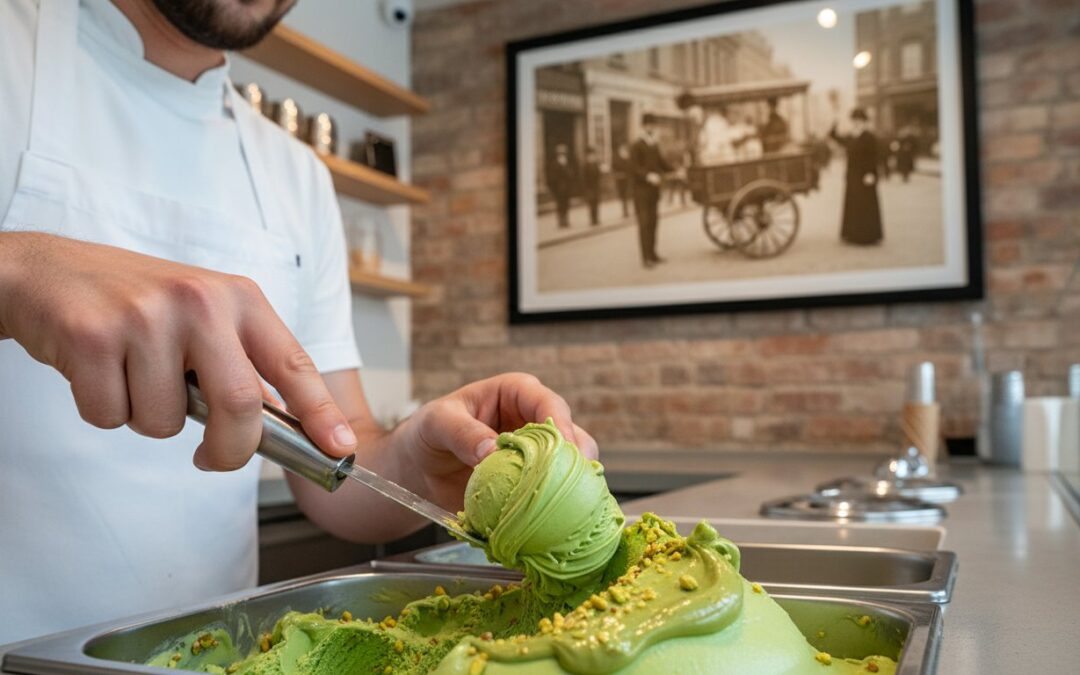
What if the story you’ve heard about Marco Polo bringing frozen treats back from the East is actually a 700-year-old marketing myth? While many people assume the answer to who made the first ice cream is found in the Renaissance courts of Italy, the historical record points much further back to the Tang Dynasty in 618 AD. You likely recognize ice cream as a staple of the British seaside or a sophisticated dessert in a high-end restaurant, yet the journey from ancient frozen buffalo milk to the sleek, ergonomic displays of a modern cafe is filled with technical hurdles and surprising innovations.
In this article, we’ll separate historical fact from legend by examining how 16th-century royal chefs and 19th-century inventors like Nancy Johnson, who patented the hand-cranked freezer in 1843, paved the way for the global industry we see today. You’ll learn the crucial distinctions between gelato, sorbet, and dairy ice cream, alongside the 1920s refrigeration shifts that allowed commercial sales to flourish. Whether you’re looking for inspiration to launch a bespoke artisan food business or simply love the history of catering, this timeline provides the professional insight needed to understand the craftsmanship behind every scoop. We’ll guide you from the initial concept of frozen snow to the seamless installation of a prestigious retail space.
Key Takeaways
- Trace the long evolutionary path of frozen desserts, starting with the earliest recorded evidence of milk-based ice during the Tang Dynasty.
- Separate fact from fiction as we examine the evidence of who made the first ice cream and debunk common myths surrounding Marco Polo.
- Examine the transition of ice cream into a prestigious luxury in the Medici courts and its eventual commercial boom in the Victorian streets of Britain.
- Identify why high-end display technology is essential for preserving the quality and ‘perfect scoop’ temperature of artisan gelato in a modern commercial setting.
- Gain insights into the journey from ancient luxury to a global icon, helping you appreciate the craftsmanship required for today’s bespoke dessert displays.
The Ancient Origins: Who Really Invented the First Frozen Dessert?
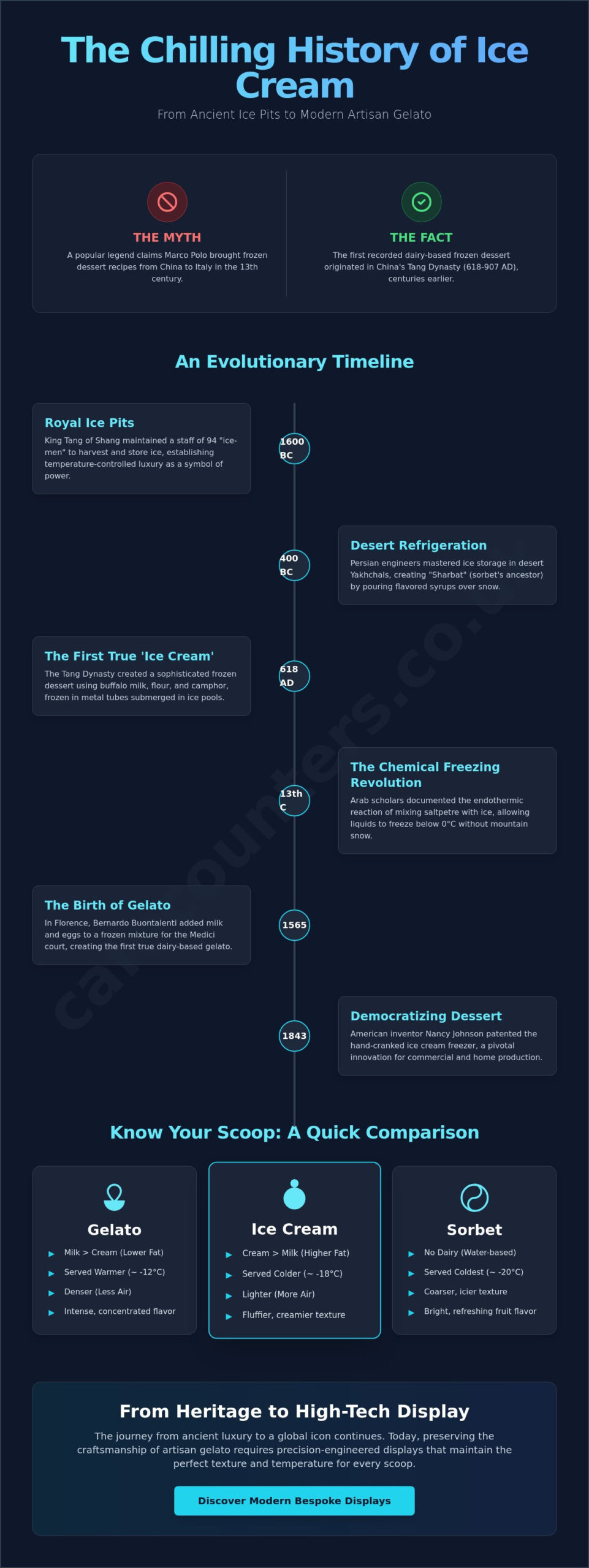
Determining exactly who made the first ice cream requires looking past a single inventor to an evolutionary timeline of cooling technology. The process wasn’t an overnight discovery but a result of centuries of refinement in temperature management and ingredient sourcing. The earliest documented evidence of a dairy-based frozen dessert originates from China during the Tang Dynasty, which lasted from 618 to 907 AD. This era saw the creation of a sophisticated frozen mixture that served as a precursor to modern confectionery.
The recipe used by the Tang court was remarkably specific, combining buffalo milk with flour and camphor to create a textured, aromatic dish. Workers placed this mixture into metal tubes and submerged them in ice pools to achieve a frozen consistency. This tradition of royal indulgence goes back even further to King Tang of Shang, who in 1600 BC maintained a dedicated staff of 94 ice-men. These specialists were responsible for harvesting and storing ice, a logistical feat that mirrors the precision required in modern commercial kitchen design. This deep-seated human desire for temperature-controlled luxury is a foundational element in the comprehensive history of ice cream.
The Persian Connection: Sharbat and Ice Houses
By 400 BC, Persian engineers had mastered the art of storing ice in the middle of the desert using Yakhchals. These massive, conical structures functioned as ancient refrigerators, utilizing evaporative cooling and thick, heat-resistant walls to keep winter ice solid throughout the scorching summer months. They used this stored ice to create early forms of chilled treats by pouring grape juice, saffron, or rosewater over bowls of snow. Sharbat is the linguistic and culinary ancestor of sorbet. These innovations represent a shift from simple chilled drinks to structured, frozen desserts that required precise environmental management and bespoke storage solutions.
The Arab Contribution to Freezing Techniques
The transition from simple snow-based treats to true frozen dairy required a leap in chemical understanding. During the 13th century, the Arab medical historian Ibn Abu Usaybi documented early methods of temperature reduction that would eventually revolutionize the food industry. These techniques utilized the endothermic reaction created by mixing saltpetre with ice; this process allows liquids to freeze at temperatures significantly below the freezing point of water. This discovery was a turning point for culinary production. Traders eventually carried these cooling methods across the Mediterranean via established trade routes, providing the technical foundation for the European confectionery boom that followed. The Arab influence ensured that cooling was no longer dependent on the weather, but was instead a repeatable, manufactured process.
From Medici Courts to Paris Cafes: The Italian Renaissance of Gelato
The 16th century marked a pivotal shift in the evolution of frozen treats. While the Middle East had long enjoyed fruit-based syrups chilled by mountain snow, the Italian Renaissance transformed these rudimentary ices into a refined art form. Florence earned its reputation as the ‘Cradle of Gelato’ during this era. The ruling elite used frozen desserts to demonstrate their immense wealth and technical capabilities. Maintaining ice houses through the summer months required significant engineering. This turned every chilled serving into a display of logistical power and prestige.
The Three Pillars of Italian Gelato
The identity of who made the first ice cream often focuses on three key figures. Ruggeri, a 16th-century livestock seller, first gained fame by winning a culinary contest hosted by the Medici court. He presented a recipe for flavored ice that captivated the judges. However, the credit for the creamy texture we recognize today often goes to Bernardo Buontalenti. In 1565, this Florentine architect and engineer introduced milk and eggs to the mixture. He created the first true dairy-based gelato. The real history of ice cream suggests that these innovations moved the industry beyond simple water-based sorbets. Finally, Francesco Procopio dei Coltelli brought this Italian expertise to the masses. In 1686, he opened Café Procope in Paris, which became the blueprint for the modern gelateria.
Artisan Craftsmanship and the First Gelaterias
Café Procope served as a catalyst for the commercialization of frozen desserts. It moved the product from the secretive kitchens of royal courts into a public space. The cafe attracted the European intelligentsia, including figures like Voltaire and Rousseau. These thinkers discussed philosophy over bowls of chilled cream. This transition required a new approach to service design. The 17th-century Parisian cafes developed dedicated serving stations. These were both ergonomic and visually impressive. They were designed to handle the delicate nature of the product while maintaining a high-end atmosphere.
This shift from private luxury to public enterprise mirrors the modern challenges of creating a functional hospitality space. The question of who made the first ice cream is tied to the evolution of these early Florentine experiments and their commercial debut in France. Whether you’re looking to design a bespoke serving counter or a full turnkey installation, the focus remains on combining aesthetic appeal with operational efficiency. The transition from ice to dairy in the 1600s demanded better insulation and specialized equipment. It’s much like the precision-engineered solutions required for today’s high-street retail environments. By the late 17th century, the secret was out. The foundation for a global industry was firmly established.
Debunking the Myths: Marco Polo and the Salt-Ice Revolution
When investigating who made the first ice cream, we must separate romantic folklore from documented manufacturing history. Many popular accounts credit Marco Polo with bringing a recipe from China in the late 13th century, or Catherine de’ Medici with introducing the dessert to the French court in 1533. Modern historians find no evidence in contemporary records to support these claims. These narratives gained traction during the Victorian era; marketers and confectioners created these origin myths to lend a sense of prestigious heritage to their products. This approach mirrors how a modern business might highlight its British roots to signify quality and reliability to a skeptical market.
The 1660s serve as the true decade of European ice cream expansion. Before this period, frozen treats were largely limited to flavored ice or snow. The shift to a creamy, consistent texture required more than just a recipe; it required a technical breakthrough in temperature control. This shift moved the industry away from fleeting aesthetics and toward a more robust, functional method of production.
The Chemistry of the Chill
The real innovation in the history of frozen desserts wasn’t a single person but a chemical discovery. By adding salt to ice, early caterers could lower the freezing point of water well below zero degrees Celsius. This endothermic reaction allowed for a controlled, seamless freezing process. It transformed what was once a chemist’s party trick into the foundation of the professional catering industry. Before the 1843 invention of the hand-cranked churn, chefs utilized the pot-freezer method. This involved placing a metal pewter pot inside a wooden bucket packed with a salt and ice mixture. This technical precision ensured a smooth texture, preventing the formation of the large, coarse ice crystals that plagued earlier attempts.
Fact vs. Fiction in the History of Food
Historical accuracy is essential for understanding the evolution of any industry. While some stories suggest King Charles I paid his personal chef a secret pension to keep his ice cream recipe private, no financial records from the 1630s exist to prove it. For a grounded perspective on these developments, Yale’s history of ice cream details how these early luxury items eventually transitioned from royal curiosities into commercial products. To understand who made the first ice cream in a documented sense, we look to 1718, the year the first recipe in the English language appeared in Mary Eales’s Receipts. This publication marked a transition toward the bespoke, structured culinary discipline that defines the modern hospitality sector. This era moved past the myths, focusing instead on the repeatable processes and technical mastery required to deliver a consistent, high-end product.
The Victorian Boom: How Britain Revolutionised the Commercial Ice Cream Trade
While the historical debate over who made the first ice cream often focuses on ancient China or the Italian Renaissance, it was Victorian Britain that transformed the dessert into a commercial powerhouse. In the early 1800s, ice cream remained a prestigious luxury reserved for the upper classes, served at lavish banquets and royal tables. This changed rapidly as the Industrial Revolution introduced mechanical refrigeration. By the 1850s, the “Penny Lick” became a London staple. Street vendors sold small scoops in thick glass cups for a penny. Customers licked the glass clean and returned it, a practice that continued until health officials banned it due to hygiene concerns in 1899.
The mid-19th century saw a surge in technical innovation. In 1843, Nancy Johnson patented the hand-cranked freezer, but it was the British market that truly scaled the production process. The transition from artisan production to mass-market availability required a shift in how food was stored and presented. Business owners began to invest in robust, functional equipment to manage the logistical challenges of temperature-controlled retail.
Agnes Marshall: The Celebrity Chef of Ice Cream
Agnes Marshall, widely known as the “Queen of Ices,” was a visionary who democratised the dessert for the British public. In 1885, she patented an improved ice cream machine that could freeze a mixture in under five minutes, a feat of engineering at the time. She even suggested using liquid oxygen to create ice cream in 1901, decades before the technique became a modern culinary trend. Her cookery school and books made sophisticated recipes accessible to the British middle class. This period marked the transition toward professional deli counters for food presentation, allowing retailers to showcase their products with the same pride and precision found in her London demonstrations.
The Birth of the Modern Ice Cream Parlour
The 20th century saw the rise of dedicated shops that prioritised high-end shopfitting and customer experience. Italian immigrants settled in cities like Manchester and Glasgow, bringing artisanal techniques and a flair for hospitality. These pioneers established the first true parlours, moving away from street carts toward sophisticated, hygienic environments. While historians still debate who made the first ice cream, there’s no doubt that these entrepreneurs defined the modern retail experience. They utilised refrigerated grab and go display units to ensure product quality while maintaining a seamless flow of service. This shift from temporary stalls to permanent, bespoke installations allowed the British ice cream trade to flourish into the multi-billion pound industry it is today.
If you’re looking to build a legacy as enduring as these Victorian pioneers, our expert team provides a Concept to Completion service for bespoke commercial spaces. Contact Cafe Counters today to discuss your next project and bring your vision to life.
The Future of Display: Preserving the Heritage of Artisan Gelato Today
The journey from ancient snow-cooled desserts to the modern high-street parlour represents a significant technological leap. While historians still investigate who made the first ice cream, the current focus of the industry is on how we preserve that legacy for future generations. Modern display technology serves as the final chapter in this global history, transforming what was once a fleeting royal luxury into a stable commercial staple. Maintaining a precise ‘perfect scoop’ temperature, typically between -13°C and -16°C, remains a major challenge in busy retail environments where display lids are constantly opened. Bespoke counters solve this by bridging the gap between historical artisanry and modern engineering efficiency, ensuring the product remains exactly as the maker intended.
Engineering the Perfect Presentation
Our design process utilises advanced CAD modelling to develop ‘Concept to Completion’ displays that maximise both ergonomics and aesthetics. We understand that visibility is a primary driver of sales; industry data suggests that 70% of purchasing decisions in parlours are made at the point of display. We integrate high-CRI LED lighting that showcases the natural pigments of artisan ingredients without emitting heat that could compromise the product’s surface. Looking toward the 2026 market, the shift is firmly toward energy-efficient cooling. New UK regulations require lower-GWP (Global Warming Potential) refrigerants and enhanced thermal insulation. Our latest units incorporate these standards to reduce operational costs while maintaining the rigorous climate control required for high-fat gelato.
Creating Your Own Legacy with TFSE Products
We help modern cafe owners honour the innovators who made the first ice cream by providing the tools to serve it perfectly in a contemporary setting. Our UK-based manufacturing facility allows for a level of quality control that imported, mass-produced units cannot match. This local oversight ensures every weld and glass joint is robust enough for the high-traffic demands of the hospitality sector. Choosing British-made counters means you receive a 100% bespoke design, allowing you to match your brand’s specific heritage style while benefiting from modern durability. We handle the entire journey, from the initial technical drawings to the final installation on your shop floor.
- Precision Cooling: Digital thermostats ensure consistent temperatures to prevent ice crystal formation.
- Bespoke Aesthetics: Custom finishes that align with your interior design and brand story.
- Durability: High-grade stainless steel and toughened glass built for longevity.
If you’re ready to elevate your service and protect the quality of your artisan products, contact us to design your bespoke ice cream or patisserie display. Our team is ready to turn your vision into a functional, high-performance reality.
Honouring the Legacy of Frozen Excellence
The journey from ancient snow-chilled honey to the sophisticated gelato of the Italian Renaissance reveals that the question of who made the first ice cream isn’t answered by a single name, but by centuries of culinary innovation. From the salt-ice revolutions of the 17th century to Agnes Marshall’s Victorian commercial boom in 1885, ice cream has evolved into a global icon that demands professional presentation. Preserving this rich heritage requires more than just a standard freezer; it necessitates a display that balances technical precision with aesthetic appeal.
Since 1991, Cafe Counters has specialized in translating this history into high-performance retail environments through our in-house UK manufacturing. We act as your expert partner, providing a Concept to Completion project management service that ensures every bespoke patisserie and gelato display meets the rigorous demands of a modern commercial space. Our team focuses on robust, functional design to help your business showcase quality products with total confidence.
Design your bespoke ice cream display with the UK experts
We look forward to helping you build a lasting legacy for your brand.
Frequently Asked Questions
Who is credited with making the first ice cream?
Ancient Chinese civilizations during the Tang Dynasty, from 618 to 907 AD, are widely credited with creating the earliest milk-based frozen desserts. They used a mixture of buffalo milk, flour, and camphor, frozen in metal tubes submerged in ice and saltpeter. While several cultures contributed to the evolution of the treat, historical records from this era provide the first concrete evidence of who made the first ice cream in a recognizable form.
When was ice cream first introduced to England?
Ice cream was first served in England at a Feast of St. George at Windsor Castle in 1671. This exclusive event, held for King Charles II, featured “one plate of ice cream” as the only cold dish on the menu. This milestone marks the beginning of the British obsession with chilled desserts, eventually leading to the bespoke catering solutions and high-end shopfitting seen across the UK today.
Is it true that Marco Polo brought ice cream from China?
Most historians believe the story of Marco Polo bringing ice cream recipes from China to Italy in 1295 is a myth. While he likely encountered frozen milk desserts during his travels, no written evidence in his journals confirms he introduced the concept to Europe. The legend gained popularity in the 19th century, but the actual spread of frozen treats followed trade routes and diplomatic exchanges rather than a single explorer.
What was the first flavour of ice cream ever made?
The earliest recorded flavours were derived from natural aromatics like camphor, rosewater, and honey. In the 17th century, when ice cream began appearing in European cookbooks, orange flower water and citrus were the most common additions. It wasn’t until 1768 that vanilla became a documented preference, following the publication of “L’Art de Bien Faire les Glaces” by M. Emy, which helped define the professional standards for dessert manufacturing.
How did they keep ice cream frozen before electricity?
Before the advent of mechanical refrigeration in the 19th century, chefs used insulated ice houses and the “pot-in-pot” method. They harvested ice from frozen lakes during winter and stored it in deep underground pits lined with straw and sawdust. By mixing this ice with salt, they created an endothermic reaction that lowered the temperature enough to freeze liquid cream, a technique that required robust physical labour and precise temperature management.
When was the first commercial ice cream machine invented?
Nancy Johnson, an American inventor, patented the first hand-cranked ice cream churn on September 9, 1843. Her design featured a wooden bucket filled with ice and salt and an inner metal cylinder with a paddle. This ergonomic innovation revolutionized the industry by making it easier to produce smooth textures. It laid the groundwork for the seamless, high-volume production systems we install in modern commercial kitchens today.
What is the difference between historic sorbet and modern ice cream?
The primary difference lies in the fat content and the use of dairy. Historic sorbets, or “sharbats,” originated in the Middle East around 1000 AD and consisted of crushed ice mixed with fruit syrups or honey. Modern ice cream requires at least 10 percent milkfat to meet legal standards in most regions. Determining who made the first ice cream depends on whether you define the dish by its frozen state or its creamy dairy base.
Why was ice cream once considered a dessert only for royalty?
Ice cream was a symbol of prestige because the cost of harvesting, transporting, and storing natural ice was astronomical. Until the mid-1800s, only the wealthiest estates could afford the infrastructure of an ice house and the staff needed for the labour-intensive freezing process. It was a status symbol of power over nature, much like how a stunning, custom-designed retail space today signals a brand’s commitment to quality and professional excellence.