
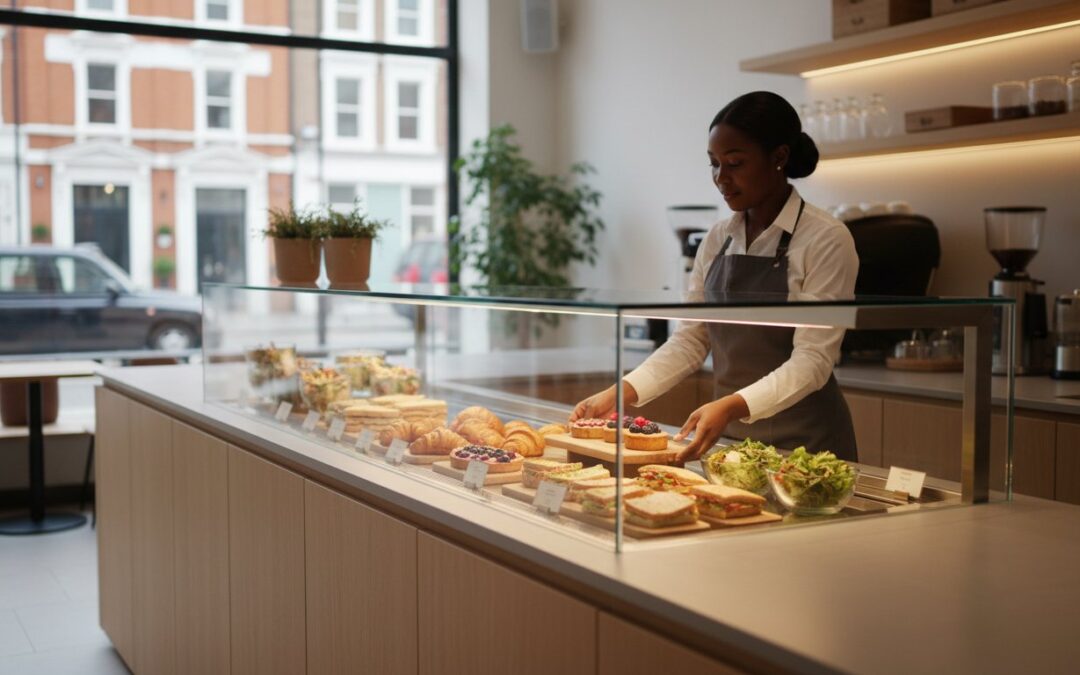
According to recent industry data from the Carbon Trust, refrigeration accounts for up to 40% of the average UK cafe’s total energy expenditure. For an independent shop, an inefficient unit can leak over £1,500 in wasted electricity costs every year. You know that finding the right refrigerated counter for cafes is a high-stakes decision where a single centimetre of poor fit or a slow temperature recovery time can ruin your workflow and your margins. It’s frustrating when standard off-the-shelf units don’t align with your vision for a prestigious, seamless shopfront.
We promise to bridge that gap by showing you how to master the technical and aesthetic factors of commercial cooling. You’ll learn how to choose a system that ensures 100% compliance with UK health and safety standards while driving a 15% increase in impulse purchases through superior visibility. This guide walks you through the transition from initial concept to a finished, functional space that stands the test of time. We’ll cover everything from bespoke British manufacturing to the latest 2026 energy regulations.
Key Takeaways
- Learn how a high-performance refrigerated counter for cafes acts as a vital sales engine by balancing crystal-clear visibility with rapid temperature recovery.
- Understand the technical importance of UK Climate Class ratings and “air curtain” technology to ensure food safety and operational efficiency in busy environments.
- Discover why bespoke British manufacturing offers superior longevity over off-the-shelf units, tailoring every dimension to your specific menu and architectural space.
- Master strategic placement techniques, such as the “Golden Zone” of display, to maximise high-margin sales and improve staff ergonomics for faster service.
- Explore the benefits of a “Concept to Completion” service, utilizing in-house CAD design and professional installation to deliver a robust, prestigious finish.
What is a Refrigerated Counter for Cafes? Defining the Sales Engine
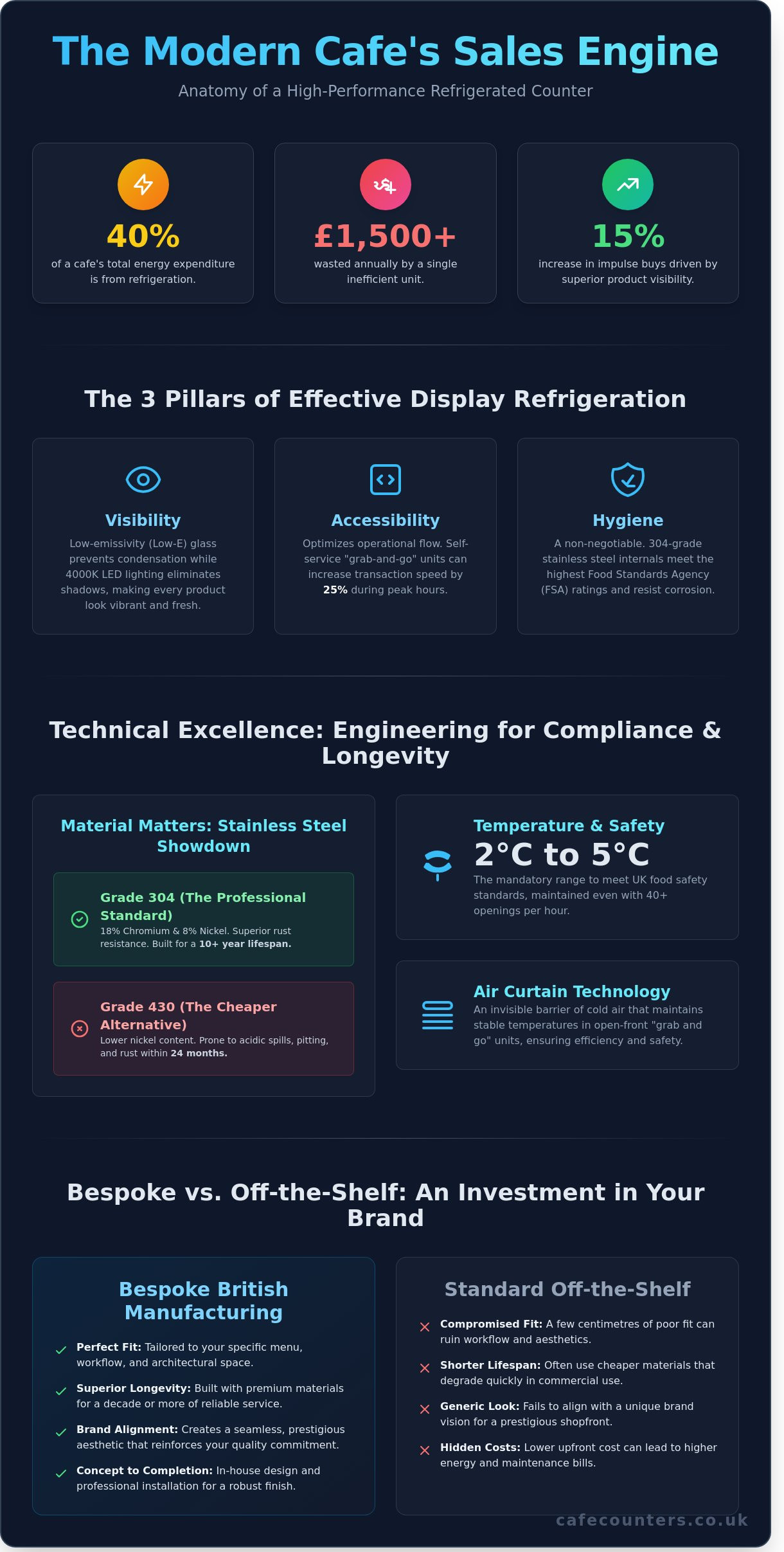
Every successful cafe interior relies on a central anchor point to convert footfall into revenue. A refrigerated counter for cafes isn’t just a cooling box; it’s a sophisticated display system engineered to protect delicate ingredients while presenting them in the best possible light. These units represent the intersection of precision engineering and high-end retail design. Unlike a standard back-of-house storage fridge, a display counter must withstand 40 or more door openings per hour while maintaining a consistent core temperature between 2°C and 5°C to meet UK food safety standards.
The technical requirements of front-of-house equipment differ significantly from hidden storage. Modern refrigeration technology has evolved to prioritize rapid temperature recovery. When a barista reaches for a milk alternative or a customer selects a wrap, the unit must instantly compensate for the influx of warm air. High-torque fans and oversized evaporators ensure the internal climate remains stable, preventing the wilting of fresh produce or the sweating of chilled pastries. This reliability allows you to focus on service rather than worrying about spoilage during a busy lunch peak.
Your counter acts as a silent salesperson and the focal point of the customer journey. It’s the first thing a patron sees when they approach the till, making it the primary driver for the 70% of cafe purchases that are decided at the point of sale. By aligning the counter’s aesthetic with your brand’s identity, you create a seamless transition from the shopfront to the product. Whether it’s a sleek, frameless glass design for a minimalist London espresso bar or a robust, timber-clad unit for a rustic Cotswolds bakery, the counter reinforces your commitment to quality. Ultimately, a refrigerated counter is a dual-purpose tool designed for rigorous food preservation and high-impact visual merchandising.
The Three Pillars of Effective Display Refrigeration
Visibility is the foundation of any display unit. We use low-emissivity (Low-E) glass to prevent condensation and 4000K LED lighting to eliminate shadows, ensuring every product looks vibrant and fresh. Accessibility determines your operational flow; while serve-over models allow for personal interaction, self-service grab-and-go units can increase transaction speed by 25% during peak hours. Hygiene remains a non-negotiable factor. Choosing 304-grade stainless steel internals ensures your unit meets the highest Food Standards Agency (FSA) ratings and stands up to daily deep-cleaning routines without corroding.
Primary Counter Types for Modern Hospitality
Patisserie displays are specialized environments that maintain high humidity levels, often around 80%, to prevent delicate sponges and tarts from drying out. These units typically feature multiple glass shelves to maximize vertical space. Deli and sandwich counters focus on airflow and ergonomic access, featuring removable crumb trays and easy-to-clean decks for high-turnover service. For businesses seeking a minimalist look, drop-in units are the preferred choice. These bespoke solutions allow the machinery to be hidden beneath the counter surface, providing a flush, integrated appearance that fits perfectly into high-end architectural designs. Each type serves a specific function in the UK’s diverse hospitality sector, from independent boutiques to large-scale educational catering facilities.
Technical Excellence: Understanding Climate Classes and Efficiency
Selecting a high-performance refrigerated counter for cafes requires more than an eye for aesthetics. It demands a deep understanding of the engineering that preserves your inventory. For UK cafe owners, the technical specifications of a unit dictate its longevity and daily operational cost. A counter that looks sleek on the shop floor but lacks the proper climate rating will struggle during a British summer heatwave, leading to increased energy draw and potential stock loss.
Material choice is the first line of defence in a busy catering environment. We exclusively recommend Grade 304 stainless steel for all internal and external surfaces. Unlike cheaper Grade 430 alternatives, Grade 304 contains approximately 18% chromium and 8% nickel. This specific metallurgical balance provides superior resistance to the acidic spills and frequent sanitisation common in food service. Investing in this robust material ensures your counter remains rust-free and hygienic for a decade or more, rather than showing signs of pitting within twenty-four months.
The science of airflow is equally vital, particularly for open-fronted “grab and go” units. These rely on invisible “air curtains” to maintain internal temperatures. High-velocity fans circulate a precise stream of cold air across the front opening, creating a thermal barrier. This technology ensures your sandwiches and salads remain at the correct food safety standards even when customers are browsing. Without a well-engineered air curtain, your compressor works 35% harder to compensate for the lost cooling, drastically shortening its lifespan.
Decoding Climate Class 4 and 5
Climate Class ratings are the industry benchmark for performance. Most standard UK cafes require Class 4 units, which are tested to operate efficiently at an ambient temperature of 30°C and 55% humidity. If your refrigerated counter for cafes is positioned near a panini press or a high-output espresso machine, ambient temperatures can easily exceed these limits. In such cases, a Class 5 “tropical” rating is necessary. These units are tested at 40°C, ensuring the compressor doesn’t burn out when the kitchen heats up. Choosing the wrong class is the leading cause of refrigeration failure in the UK hospitality sector.
Insulation and Refrigerant Standards
Thermal retention depends on high-density polyurethane insulation. We look for a minimum thickness of 60mm with high “pour quality” to eliminate air pockets. This insulation, combined with the transition to eco-friendly R290 refrigerant, significantly lowers operational costs. With UK business electricity rates fluctuating between 24p and 28p per kWh, an efficient unit can save a business over £200 annually in energy bills. Precision is managed through digital controllers, which maintain a steady +/- 1°C variance, preventing the micro-fluctuations that degrade delicate ingredients like fresh cream or artisan cheeses.
As we move toward stricter 2026 energy efficiency targets, our team focuses on helping you integrate these technical requirements into a bespoke cafe layout that balances performance with prestigious design. By selecting a unit with a high-efficiency rating today, you future-proof your business against rising utility costs and evolving environmental regulations.
Bespoke vs. Off-the-Shelf: Investing in Longevity and Brand
Choosing a refrigerated counter for cafes often presents a choice between immediate availability and long-term precision. Standard units offer a lower initial price point, with basic models often starting around £1,200. These off-the-shelf options work well for temporary pop-ups or low-volume sites where “good enough” suffices. However, many cafe owners find themselves dealing with the “square peg in a round hole” problem. A standard 1.5-metre unit might leave a 20cm gap in your counter line that serves as nothing but a dust trap and wasted retail potential. This inefficiency directly impacts your bottom line by reducing the total display area available to tempt customers.
Bespoke manufacturing eliminates these compromises by tailoring every millimetre to your specific menu and architectural quirks. If your sales data shows that 70% of your revenue comes from chilled pastries and bottled juices, your counter should reflect that ratio. We design units that maximize your high-margin items while fitting perfectly into your floor plan. This level of fitment increases operational speed by approximately 15% during peak morning rushes. Staff don’t have to overreach or move to secondary storage because the refrigerated counter for cafes is engineered around their specific workflow. Precision in design leads to precision in service.
The financial objection to custom manufacturing usually focuses on the upfront cost, which can be 25% to 40% higher than mass-produced alternatives. This is a narrow view of a 10-year investment. A high-quality UK-built counter typically lasts 12 years, whereas budget imports often require major component replacements after just 36 months. When you factor in the cost of emergency call-outs, which often start at £150 plus parts, the bespoke unit becomes the more economical choice by year five. Modern custom units also adhere to the latest energy conservation standards, which is vital when UK business electricity rates remain volatile. An efficient, well-insulated counter can save a cafe over £300 annually in running costs compared to an unrated budget model.
When to Choose a Custom Solution
Historic British high streets are filled with Grade II listed buildings featuring uneven floors, narrow doorways, and non-standard alcoves. In these environments, standard dimensions fail completely. Custom solutions are also essential for high-volume sites processing over 450 transactions daily. These sites require reinforced 304-grade stainless steel shelving and specialized tray slide integrations that standard units cannot support. If your brand identity relies on a specific aesthetic, such as reclaimed timber cladding or integrated LED “theatre” lighting, bespoke manufacturing is the only way to ensure a seamless finish that matches your prestigious vision.
The Pitfalls of Cheap Imports
Low-cost imports represent a significant false economy in the catering industry. These units frequently use thin-gauge 430 stainless steel and low-quality glass that chips easily under heavy use. The most hidden cost is the lack of parts availability. In 2023, many cafe owners reported wait times of six weeks for replacement compressors on non-UK models. A UK-made refrigerated counter for cafes ensures that critical components are available for next-day delivery. We prioritize robust construction and local support because a broken counter isn’t just a repair bill; it’s a total loss of chilled stock and thousands of pounds in missed revenue.
Strategic Placement: Maximising Customer Flow and Sales
Positioning your refrigerated counter for cafes is a precise science that balances customer psychology with mechanical efficiency. At Cafe Counters, we don’t rely on guesswork. We use advanced 3D CAD modeling to simulate footfall patterns before a single piece of British steel is cut. This allows you to visualize how a 1200mm wide unit impacts the queue length during a 9:00 AM rush, ensuring your layout facilitates movement rather than creating a bottleneck.
High-margin items like artisan cakes, fresh deli pots, or seasonal fruit salads must sit in the “Golden Zone.” This is the specific area between 1200mm and 1500mm from the floor. Data from retail environment studies shows that items placed at eye level receive 35% more engagement than those on bottom shelves. We also prioritise the physical well-being of your team. A counter depth exceeding 800mm can cause repetitive strain for a server, whereas a standard 900mm height ensures a comfortable reach for 95% of UK hospitality workers. Our designs link these technical dimensions directly to your service speed.
A comprehensive menu often requires a blend of temperatures. We frequently manufacture integrated units that house both heated and refrigerated sections within a single, seamless chassis. This allows a customer to select a chilled pasta salad and a warm, toasted panini from the same visual footprint. Implementing this dual-temperature strategy can increase the average transaction value by up to £2.40 per head, as it encourages customers to view your cafe as a complete meal destination.
Designing for Impulse Purchases
Placement is everything when it comes to the bottom line. Positioning your display within 1.5 metres of the till taps into the 72% of shoppers who make unplanned additions to their order at the point of purchase. We use 4000K “Natural White” LEDs to make fresh ingredients look vibrant without the clinical harshness of industrial lighting. Clear sightlines are equally vital; a well-lit counter visible through the front window can increase walk-in traffic by 18% based on 2023 retail footfall data.
Operational Flow and Back-Bar Integration
Your counter must work in perfect harmony with your espresso machine and prep stations to avoid staff collisions. Our turnkey solutions ensure that drainage points and electrical sockets are positioned exactly where they’re needed, eliminating messy cables and trip hazards. We design for the “end of shift” by including removable crumb trays and coved internal corners. This attention to detail reduces daily cleaning time by 15 minutes, which saves approximately £1,000 in annual labour costs for a typical independent cafe. From the initial concept sketch to a fully commissioned site, we manage the technical complexities so you can focus on your craft.
Ready to transform your floor plan into a high-performance sales environment? Explore our bespoke turnkey counter designs and see how our British craftsmanship can elevate your space.
The UK Manufacturing Advantage: Why TFSE Products Leads
Choosing a refrigerated counter for cafes involves more than just selecting a model from a catalogue. At TFSE Products Ltd, we’ve spent over three decades refining a British manufacturing process that prioritises precision, durability, and operational logic. By keeping our CAD design and fabrication entirely in-house, we eliminate the logistical delays and quality gaps often found with imported equipment. Every unit is built to order in our factory, which allows us to maintain 100% control over the production timeline and the standard of every weld and seal.
Sustainable British engineering is a practical business choice for the modern operator. Sourcing your equipment from a UK manufacturer can reduce the carbon footprint of your fit-out by over 40% when compared to units shipped from East Asia. It also ensures your investment supports local craftsmanship and high-grade materials. Our South East service hub ensures that technical support is never more than a few hours away. We provide rapid response times for maintenance, which is critical for protecting thousands of pounds worth of chilled stock during a heatwave or a technical fault.
- In-house CAD design: We translate your vision into millimetre-accurate blueprints.
- British Fabrication: Every counter is constructed using high-grade stainless steel for longevity.
- Logistical Efficiency: Reduced shipping distances mean faster delivery and lower environmental impact.
- Expert Installation: Our own teams manage the delivery and setup to ensure perfect integration.
Our Bespoke Design Process
Successful installations begin with a professional site survey. We don’t rely on guesswork or rough sketches; our engineers use laser-accurate measurements to create detailed CAD models. This ensures your refrigerated counter for cafes fits perfectly within your specific floor plan, accounting for existing plumbing and electrical points. Once the design is approved, it moves to the factory floor for precision fabrication. We handle the entire commissioning process, meaning your equipment is service-ready the moment we leave the site.
A Legacy of Quality Since 1991
We’ve been a fixture in the UK hospitality industry since 1991, delivering high-performance solutions for prestigious universities, high-street retail chains, and independent boutiques. Our “Concept to Completion” service removes the stress of managing multiple contractors. Buying direct from the manufacturer means you avoid the 15% to 25% markups typically added by third-party distributors. You’re paying for quality materials and expert labour rather than middleman commissions. This direct relationship also means we can offer tailored advice that generic retailers simply cannot provide.
Ready to transform your service area with a custom-built solution that’s designed to last? Enquire about your bespoke cafe counter project today and speak with our design team about your requirements.
Future-Proofing Your Cafe with Precision Engineering
Selecting the ideal refrigerated counter for cafes requires a balance between technical efficiency and operational flow. By 2026, stringent energy standards mean that selecting high-performance climate classes is essential to protect your margins against rising utility costs. A well-placed, robust unit acts as a high-yielding sales engine, ensuring your products look stunning while remaining at the perfect temperature. Investing in quality now prevents the expensive downtime associated with inferior, off-the-shelf equipment.
Since 1991, we’ve manufactured premium catering equipment from our UK facility, perfecting a seamless process that removes the stress from commercial renovations. Our team provides a full CAD design and project management service, ensuring every millimetre of your counter serves a functional purpose. As specialists in bespoke hospitality fit-outs from concept to completion, we’ve spent over 30 years helping brands build prestigious, durable spaces that last. You don’t have to navigate these technical decisions alone when you have an expert partner by your side.
Explore our range of bespoke and standard refrigerated counters to see how British craftsmanship can elevate your business. We’re ready to help you bring your vision to life with precision and pride.
Frequently Asked Questions
What is the ideal temperature for a cafe refrigerated counter?
The ideal temperature for a refrigerated counter for cafes is between 1°C and 5°C to ensure food safety and compliance with UK regulations. Maintaining this specific range prevents bacterial growth while keeping pastries, milk, and sandwiches fresh. Most digital controllers allow you to set the point at 2°C to account for frequent door openings during peak service hours.
How often should I clean the condenser on my refrigerated display?
You should clean the condenser on your refrigerated display at least once every 30 days to prevent dust and grease buildup. Failure to maintain this component can increase your energy consumption by 25% and eventually lead to a total compressor failure. A simple brush or vacuum every month ensures the system operates at peak efficiency and protects your equipment investment.
Do I need a floor drain for my refrigerated counter?
You don’t typically need a floor drain for a modern refrigerated counter because most units feature automatic electric condensate evaporation trays. These systems collect moisture and use the heat from the compressor to evaporate it safely. However, if your cafe handles very high volumes of wet produce, a hard-plumbed 40mm waste pipe might be recommended for 100% reliability.
What is the difference between static and ventilated cooling in a counter?
Static cooling relies on natural air circulation, which is perfect for delicate items like cream cakes that might dry out under direct airflow. Ventilated cooling uses internal fans to distribute air evenly, maintaining a consistent temperature throughout the unit. Ventilated systems recover their set temperature 40% faster than static models after the doors have been opened by staff.
Can I customize the external finish of my refrigerated counter to match my brand?
You can absolutely customize the external finish of your refrigerated counter to match your brand identity and interior decor. We offer over 200 RAL colours and various cladding options, including solid oak, Corian, or brushed stainless steel. This bespoke approach ensures your refrigeration isn’t just a functional appliance but a core element of your cafe’s professional aesthetic.
How long does a bespoke refrigerated counter take to manufacture in the UK?
A bespoke refrigerated counter for cafes typically takes 4 to 6 weeks to manufacture at our UK facility. This timeframe covers the entire process from initial design approval and technical drawings to the final hand-finished assembly. We manage every stage of production to ensure the finished product meets our rigorous quality standards before it’s delivered to your premises.
What is a Climate Class 4 rating and why does it matter for my cafe?
A Climate Class 4 rating means the unit is tested to operate efficiently in ambient temperatures up to 30°C with 55% relative humidity. This is vital for UK cafes where kitchen heat or summer sun can push room temperatures higher than a domestic environment. Choosing Class 4 equipment ensures your food stays at the legal 5°C even during a summer heatwave.
Is it better to have a remote or integral motor for my cafe refrigeration?
Integral motors are self-contained and offer a simple plug and play solution, while remote motors are housed outside the building. Remote systems remove heat and noise from your serving area, which can reduce your cafe’s air conditioning costs by 15%. However, integral units are more cost-effective for smaller setups and don’t require complex pipework through your walls or ceilings.