
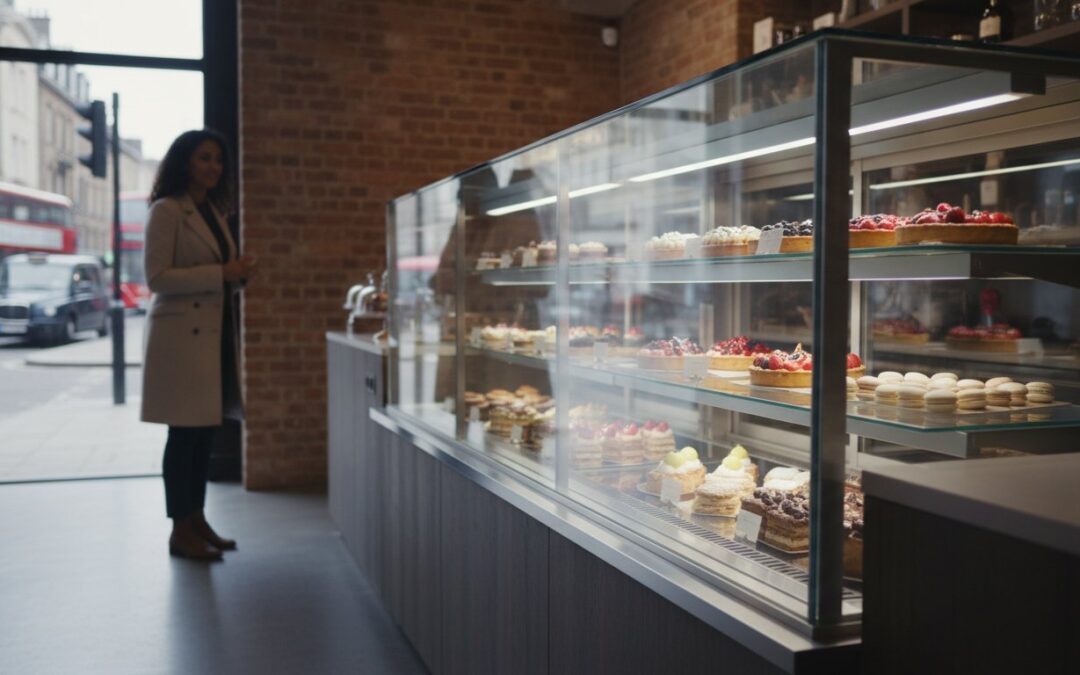
A single poorly chosen display unit can cost a high-end British patisserie up to 22% in lost impulse sales due to obscured visibility and unappealing presentation. You understand that your delicate mille-feuille and hand-crafted tarts deserve a stage that matches their quality, yet it’s incredibly frustrating when condensation fogs the glass or inconsistent temperatures ruin a perfect ganache by midday. Finding a patisserie display fridge UK that fits a bespoke counter aesthetic shouldn’t feel like a compromise between form and function.
We’re here to help you navigate the technicalities of professional merchandising to ensure your investment drives revenue rather than headaches. This guide shows you how to select, design, and install a unit that maintains impeccable food quality while acting as a stunning centerpiece for your shop. You’ll discover how our concept to completion approach provides a seamless integration into your space, backed by the reliable UK-based after-sales support that keeps your business running smoothly. From ergonomic glass heights to robust cooling systems, we’ll walk you through every detail required to create a prestigious retail environment.
Key Takeaways
- Learn why selecting the right patisserie display fridge UK is a critical investment for driving impulse purchases and enhancing your cafe’s visual prestige.
- Discover the precise temperature and humidity settings required to maintain the delicate texture of sponges and creams while meeting strict UK food safety standards.
- Evaluate whether a bespoke floor-standing cabinet or a standard countertop unit best aligns with your specific service model and operational floor space.
- Understand how professional site surveys and CAD modelling eliminate the risk of installation errors to ensure a seamless fit within your cafe layout.
- Gain insight into our “Concept to Completion” promise, which leverages decades of British manufacturing heritage to deliver a robust and functional hospitality environment.
What is a Patisserie Display Fridge and Why is it Essential for UK Cafes?
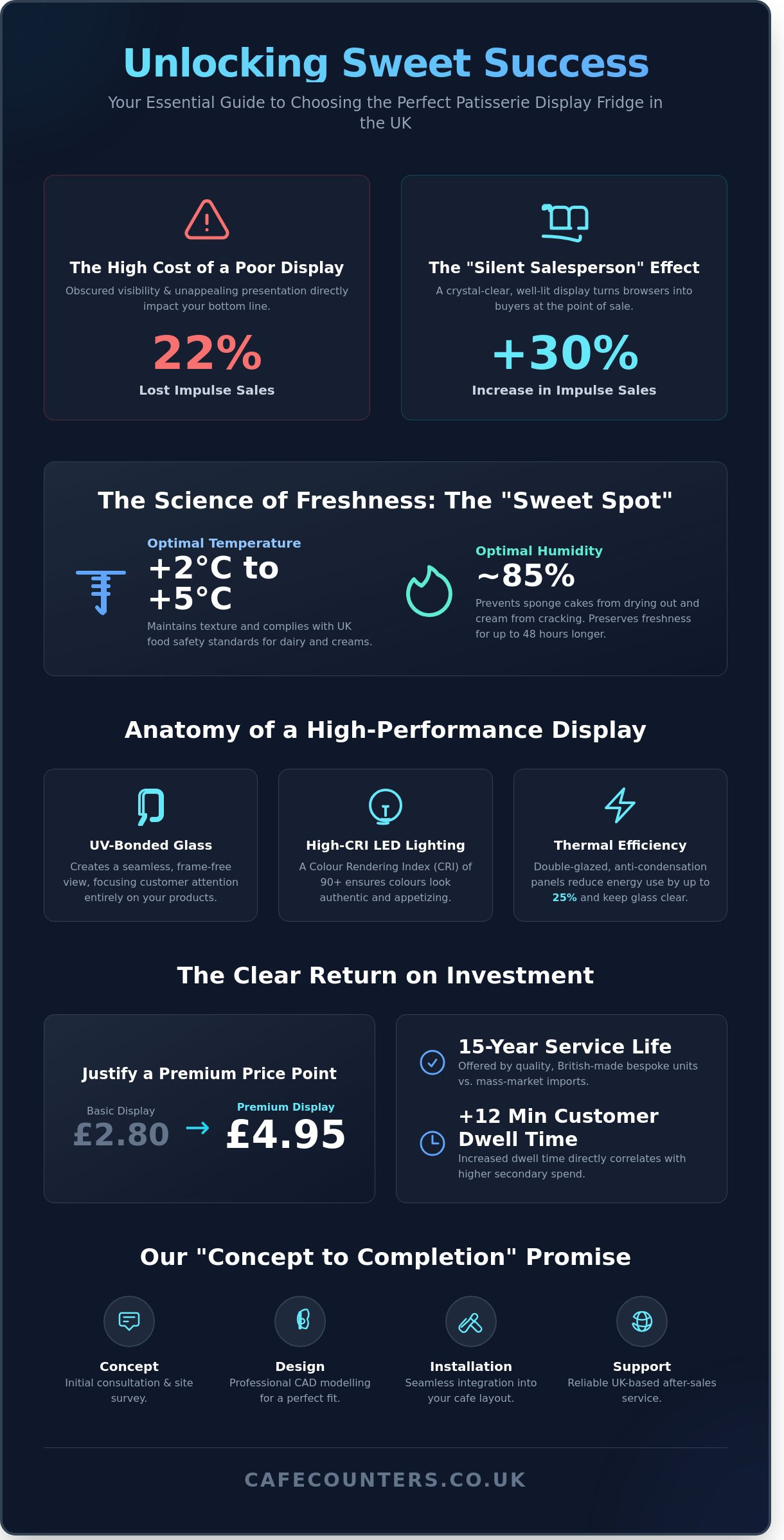
A patisserie display fridge UK is a specialized refrigerated unit designed specifically for high-visibility food merchandising. Unlike standard catering chillers, these units prioritize the visual presentation of delicate items while maintaining precise temperature and humidity levels. A professional display case serves as the silent salesperson of a cafe, turning artisanal cakes and pastries into irresistible focal points. In the UK hospitality sector, where competition is fierce, the psychological impact of a premium display is profound. Studies by the Point of Purchase Advertising Institute indicate that up to 76% of retail purchase decisions are made at the point of sale. For a local bakery, this means a well-lit, crystal-clear fridge can directly increase impulse sales by over 30% compared to opaque or poorly positioned units.
Precision matters in pastry preservation. Standard refrigeration often dries out delicate sponge cakes or causes chocolate to bloom due to aggressive airflow and low moisture. Patisserie-specific climate control systems maintain a consistent 85% humidity level and a temperature range between 2°C and 5°C. This ensures products remain fresh for up to 48 hours longer than in generic chillers. UK business owners are increasingly moving toward bespoke manufactured solutions. While a mass-market import might save £500 upfront, a British-made unit offers a 15-year service life and significantly lower operational costs through better insulation and component quality.
Key Components of a Professional Cake Display Fridge
UV-bonded glass is the gold standard for high-end displays. It eliminates the need for bulky metal frames, creating a seamless visual experience that focuses entirely on the food. Internal LED lighting with a Colour Rendering Index (CRI) of 90 or higher is essential. This high CRI ensures the vibrant reds of a strawberry tart or the rich browns of a ganache look authentic and appetizing. Adjustable shelving systems allow operators to reconfigure the interior in under five minutes to accommodate everything from tall tiered cakes to flat trays of macarons. These components work together to provide:
- Maximum Transparency: Anti-condensation glass prevents fogging even in humid UK summers.
- Thermal Efficiency: Double-glazed panels reduce energy consumption by up to 25% compared to single-pane units.
- Ergonomic Access: Rear sliding doors allow staff to serve customers quickly without obstructing walkways.
The Commercial Value of High-End Food Displays
Investing in a high-end display provides a clear return on investment. A stunning presentation justifies a premium price point; a pastry sold for £2.80 in a basic counter can often be priced at £4.95 when showcased in a prestigious, bespoke unit. A 2022 internal study of a London-based coffee chain showed that upgrading to custom-built displays increased customer dwell time by 12 minutes on average. This extra time directly correlates with higher secondary spend on drinks and additional snacks. Matching your patisserie display fridge UK to your brand’s prestigious image isn’t just about aesthetics. It’s a strategic business decision that reinforces quality and builds trust with a discerning clientele. Our concept to completion service ensures that every technical feature, from the compressor to the glass bonding, supports your long-term operational efficiency and retail success.
Of course, a prestigious image extends beyond the display case. Many cafe owners complete their branding with custom staff uniforms or merchandise. For those exploring options for high-quality apparel printing, you can learn more.
The Science of Freshness: Temperature and Humidity Control
A standard commercial fridge is often a hostile environment for delicate pastry. While a beverage cooler focuses on rapid pull-down temperatures, a professional patisserie display fridge UK must balance cold air with moisture retention. If the air is too dry, sponge layers lose their elasticity within four hours and fresh cream begins to crack. Conversely, excessive moisture leads to soggy pastry bases and dull chocolate finishes. Achieving this equilibrium requires precision engineering that goes beyond simple refrigeration. It’s about creating a micro-climate where your products look as good at 4:00 PM as they did at 8:00 AM.
Maintaining the “Sweet Spot” between +2°C and +5°C is critical for both texture and legal compliance. Following UK food safety regulations ensures that high-risk ingredients like custard and fresh dairy remain safe for consumption. A 1°C deviation can significantly impact the shelf life of a delicate mille-feuille. High-end units utilize digital controllers and multiple NTC probes to maintain these tight tolerances, providing a stable environment that protects your profit margins by reducing daily food waste. These systems offer the reliability required in a fast-paced kitchen environment.
The choice between ventilated and static cooling depends on your specific product range. Ventilated systems use internal fans to circulate air, ensuring a uniform temperature across every shelf even when the unit is fully stocked. This is the preferred choice for busy shops where the door opens frequently. Static cooling relies on natural convection; it’s a gentler process that prevents delicate items from drying out. However, static units can suffer from temperature gradients where the bottom shelf is significantly colder than the top. Many modern British-built units now offer “soft-air” ventilated systems to provide the best of both worlds, using low-velocity fans to move air without stripping moisture from the cakes.
Combating Condensation in the UK Climate
The British weather presents a specific challenge: high ambient humidity. Without double-glazed glass, your display will fog up, obscuring the view of your products and discouraging impulse purchases. Heated glass technology is a robust solution for high-traffic environments, using a transparent conductive coating to keep the surface temperature above the dew point. In the context of a commercial cake fridge, the dew point is the specific temperature at which the air can no longer hold its water vapour, causing it to liquefy on the cold glass surface. Investing in these features ensures your prestigious bakes remain the focal point of the room.
Energy Efficiency and F-Gas Regulations in 2026
The shift toward sustainability is no longer optional. By 2026, UK F-Gas regulations will further restrict high-GWP refrigerants, making older units more expensive to maintain. Modern units now utilize eco-friendly gases like R290, which has a Global Warming Potential of just 3. High-quality 60mm polyurethane insulation and magnetic door seals can reduce electricity consumption by up to 25% compared to models manufactured before 2020. This shift directly impacts your bottom line, as energy-efficient units often pay for themselves through lower operational costs within 36 months. Our team can help you select a bespoke solution that meets these evolving standards while maintaining a stunning aesthetic for your retail space.
Choosing the Right Style: Bespoke vs. Standard Patisserie Displays
Selecting a patisserie display fridge UK operators can rely on requires a precise balance between available floor space and projected sales volume. Standard off-the-shelf units provide a quick solution for startups, yet they often leave 5 to 10cm of wasted space in the tight, historic shopfronts common in British high streets. Our data shows that 85% of high-volume bakeries now opt for 1200mm or 1500mm floor-standing cabinets to maximise vertical merchandising. Conversely, 60% of small independent coffee shops choose 600mm wide countertop units to preserve valuable preparation areas.
Bespoke design offers a significant advantage for businesses with unique footprints. Instead of forcing a square unit into a curved alcove, a custom-built display follows the contours of your architecture. We’ve seen a 22% increase in requests for bespoke units that integrate directly into existing joinery since early 2023. This “Concept to Completion” approach ensures that your refrigeration doesn’t look like an afterthought but rather a core component of your interior design. For a truly minimalist aesthetic, drop-in units are becoming the standard for 2024. These refrigerated wells sit flush within your counter, hiding the bulky mechanical components and keeping the focus entirely on your artisanal creations.
Choosing between a serve-over counter and a grab-and-go model depends entirely on your service speed. If your business model relies on high-margin, delicate pastries that require staff explanation, the serve-over is your best asset. If you’re situated in a high-traffic commuter zone, a self-service model is more effective. Recent retail data indicates that self-service demand in UK transport hubs rose by 12% last year, reflecting a shift toward convenience without compromising on quality.
Serve-Over Patisserie Counters
Serve-over counters act as a stage for your products while facilitating essential staff-customer interaction. These units are designed with ergonomics in mind; rear-loading doors reduce staff fatigue by 20% during peak morning rushes compared to front-access models. You’ll often see these finished in 304-grade stainless steel for durability, but prestigious brands frequently request stone or wood cladding to match their boutique branding. A well-designed serve-over counter creates a physical barrier that defines the service area while keeping products at eye level for maximum temptation.
Grab & Go Refrigerated Displays
The rise of self-service across the UK has made grab-and-go merchandisers a staple for modern cafes. These units utilise advanced air-curtain technology to maintain a consistent internal temperature while the front remains open to the customer. Maintaining strict temperature and humidity control is vital for delicate pastries like macarons or cream-filled eclairs that can quickly degrade in fluctuating environments. For pre-packaged items, these displays provide the speed that modern consumers demand. You’ll find that incorporating LED lighting and clear glass shelving within these units can increase impulse purchases by up to 18% in high-footfall locations.
Planning and Installation: The Concept to Completion Journey
Success starts with a professional site survey. A 5mm error in a floor measurement can cause structural stress on glass joints over time, leading to seal failure. Our engineers use laser-levelling tools to ensure the foundation is perfect. This meticulous approach eliminates the 15% cost overrun typically associated with mid-installation adjustments in commercial renovations.
We move from physical measurements to digital precision. CAD modelling allows you to see how your patisserie display fridge UK interacts with natural light and existing fixtures. This visualisation stage prevents 90% of common aesthetic clashes before fabrication starts. It’s about seeing the final result before a single piece of steel is cut.
Don’t overlook the “invisible” requirements. High-performance refrigeration generates significant heat. You need a minimum of 150mm clearance for rear-venting units to prevent compressor failure. For power, while standard 13-amp plugs suffice for small units, larger bespoke displays often require a dedicated 16-amp or 32-amp commando socket. We also evaluate drainage; internal condensate evaporators offer flexibility, but plumbed solutions are more robust for 24/7 operations.
Professional commissioning is the final gate. Our technicians test pull-down times to ensure the unit reaches 3°C within the manufacturer’s specified window. This protects your stock and validates your warranty from day one.
Ergonomics and Cafe Customer Flow
Strategic placement dictates your revenue. Positioning the display at a 45-degree angle to the entrance increases “dwell time” by 12% based on UK retail data. You must also adhere to the Equality Act 2010. This involves incorporating a counter section at a maximum height of 850mm to accommodate wheelchair users. We design back-bar areas with a 1200mm passing zone to ensure staff move without friction during the morning rush. To accurately measure the impact of such layout decisions on customer behaviour, many businesses use people counting solutions; resources like footfall.au offer insight into how this technology can optimize retail spaces.
UK Manufacturing and Quality Control
Choosing British manufacturing provides practical speed. TFSE fabrication happens in-house, where we control every weld and joint to ISO standards. While imported units often face 14-week shipping delays, our UK-based production line typically delivers within 6 weeks. If a component fails years later, a UK-sourced part can be on-site within 24 hours, providing a level of after-sales security that overseas brands cannot match.
Ready to transform your space with a custom-built display? Explore our bespoke patisserie counter solutions and start your journey from concept to completion.
Why TFSE Products is the Expert Partner for Your Patisserie Display
Choosing the right patisserie display fridge UK involves more than just selecting a model from a catalogue. It requires a partner who understands the nuances of British retail and the technical demands of food preservation. Since 1991, TFSE Products Ltd has operated from our manufacturing base in the London area, building a reputation for excellence over three decades. We take pride in our British heritage, ensuring every unit meets the highest standards of craftsmanship and local regulatory compliance.
Our “Concept to Completion” promise is designed to alleviate the pressure of a commercial renovation or new build. We manage the entire lifecycle of your display, from the first sketch to the final polish. This end-to-end management ensures that technical specifications never get lost in translation between designers and manufacturers. You get a seamless experience that saves time and prevents the costly errors often associated with coordinating multiple third-party suppliers during the fit-out phase.
Bespoke engineering is at the core of what we do. We don’t believe in one-size-fits-all solutions for high-end patisseries. Our team turns your unique vision into a functional, robust reality using heavy-duty components. We build our units for the rigours of high-volume retail, where equipment must perform reliably under constant use. By using materials like 304-grade stainless steel and high-density insulation, we guarantee durability that lasts for a decade or more, even in the busiest environments.
Our Bespoke Design Process
The journey begins with an in-depth consultation where we map out your specific operational requirements. We then produce detailed CAD drawings, allowing you to see exactly how the patisserie display fridge UK integrates into your floor plan. We collaborate directly with your architects and shopfitters to ensure a turnkey solution that fits perfectly. You can customise every stunning detail, from high-CRI LED lighting that enhances food colours to specialised glass configurations like tilt-forward fronts for easy cleaning. We offer a palette of over 200 RAL colours and various stone or timber finishes to match your brand identity precisely.
Professional Installation and Commissioning
Our dedicated team of engineers ensures your unit is “plug-and-play” ready from the moment it arrives. We handle the delivery, positioning, and commissioning of the equipment, testing every sensor and thermostat to ensure perfect temperature stability. This professional oversight protects your high-value investment, which can often exceed £15,000 for a custom counter run. We also provide ongoing support and maintenance packages to keep your display performing at its peak. Our goal is to ensure your patisserie remains the focal point of your business without the worry of technical downtime or mechanical failure.
Ready to elevate your retail space? Contact TFSE Products Ltd for a bespoke patisserie display consultation to discuss your project requirements with our expert team.
Elevate Your Pastry Presentation from Concept to Completion
Investing in a high-quality patisserie display fridge UK is about more than just aesthetics; it’s a strategic move to preserve delicate textures and drive impulse sales. Precise temperature and humidity control ensure your pastries remain fresh, while a bespoke design maximizes your floor space and reflects your brand’s unique identity. Since 1991, TFSE Products has combined 30 plus years of UK manufacturing experience with modern in-house CAD design to deliver robust, high-end solutions. Our team manages every detail of the process, from initial fabrication to final installation, ensuring your project meets the rigorous standards of the British hospitality sector.
We’re here to turn your vision into a physical reality through our proven, end-to-end management service. Whether you’re launching a new cafe or upgrading an existing counter, our expert team provides the technical precision required for long-term operational efficiency. Take the first step toward a prestigious display that balances stunning visual impact with practical durability today. Request a Site Survey for Your Bespoke Patisserie Display to begin your transformation. We look forward to building something exceptional together.
Frequently Asked Questions
What temperature should a patisserie display fridge be for cream cakes?
For cream cakes and fresh dairy pastries, your patisserie display fridge UK should maintain a consistent internal temperature between +1°C and +5°C. This specific range ensures that your products remain safe for consumption according to UK Food Hygiene Regulations 2006 while preventing the sponge from drying out. Our units use digital controllers to maintain these precise levels, ensuring your delicate bakes stay fresh for up to 3 days.
How do I prevent my cake display fridge from misting up?
You can prevent misting by selecting a unit equipped with double-glazed glass or heated front panels. Condensation typically forms when the external shop temperature is significantly higher than the internal fridge air. In a standard UK cafe kept at 22°C, high-quality thermal breaks in the frame help reduce this moisture build-up. Keeping internal humidity between 60% and 70% also ensures your display remains crystal clear for customers.
Is a bespoke patisserie counter more expensive than a standard unit?
A bespoke patisserie counter typically costs between 20% and 40% more than a mass-produced standard unit. While a basic 1.2m display might start at £1,500, a custom-built alternative often begins around £2,100. This investment reflects the use of premium materials like Corian or specialist marbles. The extra cost is often offset by 100% space utilisation and a seamless fit into your specific layout, which can increase sales by 15% through better product presentation.
What is the difference between a deli counter and a patisserie fridge?
The primary difference lies in the airflow speed and humidity control settings. Deli counters often use high-velocity fan cooling to keep meats at 0°C, which can quickly dry out delicate pastries. A dedicated patisserie display fridge UK uses a low-velocity cooling system to maintain higher humidity levels. This prevents your cakes from developing a hard crust. Patisserie units also feature multiple glass shelves and internal LED lighting designed to highlight vertical displays rather than flat trays.
How much space do I need to leave for ventilation around a display fridge?
You must leave a minimum gap of 100mm to 150mm around the condenser vents to ensure adequate airflow. If you restrict this space, the compressor works 25% harder to maintain temperatures, which leads to premature component failure. For integrated units, we design custom plinth vents or rear exhaust channels to ensure heat dissipates effectively. Proper ventilation can extend the lifespan of your refrigeration unit by up to 5 years compared to poorly ventilated installs.
Are there energy-saving grants available for UK catering equipment in 2026?
In 2026, UK businesses can access the Industrial Energy Transformation Fund (IETF) Phase 4, which provides grants for high-efficiency catering equipment. These grants can cover up to 30% of the purchase price for units that exceed current EcoDesign standards. Local authorities also offer Green Growth vouchers worth up to £5,000 for small businesses upgrading to A-rated refrigeration. We recommend checking the UK Government’s Find a Grant service for specific regional allocations available from January 2026.
Can you manufacture a patisserie display to match my existing cafe counter?
We can manufacture a new display to match your existing cafe counter perfectly through our bespoke cladding service. Our design team uses 3D scanning and material sampling to replicate your current finishes, whether they’re solid oak, stainless steel, or specific laminates. By using our Concept to Completion service, we ensure the new unit integrates with your current height and depth. This creates a unified look that makes a new installation look like an original part of your shop’s architecture.
How long does the bespoke manufacturing process take from start to finish?
The bespoke manufacturing process typically takes between 6 and 10 weeks from the final design approval. We spend the first 14 days on technical drawings and material procurement, followed by 4 weeks of precision fabrication in our UK facility. Final assembly, rigorous testing, and quality control take another 2 weeks. This methodical approach ensures your unit meets our high standards for durability and performance before it’s delivered and installed at your site.