
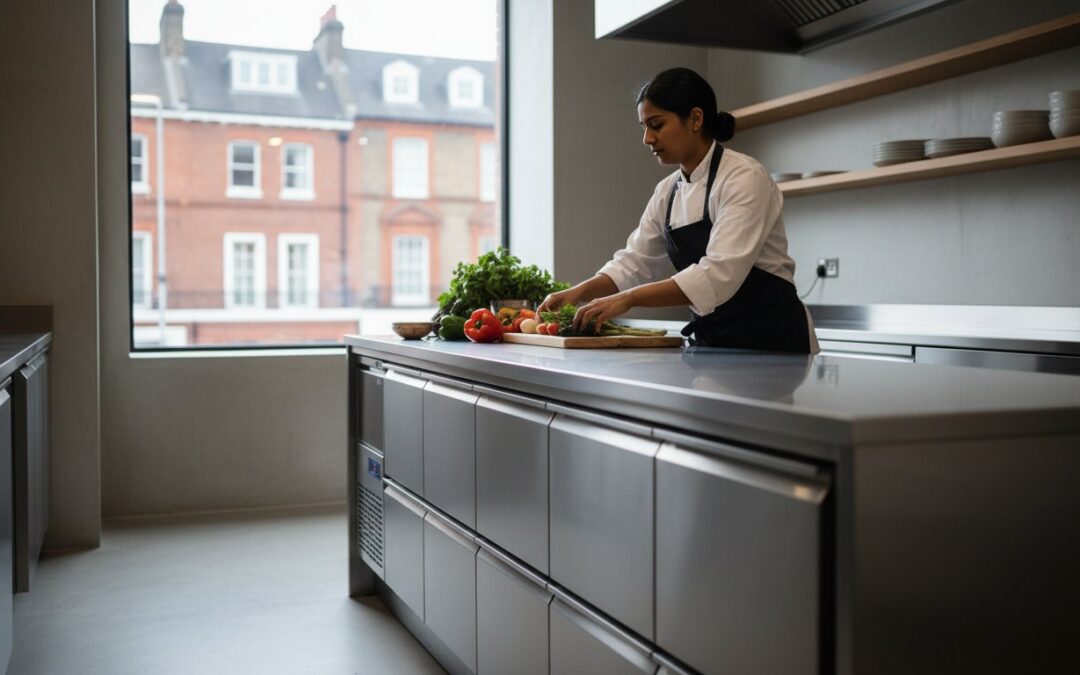
A poorly specified refrigeration unit can drain up to 40% of your cafe’s energy budget before you’ve even served your first morning flat white. You’ve likely felt the stress of a unit struggling during a 30°C summer heatwave. Perhaps you’ve wrestled with a layout that doesn’t quite fit the compact reality of a British high-street kitchen. It’s a common frustration. High operational costs and equipment downtime are the silent killers of healthy margins, and you deserve a setup that works as hard as you do.
This professional guide will help you master the technical nuances of selecting a fridge for commercial use that protects your stock and your profits. We’ll show you how to identify units that offer long-term reliability while ensuring your setup remains fully compliant with UK food hygiene standards. You’ll learn how to integrate robust cooling solutions seamlessly into your counter design, turning a standard appliance into a tailored asset. We’ll explore everything from energy-saving components to ergonomic layouts, providing the expert clarity you need to build a kitchen that stays cool under pressure.
Key Takeaways
- Understand why a high-performance fridge for commercial use is essential for demanding UK kitchens, featuring robust compressors engineered for frequent door openings.
- Discover how to maximise your kitchen’s footprint by choosing between upright storage and ergonomic undercounter units to create seamless prep workstations.
- Learn to navigate the 2026 UK Energy Label system and Climate Class ratings to ensure long-term operational efficiency and protected margins.
- Explore the impact of bespoke integrated displays and strategic layout design on reducing staff travel time and enhancing service flow.
- Gain insight into the “Concept to Completion” approach, leveraging British-made craftsmanship to ensure superior quality control and reliable lead times.
What Defines a Fridge for Commercial Use in 2026?
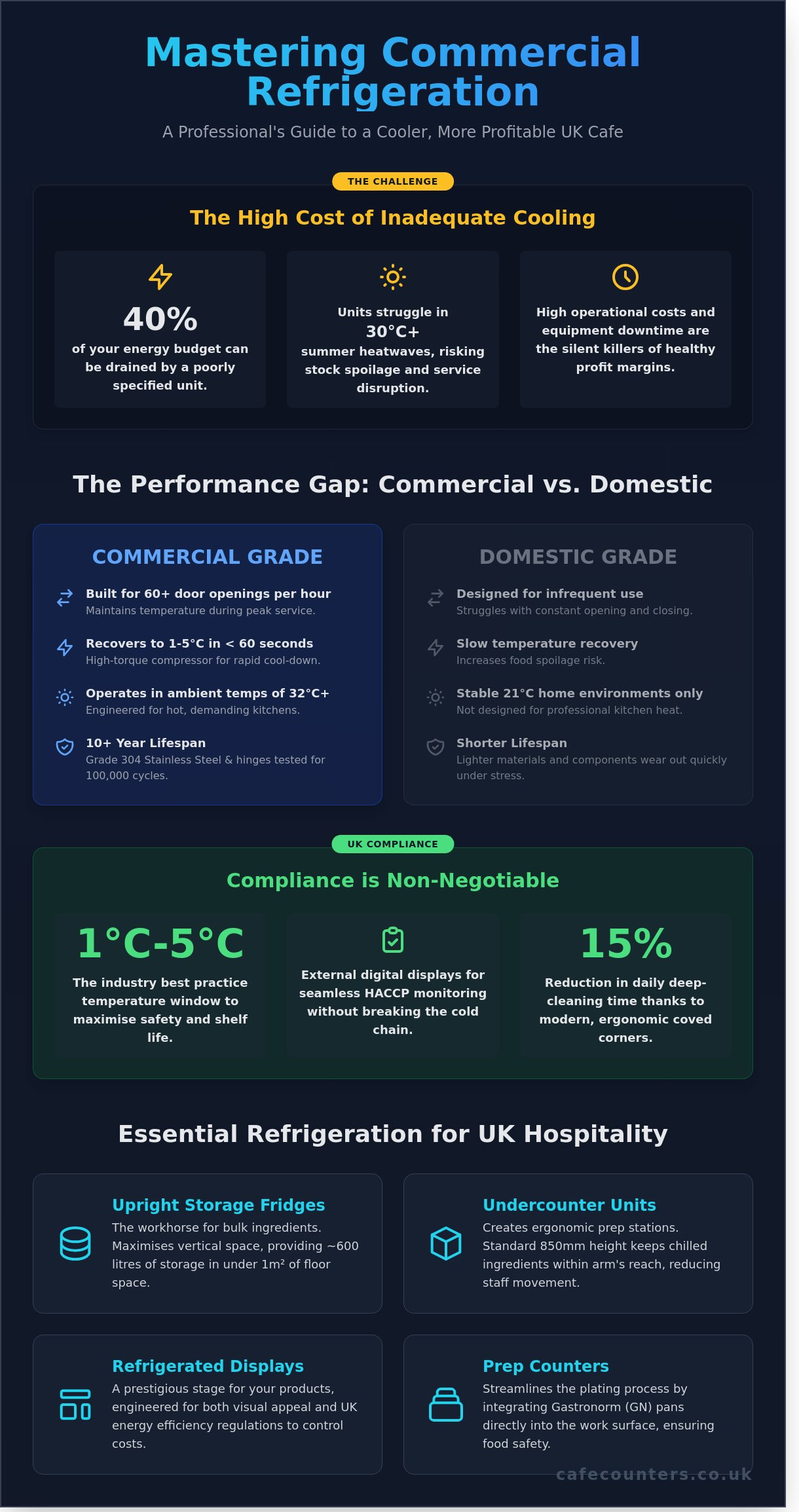
Selecting a fridge for commercial use in 2026 requires looking beyond basic cooling capabilities. In a high-traffic cafe or retail space, a unit often withstands 60 or more door openings per hour. This relentless demand places immense strain on internal components. Unlike domestic models, professional systems rely on a heavy-duty vapor-compression refrigeration cycle designed for rapid heat extraction and recovery. At Cafe Counters, we specify Grade 304 stainless steel as the benchmark for UK builds. This material doesn’t just look prestigious; its high nickel and chromium content prevents corrosion in humid environments, ensuring a robust lifespan often exceeding 10 years.
Consistency is maintained through forced-air cooling. This system uses powerful internal fans to circulate chilled air across every shelf, eliminating the warm spots that plague domestic units. It’s a technical necessity that ensures every sandwich or drink stays at the precise temperature required for both safety and quality. Without this constant circulation, products at the front of a grab-and-go unit would quickly exceed safe limits during peak service times.
Commercial vs Domestic: The Performance Gap
Domestic fridges are engineered for stable 21°C home environments. Professional kitchens frequently reach ambient temperatures of 32°C or higher. When a door opens during a busy lunch rush, internal temperatures can spike by 4°C in seconds. A fridge for commercial retail uses high-torque compressors to recover the safe 1°C to 5°C range in under 60 seconds. We also prioritise durability, installing heavy-duty hinges tested for 100,000 cycles and thick gaskets that maintain an airtight seal even under constant use.
UK Food Safety Standards and Compliance
Compliance is a legal cornerstone of the British hospitality sector. The Food Hygiene Regulations 2006 mandate that high-risk foods remain below 8°C, though industry best practice targets a tighter 1°C to 5°C window to maximise shelf life. Modern units must include external digital displays for seamless HACCP monitoring. This allows staff to verify temperatures at a glance without breaking the cold chain. Internal finishes must be food-grade and easy to sanitise. We design these units with coved corners to eliminate dirt traps, a feature that can reduce daily deep-cleaning time by 15% compared to older, less ergonomic models.
Essential Types of Commercial Refrigeration for UK Hospitality
Selecting the correct fridge for commercial use requires a technical understanding of your kitchen’s workflow and the specific demands of your menu. In a high-pressure UK hospitality environment, equipment must be robust enough to withstand constant door openings while maintaining precise thermal stability. Our experience in the British catering sector shows that the wrong choice can lead to a 15% increase in food waste due to inadequate temperature management.
- Upright Storage Fridges: These units are designed to maximise vertical space. In a kitchen with a restricted footprint, a single door upright provides roughly 600 litres of storage while occupying less than one square metre of floor space. They’re the workhorses of the industry, keeping bulk ingredients organised and accessible.
- Undercounter Units: These are essential for creating ergonomic workstations. Standing at a standard 850mm height, they allow chefs to keep chilled ingredients within reach during peak service hours without leaving their prep station. This reduces unnecessary movement across the kitchen floor.
- Refrigerated Display Counters: These units must perform a dual role. They provide a prestigious stage for your products while adhering to UK energy efficiency regulations to keep operational costs manageable.
- Prep Counters: By integrating Gastronorm (GN) pans directly into the work surface, these counters streamline the plating process. This integration reduces the time ingredients spend at ambient temperatures, which is critical for food safety compliance.
When you partner with an expert to design your commercial kitchen layout, every millimetre is accounted for to ensure seamless operation from concept to completion.
The Role of Patisserie and Deli Displays
Specialised patisserie units are engineered to maintain a high humidity level, often between 60% and 70%. This prevents delicate sponge cakes and pastries from drying out. While curved glass units evoke a traditional, artisanal feel, straight glass displays offer a minimalist aesthetic that maximises product visibility from multiple angles. You can learn more about choosing the perfect patisserie display for your cafe to ensure your bakes look as good as they taste.
Grab & Go and Open-Front Merchandisers
A high-quality fridge for commercial retail relies on an invisible air curtain to keep cold air inside the cabinet. This technology allows customers to access chilled drinks and snacks without a physical barrier. Data from 2023 indicates this open access can increase impulse purchases by 25% in high-traffic UK retail environments. To mitigate heat gain during the night, we recommend units fitted with robust night blinds. These simple additions can reduce energy consumption by approximately 20% over a 24-hour cycle, directly impacting your long-term ROI. For beverage-focused businesses, our comprehensive guide to drinks display fridge selection and positioning provides detailed insights into maximising retail impact while maintaining energy efficiency.
Technical Evaluation: Efficiency, Climate Class, and ROI
Selecting a fridge for commercial use requires a move beyond comparing initial purchase prices. True ROI is found in the Total Cost of Ownership (TCO), which accounts for energy consumption, maintenance, and equipment longevity. By 2026, the UK energy labelling system will implement stricter thresholds to align with net-zero targets, making it vital to choose equipment that exceeds current Minimum Energy Performance Standards (MEPS). Investing in units using R290 refrigerant is a primary way to future-proof your business. This natural hydrocarbon has a Global Warming Potential (GWP) of just 3, a stark contrast to the GWP of 3,922 found in older R404A systems that are rapidly becoming obsolete.
Climate Classes: Why Ambient Temperature Matters
The Climate Class rating determines the specific environment where a fridge can operate effectively without overworking the motor. A Climate Class 4 unit is tested at 30°C with 55% relative humidity, whereas a Climate Class 5 “heavy duty” model is rated for 40°C and 40% humidity. If you install a Class 4 unit in a kitchen that regularly reaches 35°C, the compressor will work overtime. This leads to a 20% spike in energy bills and potential mechanical failure within 24 months. We recommend placing refrigeration at least 1.2 metres away from ovens or hobs. This simple spatial adjustment, supported by technical guidance from the Institute of Refrigeration, ensures the cooling system doesn’t struggle against external heat loads.
Energy Efficiency and MEPS
MEPS regulations have effectively removed the most inefficient models from the British market, but a significant gap remains between an ‘E’ rated and a ‘B’ rated unit. High-efficiency components provide measurable financial returns that go straight to your bottom line:
- EC Fans: These motors use up to 70% less electricity than traditional shaded-pole versions found in budget models.
- LED Lighting: LEDs emit 80% less heat than fluorescent tubes, significantly reducing the internal cooling load.
- Condenser Maintenance: A layer of dust on the condenser can increase power consumption by 25% and is the leading cause of service call-outs.
A high-spec fridge for commercial display might cost £350 more initially, but it often saves over £190 annually in running costs at current UK energy prices. Over a standard seven-year lifespan, that represents a £1,330 saving. This proves that technical excellence and British-standard build quality are the most direct routes to a profitable retail space.
Bespoke Integration: Designing Your Refrigeration Layout
While a standalone fridge for commercial use offers immediate utility, bespoke integration transforms a standard catering space into a high-performance environment. At Cafe Counters, we’ve observed that a 15% increase in throughput is achievable when units are designed as part of a seamless counter system. We utilise advanced CAD modelling to ensure every millimetre is accounted for before fabrication begins in our UK workshop. This precision prevents common installation errors that typically delay projects by three to five working days.
Built-in units require strict adherence to airflow requirements to maintain efficiency. Without a minimum of 50mm clearance for ventilation, compressor life can drop by 30% within the first two years of operation. Our design process incorporates discreet venting that maintains the aesthetic of the counter while protecting your investment from overheating. It’s about balancing the visual appeal of a prestigious fit-out with the robust functionality needed for a 12-hour service cycle.
The Advantage of Integrated Drop-in Units
Drop-in units provide a flush, premium finish that eliminates the awkward gaps found with standalone equipment. You can choose between integral motors for easy installation or remote configurations. Remote motors move the heat and noise away from the customer service area; this often reduces ambient noise levels by 12 decibels in smaller cafes. For more technical specifications on selecting the right motor for your site, consult our Commercial Refrigerator Guide 2026: Choosing High-Performance Units.
Ergonomics and Workflow Planning
Efficiency is won or lost in the “golden triangle” of your layout. We position refrigeration to minimise staff travel. Reducing a barista’s movement by just two steps per order can save 40 minutes of labour during a typical eight-hour shift. Drawer units are often superior to door units in busy bars because they allow for top-down visibility and faster access. Our customised back-bar solutions ensure that high-volume stock is always within arm’s reach, allowing your team to focus on the customer rather than the logistics of the fridge for commercial storage.
Ready to optimise your space for peak performance? Contact our design team for a bespoke consultation.
The TFSE Approach: From Concept to Completion
Selecting the right fridge for commercial use involves more than browsing a catalogue. It requires a partner who manages the entire lifecycle of the equipment. TFSE Products operates on a “Concept to Completion” philosophy, which removes the friction of dealing with multiple subcontractors. By manufacturing in the UK, we offer lead times that are often 50% faster than overseas competitors, frequently delivering bespoke units within 4 to 6 weeks rather than the industry standard of 12 or more. This speed ensures your retail space starts generating revenue without unnecessary delays.
UK Manufacturing and Craftsmanship
Our units are fabricated in-house using high-grade 304 stainless steel, a material chosen for its exceptional durability and hygiene properties. We understand that UK high streets often feature historic or awkward building layouts. Our design team specialises in customising dimensions to millimetre precision, ensuring a seamless fit in spaces where “off-the-shelf” models would fail. This consultative approach means we don’t just sell you a fridge for commercial settings; we engineer a solution that maximises every square inch of your floor plan. Our 30-year heritage in British manufacturing ensures that every weld and finish meets the highest professional standards.
Installation and Technical Integration
The commissioning phase is vital for long-term operational efficiency. During this stage, our engineers perform a rigorous multi-point check to ensure the system is calibrated to your specific site conditions. We adjust airflow and temperature settings to maintain a consistent 2°C to 5°C, protecting your stock and ensuring food safety compliance from day one. To safeguard your investment, we provide the following as part of our handover:
- Staff Training: A 30-minute practical session for your team on basic maintenance, such as cleaning condenser filters.
- Performance Calibration: Setting the controllers to match your specific product load.
- Technical Documentation: Clear, accessible manuals for daily operation.
Effective maintenance can extend the lifespan of your refrigeration by up to 30%, significantly improving your total return on investment. If technical issues arise, our UK-based support team provides rapid assistance, ensuring you aren’t left waiting for parts to be shipped from abroad. We remain your single point of contact, providing the reassurance that your business is backed by genuine technical expertise.
Ready to upgrade your retail space with a high-performance display? Contact TFSE Products for a bespoke counter consultation and discover how our British-made solutions can drive your profits.
Future-Proof Your Kitchen with Precision Engineering
Selecting a high-performance fridge for commercial environments is a strategic investment that dictates your kitchen’s operational efficiency for years. By prioritising high climate class ratings and energy-efficient components, you ensure your equipment maintains food safety even in ambient temperatures exceeding 40°C. Since 1991, we’ve refined our UK manufacturing processes to deliver robust units that meet these rigorous technical demands while maximising your return on investment.
Our approach leverages advanced CAD modelling to eliminate guesswork during the space planning phase. This precision ensures every bespoke unit integrates seamlessly into your workflow, whether you’re operating in a high-street retail environment or a busy healthcare facility. We take full responsibility for your project through our signature Concept to Completion service, managing every detail from the initial design to the final installation. This methodical process guarantees that your refrigeration isn’t just a purchase; it’s a tailored solution built for durability.
Explore our bespoke UK-manufactured commercial refrigeration solutions and let’s start building a professional space that stands the test of time.
Frequently Asked Questions
What is the difference between a commercial fridge and a domestic one?
Commercial units are engineered for high-traffic environments where doors open up to 60 times per hour. Domestic fridges aren’t built to recover temperature quickly after frequent openings. A professional model uses powerful compressors and robust components to maintain food safety in 30°C kitchen environments, ensuring your stock stays at a consistent 3°C regardless of external heat.
How much does it cost to run a commercial fridge in the UK?
A standard upright commercial fridge typically costs between £1.50 and £3.20 per day to operate based on the current UK energy price cap of 24.5p per kWh. An energy-efficient Grade A unit can reduce these annual overheads by 40% compared to older G-rated models. Investing in high-specification insulation often pays for itself through these reduced utility bills within 24 months.
What is a Climate Class 4 rating on a commercial refrigerator?
A Climate Class 4 rating means the unit operates efficiently in ambient temperatures up to 30°C and 55% relative humidity. This is the standard requirement for most UK retail and cafe environments. If your kitchen reaches higher temperatures, you’ll need a heavy-duty Class 5 unit rated for 40°C to prevent the compressor from overworking and failing prematurely.
How long should a professional commercial fridge last?
A high-quality professional fridge should last between 8 and 12 years with a consistent maintenance schedule. Regular condenser cleaning and annual seal replacements can extend this lifespan by 25%. Cheaper, light-duty models often fail within 3 to 5 years under heavy commercial use, which makes the initial saving a false economy for busy operators.
What are the ventilation requirements for a built-in commercial fridge?
Built-in units require a minimum clearance of 50mm to 100mm around the sides and rear to prevent compressor overheating. Proper airflow ensures the fridge for commercial use doesn’t consume 15% more energy than necessary. Without this gap, heat builds up and causes the cooling system to fail, which often voids your manufacturer warranty.
Do I need a specialised technician to install a commercial fridge?
You should use a F-Gas certified technician to install any commercial refrigeration that isn’t a simple plug-and-play unit. Proper levelling and commissioning ensure the system operates at peak efficiency from day one. Professional installation prevents common issues that lead to a 10% drop in cooling performance within the first year of operation.
What is the best temperature for a commercial food display counter?
The ideal temperature for a commercial food display counter is between 1°C and 5°C to comply with UK Food Hygiene Regulations 2006. Keeping the unit within this range prevents bacterial growth and extends the shelf life of fresh products. Precise digital controllers allow you to monitor these levels to within 0.5 of a degree for total peace of mind.
Are glass door fridges less energy efficient than solid door models?
Glass door models are generally 25% less energy efficient than solid door units because glass has lower thermal insulation properties. However, choosing a fridge for commercial display with triple-glazed, argon-filled glass can significantly bridge this gap. The increased visibility often leads to a 15% rise in impulse sales, which effectively offsets the slightly higher daily running costs.