
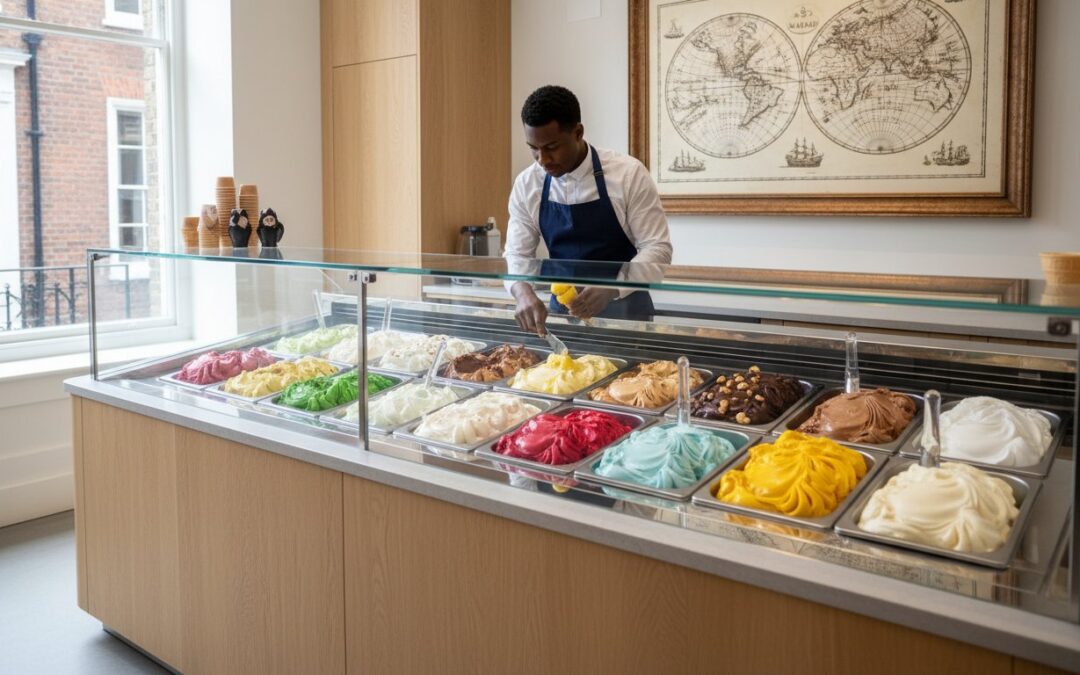
What if the premium gelato in your display cabinet owes its existence to a 7th-century Chinese emperor rather than the Italian Renaissance? Most hospitality professionals agree that while ice cream is a staple of the British summer, the question of where was the ice cream invented remains clouded by conflicting myths and historical shortcuts. You deserve a clear, technical understanding of how this product evolved from a luxury for royals into a commercial powerhouse.
We’ll guide you through a factual timeline that starts with the Tang Dynasty in 618 AD and moves through the ingenious pre-electric cooling methods of the 17th century. You’ll gain a deeper appreciation for the link between ancient preservation and the robust, high-end shopfitting solutions we manufacture today. From the first recorded recipes to the high-tech, seamless displays that drive modern sales, this article provides the expert insights required to master the heritage of your most popular product.
Key Takeaways
- Discover the historical consensus on where was the ice cream invented, tracing its journey from the Tang Dynasty to the refined tables of Europe.
- Debunk common myths and understand the 16th-century chemical breakthroughs that allowed for the consistent freezing of dairy treats.
- Trace the industrial evolution of ice cream production, from Nancy Johnson’s 1843 hand-cranked churn to the birth of the global commercial industry.
- Learn how professional lighting and precise temperature control influence consumer psychology and drive impulse purchases in UK cafes and parlours.
- Explore how bespoke British craftsmanship and a “Concept to Completion” approach can elevate your brand with a robust, high-end display counter.
The Ancient Origins: Where Was Ice Cream Invented?
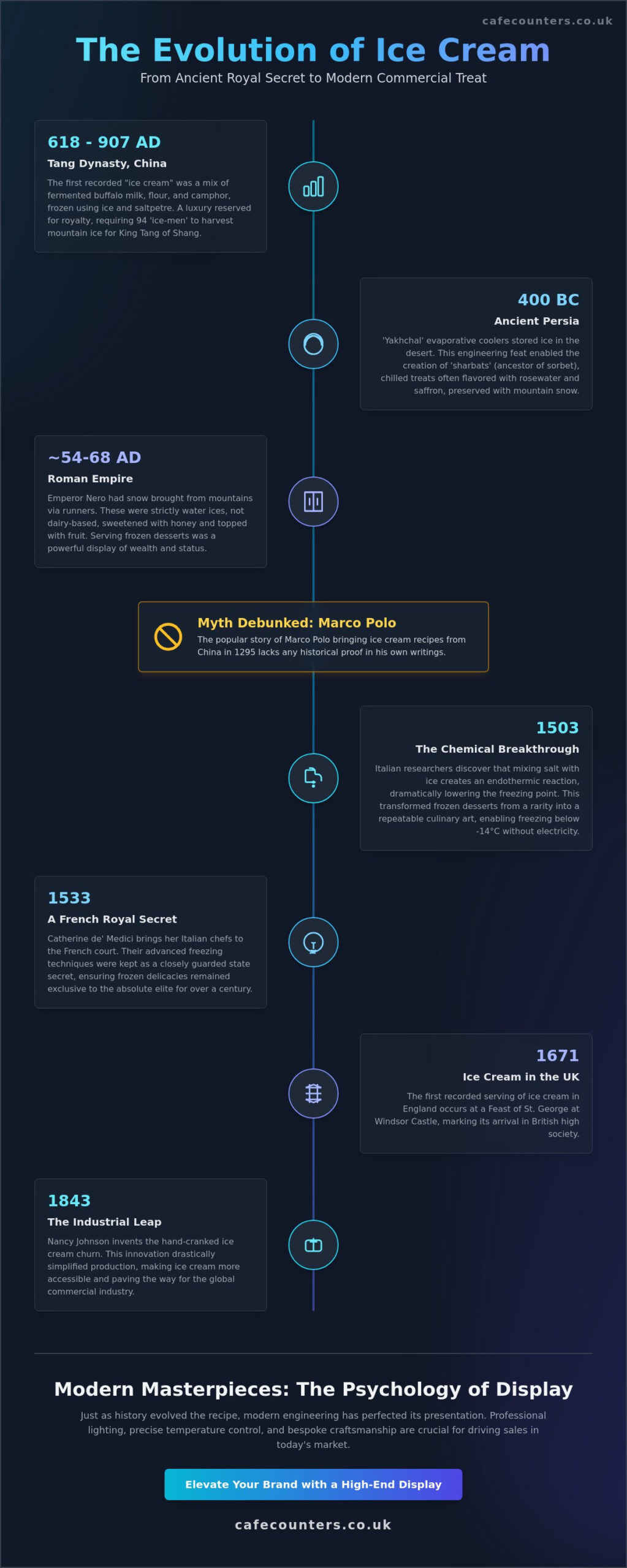
When exploring the question of where was the ice cream invented, the consensus among historians points directly to China’s Tang Dynasty between 618 and 907 AD. While many people associate frozen desserts with modern refrigeration, these early pioneers utilised sophisticated methods to manage temperature and texture long before the advent of the electrical grid. King Tang of Shang employed a dedicated team of 94 ‘ice-men’ who harvested mountain ice to freeze a variety of mixtures for the royal court. The first ice cream was a fermented milk and flour mixture frozen by saltpetre and ice. This early recipe relied on buffalo or cow milk combined with flour and camphor to provide a unique, aromatic flavour profile that satisfied the elite’s demand for luxury.
The development of these chilled delicacies reflects a broader history of ice cream that spans continents and centuries. In the same way that we approach bespoke kitchen design today, ancient civilisations treated dessert preparation as a high-end craft requiring specialized infrastructure. This wasn’t merely about taste; it was about the technical ability to preserve ice in climates where it didn’t naturally occur. The use of saltpetre was a particularly brilliant innovation. By mixing this mineral into water surrounding the metal containers, they created an endothermic reaction that lowered the temperature below the freezing point of water, allowing the dairy mixture to solidify into a consistent texture.
The Persian Influence and Sharbats
As early as 400 BC, ancient Persians developed the ‘Yakhchal’, a remarkable evaporative cooler that allowed them to store ice in the middle of the desert. This engineering feat facilitated the transition from simple chilled fruit syrups to the ‘sharbat’, the direct ancestor of modern sorbet. They relied heavily on mountain snow to preserve these desserts, creating a functional system for luxury catering that predated modern industrial methods by two millennia. These chilled treats were often flavoured with rosewater and saffron, showcasing a level of culinary sophistication that mirrored the architectural prowess of their ice houses.
Roman Luxury: Chilled Fruits and Honey
In Rome, Emperor Nero reportedly demanded snow from the Apennine Mountains to be brought to his court via a relay of runners. These treats were strictly water ices rather than dairy ice cream, often sweetened with honey and topped with fruits. Serving frozen desserts in the ancient world was a prestigious marker of social status, as the logistics of transporting and storing snow required immense resources. It was a clear display of power and wealth, proving that the host could control the elements to provide a refreshing, ergonomic dining experience for their guests.
From Chemist’s Trick to Royal Treat: The European Evolution
While many people ask where was the ice cream invented, the answer involves separating legend from historical record. The popular story that Marco Polo returned from China in 1295 with recipes for water ices lacks any documented proof from his own writings. Instead, the real evolution happened through a series of technical breakthroughs in Europe. In 1503, Italian researchers discovered that mixing salt with ice creates a chemical reaction that lowers the freezing point significantly. This discovery transformed frozen desserts from a rare seasonal luxury into a repeatable culinary art. When Catherine de’ Medici moved to the French court in 1533 to marry Henry II, she brought her own Italian chefs. These experts kept their techniques a closely guarded state secret, ensuring that frozen delicacies remained exclusive to the absolute elite for over a century.
The Endothermic Effect: The Secret of Salt
The science behind early ice cream production relied on the endothermic effect. By adding common salt to ice, the mixture absorbs heat from its surroundings, allowing liquids to freeze even in warm weather. This process allows temperatures to drop below -14°C without any modern electricity. While European chemists refined this in the 16th century, the first technical description of ice making actually came from the 13th-century Arab historian Ibn Abu Usaybi. By the 1660s, this ‘chemist’s party trick’ led to the first commercial sorbets appearing in major European cities. You can explore the delicious history of ice cream to see how these techniques spread globally. These early methods required robust, insulated storage, much like the precision-engineered units we manufacture today.
Ice Cream in the UK: A Royal Introduction
In England, the first recorded serving of ice cream occurred at a Feast of St. George at Windsor Castle in 1671. It was served exclusively to King Charles II’s table, while the rest of the guests looked on. The King even employed a personal ice cream maker and invested in a prestigious ‘Ice House’ to store blocks of ice harvested in winter. For decades, these frozen treats were a symbol of immense wealth and power. By the mid-19th century, the ‘Penny Lick’—a small glass filled with a scoop of ice cream for one penny—finally brought the treat to the Victorian masses. Understanding where was the ice cream invented helps us appreciate the journey from royal privilege to a high-street staple. If you’re looking to bring a touch of that prestige to your own business, our team specializes in bespoke shopfitting and counter installation to help you serve your customers with style.
The Industrial Leap: When Ice Cream Became a Global Industry
While the broader history of where was the ice cream invented often leads back to ancient civilisations, the modern industry was truly forged during the 19th-century Industrial Revolution. This era shifted production from the domestic kitchen to the professional manufacturing plant. In 1843, Nancy Johnson patented the hand-cranked churn, a device that utilised a central paddle to aerate the mixture. This mechanical improvement slashed production times and created a far smoother texture than previous manual methods. By 1851, Jacob Fussell established the first wholesale ice cream factory, proving that frozen desserts could be produced at scale for a growing urban population.
The transition from harvesting natural lake ice to mechanical cooling required a robust infrastructure. During this period, the need for reliable temperature control became paramount, eventually making commercial refrigerators a necessity for any serious catering operation. According to the Ice Cream Alliance history, the move away from natural ice blocks allowed for year-round production, removing the seasonal limitations that had previously restricted the trade. This shift ensured that ice cream was no longer a luxury reserved for the elite, but a staple of the British high street.
Mechanical Refrigeration and the Modern Scoop
Carl von Linde’s development of the ammonia refrigeration cycle in 1876 revolutionised the dairy industry. This technical breakthrough provided the consistent cooling required for the standardisation of ice cream textures. It eliminated the graininess associated with uneven freezing, allowing manufacturers to achieve a seamless, creamy finish every time. As cooling technology became more accessible, the British ‘Ice Cream Parlour’ emerged as a prestigious fixture of local communities. These spaces required bespoke shopfitting and ergonomic layouts to handle high customer volumes, marking the birth of the modern dessert destination.
The Invention of the Cone and the Sundae
The way we consume ice cream changed forever at the 1904 St. Louis World’s Fair. When an ice cream vendor ran out of glass bowls, Ernest Hamwi, a Syrian waffle maker, rolled his thin waffles into cones to hold the scoops. This functional innovation transformed ice cream into a portable, on-the-go treat. Around the same time, the ‘Sundae’ was created as a clever workaround for American ‘Blue Laws’ that prohibited the sale of ice cream sodas on Sundays. By removing the carbonated water and adding syrup, vendors created a new product that complied with local regulations. These developments influenced how food was displayed and served, encouraging the use of stunning glass displays and functional serving stations that remain vital to the hospitality sector today.
The Psychology of the Scoop: Why Display Matters
Understanding the historical origins of this dessert often leads to the question: where was the ice cream invented? While scholars trace its roots back to the chilled rice and milk mixtures of the Tang Dynasty in 618 AD, the modern commercial success of the treat depends entirely on how it’s presented to the contemporary consumer. In the UK market, visual appeal acts as the primary driver for impulse purchases. Research suggests that up to 70% of purchasing decisions in dessert parlours are made at the point of sale, triggered by the sight of perfectly sculpted peaks and vibrant colours. Retailers have moved far beyond the wooden buckets of the 17th century, now utilising high-specification patisserie display counters that act as stage sets for their products.
Maintaining the perfect scoop texture is a technical challenge that requires a balance of lighting and temperature. Heat from traditional bulbs can ruin the surface sheen of the product, which is why modern units utilise cool-running LED systems. These lights enhance the natural pigments of the ingredients without compromising the structural integrity of the ice cream. Retailers must also manage energy efficiency. High-performance glass and insulated casings ensure that even when ambient temperatures in a busy cafe rise, the internal climate remains stable to protect the manufacturer’s craftsmanship.
The Role of the Modern Deli Counter
A high-quality deli counter is essential for preserving the delicate overrun of premium ice cream. Overrun refers to the amount of air incorporated during the freezing process; it’s what gives high-end gelato its smooth, dense mouthfeel. To keep this texture consistent, modern counters use laminar airflow technology to create a consistent thermal barrier, which successfully prevents the formation of abrasive ice crystals. We specify anti-fog glass in our builds to ensure that condensation never obscures the view, while integrated LED lighting provides a crisp, professional finish that highlights the product’s quality.
Maximising Customer Flow in Dessert Stations
Strategic placement of ice cream displays is vital to boost grab and go sales. By positioning a bespoke counter near the entrance or along a natural queue line, businesses can tap into the psychology of visual temptation. We’ve seen a significant shift toward theatre in the food service sector. Customers enjoy watching the physical act of the scoop being served, as it reinforces the idea of freshness and personal service. Using a prestigious, custom-built counter design doesn’t just hold the product; it elevates the entire customer experience, turning a simple purchase into a memorable event. This end-to-end management of the retail space ensures that the shop floor is both functional for staff and inviting for guests.
Ready to transform your dessert parlour with a bespoke display solution? Contact our expert design team today to discuss your project from concept to completion.
Modern Masterpieces: Designing Your Ice Cream Display
While the historical debate over where was the ice cream invented often takes us back to ancient China or 16th-century Italy, the modern presentation of this treat is a British engineering success story. TFSE Products Ltd carries this legacy forward through precision manufacturing in our UK facility. We don’t just build counters; we create environments where history meets modern retail performance. Our team understands that a display must do more than just keep products cold. It has to act as a silent salesperson, drawing customers in through impeccable aesthetics while maintaining the technical integrity of the food.
Bespoke British Manufacturing
Our in-house manufacturing process ensures every unit meets rigorous quality standards that imported alternatives often miss. By keeping production within the UK, we offer faster lead times and direct communication with the craftsmen building your unit. We use advanced CAD modelling to plan every millimetre of your layout, ensuring a seamless fit into your specific floor plan. This technical precision allows us to integrate diverse temperature zones within a single footprint. For example, our Vision Heated Counters can be positioned directly alongside cooling units. This allows you to serve hot waffles or crepes right next to your chilled gelato without compromising thermal efficiency or food safety.
Future-Proofing Your Food Business
Operating a hospitality business in 2026 requires a relentless focus on operational overheads. We integrate the latest energy-efficient compressors and high-density insulation that can reduce daily power consumption by up to 22% compared to equipment from a decade ago. We prioritise robust materials like 304-grade stainless steel. This isn’t just for its sleek appearance; it’s chosen for its superior hygiene properties and its ability to withstand the heavy use of a busy high-street environment.
Our Concept to Completion service removes the stress from your fit-out. We manage the entire journey, including:
- Initial site surveys and ergonomic layout design.
- Custom fabrication in our British workshop.
- Professional installation by qualified engineers.
- Final commissioning to ensure optimal temperature performance.
Professional installation is vital. Even the best equipment underperforms if it isn’t levelled and calibrated correctly for its specific environment. When you’re considering the long history of where was the ice cream invented, remember that its future in your shop depends on how well it’s displayed and preserved. Choosing an expert partner for your next hospitality project ensures your investment remains both stunning and functional for years to come.
Transforming Your Ice Cream Vision Into Reality
The journey of frozen desserts spans centuries, evolving from ancient snow-chilled delicacies to the sophisticated treats we enjoy today. Understanding the historical context of where was the ice cream invented reveals a transition from royal luxury to a global staple, particularly after Jacob Fussell opened the first commercial factory in 1851. Today, the success of a gelateria or cafe depends as much on visual presentation as the recipe itself. A well-designed display taps into the psychology of impulse buying, turning a simple scoop into a premium experience that captures the customer’s imagination.
Since 1991, Cafe Counters has supported the UK hospitality sector by manufacturing high-quality, durable shopfitting solutions. Our expert team utilizes advanced CAD modelling to ensure every bespoke counter fits your specific space perfectly. We manage the entire process through our in-house UK manufacturing facility, providing a seamless transition from initial concept to final installation. This end-to-end approach ensures your equipment is robust, functional, and aesthetically stunning. It’s about more than just looks; it’s about creating a reliable environment where your business can thrive.
Ready to showcase your frozen masterpieces? Explore our bespoke cafe counter solutions today. We look forward to helping you build a space that delights your customers and drives operational efficiency.
Frequently Asked Questions
Is it true that Marco Polo brought ice cream to Italy from China?
Historical records suggest Marco Polo returned to Italy from the East in 1295 with recipes for water ices that closely resemble modern sorbet. While the exact location where was the ice cream invented remains a point of historical debate, Chinese texts from the Tang Dynasty (618-907 AD) describe a frozen mixture of buffalo milk, flour, and camphor. Polo’s introduction of these techniques provided the foundation for Italian artisans to refine the process for European tastes.
What was the very first flavour of ice cream ever made?
The earliest recorded frozen desserts didn’t use the vanilla or chocolate we recognise today; instead, they focused on honey, fruit, and floral aromatics. In the 16th century, Mughal emperors used saltpeter to freeze mixtures of rosewater and fruit purees. The first published recipe for a creamy ice appeared in the 1692 Italian book “Lo Scalco alla Moderna,” which detailed a lemon and sugar flavoured base that set the standard for future confectioners.
How did people keep ice cream frozen before the invention of freezers?
Before mechanical refrigeration became viable in the mid-19th century, ice was harvested from frozen lakes and stored in deep, straw-insulated ice houses. Chefs used a technical process involving salt and crushed ice to create an endothermic reaction. This method lowered the freezing point of the surrounding slush, allowing them to freeze a liquid custard inside a metal pot through constant agitation and contact with the sub-zero brine.
Who invented the first commercial ice cream machine?
Nancy Johnson of Philadelphia patented the hand-cranked ice cream churn in 1843, which replaced the arduous “pot-in-pail” manual method. This mechanical breakthrough allowed for more consistent aeration and a smoother texture. In 1851, Jacob Fussell established the first wholesale ice cream factory, applying Johnson’s technology to produce large volumes of the treat for the mass market, which significantly lowered the cost for consumers.
Why is the invention of the ice cream cone so significant for business?
The commercialisation of the edible cone at the 1904 St. Louis World’s Fair revolutionised the industry by removing the need for “penny licks,” which were glass serving bowls that required washing. For a business owner, this shifted the product into a portable, low-overhead category. It eliminated the cost of broken glassware and improved hygiene, allowing for a seamless service model that fits perfectly into high-traffic retail and seaside environments.
What is the difference between gelato and traditional ice cream in terms of history?
Gelato traces its heritage back to the Renaissance courts of Florence, whereas traditional ice cream followed a more industrial path through the UK and USA. Gelato is crafted with a higher proportion of milk to cream and is churned at a much slower speed, resulting in less than 30% air. This creates a dense, bespoke product that is served at a slightly warmer temperature than traditional British ice cream, which often contains at least 10% butterfat.
When did ice cream become popular in the United Kingdom?
Ice cream transitioned from an elite luxury to a popular treat in the UK during the 1850s. This surge was driven by Italian immigrants like Carlo Gatti, who opened the first ice cream stand in London in 1851. By 1860, the “Hokey Pokey” men were common across British cities, selling affordable scoops to the working class. This era established the foundation of the UK’s robust ice cream parlour culture that persists in many coastal towns today.
What temperature should a commercial ice cream display be kept at?
A professional commercial display must maintain a steady temperature between -14°C and -16°C to ensure the product remains scoopable yet firm. If the temperature rises above -12°C, the ice cream risks losing its ergonomic texture and developing large ice crystals. Our bespoke counter designs focus on high-performance insulation and airflow to manage these precise technical requirements, ensuring your inventory stays in peak condition for every customer.