
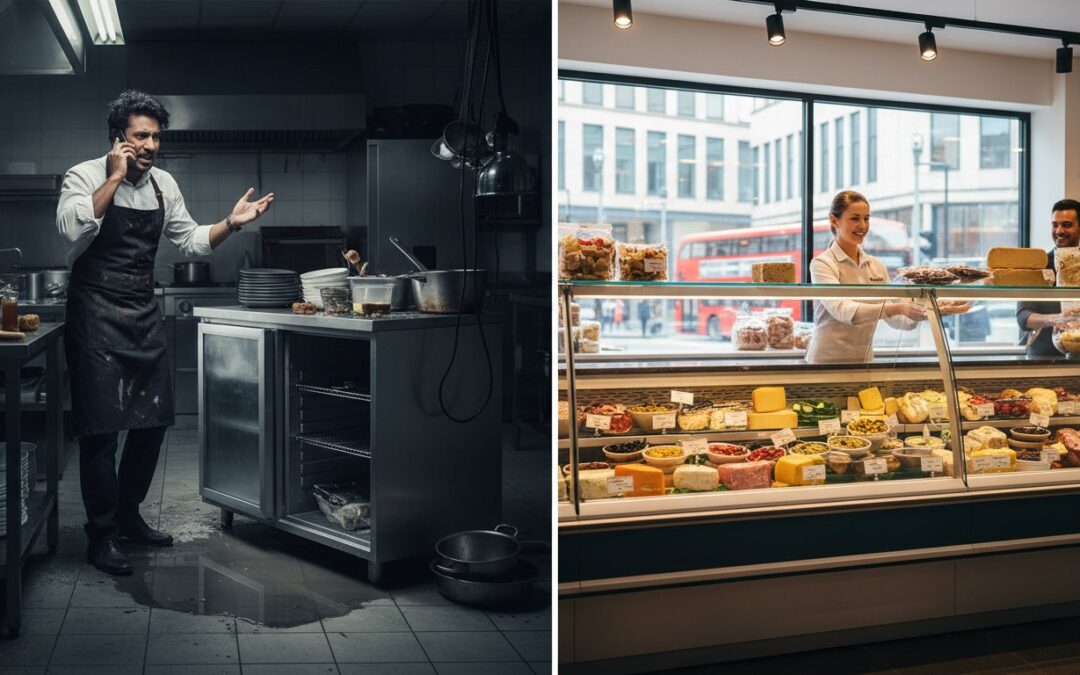
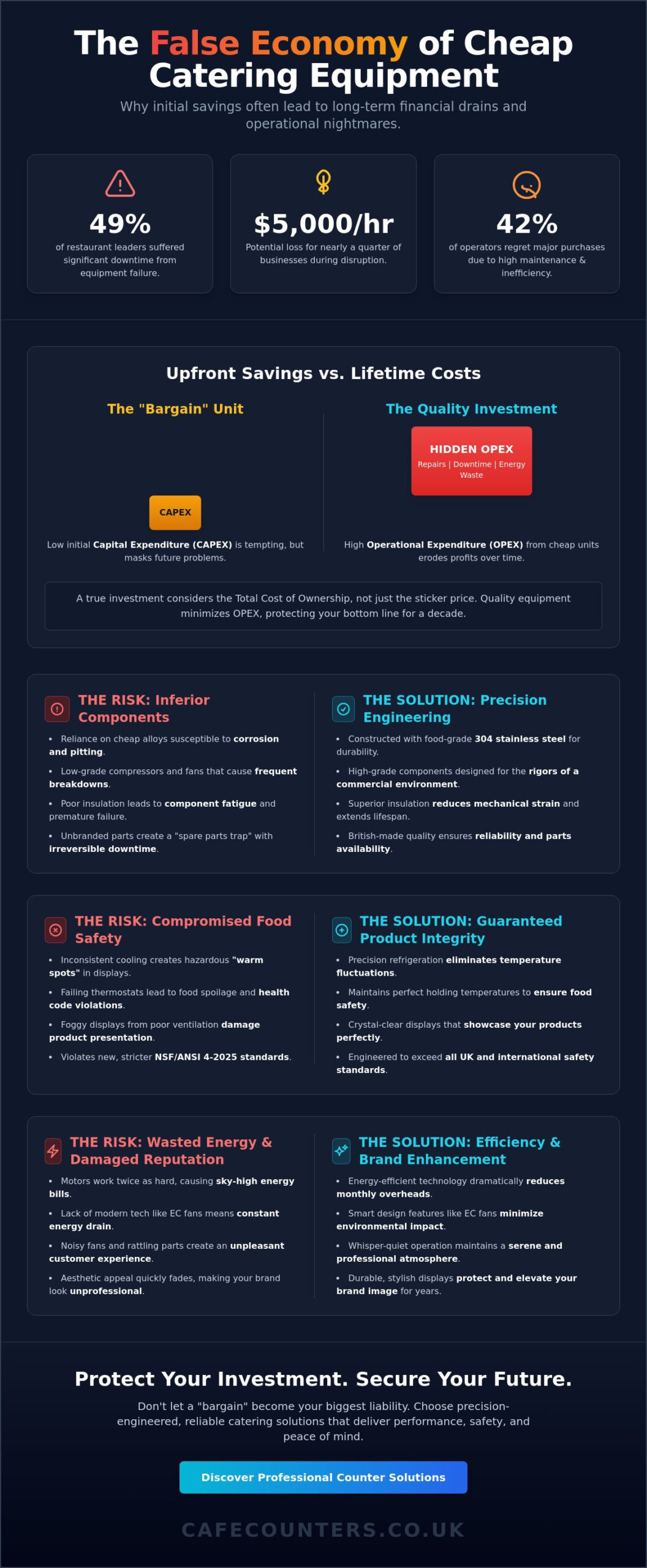
A 2026 survey of 400 restaurant leaders revealed that 49% suffered significant downtime due to equipment failure, with nearly a quarter of those businesses losing up to $5,000 for every hour of disruption. When you’re managing tight margins and rising energy bills, the pressure to cut upfront costs is understandable. However, the hidden risks of buying cheap catering equipment often turn a perceived bargain into a recurring financial drain. What looks like a saving today frequently results in the “buyer’s remorse” that affects 42% of operators who regret major purchases due to high maintenance and inefficiency.
We understand the pressure to keep your service flawless while protecting your bottom line. You deserve reliable equipment that projects a professional image and stands the test of time. This article will show you why low-cost units often lead to a false economy and how to protect your hospitality business from hidden operational risks. We’ll explore the total cost of ownership, the impact of the new NSF/ANSI 4-2025 standards, and how investing in precision-engineered deli counters and grab and go displays ensures your front-of-house remains both functional and profitable for the next decade.
Key Takeaways
- Recognize the difference between upfront savings and long-term operational costs to avoid the common pitfalls of the “false economy” in commercial kitchens.
- Explore the technical risks of buying cheap catering equipment, specifically how inferior components and unbranded parts lead to irreversible downtime.
- Protect your product integrity by understanding how high-quality deli counters and salad bars eliminate the “warm spots” that compromise food safety.
- Reduce your monthly overheads by identifying the energy-efficient technologies, such as EC fans and superior insulation, that are typically missing from budget gear.
- Safeguard your brand reputation by choosing durable, professional-grade displays that maintain their aesthetic appeal and quiet operation over a ten-year lifespan.
The False Economy of Low-Cost Catering Equipment
The concept of a “false economy” is particularly dangerous in the high-pressure food service industry. It describes a situation where an initial saving on a purchase eventually costs significantly more than the premium alternative. When you choose the lowest price point, you aren’t just buying a machine; you’re often buying a future of unplanned expenses. Many online retailers operate as “box-shifters,” relying on high-volume sales of mass-produced imports. These businesses provide no site surveys, no professional installation, and zero after-sales support. They leave you to manage the complex logistics of commissioning technical equipment alone. By contrast, investing in British-made display solutions ensures that the material choices and engineering are tailored to the specific rigours of your regional environment.
Psychologically, it’s tempting to focus on Capital Expenditure (CAPEX) to keep startup costs low. However, this often leads to a massive inflation of Operational Expenditure (OPEX). Cheap components consume more electricity and require frequent repairs, which erodes your margins over time. A professional partner looks beyond the initial invoice, guiding you from an initial idea to a finished physical space with a focus on durability and long-term efficiency.
Initial Savings vs. Operational Downtime
Downtime is the silent killer of profit. A 2026 survey of 400 restaurant leaders found that 49% had suffered equipment failure, with 24% of those estimating losses between $1,001 and $5,000 for every hour of disruption. One of the primary risks of buying cheap catering equipment is “death by a thousand cuts.” Frequent minor faults, such as failing thermostats or noisy fans, lead to inconsistent service. Beyond the direct revenue loss, there’s the severe reputational damage. A warm deli counter or a foggy patisserie display during a lunch rush tells your customers that quality isn’t your priority. Precision-engineered units are designed to withstand these peak pressures without flinching.
The Hidden Costs of Overseas “Box” Sales
The allure of overseas imports often masks significant logistical hurdles. Without a professional site survey, you risk purchasing units that don’t fit your floor plan or align with your existing utilities. Cheap equipment frequently lacks the robust certification required for UK-specific electrical and safety standards, which can lead to failed health inspections or insurance complications. When you buy a “box” online, you miss out on the end-to-end project management that ensures a bespoke serving counter or grab & go display is commissioned correctly. These hidden costs, from professional electrical modifications to unexpected shipping fees, quickly erase any initial savings.
Technical Vulnerabilities and the Spare Parts Trap
The mechanical integrity of your kitchen determines the pace of your service. While a budget unit might appear identical to a premium model on a website, the internal engineering tells a different story. One of the most significant risks of buying cheap catering equipment is the reliance on inferior component materials that aren’t designed for the relentless heat and humidity of a professional environment. Cheap compressors and heating elements often fail within the first 18 months because they lack the thermal tolerance of high-grade alternatives. This leads to a cycle of repairs that quickly exceeds the original purchase price.
Component Quality and Frequent Breakdowns
Material selection is the foundation of durability. Premium manufacturers use food-grade 304 stainless steel, whereas budget imports often rely on cheaper alloys that are susceptible to pitting and corrosion. This isn’t just an aesthetic issue; it’s a structural one. Poor insulation in low-cost refrigeration units forces motors to work twice as hard to maintain temperatures, leading to premature mechanical strain. Component fatigue is the progressive structural damage that occurs when mechanical parts are subjected to repetitive thermal or physical stress in a commercial environment.
Safety is another critical factor often overlooked in the pursuit of a bargain. Many unbranded units fail to meet rigorous NFPA 96 fire protection standards, which govern the ventilation and fire safety of commercial cooking operations. Using equipment that doesn’t comply with these benchmarks puts your premises and staff at risk, potentially voiding your insurance in the process. We prioritize technical precision to ensure every heated gantry and back-bar unit we produce meets these essential safety requirements.
The “Obsolete” Problem: Continuity of Supply
The “spare parts trap” is a reality for many who choose unbranded import models. These manufacturers frequently change designs and discontinue parts to keep production costs low. If a specific circuit board or bespoke gasket fails, you might find that the entire unit is unrepairable simply because the part no longer exists. This turns a minor repair into a full replacement. It’s a frustrating situation that can be avoided by choosing partners who value longevity over volume.
When you invest in a bespoke cafe counter or specialized display, you should expect decades of service. We maintain meticulous CAD models and records of every unit we produce in our internal facilities. This ensures that if you need a replacement part ten years from now, we can manufacture it to the exact original specifications. This continuity of supply is vital for expanding businesses that want a consistent look and feel across multiple sites. Our UK-based manufacturing allows for rapid parts dispatch and direct technical support from the people who actually built the equipment. If you’re planning a new layout, choosing integrated drop-in units from a reliable partner prevents the headache of future obsolescence.
Compromising Food Safety and Product Integrity
Food safety is the non-negotiable foundation of any successful hospitality business. While the aesthetic of your front-of-house matters, the technical reliability of your storage and display units is what prevents catastrophic stock loss. One of the primary risks of buying cheap catering equipment is the lack of thermal stability. Inadequate insulation and underpowered cooling systems in budget deli counters create inconsistent internal environments. These fluctuations don’t just wilt your salads; they create dangerous “warm spots” where bacteria can proliferate rapidly. When equipment fails to maintain a steady temperature, the resulting food waste quickly erodes the money you initially saved on the purchase price.
Precision-engineered airflow is particularly critical for delicate patisserie displays. High-end units manage humidity and air velocity to ensure that cakes and pastries remain fresh without drying out. Cheap alternatives often rely on crude cooling methods that cause condensation or uneven chilling, ruining the visual appeal and texture of your products. Protecting your product integrity requires a level of engineering that mass-produced “box” sales simply cannot provide.
Temperature Stability in Professional Displays
The difference between a basic unit and a professional display often lies in the cooling technology. Many budget models use “static” cooling, which relies on natural convection and often leads to uneven temperatures. We utilize ventilated cooling systems that circulate air precisely to every corner of the unit. This technology, combined with high-quality thermal glass, prevents the fogging and condensation that obscure your products. For hot food, our Vision Heated Counters are engineered to provide consistent heat distribution, ensuring that every item stays at a safe, appetizing temperature without hot spots or cold zones.
Compliance and Health & Safety Regulations
Legal compliance is a significant operational burden that becomes much heavier with unreliable gear. The Food Standards Agency (FSA) and local environmental health officers require rigorous temperature logging to ensure public safety. Cheap units often feature inaccurate analogue dials or low-grade sensors that make verifiable data collection difficult. Under the updated NSF/ANSI 4-2025 standards, the requirements for food protection and sanitation in equipment construction have become even more stringent. Failing a health inspection due to a malfunctioning refrigerator commercial unit can lead to heavy fines and public notices that permanently damage your brand. Investing in equipment with high-quality digital controllers ensures you have the accurate data needed to prove compliance every day.
Energy Inefficiency and Environmental Impact
The true cost of a catering unit isn’t found on the price tag; it’s hidden in your monthly utility bill. Many operators overlook the Total Cost of Ownership (TCO), focusing instead on the initial transaction. One of the major risks of buying cheap catering equipment is the lack of energy-efficient components that modern, high-end units provide as standard. While a budget display might save money today, its high electricity consumption can cost thousands over its short operational life. Savvy operators now evaluate equipment based on its energy draw, recognizing that efficiency is a direct contributor to profit margins.
The High Price of Poor Insulation
Thermal efficiency is the primary driver of refrigeration costs. Budget manufacturers often use low-density foam or thinner insulation panels to reduce production costs. This allows heat to leak into the cabinet, forcing the compressor to run almost 24/7 to maintain the required temperature. A compressor running constantly due to poor thermal retention can cost hundreds of pounds more in electricity per year compared to a unit featuring high-density polyurethane insulation. While unrated imports often draw excessive power to compensate for poor build quality, high-efficiency UK units are designed to reach temperature quickly and hold it with minimal mechanical effort. Integrating advanced components like EC fans and LED lighting, which are rarely found in budget gear, further reduces the daily operational load.
Sustainability and Your Business Carbon Footprint
The UK hospitality sector is shifting toward sustainable procurement, driven by both regulation and consumer demand. Choosing “disposable” equipment that ends up in a landfill within 24 months is no longer a viable business strategy. We focus on the circular economy, designing for repairability rather than replacement. By manufacturing our equipment in our own regional facilities, we significantly reduce the carbon footprint associated with international shipping and logistics. High-quality commercial refrigerators eventually pay for themselves through these cumulative energy savings and the avoidance of frequent replacement cycles.
Our commitment to artisanal quality ensures that your investment supports a more sustainable future for your business. If you’re ready to upgrade to a more efficient service line, explore our range of bespoke serving counters and displays to see how precision engineering reduces long-term overheads.
Protecting Your Brand with Quality Counter Solutions
Your serving counter is the physical handshake of your business. It’s the first point of contact for every guest and the frame through which they view your culinary craft. One of the most significant risks of buying cheap catering equipment is the speed at which budget finishes degrade under the pressure of daily service. While a unit might look acceptable in an online catalog, the reality of peeling laminates, foggy glass panels, and the distracting hum of a noisy motor quickly erodes customer trust. These visible flaws suggest a lack of attention to detail that diners subconsciously associate with the quality of the food itself.
A premium refrigerated grab and go display is far more than a cooling cabinet; it’s a sophisticated sales tool. High-quality lighting and crystal-clear, thermally efficient glass elevate the perceived value of your products, making them appear more vibrant and appetizing. When you invest in precision-engineered displays, you’re investing in the psychological triggers that drive impulse purchases and repeat visits. Cheap gear often fails to maintain this visual standard, leading to a “tired” shop floor that can drive customers toward competitors who prioritize a more professional presentation.
Visual Impact and Customer Trust
Maintaining a cohesive brand identity requires a level of customization that off-the-shelf “box” sales can’t provide. We take an Expert Partner approach, often beginning with a meticulous site survey to ensure that every patisserie display or salad bar fits perfectly within your architectural space. This prevents the cluttered, mismatched look that occurs when businesses rely on budget-buy equipment from multiple sources. By utilizing high-grade materials and artisanal finishes in our internal production facilities, we ensure your front-of-house remains a source of pride rather than a maintenance headache.
The Bespoke Advantage: Design for Longevity
True value in restaurant equipment is found in its lifespan and adaptability. We use advanced CAD modeling to help you visualize your layout before a single piece of steel is cut, ensuring every bespoke serving counter is optimized for both workflow and aesthetics. Integrating integrated drop-in units creates a seamless, high-end finish that is impossible to achieve with standalone budget appliances. Viewing your equipment as a long-term asset rather than a consumable expense allows you to build a space that stands the test of time. This methodical approach to design ensures that your investment continues to project total competence and reliability for a decade or more, safeguarding your brand’s reputation in a competitive market.
Future-Proofing Your Service Through Precision Engineering
Successfully managing a hospitality business in 2026 requires a shift from short-term savings to long-term operational excellence. The risks of buying cheap catering equipment encompass everything from astronomical energy bills to the “spare parts trap” that renders unbranded units obsolete. Protecting your profit margins means choosing equipment that offers consistent thermal stability and professional aesthetics, ensuring your brand remains a steady, reliable presence for your customers. You don’t have to face these technical decisions alone.
Since 1991, TFSE Products Ltd has served as an Expert Partner to the UK hospitality sector, providing high-end manufacturing from our own internal facilities. Every project we undertake includes expert CAD modelling and meticulous site surveys to ensure a perfect fit for your vision. By integrating energy-efficient technologies across our entire range, we help you reduce overheads while maintaining a flawless front-of-house. We invite you to Contact TFSE Products Ltd for a Bespoke Counter Consultation and take the first step toward a more durable, profitable future. Let’s work together to bring your vision to life with the technical expertise it deserves.
Frequently Asked Questions
Why is cheap catering equipment considered a “false economy”?
A false economy occurs when the low initial purchase price is eclipsed by high operational costs and early failure. One of the primary risks of buying cheap catering equipment is that budget units are often built with inferior components that require constant maintenance. Over a five-year period, the cumulative cost of repairs and inflated energy bills usually far exceeds the investment required for a precision-engineered unit designed for longevity.
How does low-cost refrigeration affect my food safety compliance?
Low-cost refrigeration often lacks the sophisticated airflow management needed to maintain consistent temperatures across all shelves. This leads to dangerous “warm spots” that can cause bacterial growth and compromise food safety. Without the accurate digital controllers found in premium units, you’ll struggle to provide the verifiable temperature logs required by local health departments, potentially leading to failed inspections and legal penalties.
Can I get spare parts for unbranded catering equipment in the UK?
Sourcing spare parts for unbranded or imported equipment is notoriously difficult in the UK. Manufacturers of budget gear frequently change their designs or discontinue models to keep production costs low, leaving older units unrepairable. Choosing a UK-based manufacturer ensures a continuity of supply, as we maintain CAD models and internal production capabilities to dispatch bespoke parts quickly, even for units installed over a decade ago.
What is the average lifespan of budget vs. premium catering displays?
Premium catering displays are built to provide a service life of ten years or more, whereas budget alternatives often fail within 24 to 36 months. This disparity stems from the material choices, such as using 304-grade stainless steel rather than cheaper alloys. While the upfront cost is higher, the extended lifespan of professional-grade equipment ensures a much lower cost per year of operation and prevents the disruption of frequent replacements.
How much more energy does a cheap display fridge consume?
Cheap display fridges consume significantly more electricity because they rely on thin insulation and underpowered compressors that must run constantly. A unit with poor thermal retention forces the mechanical components to work harder to fight heat leak, leading to high utility bills. High-efficiency units utilizing high-density polyurethane insulation and EC fans reach temperature faster and hold it with minimal energy draw, paying for themselves through monthly savings.
Is it better to lease high-end equipment or buy cheap units outright?
Leasing high-end equipment is often a superior strategy to buying cheap units outright because it preserves your capital while providing more reliable assets. As of May 2026, commercial financing rates for qualified businesses typically range from 7.00% to 12.50%. This allows you to install durable, energy-efficient displays that lower your monthly overheads, whereas buying cheap gear outright often leads to unpredictable repair costs that strain your cash flow.
What are the risks of buying second-hand catering equipment?
Buying second-hand equipment carries the risk of inheriting hidden mechanical faults and outdated technology that doesn’t meet the latest safety standards. Many older units fail to comply with the updated NSF/ANSI 4-2025 requirements for food protection and sanitation. Without a manufacturer’s warranty or a clear service history, you face the immediate threat of equipment failure during peak service, which can cause significant revenue loss and stock waste.
How does equipment quality impact my cafe’s resale value?
High-quality equipment is viewed as a tangible asset that significantly enhances the resale value of a hospitality business. Potential buyers look for a professional-looking front-of-house and a kitchen equipped with durable, branded units that have a documented service history. Cheap, mismatched gear is often seen as a liability that the new owner will need to replace immediately, which can lead to lower valuations during the negotiation of a business sale.