
Most people believe Marco Polo brought ice cream to Italy from China in the 13th century, but this popular tale is more fiction than historical fact. You’ve likely enjoyed a scoop of gelato or a classic vanilla cone without considering the complex engineering required to keep it frozen. It’s a treat we often take for granted in modern British retail spaces, yet the question of when was ice cream invented reveals a timeline spanning over 1,400 years. We understand that for hospitality professionals, the history of a product is as important as the equipment used to serve it.
You probably recognize that ice cream is the ultimate test of temperature control and functional design. We’ll clarify the confusing myths by tracing the transition from the snow-chilled honey treats of the Tang Dynasty in 618 AD to the first hand-cranked churns patented in 1843. This article promises a myth-free exploration of how royal luxuries became commercial staples. We’ll examine the technical evolution from ancient ice-houses to the bespoke, high-performance refrigeration counters that define the modern high street, ensuring you understand the innovation behind every serving.
Key Takeaways
- Uncover the authentic origins of dairy-based frozen treats in the Tang Dynasty, debunking common Victorian myths to reveal the true history of this global favourite.
- Trace the definitive timeline of when was ice cream invented and how it evolved from an exclusive royal delicacy into an accessible treat for the public.
- Identify the pivotal technological shifts, from Nancy Johnson’s 1843 hand-cranked freezer to the mechanical refrigeration that industrialised production.
- See how the transition from hidden “dipping cabinets” to stunning visual displays revolutionised retail layout and consumer habits in the 20th century.
- Gain insights into the future of patisserie display, where British craftsmanship delivers bespoke, energy-efficient solutions that balance robust functionality with prestigious design.
The Ancient Roots: When Was the First Ice Cream Created?
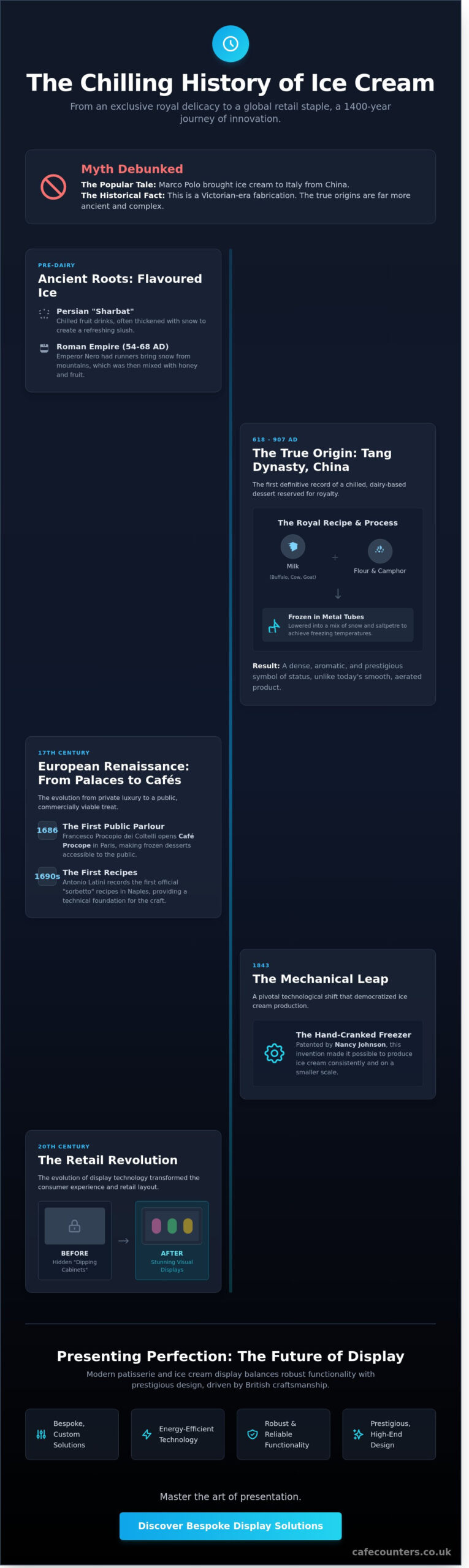
Understanding the origins of dairy-based delicacies requires looking past the romanticised tales of the Victorian era. Many popular histories credit Marco Polo or Catherine de’ Medici with introducing frozen treats to Europe, yet these stories lack contemporary evidence. To accurately determine when was ice cream invented, we must look to the Tang Dynasty between AD 618 and 907. This period provides the first definitive records of a chilled, dairy-based dessert that resembles the foundations of the modern industry.
In these royal courts, managing temperature was a logistical feat that required total competence. Specialized “ice-men” were employed to harvest natural ice from mountains during winter months, storing it in deep, insulated pits. This meticulous process ensured that the elite had access to chilled luxuries throughout the year. While the History of ice cream shows a clear progression from these icy precursors, the early versions were far from the soft-serve textures we recognise today. They were robust, functional, and strictly reserved for the powerful.
The Chinese Origin: Flour, Camphor, and Fermentation
The Tang period (AD 618–907) utilised a specific blend of ingredients that would surprise modern palates. Chefs mixed buffalo, cow, and goat milk with flour and camphor, an aromatic substance harvested from evergreen trees. This mixture was often fermented before being placed into metal tubes. To achieve a frozen state, the tubes were lowered into pools of snow mixed with saltpetre. This chemical reaction lowered the freezing point significantly, allowing the mixture to solidify. It wasn’t the aerated, smooth product found in a modern display cabinet, but rather a dense, aromatic treat that served as a prestigious symbol of status.
Ancient Rome and Persia: The Precursors to Sorbet
Before dairy became the standard, ancient civilizations mastered the art of flavoured ice. Emperor Nero, who ruled from AD 54 to 68, famously employed runners to bring snow from the Apennine Mountains to the Roman court. This snow was mixed with honey and fruit, creating a primitive chilled dessert. In Persia, the “Sharbat” emerged as a chilled fruit drink, often thickened with snow to create a refreshing slush. These early innovations highlight that when was ice cream invented is a question of evolution rather than a single moment of discovery. These bespoke creations required immense labour and resources, marking the beginning of a long journey toward the turnkey solutions we see in the global catering sector today.
The European Renaissance: From Royal Palaces to Public Cafes
During the 17th century, the evolution of frozen desserts moved from the private kitchens of the Italian elite to the French royal court. This transition marked a turning point in the history of when was ice cream invented as a structured culinary discipline. In the 1690s, Antonio Latini recorded the first official “sorbetto” recipes while working for the Spanish Viceroy in Naples. His detailed documentation provided a technical foundation that transformed a simple chilled treat into a refined, repeatable dish that could be manufactured for high-society banquets.
By 1686, the opening of Café Procope in Paris by Francesco Procopio dei Coltelli signalled the birth of the public ice cream parlour. This establishment offered a sophisticated space where the public could consume frozen ices, moving the product away from exclusive royal circles. According to the International Dairy Foods Association, these early versions were often flavoured with exotic ingredients like pomegranate, orange flower water, and succulent fruits. The success of Café Procope proved that there was a robust commercial market for chilled desserts, provided the service environment was sufficiently prestigious.
In the UK, the British aristocracy maintained their social standing through the construction of “ice houses.” These deep, subterranean brick structures allowed the wealthy to store ice harvested from lakes during winter. This infrastructure turned chilled food into a potent symbol of power and logistics. Designing a functional space for modern dessert service requires the same attention to detail that these early cooling systems once demanded. If you’re planning a high-end retail environment, our bespoke counter solutions provide the operational efficiency needed to serve modern crowds while maintaining a premium aesthetic.
The Italian Influence and the Birth of Gelato
Italian gelato traditions diverged from early French styles through their density and lower milk fat content. The primary technical breakthrough was a “chemist’s party trick”: mixing salt with ice to create a freezing brine. This method allowed chefs to lower the temperature of their mixtures far below the freezing point of water, resulting in a smoother, more ergonomic texture. Naples and Florence became the primary hubs for refining these ices, ensuring the final product was both delicious and consistent in its physical properties.
Ice Cream in the UK: A Victorian Obsession
The 19th century saw the rise of “Hokey Pokey” men, Italian immigrants who sold ices from hand-drawn street carts. This movement democratised the dessert, making it accessible to the working class for the first time. However, the use of the “Penny Lick”, a small glass cup that was reused without proper washing, raised serious hygiene concerns. By 1899, medical reports linked these glasses to the spread of tuberculosis, which eventually led to the adoption of the hygienic, edible waffle cone. This shift solidified ice cream as a permanent fixture of British seaside culture and holiday leisure.
The Industrial Revolution and the Birth of Mechanical Refrigeration
The shift from natural ice harvesting to mechanical production represents one of the most significant transformations in food history. For centuries, the question of when was ice cream invented was answered by the presence of private ice houses owned by the wealthy. The 19th century dismantled this barrier through engineering and innovation. It was a period where British and global craftsmanship began to prioritize operational efficiency over manual, inconsistent methods. Precision replaced guesswork, and the results were revolutionary for the catering trade.
From Hand-Cranked Tubs to Factory Production
In 1843, Nancy Johnson patented the “Artificial Freezer,” a hand-cranked device that replaced the inefficient pot-freezing method. This invention used a geared agitator to aerate the mixture, resulting in the smooth, creamy texture we recognize today. Her design was so effective that it remains the blueprint for many modern churns. By 1851, Jacob Fussell established the first wholesale factory in Baltimore. He transformed surplus milk into a scalable business model, proving that high-quality dessert production didn’t have to be limited to small batches. This transition meant ice cream was no longer a summer rarity. It became a year-round commercial reality for the public.
The transition was fueled by three key developments:
- Mechanical Agitation: Nancy Johnson’s geared agitator ensured a consistent texture that manual stirring couldn’t match.
- Industrial Scaling: Jacob Fussell’s factory model moved production from domestic kitchens to dedicated industrial plants.
- Thermal Engineering: The move from ice houses to mechanical cooling allowed for year-round sales regardless of the weather.
The Science of the Cold: Mastering Temperature Control
The late 19th century saw the birth of mechanical refrigeration, which ended the dependency on seasonal ice harvests. This was the era where the industry moved toward the sophisticated cooling solutions we see today. Modern commercial refrigerators are the direct descendants of these early cooling units. They provide the precise thermal stability needed to prevent the formation of large ice crystals, ensuring a superior mouthfeel for the end consumer. When you consider when was ice cream invented, it’s clear that the dessert only reached its full potential once we mastered the science of the cold.
Consistent temperatures are the foundation of any professional kitchen. As noted in The Old Farmer’s Almanac, the development of reliable freezing technology allowed manufacturers to control the entire production cycle. For a business to succeed, the infrastructure must be robust. High-end engineering ensures that the product remains stable from the moment it’s churned to the moment it’s served. This focus on durability and precision is what allowed the ice cream industry to grow from small-scale shops to a massive global market. The transition from natural ice to mechanical cooling didn’t just change how we made dessert; it changed how we designed commercial spaces to handle temperature-sensitive products.
The 20th Century: How Display Technology Revolutionised Ice Cream Retail
While historians often look back to ancient civilisations to determine when was ice cream invented, the commercial success of the dessert was truly defined by 20th-century engineering. Before 1945, most retailers relied on “dipping cabinets.” These were functional but opaque units that kept the product frozen beneath heavy metal lids. Customers couldn’t see the ice cream until it was already being scooped. This lack of visibility limited the dessert’s appeal to a pre-planned purchase rather than an impulse treat.
The 1950s marked a significant turning point for the British cafe. A new “Grab & Go” culture emerged, influenced by American diners and the post-war boom in leisure spending. This era demanded a layout that prioritised speed and visibility. The historical question of when was ice cream invented mattered less to the modern business owner than the quality of their display. By 1955, the shift from “behind the counter” hidden storage to high-visibility glass units began to transform high streets across the UK. The dessert moved from a hidden commodity to a visual centrepiece, making the “theatre” of food service just as vital as the flavour itself.
The Rise of Visual Merchandising
Modern retail success relies on the psychological impact of sight. Clear sightlines in refrigerated grab and go display units allow customers to engage with the product the moment they walk through the door. This visual access is a proven driver of sales; seeing vibrant gelato peaks and meticulous toppings triggers immediate desire. The development of triple-glazed tempered glass and internal LED lighting, which became industry standards by the late 1990s, allowed shop owners to showcase textures without risking temperature fluctuations. It’s no longer just about storage; it’s about creating a stunning visual spectacle that justifies a premium price point.
Ergonomics and Efficiency in the Modern Parlour
As footfall in British cafes increased, the ergonomics of the service counter became a critical factor in operational success. A parlour must handle high volumes of customers without creating bottlenecks. We now integrate deli counters and patisserie units into cohesive, bespoke runs that fit the unique footprints of historic UK high streets. This seamless integration ensures a logical workflow from selection to payment. A robust, functional counter isn’t just a piece of furniture. It’s a precision-engineered tool designed to withstand the rigours of a busy commercial environment while maintaining a prestigious aesthetic.
Ready to elevate your retail space with British-made quality? Explore our bespoke counter solutions and start your journey from concept to completion.
Presenting Perfection: The Future of Ice Cream and Patisserie Display
While the question of when was ice cream invented leads us back to ancient culinary experiments, the modern hospitality sector focuses on the precision of the present. Today’s consumers expect a high-end aesthetic that matches the quality of the artisanal ingredients inside the glass. This demand for visual excellence must be balanced with sustainable technology. Retailers now require display solutions that reduce carbon footprints while enhancing the customer experience through crystal-clear visibility and ergonomic design.
TFSE Products Ltd leads this evolution by providing bespoke solutions that bridge the gap between historical tradition and future-proof engineering. Our British-based manufacturing facility ensures that every counter is built to last, using materials that offer both durability and a prestigious finish. By integrating energy-efficient cooling systems, we help businesses prepare for stricter environmental regulations coming in 2026, ensuring that the world’s favourite dessert is stored in a way that’s both responsible and profitable.
Bespoke Craftsmanship for Today’s Hospitality Sector
Choosing UK-based manufacturing offers distinct advantages in quality control and customisation. We don’t believe in one-size-fits-all solutions. Instead, we use advanced CAD modelling to allow cafe owners to visualise their ice cream display within their specific floor plan before the build begins. This process ensures that every millimetre of space is utilised effectively. Our move toward energy-efficient cooling aims to help operators reduce operational costs by up to 22% by 2026, making high-performance displays a smart investment for businesses of all sizes.
Choosing Your Partner in Counter Design
Selecting the right patisserie display counter is a critical decision for any shop fit-out. You need a partner who offers a turnkey service, taking you from the initial site survey through to the final technical installation. This “Concept to Completion” approach alleviates the stress of managing multiple contractors and ensures a cohesive design language throughout the space.
A well-designed display does more than hold products; it preserves the integrity and history of the dessert. Whether you’re showcasing traditional recipes from the era when was ice cream invented or modern vegan alternatives, the right environment keeps textures perfect and flavours fresh. We provide the technical expertise and robust engineering required to bring your vision to life, ensuring your counter remains a functional centerpiece for years to come.
Elevate Your Dessert Presentation for the Modern Era
The journey from the snow-chilled honey delicacies of 200 BC China to Nancy Johnson’s 1843 hand-cranked freezer patent demonstrates a constant drive for innovation. While the question of when was ice cream invented takes us back over two millennia, the focus today has shifted toward technical precision and visual impact. Modern retail success relies on maintaining perfect temperatures while creating an inviting atmosphere for every customer who walks through your doors.
Cafe Counters has been a leader in expert British manufacturing since 1991, providing the industry with robust and functional solutions. We manage the entire process through our comprehensive Concept to Completion service, ensuring your vision becomes a physical reality without the usual stress of a renovation. Our display units incorporate energy-efficient technology specifically engineered for the demands of the UK hospitality sector, balancing operational costs with stunning aesthetics.
Your business deserves a display that reflects the rich history of your craft. Explore our bespoke patisserie and ice cream display counters to see how our three decades of expertise can transform your space. We’re ready to help you build a prestigious retail environment that’s built to last.
Frequently Asked Questions
Is it true that Marco Polo brought ice cream to Europe from China?
Historical records indicate Marco Polo brought recipes for snow-chilled desserts from China to Italy in 1295. While these weren’t dairy-based like modern versions, they laid the foundation for European frozen treats. These early sherbets used saltpeter to lower the freezing point of water. This technique allowed 13th-century chefs to create consistent textures that previously relied on simple mountain snow.
When was the first ice cream parlour opened in the UK?
The first recorded ice cream parlour in the UK opened in 1851 at the Great Exhibition in London. Domenico Santorelli established this landmark shop to serve the 6 million visitors who attended the event. Before this date, street vendors known as hokey pokey men sold one penny licks. This transition to dedicated retail spaces marked a shift toward professional catering environments and higher hygiene standards.
What is the difference between ancient ice cream and modern gelato?
Ancient ice cream dates back to 400 BC in Persia as chilled vermicelli and rosewater, whereas modern gelato is a precise emulsion of milk, sugar, and 4% to 8% butterfat. Modern gelato is churned at a slower speed to incorporate only 25% to 30% air. This creates a denser, silkier mouthfeel than the icy, granular textures found in historical records or high-overrun commercial products.
How was ice cream kept frozen before the invention of the refrigerator?
Before mechanical refrigeration arrived in 1875, people stored ice in insulated subterranean ice houses. These structures used thick stone walls and layers of straw or sawdust to preserve blocks of lake ice for up to 12 months. When considering when was ice cream invented, it’s vital to remember that these pot-in-pot freezing methods allowed 17th-century confectioners to create frozen desserts even in peak summer temperatures.
Who invented the ice cream cone and when did it become popular?
Italo Marchiony patented a machine to produce edible ice cream cups in December 1903. However, the cone truly became a global phenomenon during the 1904 St. Louis World’s Fair. During this event, Ernest Hamwi rolled waffles into cones to help an ice cream vendor who ran out of dishes. This practical solution quickly transformed how 20th-century consumers enjoyed their desserts on the move.
What are the most important features of a modern commercial ice cream display?
A modern commercial display must feature ventilated cooling systems and heated anti-fog glass for 100% visibility. High-quality units utilize R290 refrigerant to meet current UK environmental standards while maintaining a consistent -16°C environment. We focus on ergonomic designs that allow staff to serve efficiently. This ensures the product remains the star of the show while the hardware operates reliably behind the scenes.
Why is temperature stability so critical for artisanal ice cream and gelato?
Temperature stability is essential because a variation of just 2 degrees Celsius can cause lactose crystals to form. This process, known as heat shock, destroys the smooth texture of artisanal gelato. Our display counters use precision digital controllers to maintain exact parameters. This technical reliability protects your investment and ensures every scoop served to your customers meets the highest quality standards.
Can I get a bespoke display counter designed specifically for my cafe layout?
You can certainly get a bespoke display counter designed specifically for your cafe through our Concept to Completion service. We manufacture every unit in our UK-based facility, allowing us to tailor dimensions to your exact floor plan. Our team manages everything from the initial 3D design to the final installation. This professional approach ensures your counter is both a functional tool and a stunning centerpiece for your business.