
Most of the popular stories regarding the origins of our favourite frozen dessert are actually historically inaccurate. While many people ask who created the ice cream and expect to hear names like Marco Polo or Catherine de’ Medici, evidence from 200 BC suggests the true story began centuries earlier with chilled rice and milk concoctions in China. We all appreciate the timeless appeal of a perfectly served scoop, yet the journey from ancient ice pits to the modern British high street is rarely understood by most enthusiasts.
You’ll gain a definitive understanding of this timeline, debunking common myths while discovering how the treat evolved from an elite royal luxury into a global staple. We’ll examine the critical influence of British innovators like Agnes Marshall, who was known as the “Queen of Ices” in 1885, and explore how refrigeration technology transformed the industry. From the first patented ice cream machines to the sophisticated, bespoke display counters we manufacture today, this guide provides the clarity and inspiration you need to elevate your own catering space.
Key Takeaways
- Uncover the truth about who created the ice cream by exploring its thousand-year evolution from ancient Persian ice-houses to European royal courts.
- Debunk popular Victorian myths, such as the legend of Catherine de’ Medici, to reveal the real Italian “chemists” who pioneered the science of freezing.
- Trace the journey of ice cream’s democratisation in Britain, driven by 19th-century mechanical innovation and the global trade of natural ice.
- Understand how the transition from street barrows to elegant, permanent parlours shaped the aesthetic and culture of the modern British high street.
- Learn why temperature stability is the cornerstone of modern preservation and how robust, British-engineered display units protect product quality and legacy.
The Ancient Origins of Frozen Delights: From China to Persia
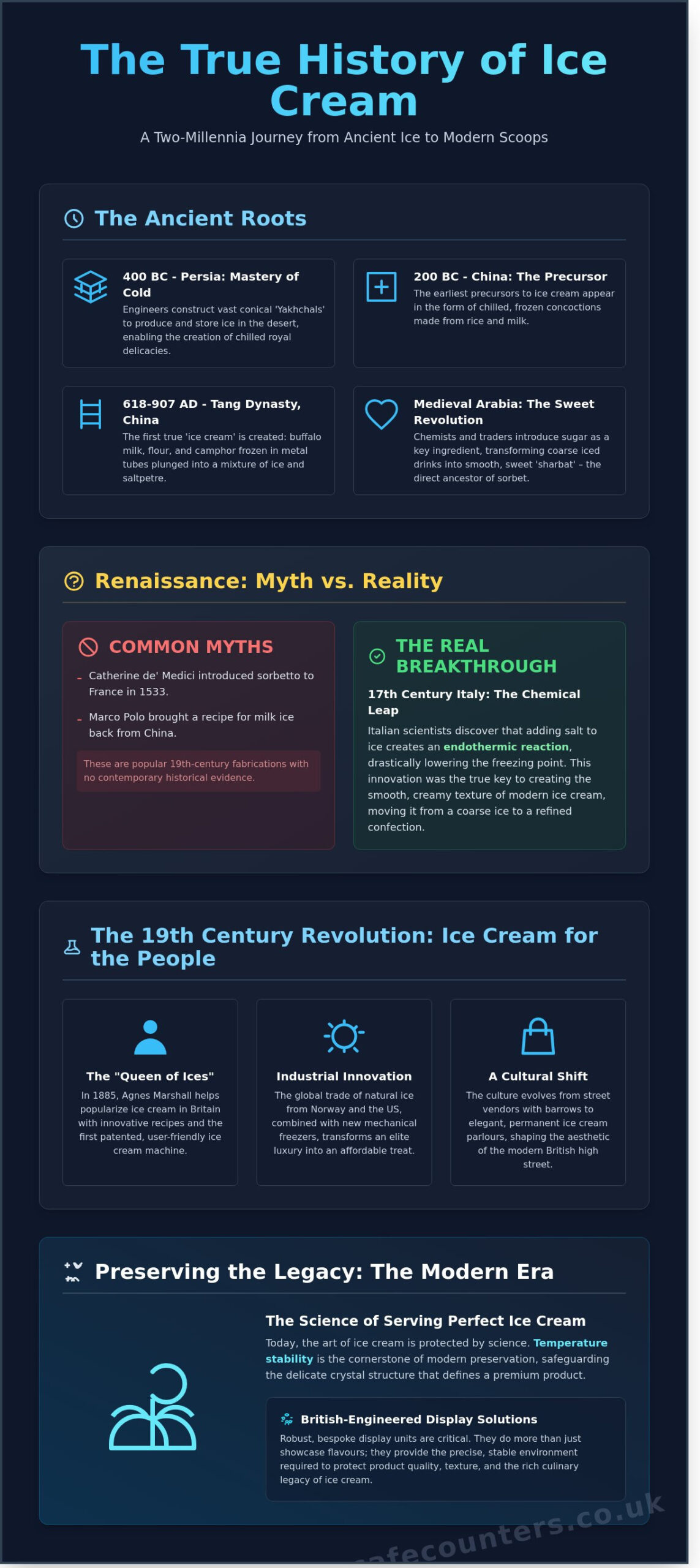
Pinpointing exactly who created the ice cream is a complex task because the treat didn’t emerge from a single kitchen or a specific inventor. Instead, it represents a technical evolution that spans over two millennia. This journey began with the mastery of temperature control and ice storage. As early as 400 BC, Persian engineers constructed the Yakhchal, a sophisticated conical structure designed to store ice in the middle of the desert. This infrastructure allowed ancient civilizations to experiment with chilled delicacies long before the advent of modern commercial refrigeration.
The Ancient Origins of Frozen Delights are rooted in these early engineering feats. While these early versions were closer to flavoured ice or snow, they established the fundamental desire for frozen refreshment. The process moved from simple cooling to intentional freezing through a series of methodical culinary breakthroughs across Asia and the Middle East.
China’s Tang Dynasty: The First True Milk Ice
The Tang Dynasty, which ruled from 618 to 907 AD, provided the first recorded evidence of a dish resembling modern ice cream. Royal chefs developed a recipe using buffalo, cow, and goat milk. They thickened this mixture with flour to provide a more robust structure. To enhance the sensory experience, they added camphor, an aromatic substance harvested from evergreen trees, which gave the treat a distinct and prestigious flavour profile.
The production process was remarkably advanced for the era. Chefs poured the mixture into metal tubes and buried them in a pool of ice mixed with saltpetre. This specific combination lowered the freezing point of the ice, allowing the milk mixture to solidify. This early adoption of end-to-end temperature management mirrors the precision we value in modern kitchen design today. It wasn’t just about the ingredients; it was about the technical capability to manipulate the environment.
The Persian and Arab Contribution to Sweetness
Arab traders and chemists significantly refined the texture of frozen treats by introducing sugar as a primary sweetener. Previous iterations relied heavily on fruit juices, which often resulted in a coarse, icy consistency. By incorporating sugar, they achieved a smoother, more palatable mouthfeel. These recipes travelled along established trade routes, eventually reaching the Mediterranean and the ports of Italy.
This period saw the rise of the “sharbat”, a chilled drink made from fruit and flower petals. “The Persian sharbat stands as the direct ancestor of modern sorbet, marking the transition from simple iced water to a sophisticated confection.” This evolution highlights the importance of bespoke recipes and high-quality ingredients in creating a lasting culinary legacy. Understanding who created the ice cream requires acknowledging these Arab innovators who transformed a seasonal luxury into a structured culinary discipline.
The European Renaissance and the Myth of Catherine de’ Medici
While many enthusiasts ask who created the ice cream, the answer isn’t found in a single royal decree or a solitary moment of inspiration. Victorian historians often credited Catherine de’ Medici with introducing the treat to the French court in 1533. There is no contemporary evidence to support this claim. It is a romantic fabrication designed by 19th-century storytellers to link a popular dessert to prestigious royal lineage. Similarly, the tale of Marco Polo returning from China with a recipe for milk ice in the late 13th century lacks any historical backing in his own writings.
The real shift occurred in 17th-century Italy. Scientists and chemists discovered that mixing salt with ice created an endothermic reaction, allowing them to freeze liquids much faster than ambient winter temperatures. Initially, this was a theatrical party trick used to amaze guests at banquets. Determining exactly who created the ice cream requires looking past these legends toward the technical innovations of the 1600s. Italian confectioners eventually harnessed this chemical technique to refine textures, moving away from coarse, icy shards toward the smooth, creamy consistency we recognise today. This period of experimentation laid the foundation for The Industrial Revolution: Bringing Ice Cream to the British Masses, which later transformed these artisanal methods into a global industry.
Debunking the Marco Polo and Medici Legends
The myth of the Italian princess bringing sorbet to Paris was likely popularised to add a sense of “old world” glamour to 19th-century confectionery shops. In reality, the transition from chilled drinks to frozen solids was a gradual process led by anonymous Italian chefs. These craftsmen were the first to move beyond simple fruit waters, experimenting with dairy and sugar to create a more robust product. By the mid-1600s, these techniques had spread to France and England, though the process remained a closely guarded professional secret.
Ice Cream Reaches the British Aristocracy
In England, the first recorded service of ice cream took place during the Feast of St George at Windsor Castle in May 1671. King Charles I was the only person at the table offered the “one plate of white strawberries and one plate of iced cream.” At the time, it was an immense display of wealth and power. Harvesting ice from frozen lakes during winter and storing it in deep, brick-lined “ice houses” required significant labour and dedicated infrastructure. These structures were common on prestigious British estates, ensuring that the elite could enjoy frozen delicacies even in the height of summer.
The first printed English recipe appeared in 1718 within “Mrs. Mary Eales’s Receipts.” As the confectioner to Queen Anne, her instructions were meticulous. She detailed how to fill tin pots with cream and fruit before burying them in a mixture of broken ice and salt for four hours. This method proved so effective that it remained the standard for over a century.
The Industrial Revolution: Bringing Ice Cream to the British Masses
The 19th century transformed ice cream from a rare luxury into a staple of British street life. While earlier centuries focused on who created the ice cream for royalty, this era was about who could deliver it to the masses. Technological leaps replaced the laborious “pot-freezing” method, where a bowl was hand-rotated inside a bucket of ice and salt, with efficient mechanical churners. This shift significantly reduced manual labour while improving the aeration of the mixture, resulting in a smoother, more consistent texture that consumers loved. This period also saw the peak of the “Atlantic Trade.” Between 1820 and 1850, massive blocks of natural ice were shipped from Norway and America to British ports. This influx of affordable cooling material meant that frozen treats were no longer restricted to those with private ice houses.
By the 1850s, the “Penny Lick” emerged in London. For a single penny, customers received a small glass filled with ice cream. They would lick it clean and return the glass to the vendor. Although this raised hygiene concerns, it established a vibrant street-vending culture that defined the Victorian summer. The accessibility of these treats was a direct result of improved supply chains and the industrialisation of dairy processing.
Agnes Marshall: The British “Queen of Ices”
Agnes Marshall redefined the conversation about who created the ice cream for the modern era. In 1885, she secured a patent for a revolutionary ice cream machine that could freeze a batch in just five minutes. Her influence extended beyond hardware; she authored four influential cookbooks that demystified complex recipes for middle-class households. Marshall even suggested using liquid oxygen to create ice cream as early as 1901. This visionary idea predated modern cryogenic cooking by a century. According to The Delicious History of Ice Cream, these innovations were crucial in transitioning the treat from an artisanal product to a global phenomenon.
The Invention of Mechanical Refrigeration
The most critical turning point for the industry was the move away from harvested natural ice toward artificial cooling. In the 1870s, Carl von Linde developed vapor-compression refrigeration, which utilised ammonia as a coolant. This technology allowed for consistent, commercial-scale production regardless of the season. It removed the reliance on the unpredictable Norwegian ice trade and provided a stable environment for dairy storage. These early industrial breakthroughs provided the foundation for the modern equipment we use today. For businesses looking to establish a reliable cold chain, understanding the evolution of commercial refrigerators is essential. These systems ensure that products remain at precise temperatures, maintaining the quality and safety standards that British consumers expect from a professional catering environment.
The Evolution of the Ice Cream Parlour and Display Culture
The 20th century marked a definitive shift in how the British public consumed frozen desserts. What began as a trade dominated by street barrows and nomadic vendors evolved into a sophisticated retail experience. This transformation was largely driven by the “Italian Influence.” Between 1870 and 1920, the number of Italians living in the UK rose from approximately 4,000 to over 20,000. These families established permanent, elegant parlours that became social hubs on the British high street. While scholars still investigate who created the ice cream in its ancient form, these entrepreneurs created the modern commercial model we recognise today.
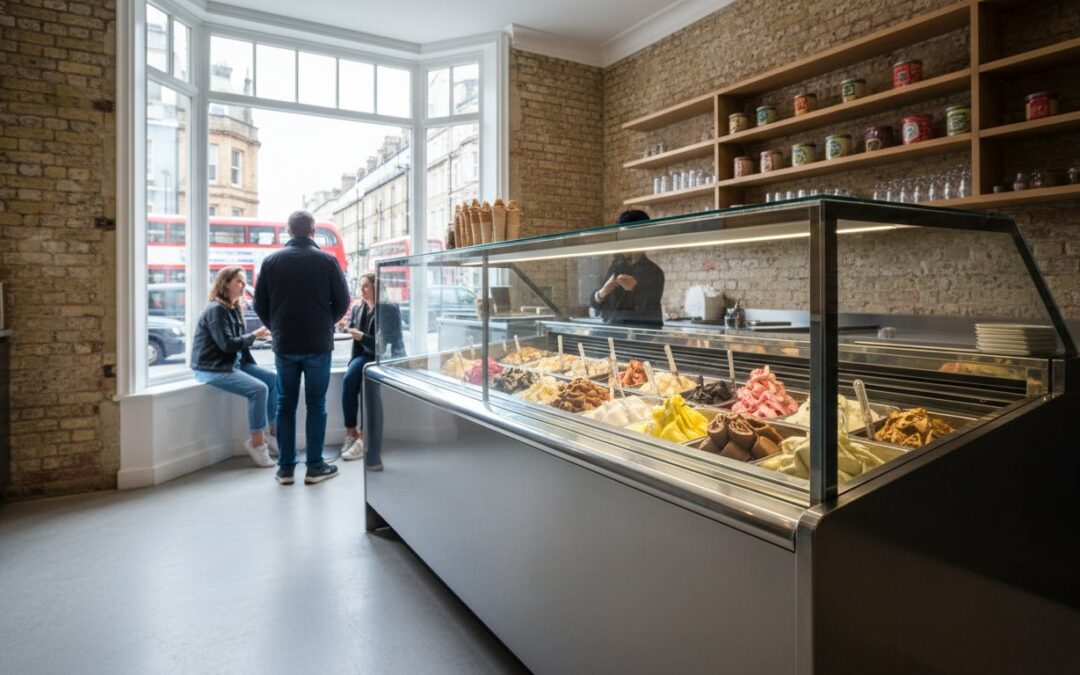
A critical technical shift occurred in the mid-1900s. Retailers moved away from hidden “deep wells,” where the product was obscured in metal canisters, to transparent glass display counters. This change turned ice cream into a visual spectacle. Modern merchandising relies on this visibility to drive impulse purchases. Seeing the ripples of sauce and the smooth texture of the churned cream through high-clarity glass is often the primary factor in a customer’s decision to buy. When people ask who created the ice cream, they are often looking for a single name, but the evolution of the parlour shows it was a collective effort of design and engineering.
The Victorian “Penny Lick” vs. The Modern Cone
Before the 1900s, vendors sold small servings in “penny lick” glasses. Customers would lick the glass clean and return it to the vendor. This practice caused a massive hygiene crisis, contributing to the spread of tuberculosis. London authorities eventually banned the penny lick in 1899. The edible wafer cone, patented by Italo Marchiony in 1903, provided a sanitary, portable solution that revolutionised on-the-go eating. In the current market, hygiene and speed remain paramount. High-traffic retailers now rely on refrigerated grab and go display units to maintain safety standards while maximising throughput during peak summer periods.
Designing the Modern Gelateria Experience
Professional counter design focuses on ergonomics and operational efficiency. For a high-volume gelateria, a counter must be set at an optimal height, typically 900mm, to reduce strain on staff during repetitive scooping. Lighting also plays a vital role. Using LEDs with a colour temperature of 4000K ensures that fruit-based sorbets and rich chocolates look vibrant rather than washed out. At Cafe Counters, we specialise in bespoke manufacturing that integrates these technical requirements into stunning aesthetics. Our turnkey approach allows business owners to evoke traditional parlour heritage through custom woodwork while utilising state-of-the-art refrigeration technology. We manage the process from concept to completion, ensuring every cabinet and counter is robust enough for daily commercial use.
Preserving the Legacy: Modern Commercial Display Solutions
While historians still investigate who created the ice cream in its earliest forms, the challenge for modern retailers has shifted from invention to preservation. Today’s premium gelato and artisanal ice creams require precise environmental controls that were unimaginable to 19th-century pioneers. Maintaining the perfect scoop isn’t just about freezing; it’s about engineering a stable micro-climate that protects the product’s delicate structure from the moment it leaves the churn.
TFSE Products Ltd carries forward the innovative spirit of Agnes Marshall, the British “Ice Cream Queen” who patented an improved ice cream machine in 1885. We apply that same British ingenuity to create robust, high-performance display units. Our engineering team focuses on total climate control, ensuring that your inventory remains as fresh as the day it was made. By 2026, the market will demand even higher standards of energy efficiency. We’re already meeting these needs through natural refrigerants and high-performance insulation that reduce operational costs without compromising on cooling power.
Why Temperature Stability is the Manufacturer’s Priority
Ice cream is a complex emulsion of air, water, and fat. When temperatures fluctuate by as little as 2 degrees Celsius, a phenomenon known as “heat shock” occurs. This causes microscopic ice crystals to melt and refreeze into larger, gritty structures that ruin the mouthfeel of premium products. We use advanced CAD modelling to map airflow within every patisserie display counter we build. This technical precision ensures a consistent curtain of cold air across the entire display area. To support your daily operations, we also prioritise:
- Advanced Airflow: Eliminating warm spots that lead to product spoilage.
- Hygiene Standards: Utilising easy-clean surfaces and seamless joints to meet strict UK food safety regulations.
- Precision Thermostats: Providing digital accuracy to maintain the exact serving temperature required for different fat contents.
Concept to Completion: Bespoke Counters for the 21st Century
Our design process bridges the gap between historical aesthetics and modern functionality. Whether you’re aiming for a traditional Victorian parlour theme or a sleek minimalist look, we manage the journey from the initial CAD drawings to the final installation. This “Concept to Completion” approach removes the stress from commercial builds, providing you with a single point of contact and total accountability. Manufacturing in the UK allows us to maintain rigorous quality control and provide rapid after-sales support that overseas competitors can’t match.
Investing in a high-quality deli counter is about more than just equipment; it’s about honouring the legacy of those who created the ice cream by ensuring it reaches the customer in perfect condition. Our bespoke solutions provide the prestigious visual impact your brand deserves while delivering the functional durability needed for a busy high-street environment. We don’t just build counters; we build reliable stages for your culinary craft.
Shaping the Future of Your Ice Cream Parlour
Ice cream has journeyed from the ice-houses of 7th-century China to the bustling streets of Victorian Britain, where the 1851 Great Exhibition helped solidify its place in the national heart. While historians still debate exactly who created the ice cream, the evolution from a hand-churned luxury to a global retail phenomenon is undeniable. Today, the success of your parlour depends on more than just a recipe; it requires a professional environment that balances aesthetic appeal with technical precision.
Since 1991, Cafe Counters has acted as the expert partner for catering businesses across the UK. Our in-house UK manufacturing facility ensures every installation meets the highest standards of British craftsmanship. We manage every detail through our proven Concept to Completion service, taking the stress out of your commercial renovation. Whether you’re launching a new venture or upgrading a prestigious high-street site, our team delivers robust, ergonomic solutions designed for long-term operational efficiency.
Design your dream ice cream display with our bespoke counter experts and create a space that honours the rich history of this frozen treat while securing your business’s future.
Frequently Asked Questions
Is it true that Marco Polo discovered ice cream in China?
Marco Polo is widely credited with introducing the concept of milk-based frozen desserts to Italy after his travels to China in 1295. While the question of who created the ice cream remains complex, Polo’s descriptions of these chilled delicacies encouraged European chefs to experiment with their own recipes. These early iterations eventually evolved into the creamy textures we recognise in modern British cafes and parlours today.
When was the first ice cream parlour opened in the UK?
Domenico Negri opened the first recorded commercial ice cream establishment in London in 1760 at Berkeley Square. This shop eventually became the famous Gunter’s, which served the British aristocracy throughout the 19th century. By 1851, ice cream production became more industrialised, allowing these prestigious treats to reach a wider public audience beyond the elite circles of London society.
Who is Agnes Marshall and why is she important to ice cream history?
Agnes Marshall was a pioneering culinary entrepreneur known as the Queen of Ices who revolutionised the industry in the late 19th century. In 1885, she published The Book of Ices and patented a portable ice cream machine that could freeze a pint of cream in five minutes. Her innovative use of liquid air for freezing predated modern molecular gastronomy by over 100 years.
What was a ‘Penny Lick’ and why was it banned?
A Penny Lick was a small, thick glass vessel used by Victorian street vendors to serve a single portion of ice cream for one penny. These glasses were rarely washed properly between customers, leading to the spread of diseases like tuberculosis. Consequently, the London County Council banned the use of Penny Licks in 1899 to protect public health and improve food hygiene standards.
How did people keep ice cream frozen before electricity?
Before the advent of electric freezers, people used ice houses and a chemical process involving salt and harvested ice. By mixing salt with ice, they created an endothermic reaction that lowered the freezing point below 0°C. This technique allowed confectioners to freeze dairy mixtures in metal canisters. Large estates often had deep underground ice houses to store blocks of ice harvested during the winter months.
What is the difference between historical sorbet and modern ice cream?
Historical sorbets were primarily made from crushed ice or snow flavoured with fruit juices and honey, whereas modern ice cream relies on a dairy base. The transition occurred in the 17th century when Italian and French chefs began adding cream and egg yolks to the mixture. This change created a smoother, more robust texture that could be moulded into the intricate shapes favoured by high-end catering establishments.
Who invented the ice cream cone?
Italo Marchiony received a US patent for a cone-making machine in 1903, though Ernest Hamwi is often credited with popularising the edible wafer at the 1904 St. Louis World’s Fair. Hamwi rolled his waffle-like pastries into cones to help an ice cream vendor who’d run out of clean dishes. This practical solution transformed the industry by providing a portable, waste-free way to enjoy frozen treats.
How has refrigeration technology changed the way we display ice cream?
Modern refrigeration technology has moved from basic static cooling to sophisticated ventilated systems that maintain precise temperatures across the entire display. These advancements allow for the creation of bespoke, ergonomic counters that showcase products without frost build-up. Today’s high-end units use high-efficiency LED lighting and triple-glazed glass to ensure the product remains visually stunning while reducing operational costs for business owners.