
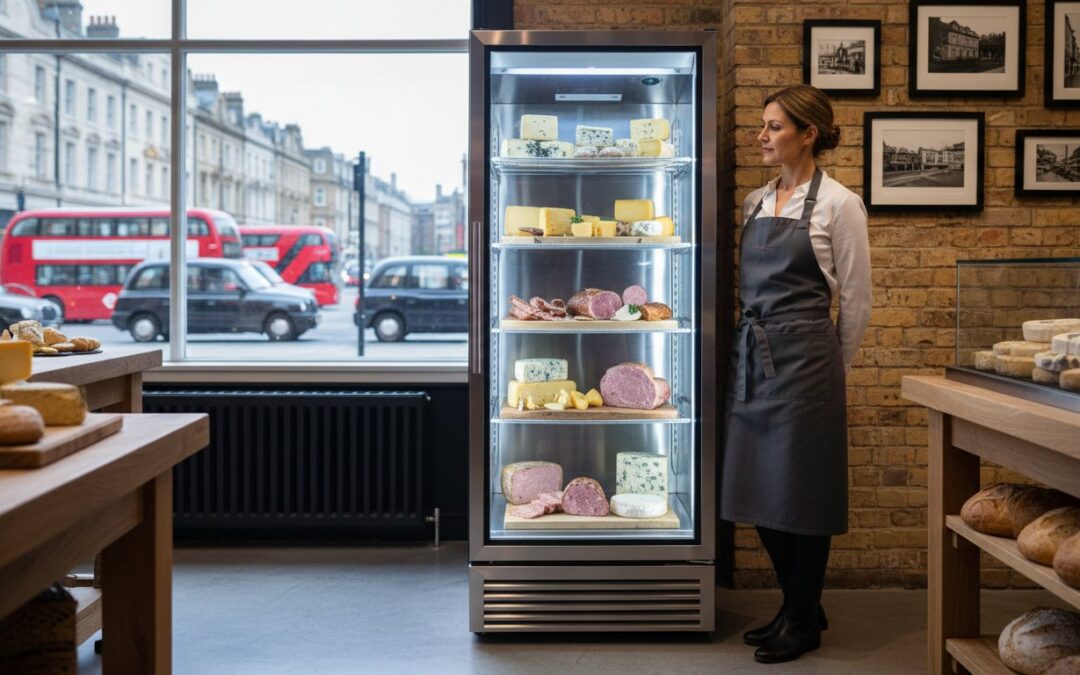
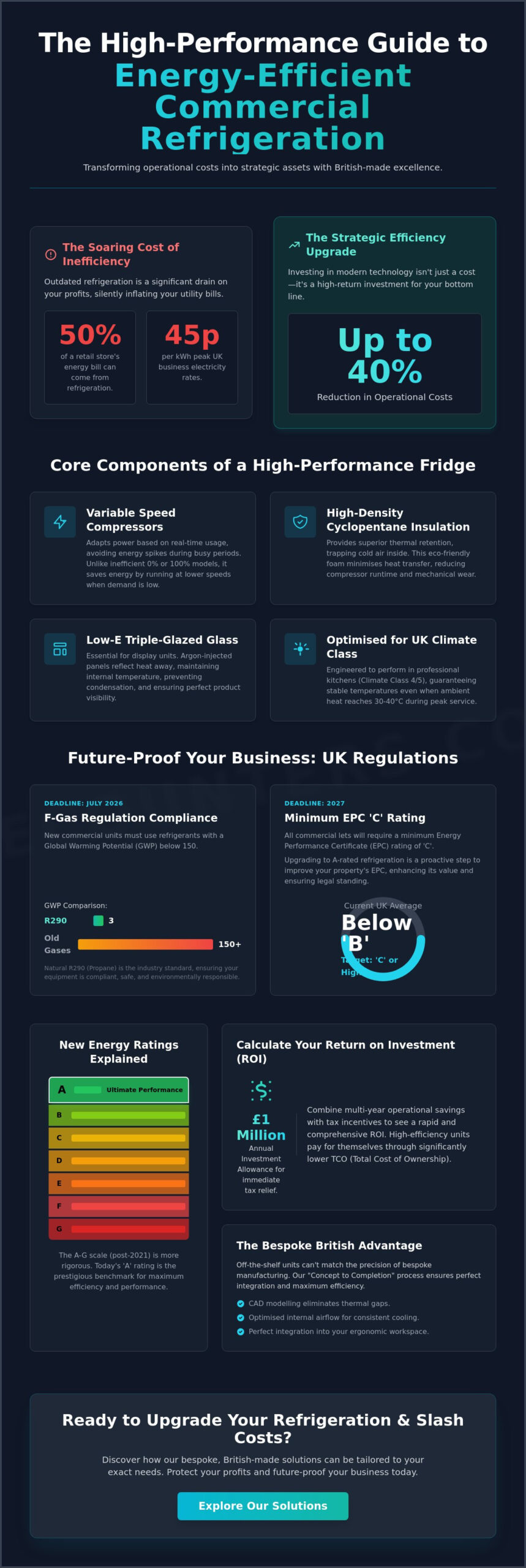
Did you know that refrigeration can account for up to 50% of a retail store’s total energy consumption, especially with UK business electricity rates currently peaking at 45p per kWh? Investing in a high-performance energy efficient commercial fridge UK specialists design is no longer just a sustainability goal; it’s a vital strategy for protecting your profit margins. You’ve likely felt the sting of these rising overheads or the frustration of older “eco” models that hide your products behind poor lighting and thick, heavy frames.
We believe that efficiency should never come at the cost of a prestigious display. This guide will show you how to slash operational costs by up to 40% while ensuring your equipment remains fully compliant with the July 2026 F-Gas regulations. We’ll explain how to leverage the £1 million Annual Investment Allowance for immediate tax relief and walk you through the technical precision required to meet the 2027 EPC ‘C’ rating standards. From natural R290 refrigerants to bespoke British manufacturing, you’ll discover how to transform your cold storage into a functional, cost-saving asset.
Key Takeaways
- Understand the 2026 energy labelling landscape and why the current ‘A’ rating represents the ultimate benchmark for professional hospitality performance.
- Identify high-performance components like variable speed compressors and cyclopentane insulation that maintain thermal integrity during heavy service periods.
- Discover how a bespoke energy efficient commercial fridge UK manufactured solution uses CAD modelling to eliminate thermal gaps and optimise internal airflow.
- Learn to project a comprehensive return on investment by calculating multi-year operational savings alongside the strategic use of the Annual Investment Allowance.
- Explore the “Concept to Completion” process where in-house British craftsmanship ensures your refrigeration is perfectly integrated into a functional, ergonomic workspace.
Understanding Energy Ratings for Commercial Refrigeration in the UK
The UK energy labelling system underwent a significant transformation to provide clearer transparency for the hospitality sector. As of May 2026, storage cabinets still utilise the A+++ to G scale, while display units follow the more rigorous A to G hierarchy introduced in 2021. An “A” rating has become the prestigious benchmark because it indicates a unit that maximizes its Coefficient of Performance (COP); this ensures that every kilowatt of electricity produces the maximum possible cooling effect. When you’re selecting an energy efficient commercial fridge UK manufacturers provide, you must look beyond the letter on the sticker. The technical data sheet reveals the true power draw, usually measured in kWh per 24 hours. A professional data sheet should also specify the climate class, typically Class 4 or 5 for UK kitchens, ensuring the unit maintains temperature even when ambient heat hits 30°C or 40°C.
The relationship between internal volume and energy consumption is a critical factor in your purchasing decision. A unit with a large internal volume might seem efficient on paper, but if it remains half-empty, you’re paying to cool dead air. We recommend a meticulous assessment of your inventory needs to ensure the fridge is sized correctly for your specific workflow. If a manufacturer avoids listing these fine technical details, the unit likely lacks the robust components required for high-volume retail environments where doors are opened frequently throughout a shift.
The Hidden Costs of Inefficient Cooling
Choosing a budget unit often leads to a higher total cost of ownership (TCO) over a standard five-year cycle. Poor insulation forces the compressor to run for longer periods, which increases mechanical wear and leads to frequent breakdowns. Research from March 2025 indicates that a poorly specified refrigeration unit can account for up to 40% of a cafe’s total energy expenditure. Beyond the direct costs, inefficient fridges vent excessive heat into your workspace. This places an unnecessary burden on your HVAC system, further inflating your monthly utility bills while compromising the comfort of your staff and guests. Investing in a high-quality energy efficient commercial fridge UK build avoids these compounding expenses by maintaining thermal integrity from the start.
UK Regulations and Compliance in 2026
Compliance is a moving target that requires a proactive approach. From July 2026, UK law prohibits the sale of new commercial refrigeration using gases with a Global Warming Potential (GWP) of 150 or more. This shift has established natural refrigerants like R290 (propane), which has a GWP of only 3, as the industry standard. Meeting these Minimum Energy Performance Standards (MEPS) is essential for passing environmental audits and maintaining food safety certifications. Approximately 80% of UK commercial buildings currently sit below an EPC ‘B’ rating. By upgrading to A-rated units now, you’re actively elevating your property’s value and legal standing before the 2027 deadline, which expects a minimum EPC rating of ‘C’ for all commercial lets.
Key Features of High-Performance Energy Efficient Commercial Fridges
Selecting a high-performance energy efficient commercial fridge UK businesses rely on involves looking deep into the specific engineering of the unit. High-density cyclopentane insulation is a critical starting point; it provides superior thermal retention compared to standard foams. This material choice ensures that cold air remains trapped inside, which significantly reduces the frequency of compressor cycles. Modern units also feature variable speed compressors. Unlike traditional models that only operate at 0% or 100% capacity, these adaptive systems adjust their output based on real-time usage patterns. This prevents the energy spikes common during high-traffic periods, such as a busy lunch rush in a high-street retail environment.
According to the Carbon Trust refrigeration guide, selecting the right components is the most effective way to manage long-term operational costs. For display units, Low-emissivity (Low-E) triple-glazed glass is essential. These panels are often injected with argon gas to create a thermal barrier that reflects heat away from the food while maintaining absolute clarity. High-efficiency EC (Electronically Commutated) fan motors are another staple of a premium energy efficient commercial fridge UK build. These motors consume up to 70% less energy than traditional shaded-pole motors, running cooler and lasting significantly longer.
Advanced Airflow and Temperature Stability
Precision is the hallmark of British manufacturing. Advanced airflow design uses “air curtains” in open-front displays to create an invisible barrier, preventing cold air from spilling out into the aisle. We integrate precision digital controllers that maintain +/- 1 degree accuracy, ensuring your products stay within safe storage windows. This stability is reinforced by self-closing door mechanisms and high-integrity magnetic gaskets that prevent costly leaks. If you’re looking for a bespoke refrigeration solution that prioritises these technical details, our design team can help you map out a layout that maximises airflow efficiency.
LED Lighting: Efficiency Meets Aesthetics
Lighting does more than just illuminate; it sells. Cool-running LEDs are vital for refrigerated patisserie displays because they don’t emit the infrared heat that can degrade delicate creams or chocolates. We focus on a high Colour Rendering Index (CRI) to ensure your food looks vibrant and appealing under prestigious lighting. Automated schedules further reduce consumption by dimming or turning off lights during out-of-hours periods. This methodical approach to lighting ensures that your stunning food presentation doesn’t come at the cost of your electricity bill.
Bespoke vs. Standard Units: Maximising Efficiency Through Design
Standard refrigeration units are often treated as standalone appliances, but this approach overlooks the energy waste caused by poor integration. When an off-the-shelf unit is placed into a custom counter, invisible thermal gaps allow cold air to escape and ambient heat to seep in. A bespoke energy efficient commercial fridge UK build eliminates these inefficiencies by ensuring a seamless, airtight fit between the refrigeration housing and the shop fit-out. We use advanced CAD modelling to predict airflow and heat dissipation before a single piece of steel is cut. This precision engineering ensures that compressors aren’t fighting trapped heat, which is a common cause of premature equipment failure in poorly ventilated installations.
Our custom stainless steel fabrication further enhances this efficiency. High-grade stainless steel reflects heat rather than absorbing it, which helps maintain a stable internal environment. When selecting equipment, we recommend consulting the Energy Technology List (ETL) to identify products that meet the highest independently verified standards. By combining ETL-listed components with our bespoke manufacturing, you create a system where every element works in harmony to reduce your carbon footprint. It’s a methodical process that moves from a broad concept to a high-performance physical space.
The Synergy of Integrated Drop-in Units
Integrating drop-in refrigerated displays into your counter offers a significant advantage over standalone models. These units are designed to be encased within an insulated counter structure, providing a secondary layer of thermal protection that standalone cabinets lack. We strategically place compressors to ensure optimal ventilation, preventing the “heat soak” effect often found when refrigeration is placed too close to coffee machines or ovens. This methodical approach to layout ensures that your energy efficient commercial fridge UK solution remains functional and cost-effective throughout its entire lifecycle.
Tailoring Capacity to Real-World Demand
One of the most common mistakes in commercial kitchen design is over-specifying capacity. An oversized fridge doesn’t just cost more to buy; it carries a permanent energy penalty because you’re paying to cool “empty air.” Bespoke design allows us to tailor the internal volume to your actual inventory needs, reducing waste and improving product visibility. For businesses with variable footfall, we often install modular display solutions. This allows you to scale your cooling capacity up or down based on seasonal demand, ensuring you’re never consuming more power than necessary to keep your products in prestigious condition.
Calculating ROI: Why Energy Efficiency is a Strategic Investment
Viewing a high-specification energy efficient commercial fridge UK build as a capital investment rather than a simple overhead is essential for long-term financial health. With business electricity rates reaching up to 45p per kWh as of April 2026, the delta between an A-rated unit and a budget G-rated model can represent thousands of pounds in operational savings over a 36-month period. These savings aren’t limited to the utility bill alone. Stable temperature zones, achieved through precision engineering, significantly extend the shelf-life of perishable stock. By reducing food waste by even a small percentage, a prestigious hospitality venue can see a full return on the initial price premium within the first 12 to 18 months of operation. Reliability is the silent partner of ROI; equipment that doesn’t break down ensures business continuity and protects your reputation for quality.
We approach every project with a focus on durability because we understand that a “cheap” unit is often the most expensive one you’ll ever own. When you factor in the cost of emergency call-outs and potential stock loss, the argument for British-made, high-efficiency systems becomes undeniable. If you’re ready to upgrade your facility with equipment designed for decades of service, you can view our range of bespoke refrigeration solutions to start your ROI calculation.
Tax Incentives and UK Capital Allowances
The UK government provides significant support for businesses investing in green technology. For the 2026/27 tax year, the Annual Investment Allowance (AIA) remains at £1 million. This allows you to claim 100% tax relief on qualifying plant and machinery, including an energy efficient commercial fridge UK specialists have manufactured to meet strict environmental standards. By utilizing the AIA, you can deduct the full value of the equipment from your profits before tax, effectively reducing the net purchase price. We recommend consulting the Energy Technology List (ETL) and working with your accountant to ensure your business case for high-end equipment is robust and compliant with current HMRC guidelines.
Maintenance: Preserving the Energy Rating
An energy rating is only as good as the maintenance regime supporting it. Data from March 2025 shows that dirty condenser coils can decrease a fridge’s efficiency by up to 30%, forcing the system to work harder and consume more power to maintain the same temperature. We provide professional commissioning and calibration services to ensure your unit is operating at peak performance from day one. Proactive maintenance, such as checking magnetic gasket integrity and scheduling regular coil cleanings, is vital for preserving your ROI. A split gasket might seem minor, but the resulting cold air leak can increase energy consumption by 15% overnight, quietly eroding your profit margins.
British-Made Excellence: TFSE’s Energy-Efficient Display Solutions
True efficiency isn’t found in a warehouse of imported, standardised cabinets; it’s forged in a UK facility where every weld and gasket is inspected for absolute quality. By choosing an energy efficient commercial fridge UK specialists have built from the ground up, you gain total control over the manufacturing process. Unlike importers who simply “design” in Britain while outsourcing the heavy lifting, our in-house manufacturing ensures that the high-density cyclopentane insulation and triple-glazed panels discussed earlier are integrated with surgical precision. This local oversight eliminates the quality variance often found in mass-produced units, providing a level of build quality that supports long-term operational savings.
Our commitment to British craftsmanship also significantly reduces the carbon footprint of your project. By avoiding the environmental cost of long-distance shipping, we ensure that your equipment arrives with a lower total carbon impact. This proximity also means that our engineers have an intimate knowledge of your specific unit. Should you require maintenance or a simple component upgrade, we don’t rely on global shipping lanes for parts. We maintain a robust inventory of UK-based spares, ensuring your business stays operational without the weeks of downtime associated with imported equipment.
Our “Concept to Completion” Process
We’ve anchored our business on a “Concept to Completion” service that alleviates the stress of a commercial build. This journey begins with a meticulous site survey to ensure your chosen equipment matches the local power capacity and space constraints of your venue. A fridge can only reach its rated efficiency if it has the correct clearance for airflow and heat dissipation. Our professional installation team guarantees that every unit is commissioned to the manufacturer’s exact specifications. You can see this methodical approach in our high-performance patisserie display counters, where stunning aesthetics meet the technical rigour required for delicate food preservation.
Why Local Manufacturing Matters in 2026
The global supply chain remains unpredictable in 2026, making local manufacturing a strategic advantage for the catering industry. We offer bespoke modifications that off-the-shelf importers simply cannot provide, such as custom-sized counters or integrated storage solutions that fit your unique floor plan. This flexibility allows us to design out the “empty air” cooling waste mentioned in previous sections. Our British-engineered units are built for durability; they’re robust enough to handle the unique pressures of the UK’s high-street retail and healthcare sectors. When you partner with us, you aren’t just buying a cabinet; you’re securing a lifelong expert ally for your energy efficient commercial fridge UK needs.
Securing Your Operational Future with British Precision
Navigating the transition to the 2027 EPC ‘C’ mandate and the July 2026 F-Gas regulations requires a partner who understands the technical nuances of the UK market. True energy savings come from a synergy of high-performance components and bespoke integration rather than a simple equipment purchase. By leveraging the £1 million Annual Investment Allowance and focusing on a high Coefficient of Performance, you can successfully mitigate the impact of 45p per kWh electricity rates while enhancing your food presentation.
As a dedicated UK manufacturer since 1991, we combine advanced CAD modelling with our signature Concept to Completion service to ensure your energy efficient commercial fridge UK installation is seamless and robust. Our team is ready to help you move from an initial vision to a finished, prestigious workspace that prioritises both aesthetics and durability. We invite you to Request a Bespoke Counter Consultation for Your Energy-Efficient Upgrade and take the first step toward a more profitable, sustainable facility. Your vision deserves the technical expertise of a seasoned Expert Partner.
Frequently Asked Questions
How much can an A-rated commercial fridge save on energy bills?
An A-rated unit can reduce electricity expenditure by up to 40% compared to older G-rated models. With UK business rates reaching 45p per kWh as of April 2026, this represents a substantial annual saving. These efficiencies are achieved through variable speed compressors and high-density insulation. Choosing an energy efficient commercial fridge UK build ensures these savings are sustained over the equipment’s long operational lifetime.
What is the difference between climate classes for commercial fridges?
Climate classes indicate the ambient temperature and humidity a unit can handle while maintaining internal safety. Class 4 is tested at 30°C, whereas Class 5 is designed for “tropical” conditions up to 40°C. In a busy UK commercial kitchen, a Class 5 rating is the professional choice. It prevents the compressor from overworking when the kitchen heat rises during a demanding peak service.
Is it better to buy a standalone unit or an integrated drop-in display?
Integrated drop-in displays are generally superior for energy retention because they’re encased within an insulated counter structure. This design eliminates the thermal gaps often found around standalone units. While standalone cabinets offer more flexibility for relocation, integrated solutions provide a seamless finish and better protection against heat soak from nearby equipment. They’re a core part of a prestigious, functional shop fit-out.
Does a glass door fridge use more energy than a solid door unit?
Solid door units are technically more efficient, but modern triple-glazed Low-E glass has narrowed the gap significantly. Argon-injected glass panels reflect heat while maintaining stunning product visibility for your customers. While a glass door may consume slightly more power than a solid one, the marketing benefits of better product visibility often outweigh the marginal increase in monthly utility costs.
What UK tax incentives are available for energy-efficient catering equipment?
Businesses can claim 100% tax relief through the Annual Investment Allowance (AIA), which is set at £1 million for the 2026/27 period. This allows you to deduct the full cost of an energy efficient commercial fridge UK from your pre-tax profits. It’s a powerful incentive that reduces the effective purchase price and accelerates your return on investment while supporting your sustainability goals.
How often should I service my energy-efficient commercial fridge?
You should schedule a professional service every six months to maintain peak efficiency. This maintenance includes cleaning condenser coils, checking magnetic gasket seals, and calibrating digital controllers. Neglecting this routine can cause energy consumption to spike by 30% due to restricted airflow. Regular commissioning ensures your equipment continues to meet its original energy label standards and prevents premature mechanical failure.
What refrigerants should I look for to be future-proof in the UK?
Look for natural refrigerants like R290 (propane) or R600a (isobutane) to ensure your equipment is future-proof. UK regulations coming into force in July 2026 will ban the sale of new units using refrigerants with a GWP higher than 150. These natural gases have a Global Warming Potential of 3 or less, making them the most environmentally responsible and legally compliant choice for the hospitality sector.
Can bespoke counters be as efficient as off-the-shelf eco-models?
Bespoke counters are frequently more efficient than off-the-shelf models because they’re designed for a precise physical fit. Standard units often leave air gaps that trap heat or allow cold air to pool ineffectively. By using CAD modelling and custom stainless steel fabrication, we ensure every millimetre of the installation contributes to thermal stability. This meticulous approach prevents the “empty air” cooling waste common in standardised layouts.