
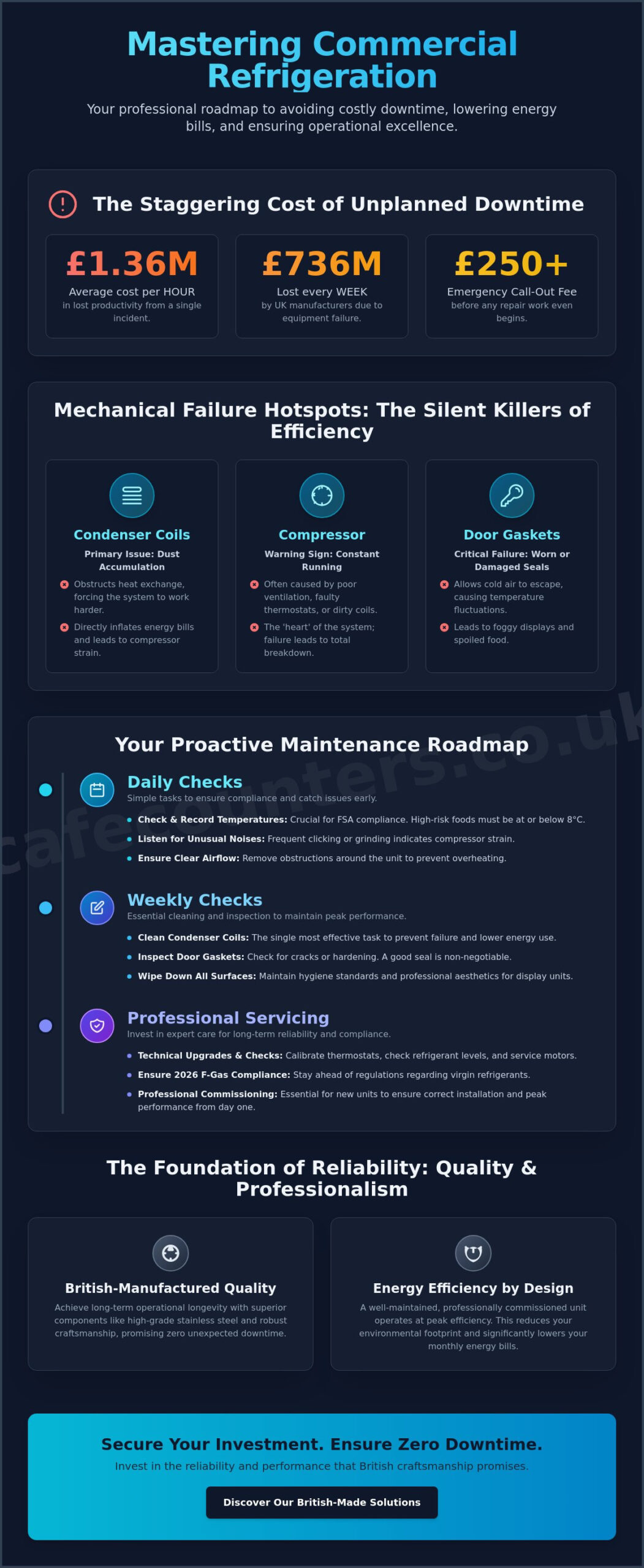
Unplanned equipment downtime costs UK manufacturers up to £736 million every week, with a single incident averaging a staggering £1.36 million per hour in lost productivity. You’ve likely felt the immediate stress of a sudden compressor failure or a noisy motor disrupting your customer atmosphere; it’s a frustration that threatens both your stock and your professional reputation. Mastering the art of avoiding common commercial fridge problems is no longer just a recommendation; it’s a financial necessity in an era where emergency call-out fees can jump to £250 before any actual repairs begin.
We understand that your refrigeration is the backbone of your operational success. This guide provides a professional roadmap to help you identify early warning signs, prevent food spoilage, and ensure your equipment meets the strict 2026 F-Gas regulations regarding virgin refrigerants. We’ll walk you through a methodical process from daily maintenance checks to technical efficiency upgrades, ensuring your bespoke counters and grab and go displays achieve the longevity that British craftsmanship promises. By the end of this article, you’ll have the expert knowledge required to maintain consistent temperatures, lower your energy bills, and secure a reliable, high-performance future for your catering space.
Key Takeaways
- Identify how dust accumulation on condenser coils and compressor strain silently inflate your energy bills and lead to premature mechanical failure.
- Discover the critical role of high-quality door gaskets and ergonomic design in maintaining the crystal-clear visibility of your patisserie displays.
- Master the art of avoiding common commercial fridge problems by implementing a structured daily and weekly preventative maintenance schedule tailored for 2026 standards.
- Learn why professional commissioning and British-manufactured stainless steel components are essential for achieving long-term operational longevity and zero downtime.
Understanding the Impact of Commercial Refrigeration Downtime
When a refrigeration unit fails in a professional kitchen or retail space, the clock starts ticking on more than just the temperature. For a busy UK establishment, an eight-hour breakdown during peak trade can result in hundreds of pounds in wasted ingredients and thousands in lost revenue. Beyond the immediate stock loss, the hidden costs of emergency labour and the risk of secondary mechanical failures often outweigh the price of a proactive service plan. Focusing on avoiding common commercial fridge problems is the most effective way to protect your profit margins and ensure your bespoke serving counters remain a reliable asset rather than a liability.
Inefficiency is a silent drain on your resources. When components like the compressor or condenser coils are neglected, they work harder to achieve the same cooling effect, directly inflating your monthly energy bills. Understanding how vapor-compression refrigeration works reveals that even minor airflow obstructions or coolant leaks can lead to excessive power consumption. Given that refrigeration and cooling account for approximately 16% of the UK’s total electricity usage, a single poorly maintained unit can significantly impact your operational overheads. A robust maintenance culture ensures that your equipment operates at peak efficiency, extending its lifespan and reducing its environmental footprint.
The Financial Reality of Equipment Failure
Calculating the true cost of downtime involves more than just the repair bill. You must account for the loss of trade when customers see empty shelves or “out of order” signs. Quick fixes, such as bypassing a faulty sensor or overcharging a system with gas, often mask deeper issues that lead to more expensive secondary failures later. We believe that investing in high-quality commercial refrigerators is the first step toward long-term ROI, but a disciplined approach to maintenance is what secures those gains. Consistent care prevents the “domino effect” where one failing part puts undue strain on the entire system, leading to a total seizure of the compressor.
Health and Safety Compliance
Reputation is built on consistency, and nothing kills customer trust faster than a lukewarm beverage or a foggy deli counter. This lack of trust is difficult to repair and often leads to a permanent loss of trade. Poorly maintained equipment is also a primary red flag for local authority health inspectors. To meet UK Food Standards Agency (FSA) requirements, you must demonstrate robust temperature logging and proof of regular servicing. Consistent cooling prevents bacterial growth and cross-contamination, ensuring your business remains a safe environment for both staff and patrons. In the UK, high-risk chilled foods must be stored at or below 8°C to remain legally compliant with food safety regulations.
By implementing a structured approach to avoiding common commercial fridge problems, you transition from reactive firefighting to proactive management. This shift not only saves money but also reinforces the professional image of your brand, showing clients that you value quality and safety in every detail of your operation.
Mechanical Failure Points: Coils, Compressors, and Fans
Maintaining the mechanical integrity of your refrigeration is a disciplined practice that separates successful operators from those plagued by emergency repairs. The compressor acts as the heart of the system, and identifying early signs of strain is vital for avoiding common commercial fridge problems. If you notice your unit running constantly or hear a frequent clicking sound, the compressor is likely struggling to reach set temperatures. This strain is often caused by external factors rather than a faulty part, such as poor ventilation or a failing thermostat that cannot accurately regulate the cooling cycle.
According to the Department of Energy maintenance guidelines, regular inspections of these core components can prevent the significant energy consumption increases typically seen in neglected units. When the thermostat fails to communicate with the cooling system, it can lead to over-cooling. This doesn’t just freeze your stock; it puts unnecessary pressure on the entire mechanical assembly, leading to a shortened equipment lifespan. Consistent monitoring ensures your equipment remains a reliable partner in your kitchen’s daily workflow.
The Condenser Coil Cleaning Protocol
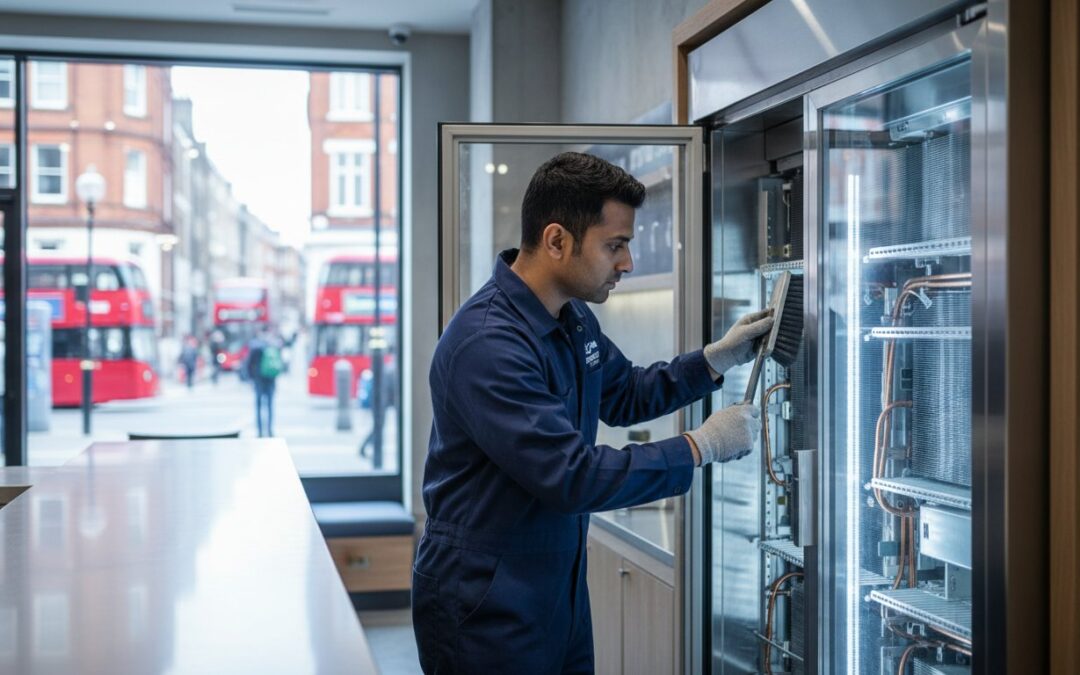
Condenser coils are the silent victims of a busy kitchen. In an environment where fryers and griddles are in constant use, airborne grease combines with dust to form a thick, insulating blanket over the coils. This prevents heat exchange, forcing the system to work twice as hard to maintain food-safe temperatures. For those utilizing bespoke serving counters, ensuring the ventilation paths remain clear is essential for long-term operational health. You should follow a methodical cleaning process to keep your system breathing freely:
- Disconnect the power to ensure safety before touching any internal components.
- Vacuum the fins using a soft brush attachment to remove loose dust and lint.
- Brush away stubborn debris with a dedicated coil brush, moving in the direction of the fins to avoid damaging them.
- Inspect for oil leaks, which often indicate a refrigerant breach that requires a qualified engineer to resolve.
Identifying Fan and Motor Issues
Evaporator fans are responsible for circulating cold air throughout the cabinet. If you see ice building up on the back wall, it’s a sign of restricted airflow or a failing fan motor. Listen to the rhythm of your kitchen; a healthy motor has a steady hum, whereas a mechanical grinding or rattling indicates a bearing failure that requires immediate attention. Blocked vents are the most common cause of fan motor burnout, as they force the motor to spin against high resistance. Distinguishing these sounds early can save you from the £400 cost of a compressor repair or the £250 emergency call-out fees that are common in 2026. If the sound persists after a thorough cleaning of the vents, it’s time to call a technician for a motor replacement before the entire unit fails.
Maintaining Aesthetic and Hygiene Standards in Display Units
A prestigious display is a window into the quality of your craft, yet its visual impact is instantly diminished by condensation or worn components. Maintaining high aesthetic and hygiene standards is about more than just surface-level cleaning; it’s a fundamental part of avoiding common commercial fridge problems that can alienate customers. From the clarity of the glass to the integrity of the door seals, every detail contributes to the perception of freshness and professional competence.
We believe that robust design should facilitate easy maintenance. Utilizing high-grade stainless steel in our fabrication processes ensures that surfaces are non-porous and resistant to bacterial growth. When combined with modern LED lighting, which produces minimal heat compared to traditional bulbs, your food looks as fresh as it tastes without compromising the internal climate of the unit. This attention to detail ensures your equipment remains a functional and stunning centerpiece of your retail space.
The “Paper Test” for Door Seals
Door gaskets are perhaps the most underrated component in any kitchen, yet they’re the primary line of defence against ambient heat. A split or flattened seal allows warm, moist air to enter the cabinet, leading to “sweating” on the interior walls and rapid frost build-up on the evaporator. You can perform a simple 10-second diagnostic by placing a sheet of paper between the gasket and the frame. If the paper slides out easily when the door is closed, the seal has lost its integrity and must be replaced. Neglected gaskets also become a hygiene risk, as the deep grooves can harbour mould if not cleaned weekly with a mild detergent.
Managing Display Clarity and Condensation
Achieving perfect visibility in patisserie display counters requires a delicate balance between internal cooling and the ambient shop environment. Glass fogging occurs when the surface temperature of the glass drops below the dew point of the surrounding air. To prevent this, ensure your shop’s ventilation is managed to avoid excessive humidity near the units. In refrigerated grab and go display units, condensation is often caused by overstocking, which blocks the internal air curtain designed to keep the cold in. Similarly, when loading deli counters, you must leave adequate space around the vents to prevent “hot spots,” ensuring that every product remains within the safe 2026 compliance temperature range. By avoiding common commercial fridge problems related to airflow, you maintain crystal-clear visibility and food safety simultaneously.
A Step-by-Step Preventative Maintenance Schedule for 2026
A disciplined maintenance schedule is the difference between a seamless service and a costly kitchen crisis. By breaking down tasks into manageable daily, weekly, and monthly increments, you create a culture of accountability that is essential for avoiding common commercial fridge problems. This structured approach ensures that minor issues are caught before they escalate into total mechanical failures, protecting your stock and your bottom line. We believe that professional equipment deserves a professional care routine to maintain its operational longevity.
For 2026, compliance is more rigorous than ever. With the ban on virgin refrigerants with a GWP of 2,500 or more now in effect for servicing, maintaining your current system’s gas integrity is vital. A quarterly professional service should now include a comprehensive F-Gas leak check to ensure your equipment remains legal and efficient. This proactive stance prevents the sharp price increases associated with reclaimed gases and helps you avoid the significant fines for non-compliance reported by the Environment Agency.
Daily Staff Duties for Equipment Health
Implementing a “close-down” checklist empowers your team to take ownership of equipment health. Staff should perform a visual inspection of all door seals and ensure that vents are not obstructed by food packaging or debris. Overstocking at the end of a shift is a frequent culprit of overnight failures; when air cannot circulate, the evaporator coils can ice up, leading to a warm unit by the following morning. To remain compliant with UK food safety standards, you must record the internal temperature of each refrigeration unit at least twice daily using a calibrated probe or a verified digital controller readout.
The Monthly Technical Check
While daily tasks focus on hygiene, the monthly check is where you address the mechanical heart of the unit. Safely accessing the motor compartment allows you to inspect for signs of wear or excessive dust accumulation before they cause a breakdown. This level of detail is a core part of avoiding common commercial fridge problems and ensuring your kitchen runs like clockwork.
- Clear the drainage: Check the condensate tray and drain line for slime or blockages that can cause water to pool at the base of your counter.
- Vacuum the coils: Removing grease and dust from the condenser is the single most effective way to lower energy bills and prevent compressor seize.
- Test responsiveness: Ensure the digital controller responds to inputs and that all internal LED lighting is functioning to maintain a prestigious display.
Maintaining this level of detail requires high-quality equipment designed with serviceability in mind. If your current units are difficult to clean or frequently fail, it may be time to consider a more robust, ergonomic solution. Explore our range of British-built bespoke serving counters to find equipment that supports your maintenance goals and enhances your professional environment.
Why Professional Commissioning and British Manufacturing Reduce Long-Term Issues
High-end refrigeration is a significant investment in your business’s future, but the journey to zero downtime begins long before the first temperature log is recorded. Professional commissioning is the critical step that many operators overlook. It’s the methodical process of ensuring that a unit is perfectly leveled, has the required clearance for airflow, and is connected to a stable power supply. Without this foundation, even the most expensive equipment will struggle, leading to the mechanical strain we identified in earlier sections. By focusing on quality from the outset, you are effectively avoiding common commercial fridge problems that stem from poor initial setup.
Our commitment to British manufacturing isn’t just about heritage; it’s about total quality control. Using high-grade stainless steel ensures a robust frame that won’t warp or corrode under the pressures of a high-volume kitchen. Unlike imported units where parts might take weeks to arrive, UK-based manufacturing means you have immediate access to after-sales support and authentic components. This proximity allows for a rapid response that is vital for maintaining operational longevity in the UK market, where the catering equipment segment is expected to reach over £1 billion by 2026.
Bespoke Design for Operational Efficiency
The “Concept to Completion” philosophy ensures that every detail of your unit is engineered for its specific environment. Our CAD modelling process allows us to visualize how air will flow around your equipment before manufacturing even begins. This precision is essential for avoiding common commercial fridge problems like “hot spots” or fan motor burnout caused by poor ventilation. When you choose a bespoke cafe counter, you aren’t just buying a display; you’re investing in a system designed for seamless hygiene management. Integrated drop-in units, for example, eliminate the difficult-to-clean gaps found in modular setups, ensuring your salad bars and deli counters remain pristine with minimal effort.
The TFSE Products Ltd Expert Partner Advantage
As your expert partner, we understand that a successful installation is about more than just plugging in a unit. Our team manages the entire process, from the initial site survey to the final commissioning check. This hands-on approach eliminates common setup errors, such as placing a grab and go display too close to a heat source or failing to provide adequate clearance for the condenser. We invite our clients to participate in a detailed site survey to plan for a trouble-free future. This collaborative process ensures that your bespoke serving counters and patisserie displays are set to exact manufacturer specifications, providing you with the peace of mind that comes from a steady, reliable hand in a complex industry.
Securing the Longevity of Your Professional Cooling Assets
True refrigeration reliability is the result of a disciplined, proactive culture. By mastering the daily staff duties and technical checks outlined in this guide, you move from reactive repairs to a state of total operational control. Mastering the art of avoiding common commercial fridge problems ensures your stock remains protected and your energy bills stay manageable. It’s a commitment to quality that pays dividends in equipment lifespan and long-term customer trust.
Since 1991, we’ve focused on the precision of British manufacturing to solve these challenges before they begin. Our Concept to Completion service utilizes comprehensive CAD modelling to ensure perfect ventilation for every bespoke unit. Whether you require patisserie displays or robust back-bar units, our team provides the technical expertise to bring your vision to life. Book a Professional Site Survey for Your Bespoke Counter Project today to ensure your next installation is built for durability and peak performance. We look forward to being your expert partner in creating a seamless, high-performance catering environment.
Frequently Asked Questions
Why is my commercial fridge leaking water onto the floor?
A blocked drain line or an overflowing condensate tray is the primary cause of water leaks in a professional kitchen. Over time, food debris and biological slime accumulate within the drainage system, preventing water from escaping the unit during the automatic defrost cycle. You should clear the drain line with a soft pipe brush or compressed air to restore proper flow. Regular monthly checks are essential for avoiding common commercial fridge problems like floor slip hazards and structural damage to your kitchen flooring.
What is the ideal temperature for a commercial display fridge in the UK?
In the UK, high-risk chilled foods must be stored at or below 8°C to comply with the Food Hygiene Regulations 2006. However, for maximum food safety and optimal shelf life, we recommend maintaining an internal temperature between 1°C and 5°C. Operating within this tighter range provides a necessary safety buffer during busy service periods when doors are frequently opened. Always use a calibrated independent thermometer to verify that your digital controller matches the actual air temperature inside the cabinet.
How often should I have my commercial refrigeration professionally serviced?
You should schedule a professional service at least twice per year to maintain mechanical efficiency and ensure F-Gas compliance. High-volume environments, such as high-street cafes or hospital kitchens, often benefit from quarterly inspections to catch wear and tear before it leads to a breakdown. These visits ensure that your system’s refrigerant levels are correct and that the compressor is operating within manufacturer specifications. Consistent servicing is a cornerstone of avoiding common commercial fridge problems and extending the lifespan of your bespoke counters.
Why is my fridge making a loud humming or buzzing noise?
A loud humming or buzzing usually indicates a failing fan motor or a vibrating component that has shaken loose. While a steady hum is normal for any cooling system, an increase in volume often suggests that the motor bearings are worn or that the fan blades are hitting an external obstruction like ice. If the noise is accompanied by a rattling sound, it could be the compressor mounts failing or a loose panel. You should address these acoustic warnings immediately to prevent a total mechanical seizure and expensive emergency repairs.
Can I fix a broken door gasket myself or do I need a technician?
You can often replace a push-in door gasket yourself without the need for a professional technician. Most modern commercial units use magnetic gaskets that simply slot into a dedicated groove on the door frame, making them user-replaceable. However, you must ensure the replacement part is the exact model-specific match to maintain an airtight seal. If the gasket is screwed in or requires heat-sealing to fit, we recommend professional installation to ensure the door remains perfectly level and energy-efficient.
Why is there ice building up on the back wall of my fridge?
Ice accumulation on the back wall is typically caused by restricted airflow or warm air entering through a faulty door seal. When the evaporator coils cannot breathe due to overstocking, moisture in the air freezes onto the cold surfaces instead of being drained away. This layer of ice acts as an insulator, forcing the compressor to run longer and significantly increasing your energy bills. Ensure there is at least a 50mm gap between your stock and the back wall to allow for proper air circulation.
How much space does a commercial fridge need for proper ventilation?
A commercial fridge generally requires a minimum clearance of 5cm to 10cm around the top, back, and sides to allow heat to dissipate effectively. Units with bottom-mounted compressors may need less rear clearance but require completely unobstructed front grilles to function. Our CAD modelling process ensures that bespoke serving counters are designed with these specific airflow requirements in mind. Insufficient ventilation is a leading cause of premature compressor failure, as it forces the unit to operate in an overheated environment.
What should I do if my fridge temperature starts fluctuating?
If your temperature starts fluctuating, your first step should be to inspect the door gaskets for gaps and the condenser coils for dust buildup. Inconsistent cooling is often the result of the system struggling to shed heat or losing cold air through worn seals. If these basic checks don’t resolve the issue, the problem likely lies with a faulty thermostat or a refrigerant leak. You should contact a qualified engineer immediately to diagnose the internal components before stock spoilage occurs and your business faces a compliance risk.