
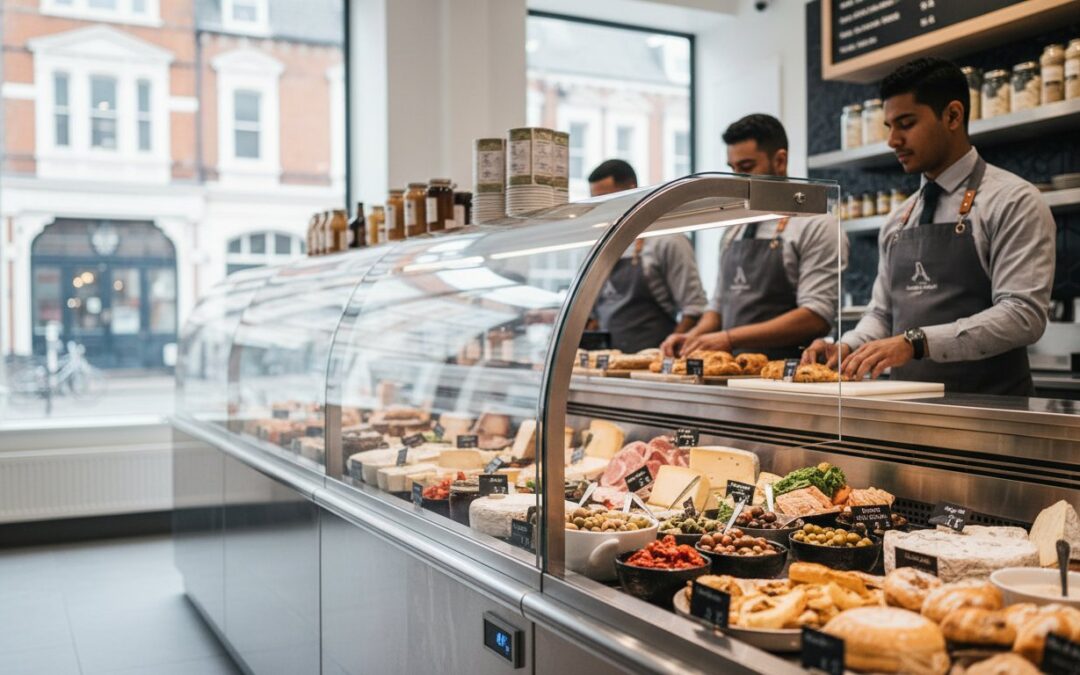
If your display counter features hidden bacteria traps in its seams, even the most rigorous cleaning schedule won’t save your Food Hygiene Rating Scheme (FHRS) score during a surprise inspection. Mastering the latest food hygiene standards for display counters is essential for any reputable caterer, particularly as the Food Standards Agency implements a phased ban on Bisphenol A (BPA) in food contact materials starting July 20, 2026.
We know you value the reputation of your business and feel the pressure of maintaining a five star rating while managing complex temperature logs. It’s often stressful to balance the aesthetic appeal of your patisserie or deli units with the practical need for deep cleaning. This guide provides a clear path to total compliance, ensuring your hot food stays above 63°C and your chilled displays remain between 0°C and 5°C as recommended by best practice. You’ll discover a practical daily checklist for seamless operations and learn why investing in bespoke, British-built counters is the most reliable way to secure your business’s future.
Key Takeaways
- Understand how the latest FSA regulations and the 2026 BPA ban directly influence your choice of display equipment and overall hygiene rating.
- Learn the precise temperature thresholds for hot and chilled units and why 304-grade stainless steel is the professional standard for long-term durability.
- Discover how to integrate essential safety features like sneeze guards without compromising the visual appeal of your patisserie or deli counter.
- Access a comprehensive daily checklist to ensure your food hygiene standards for display counters consistently meet legal requirements and inspection criteria.
- Explore the benefits of bespoke, British-manufactured counters that use CAD modelling to eliminate bacteria-harbouring ‘dead zones’ in your serving area.
Understanding the UK Regulatory Landscape for Food Display Counters
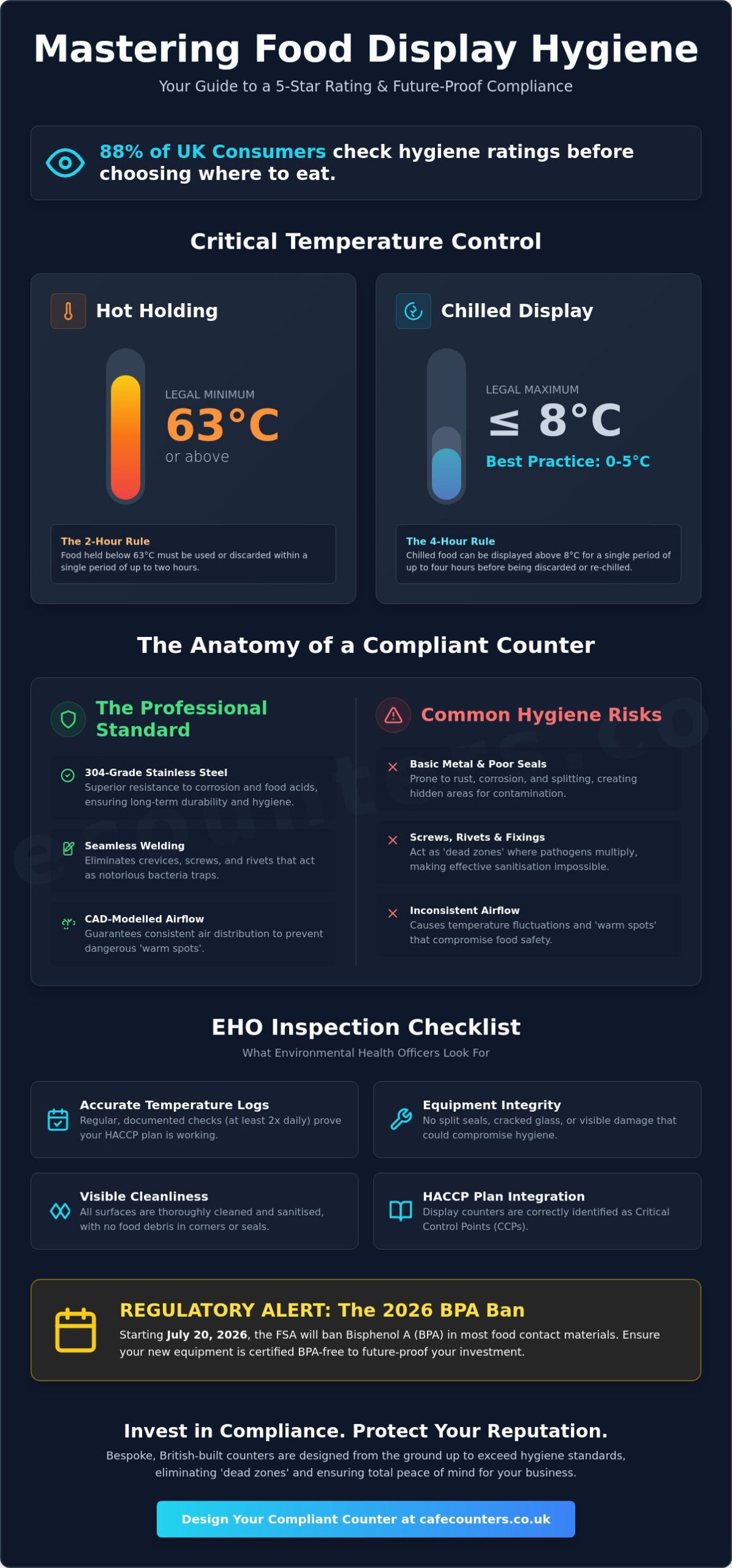
The Food Standards Agency (FSA) serves as the primary architect of the UK’s food safety framework. For any hospitality business, adhering to food hygiene standards for display counters isn’t just a recommendation; it’s a legal necessity defined by the Food Safety Act 1990. Failing to meet these requirements doesn’t just invite legal scrutiny. It directly threatens your Food Hygiene Rating Scheme (FHRS) score. In a market where approximately 88% of UK consumers check hygiene ratings before choosing where to eat, a score below a four or five can be catastrophic for your brand’s reputation.
The core of these regulations rests on temperature control. Legally, high-risk chilled foods must be kept at 8°C or below. To ensure a safety buffer, the industry best practice is to maintain display units between 0°C and 5°C. Conversely, hot food display counters must hold products at a minimum of 63°C. There are limited exemptions, such as the ‘four-hour rule’ which allows chilled food to be displayed above 8°C for a single period of up to four hours. After this time, the food must be discarded or chilled back down to 8°C. Similarly, a ‘two-hour rule’ applies to hot food held below 63°C. These are one-off allowances, not daily operational targets.
HACCP Principles and Your Display Strategy
Your Hazard Analysis and Critical Control Point (HACCP) plan must treat your display counters as critical control points. It isn’t enough to simply hope the equipment works. You need to document regular temperature checks, usually at least twice daily, to prove your food safety principles are being applied in real-time. This documentation should include probe calibrations and cleaning logs for every deli counter or patisserie display in your facility. Clear records provide the transparency needed to satisfy local authorities during an audit.
Local Authority Inspections: What the EHO Looks For
Environmental Health Officers (EHOs) focus on visual evidence of temperature management and equipment integrity. Common red flags include split door seals, cracked glass, or ‘warm spots’ caused by overstocked shelves blocking airflow. Cheaply manufactured units often struggle with consistent air distribution, leading to these failures. Our ‘Concept to Completion’ approach addresses these risks during the design phase. By choosing bespoke, UK-manufactured counters, you ensure every unit is built to facilitate easy cleaning and robust temperature maintenance. This makes the EHO visit a moment of pride rather than panic, showcasing your commitment to British quality and public safety.
Core Hygiene Pillars: Temperature Control and Material Integrity
True food hygiene standards for display counters are built into the physical structure of the unit long before the first service begins. While many manufacturers claim to use ‘industry standard’ materials, there’s a significant difference between basic metal and food-grade 304 stainless steel. This specific grade is non-negotiable for professional catering because its high chromium and nickel content provides superior resistance to corrosion and acids found in food. Our bespoke manufacturing process prioritises seamless welding over mechanical fixings. Screws, rivets, and excessive silicone seals act as notorious bacteria traps where pathogens can multiply undisturbed. By eliminating these crevices through precision engineering, we ensure your cleaning protocols remain effective and your surfaces remain truly sanitised.
Temperature distribution is equally dependent on the science of airflow. Poorly designed counters often suffer from ‘warm spots’ where air stagnates, typically in corners or near the front edge. This is why we use advanced CAD modelling to map air movement, ensuring every inch of the display remains within the legal safety margin. We also utilise toughened safety glass as a standard. It provides a robust barrier against physical contamination and can withstand the rigours of a high-volume commercial environment without cracking or harbouring grime in micro-fissures. Adhering to these structural UK food hygiene regulations is the only way to guarantee long-term operational safety.
High-Performance Refrigeration and Food Safety
Maintaining a consistent 5°C buffer requires more than just a powerful compressor. Our refrigerated grab and go display units utilise precision-engineered air curtains to lock in cold air even in high-traffic areas. Digital temperature displays allow staff to monitor performance at a glance, while automatic defrost cycles are timed to prevent ice build-up without compromising the shelf-life of delicate products. These features ensure your food hygiene standards for display counters never slip during peak hours.
Hot Food Display: Safety Beyond the Temperature
Hot holding presents the unique challenge of preventing bacterial growth while maintaining food quality. In our Vision Heated Counters, we balance temperature with humidity control. This prevents the ‘crusting’ of sauces and proteins that can create cool pockets where bacteria might survive. By using integrated heated gantries, we ensure the core temperature remains above the legal 63°C threshold from the moment food is plated until it reaches the customer. If you’re planning a new build, exploring our range of bespoke serving counters can help you identify potential hygiene risks before they become operational headaches.
Selecting Compliant Equipment: Form vs. Function in Hygiene
Choosing the right equipment is a balance between visual merchandising and strict operational safety. When you evaluate ‘serve-over’ versus ‘self-service’ displays, the primary difference lies in how you manage the risk of customer contamination. Serve-over counters provide a full physical barrier, giving your staff total control over food handling. In contrast, self-service units rely heavily on high-performance air curtains and specific architectural features to maintain safety. Your choice here directly impacts your standing within the Food Hygiene Rating Scheme, as inspectors will scrutinise how easily customers can touch or cough over unprotected products.
To achieve a truly seamless aesthetic that doesn’t compromise on cleanliness, many high-end UK cafes now opt for integrated drop-in units. These units sit flush with the counter surface, eliminating the awkward lips and gaps where food debris typically accumulates. Ergonomics also play a vital role in long-term compliance. If a counter is too deep or the glass is fixed in a way that staff can’t reach the back corners, those areas won’t be cleaned properly. We design our bespoke counters with optimal reach-depths and hinged glass, ensuring your team can maintain food hygiene standards for display counters without physical strain or skipped steps.
Sneeze Guards and Breath Protection Standards
UK law requires a clear barrier between the customer and any open, ready-to-eat food. These sneeze guards, or breath guards, must be positioned to intercept droplets from a customer’s mouth or nose. Fixed glass guards offer the most robust protection for high-traffic environments, while adjustable versions provide flexibility for different service styles. In open-fronted ‘Grab & Go’ displays, the barrier is often invisible; it’s a high-velocity curtain of cold air. However, this only works if the unit is positioned away from external draughts, such as front doors, which can disrupt the air seal and lead to temperature spikes.
Deli and Patisserie: Specialised Hygiene Needs
Managing cross-contamination in deli display counters requires specific hardware features. We include removable deck plates and crumb trays as standard, allowing for a complete teardown and sanitisation at the end of every shift. Lighting is another critical factor. While it’s tempting to use high-intensity bulbs to make products pop, traditional lighting emits heat that can create ‘hot spots’ on the food surface. Our units use specialised cool-running LEDs that enhance the visual appeal of your patisserie without affecting the delicate thermal balance required by food hygiene standards for display counters.
The Ultimate Food Hygiene Checklist for Display Counters
Maintaining food hygiene standards for display counters requires a methodical approach that mirrors the precision of their manufacture. A robust daily routine is your best defence against a failing FHRS score. Start your morning with a technical verification: check that chilled units have reached the recommended 5°C buffer and inspect door seals for any signs of perishing. During service, adopt a ‘clean-as-you-go’ protocol. High-visibility glass on a patisserie display or deli counter should be wiped regularly with a lint-free cloth to remove smears without introducing chemical odours to the food environment.
Closing procedures are equally critical. All food must be transferred to dedicated overnight storage, allowing you to remove deck plates and crumb trays for sanitisation. Weekly, your team should inspect the condenser coils. Dust buildup here restricts airflow, forcing the compressor to work harder and potentially causing the ‘warm spots’ discussed earlier. Monthly, perform a professional audit of your thermostat accuracy using an independent calibrated probe. If you find your current equipment is difficult to maintain, it might be time to upgrade to a bespoke serving counter designed for effortless cleaning.
Daily Temperature and Visual Logs
To satisfy an Environmental Health Officer (EHO), your temperature logs must be more than just a list of numbers. Record the time of the check, the displayed temperature, and a manual probe reading of a test product. Be vigilant for condensation inside the glass. While it might seem like a minor aesthetic issue, persistent fogging often indicates a failing seal or a blocked drainage channel. If you’re using ‘hot hold’ water baths or dry-heat wells, verify that water levels are sufficient to maintain even heat distribution above the legal 63°C threshold.
Cleaning Chemicals and Surface Care
Protecting the integrity of your equipment is as important as the cleaning itself. Always select food-safe sanitisers specifically formulated for 304-grade stainless steel. Harsh, bleach-based cleaners can cause ‘pitting’ over time, creating microscopic holes where bacteria can hide. Follow a two-stage cleaning process: first, use a detergent to remove physical debris and grease; second, apply a disinfectant to kill remaining pathogens. Never use abrasive scouring pads on bespoke countertops or toughened safety glass, as scratches provide a foothold for grime and compromise the professional finish of your display. These steps ensure your food hygiene standards for display counters remain at the highest level possible.
Why British-Made Bespoke Counters Excel in Hygiene Compliance
UKCA and CE markings aren’t just badges; they’re your assurance that equipment meets stringent safety and environmental standards. When you choose British-made equipment, you’re investing in units specifically engineered to satisfy UK food hygiene standards for display counters. Unlike mass-produced imports that may use inferior materials, our bespoke counters are fabricated using heavy-duty 304-grade stainless steel. We use advanced CAD modelling during the design phase to identify and eliminate ‘dead zones’. These are the hard-to-reach areas where stagnant air or food debris could allow bacteria to multiply. By visualising the airflow and physical structure in a digital environment, we ensure every corner of your deli or patisserie display is accessible for cleaning.
Bespoke fabrication allows us to create truly seamless surfaces. In a standard off-the-shelf unit, you’ll often find mechanical joins or visible screws that act as reservoirs for grime. Our craftsmen prioritise continuous, polished welds that create a single, non-porous surface. This level of detail extends to our after-sales support and professional installation. A counter that isn’t perfectly level or correctly sealed to the floor creates a hygiene risk from day one. Our expert team ensures the physical installation is as robust as the unit itself, providing a long-term foundation for your food safety protocols.
In-House Manufacturing and Quality Control
At TFSE Products Ltd, we maintain total control over the production process. This means every weld is a ‘hygiene weld’, ground smooth and polished to ensure no bacteria can take hold. We source high-specification materials locally, ensuring they meet the durability requirements of a busy UK high street. Because we manufacture in-house, we can customise airflow systems to suit your specific cafe layout, preventing the external draughts that often compromise food hygiene standards for display counters in open-fronted units.
Concept to Completion: Building for the EHO
Our ‘Concept to Completion’ service starts with a professional site survey. We don’t just look at where the counter fits; we identify potential hygiene risks, such as proximity to waste areas or heat sources. By integrating your display units with stainless steel back-bar units, we create a turnkey solution where every surface is designed for rapid sanitisation. This holistic approach ensures your facility is built to impress any Environmental Health Officer from the moment you open your doors. Contact TFSE Products Ltd for a bespoke, compliant counter consultation and secure your five-star rating today.
Future-Proof Your Food Safety Rating
Success in the UK hospitality sector relies on more than just great food; it demands a total commitment to public safety. We’ve explored how strict temperature control and the 2026 BPA ban shape the modern regulatory environment. By implementing a rigorous daily checklist and moving away from equipment with bacteria-harbouring joins, you protect both your customers and your Food Hygiene Rating Scheme score. Adhering to food hygiene standards for display counters is a continuous process of monitoring and maintenance that defines your brand’s integrity.
Since 1991, TFSE Products Ltd has helped businesses achieve this through our in-house UK manufacturing facility. We use expert CAD modelling to ensure every unit we build is a masterpiece of precision hygiene. It’s time to replace confusing regulations with total confidence in your equipment. Design your compliant, bespoke counter with TFSE Products Ltd today. We’re ready to help you turn your vision into a stunning, compliant reality that stands the test of time. Your journey from concept to completion starts with a single conversation.
Frequently Asked Questions
What is the legal temperature for a chilled food display counter in the UK?
Legally, high-risk chilled food must be kept at 8°C or below in the UK. However, the Food Standards Agency recommends a best practice temperature of 5°C or lower to provide a safety buffer. Our refrigerated units are engineered to maintain a precise range between 0°C and 5°C, ensuring you meet food hygiene standards for display counters while preserving the delicate texture of your products.
Do I legally need a sneeze guard on my cafe counter?
Yes, you legally require a physical barrier between customers and any open, ready-to-eat food to prevent contamination from breath, coughing, or touch. This is typically achieved through toughened glass sneeze guards or breath guards. For high-traffic cafes, a fixed glass barrier provides the most robust protection, helping you maintain a consistent five star rating under the Food Hygiene Rating Scheme.
How often should I clean my commercial display fridge?
You should perform surface cleaning daily, following a clean-as-you-go protocol during service hours to remove visible smears or debris. A comprehensive sanitisation of removable deck plates and crumb trays is required at the end of every shift. Additionally, we recommend a weekly technical clean of the condenser coils and drainage channels to prevent dust buildup and ensure your unit operates at peak efficiency.
Can I display ambient food like cakes without a cover?
You can display low-risk ambient products like dry cakes or bread without a full cover, provided they are protected from customer touch and environmental contaminants. However, we always recommend using a glass enclosure or a bespoke patisserie display to enhance food safety. This setup protects the product from debris and ensures your presentation remains professional and hygienic throughout the trading day.
What happens if my display counter fails a food hygiene inspection?
If an inspection reveals non-compliance, an Environmental Health Officer may issue an Improvement Notice outlining specific changes required within a set timeframe. Serious risks can lead to a Hygiene Emergency Prohibition Notice, which forces the immediate closure of your premises. A failed inspection also results in a low hygiene score, which can negatively impact the 88% of UK consumers who check ratings before visiting.
What is the 63 degree rule for hot food display?
The 63-degree rule requires all hot-held food to be maintained at a core temperature of 63°C or above to inhibit the growth of harmful bacteria. If the temperature drops below this threshold, you have a single two-hour window to serve the food before it becomes unsafe and must be discarded. Our heated gantries and Vision counters are specifically designed to hold these temperatures consistently across the entire display area.
Is stainless steel the only hygienic option for commercial counters?
While food-grade 304 stainless steel is the professional standard due to its durability, solid surface materials like Corian are also excellent hygienic options. These materials are non-porous and can be fabricated with seamless joins to eliminate bacteria traps. We often combine stainless steel internal components with prestigious solid surface exteriors to balance technical food hygiene standards for display counters with high-end, bespoke aesthetics.
How do I know if my display counter is CE or UKCA compliant?
You can verify compliance by checking the manufacturer’s data plate, which is usually located on the back or inside the service compartment of the unit. Every bespoke counter we manufacture in our UK facility comes with full documentation confirming UKCA or CE certification. This ensures your equipment meets the latest safety, health, and environmental protection requirements for the British market.