
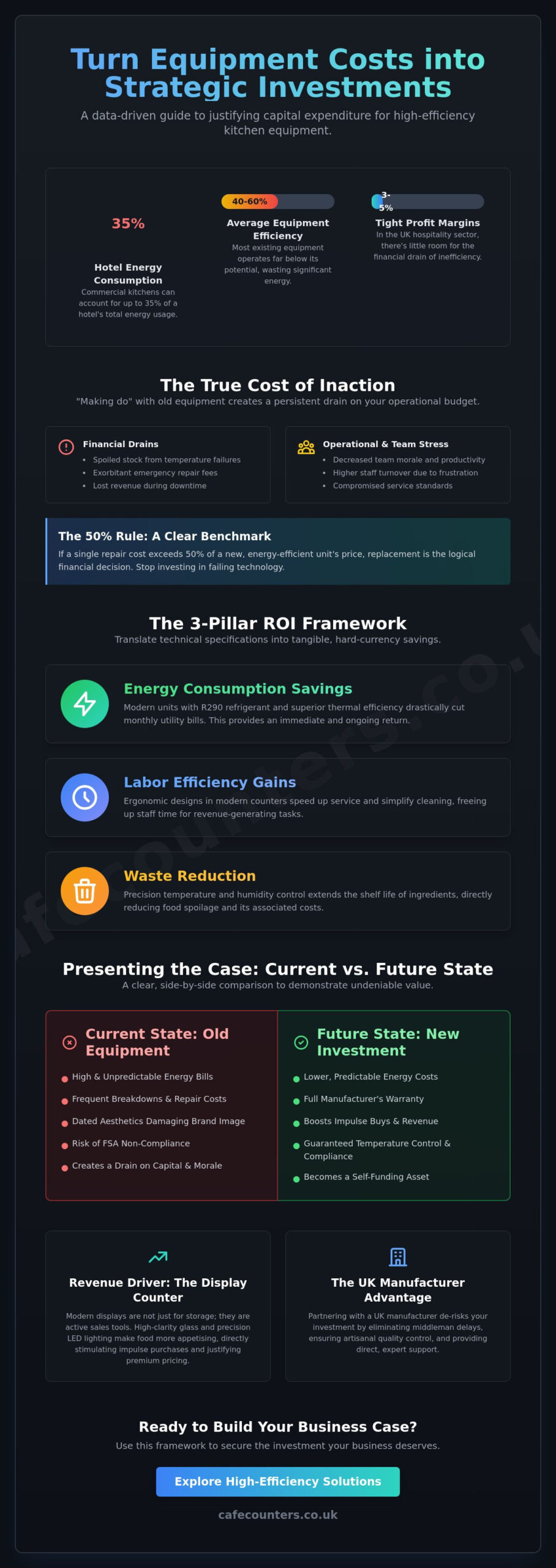
Did you know that commercial kitchens can account for up to 35% of a hotel’s total energy consumption, yet the average efficiency of that equipment often sits between 40% and 60%? When you are tasked with justifying new equipment cost to a manager, these figures represent more than just overhead; they are the key to unlocking hidden capital. We understand the stress of managing tight profit margins, which currently range between 3% and 5% for most UK hospitality businesses. It is difficult to maintain a high-end aesthetic when frequent equipment breakdowns or inefficient units compromise your stock and your service standards.
This guide will help you master the art of building a data-driven business case that turns equipment “cost” into a strategic investment. We’ll provide you with the technical insights to quantify the cost of inaction, from rising energy charges to lost impulse buys. You will learn how to leverage the 100% Annual Investment Allowance and use our structured proposal template to present a high-value CAPEX request with the confidence of a seasoned professional who values quality and durability.
Key Takeaways
- Identify the “Cost of Inaction” to demonstrate how maintaining failing units creates a persistent drain on your quarterly operational budget.
- Apply a three-pillar ROI framework that converts technical efficiency into tangible savings across energy, labor, and waste management.
- Discover how high-clarity glass and precision LED lighting in modern displays can directly stimulate impulse purchases and drive front-of-house revenue.
- Master a structured, step-by-step approach to justifying new equipment cost to a manager by leading with a clear “Current vs. Future State” comparison.
- Understand the strategic advantages of partnering with a UK manufacturer to eliminate middleman delays and ensure artisanal quality control.
The True Cost of Inaction: Why ‘Making Do’ is Costing Your Business
In the hospitality industry, “making do” with aging assets is often seen as a badge of frugality. However, this approach frequently leads to the Cost of Inaction (COI), which is the cumulative financial loss incurred by keeping unreliable equipment in service. When you’re justifying new equipment cost to a manager, it’s vital to shift the conversation from the initial purchase price to the ongoing drain on the bottom line. Frequent repairs don’t just cost money; they create a sunk cost fallacy where businesses continue to invest in failing technology simply because they’ve already spent so much on “fixing it” previously.
These hidden drains manifest as spoiled stock, exorbitant emergency call-out fees, and lost trading hours that can never be recovered. Beyond the ledger, unreliable equipment places immense operational stress on your team. A chef struggling with a temperamental heated gantry or a server dealing with a leaking display is a chef or server closer to resigning. In an industry where staff retention is a constant challenge, the physical environment must support, rather than hinder, their daily performance. Total competence in your kitchen or front-of-house starts with tools that actually work.
Quantifying the Repair vs. Replace Threshold
A practical benchmark for any hospitality professional is the “50% rule.” If the cost of a single repair exceeds half the value of a new, energy-efficient unit, the investment is no longer logical. You should also audit the frequency of “emergency patches” over the last twelve months. While a new piece of equipment comes with a manufacturer’s warranty and predictable performance, older units often carry the risk of regulatory non-compliance. With the Food Standards Agency (FSA) implementing more flexible, digitally enabled enforcement models, having equipment that guarantees precise temperature control is essential for passing remote video inspections. Calculating a clear Return on Investment (ROI) helps move the discussion from a “want” to a “need.”
The Invisible Drain on Brand Reputation
Your equipment serves as a silent ambassador for your brand’s quality and artisanal pride. A flickering or dated deli counter signals to customers that the business might be cutting corners elsewhere. In a competitive market, modern aesthetics are directly linked to premium pricing power. High-clarity glass and precision lighting don’t just look better; they dictate the average transaction value by making food appear more appetizing. First impressions are final in retail hospitality. If your display doesn’t reflect quality and durability, you’re likely losing impulse buys before the customer even reaches the till.
The ROI Framework: Turning Efficiency into Hard Currency
Building a business case for new assets requires a shift from emotional appeal to mathematical certainty. When you’re justifying new equipment cost to a manager, you must present a framework that translates technical specifications into hard currency. We categorize this Return on Investment (ROI) into three distinct pillars: energy consumption, labor efficiency, and waste reduction. By isolating these variables, you demonstrate that a new patisserie display or deli counter isn’t an expense, but a self-funding asset that protects your bottom line.
Energy costs are a primary concern for 2026, especially with the projected rise in the TNUoS residual charge starting in April. Modern cooling technologies, such as those utilizing R290 refrigerant, offer significantly higher thermal efficiency compared to units manufactured just a decade ago. There are many factors to consider before upgrading, but the ability to slash monthly utility overheads is often the most compelling for a finance-minded director. Precision temperature and humidity control also play a vital role in reducing food spoilage, ensuring your inventory remains sellable for longer and reducing the environmental impact of waste.
Labor ROI is often overlooked but remains equally impactful for long-term operational health. Ergonomic designs in bespoke serving counters or grab-and-go displays speed up service and simplify cleaning cycles. When your team spends less time fighting with difficult-to-reach corners or inefficient layouts, they can focus on customer engagement and upselling. If you’re looking for ways to optimize your floor plan, you might consult our design experts for a tailored layout that prioritizes workflow efficiency.
Energy Efficiency as a Primary Justifier
Comparing the kWh consumption of a 10-year-old unit against a modern system reveals a stark contrast. Older equipment often operates at only 40% to 60% efficiency, while new R290 systems maximize thermal retention and minimize compressor runtime. Choosing equipment from a UK manufacturer ensures compliance with the latest energy ratings and simplifies the calculation of a “payback period.” This period is the point where the accumulated energy savings equal the initial investment, providing a clear, evidence-based timeline for profitability that managers find reassuring.
Operational Gains and Maintenance Reduction
A manufacturer’s warranty de-risks the first three to five years of ownership, eliminating the unpredictable costs of emergency repairs. High-quality stainless steel fabrication reduces the wear and tear typically seen in busy back-bar environments, ensuring the unit remains hygienic and functional for years. Additionally, integrated drop-in units allow for a more flexible kitchen layout, making future upgrades or site surveys much simpler and less invasive for your ongoing operation. This methodical approach to equipment selection reflects a commitment to quality and durability over fleeting aesthetics.
Revenue Drivers: How Display Counters Pay for Themselves
While previous sections focused on mitigating losses, the most persuasive part of justifying new equipment cost to a manager often lies in revenue generation. In the retail hospitality sector, the “first bite is with the eyes” is a fundamental truth. A display counter is not merely a storage vessel; it’s a high-performance sales tool designed to trigger impulse purchases. Industry data suggests that upgrading to units with high-clarity glass and specialized LED lighting can increase impulse purchase rates by up to 30%. This uplift happens because modern displays eliminate the visual barriers between the customer and the product, presenting food in its most appetizing light.
Strategic placement of refrigerated grab and go display units allows businesses to capture high-margin “to-go” sales that might otherwise be lost to nearby competitors. These units are engineered to maintain strict temperature zones while offering an open-front design that encourages quick selection. Beyond the visual appeal, bespoke counter design directly improves customer flow. By analyzing your specific site dimensions and peak-hour footfall, a custom-built serving line can reduce queue times and ensure that the path from selection to payment is frictionless.
Maximising the ‘Hero’ Product Visibility
Tiered patisserie displays create vertical interest and a sense of abundance that flat shelving simply cannot match. This “stadium seating” for your cakes and pastries ensures every item is a hero product. Specialized lighting also plays a critical role; for deli and salad bars, specific color rendering indexes (CRI) make greens look crisper and proteins more vibrant. Custom-built counters allow for higher product density without looking cluttered, ensuring you maximize every square inch of your front-of-house footprint while maintaining a premium aesthetic.
Adapting to Modern Consumer Habits
The UK market has seen a definitive shift toward contactless, self-service environments. Modern display units support this by facilitating faster throughput during peak lunchtime rushes. Better counter ergonomics don’t just help the customer; they reduce the physical strain on your staff, allowing them to process transactions more efficiently. Additionally, contemporary units are designed to accommodate clear dietary labeling and allergen transparency, meeting the needs of the modern, health-conscious consumer who values information as much as taste. This alignment with consumer behavior ensures your equipment remains a relevant, revenue-generating asset for years to come.
Step-by-Step: Creating a Professional Equipment Proposal
A formal proposal transforms a verbal request into a strategic business document that directors can respect and act upon. When justifying new equipment cost to a manager, your presentation should mirror the precision of the equipment you are requesting. Start with a concise Executive Summary. This isn’t a list of features; it’s a summary of the bottom-line benefit, such as a projected 15% reduction in energy overheads or a measurable increase in peak-hour throughput. By leading with the financial result, you immediately align your request with the business’s commercial objectives.
Your proposal must include a “Current State vs. Future State” comparison. This table should contrast your existing unreliable units with the proposed solution across metrics like daily energy cost, weekly maintenance hours, and estimated food waste. While it’s standard practice to gather three quotes, you should highlight the distinction between price and value. A lower upfront cost often masks higher long-term operational expenses. Use CAD modeling and professional site surveys to prove the equipment will function perfectly within your specific environment, removing any doubt about installation hurdles or spatial constraints.
The Data You Need to Collect
Evidence is the foundation of any successful CAPEX request. You should compile at least 12 months of repair invoices and document every instance of lost stock due to equipment failure. Don’t ignore the qualitative data. If customer reviews mention slow service or poor food presentation, include them. Recording the duration of service bottlenecks during peak UK lunchtime rushes provides a tangible link between outdated hardware and lost revenue. These data points move the conversation from a subjective opinion to an objective business necessity.
Presenting the ‘Expert Partner’ Strategy
Managers are naturally risk-averse. You can de-risk the decision by recommending a full-service UK manufacturer that handles everything from initial design to final installation. This end-to-end management ensures total accountability and eliminates the stress of coordinating multiple contractors. Emphasize the security of UK-based after-sales support; having a reliable hand nearby is invaluable for long-term operational security. Finally, frame the purchase as a critical milestone toward the company’s three-year growth goals. To start building your case with precision, request a professional site survey to obtain the technical data you need for your proposal.
De-Risking the Decision: Why Partnering with a UK Manufacturer Matters
The final hurdle in justifying new equipment cost to a manager is often the fear of project failure or unforeseen logistical complications. Managers are naturally cautious about large capital outlays, especially when they involve complex installations. Partnering with a UK manufacturer addresses these anxieties by providing a transparent, direct line of communication. When you buy direct, you eliminate middleman markups and the unpredictable shipping delays associated with international supply chains. This ensures that the technical specifications discussed during the design phase are exactly what arrive at your door, overseen by those with deep-seated regional artisanal pride.
Quality control is a cornerstone of our internal production facilities. British-made catering equipment is engineered for the rigors of high-volume environments, prioritizing durability over fleeting aesthetics. By utilizing CAD design and meticulous site surveys, we identify potential installation errors before the manufacturing process even begins. This methodical progression from a concept to a finished physical space acts as an insurance policy for your manager. It guarantees that every salad bar or heated gantry is built to last, reflecting the total competence and reliability required in a professional commercial setting.
Bespoke Solutions vs. Off-the-Shelf Compromises
Standard units often force you to compromise your operational workflow to fit the dimensions of the machine. In contrast, custom-built counters frequently offer a lower Total Cost of Ownership (TCO) because they are designed for your specific volume and site requirements. In high-rent UK retail environments, millimetre-perfect fitment is essential to maximize revenue-generating floor space. Bespoke designs also allow you to incorporate brand-specific materials and finishes, ensuring your patisserie display or deli counter enhances your unique brand identity rather than looking like a generic addition.
The Security of Local Technical Support
The value of a local partner is most evident during the commissioning phase and future technical integration. UK-based support ensures faster response times and a better understanding of regional safety standards and regulations. Having a steady, reliable hand nearby during a complex fit-out alleviates the stress of the project and provides long-term operational security. This comprehensive service ensures that your investment continues to perform at its peak for years to come. If you are ready to transform your vision into a high-performance reality, partner with TFSE Products Ltd for your next high-performance counter project and invest with total confidence.
Secure Your Operational Future with Data-Driven Investment
Transitioning from “making do” to a high-performance environment requires a shift in perspective. By quantifying the cost of inaction and focusing on the three pillars of ROI, you’ve gained the tools necessary for justifying new equipment cost to a manager with total confidence. You now understand how modern R290 refrigeration and bespoke counter designs don’t just reduce overheads; they act as active revenue drivers by capturing high-margin impulse sales that would otherwise be lost to competitors.
Since 1991, we’ve utilized our UK manufacturing expertise to help hospitality professionals bridge the gap between vision and reality. Our comprehensive service includes full CAD modelling and end-to-end project management, ensuring your installation is millimetre-perfect and operationally sound. We invite you to take the next step in your professional journey by speaking with our team of specialists. Request a Professional Site Survey for Your Bespoke Counter Project today. With the right data and a reliable partner by your side, turning a capital request into a successful business transformation is well within your reach.
Frequently Asked Questions
What is the most convincing argument for a new equipment budget?
The most convincing argument is quantifying the “Cost of Inaction” (COI) by showing exactly how much capital is leaking through food waste, emergency repair fees, and lost trading hours. Managers respond best to data that proves keeping old equipment is more expensive than buying new. By highlighting these existing losses, you shift the discussion from a discretionary purchase to an essential financial recovery strategy.
How do I calculate the payback period for a new refrigerated display?
To calculate the payback period, divide the total investment by the sum of monthly energy savings and projected revenue increases. For example, if a new patisserie display reduces energy bills and boosts impulse sales, those combined gains determine how many months it takes for the unit to pay for itself. This calculation provides a clear timeline for when the asset begins generating pure profit for the business.
Should I focus on energy savings or increased sales in my proposal?
You should present both, but lead with energy savings as they represent guaranteed “hard” cost reductions. While increased sales are a powerful motivator, energy efficiency is a predictable metric that finance directors find more reliable. Combining these two factors in your proposal strengthens your case for justifying new equipment cost to a manager by showing both defensive and offensive financial benefits.
Is it better to lease or buy commercial catering equipment in the UK?
The choice depends on your cash flow and tax strategy. Buying allows you to claim 100% tax relief through the Annual Investment Allowance on qualifying capital expenditure up to £1 million. However, flexible funding solutions saw a 43% increase in the first quarter of 2026 as businesses sought to preserve working capital. Both options have merits, so consult your accountant to determine which aligns with your quarterly goals.
How can CAD modelling help justify the cost of bespoke counters?
CAD modelling provides visual proof that a bespoke counter will fit perfectly within your specific site dimensions, eliminating the risk of expensive installation errors. It allows a manager to see the “Future State” of the business before any manufacturing begins. This precision ensures that service workflows and customer paths are optimized, providing technical assurance that the investment will function exactly as promised.
What happens if my manager says ‘wait until next year’?
If a manager suggests waiting, you must re-frame that delay as an active expense. Remind them that energy costs are projected to increase from April 2026 due to the TNUoS residual charge. Waiting a year means another twelve months of high utility bills and potential breakdown risks. Presenting a comparison of the “Cost of Waiting” versus the “Cost of Investing” often prompts immediate action.
How do I account for installation costs in my equipment justification?
Always include installation and commissioning costs within the initial CAPEX request to ensure there are no hidden surprises later. When you partner with a manufacturer that offers end-to-end project management, these costs are usually bundled and clearly defined. This transparency builds trust with your manager, as it shows you’ve accounted for the entire journey from the factory floor to the final physical space.
Why is ‘Buy British’ a strong point for a business case?
“Buying British” is a strong point because it guarantees shorter lead times and direct access to internal production facilities for quality control. It also simplifies future technical support and commissioning, as the manufacturer is geographically closer to your site. Highlighting this regional artisanal pride reinforces the idea of durability and professional competence, which are vital for justifying new equipment cost to a manager who values long-term reliability.